
Top 9 Outscraper Alternatives for Prospecting Teams in 2026
Outscraper is a web scraping platform built around real-time data extraction from Google Maps and 50+ public sources. It appeals to researchers, digital marketers, and developers who need location-based business data on a pay-as-you-go basis. But as teams grow and their go-to-market needs expand, they often find that raw data extraction is only part of the puzzle. Outscraper does not provide native email sequencing, CRM enrichment workflows, dialer functionality, or AI-driven prospecting, capabilities that modern B2B sales teams increasingly require in one connected system.
If you're evaluating Outscraper alternatives, the right choice depends on your use case: pure data enrichment, full sales engagement, workflow automation, or a platform that does all three. This guide covers nine alternatives, from lightweight scraping tools to complete GTM platforms, so you can make an informed decision based on your team's needs in 2026.

Research Less, Close More With Apollo
Tired of burning hours tracking down contact info that's already outdated? Apollo delivers 240M+ verified contacts with 98% email accuracy so your reps spend time selling, not searching. Start hitting your numbers today.
Start Free with Apollo →Key Takeaways
- Apollo: AI sales platform combining a 240M+ person database, outbound sequencing, dialer, inbound routing, and data enrichment in one connected GTM system, starting at $49/user/month.
- PhantomBuster: Cloud-based automation for lead extraction and outreach across 15+ platforms; priced by execution time and automation slots.
- Thunderbit: AI-powered web scraper with a no-code interface for extracting data from websites, PDFs, and documents in two clicks.
- Captain Data: People and company data API designed for AI agents and B2B SaaS platforms, with volume-based credit pricing.
- TexAu: GTM automation engine with waterfall enrichment across 32+ data providers, lead scoring, and CRM sync.
- Clay: GTM orchestration layer with access to 200+ data providers, AI agents, and workflow automation for building revenue systems.
- ZoomInfo: B2B intelligence platform with contact data, intent signals, and sales engagement tools; pricing not publicly displayed.
- Cognism: Sales intelligence platform focused on phone-verified contact data for European and global markets; pricing not publicly displayed.
- SalesLoft: Revenue orchestration platform unifying sales engagement, conversation intelligence, and deal management; pricing not publicly displayed.
Apollo

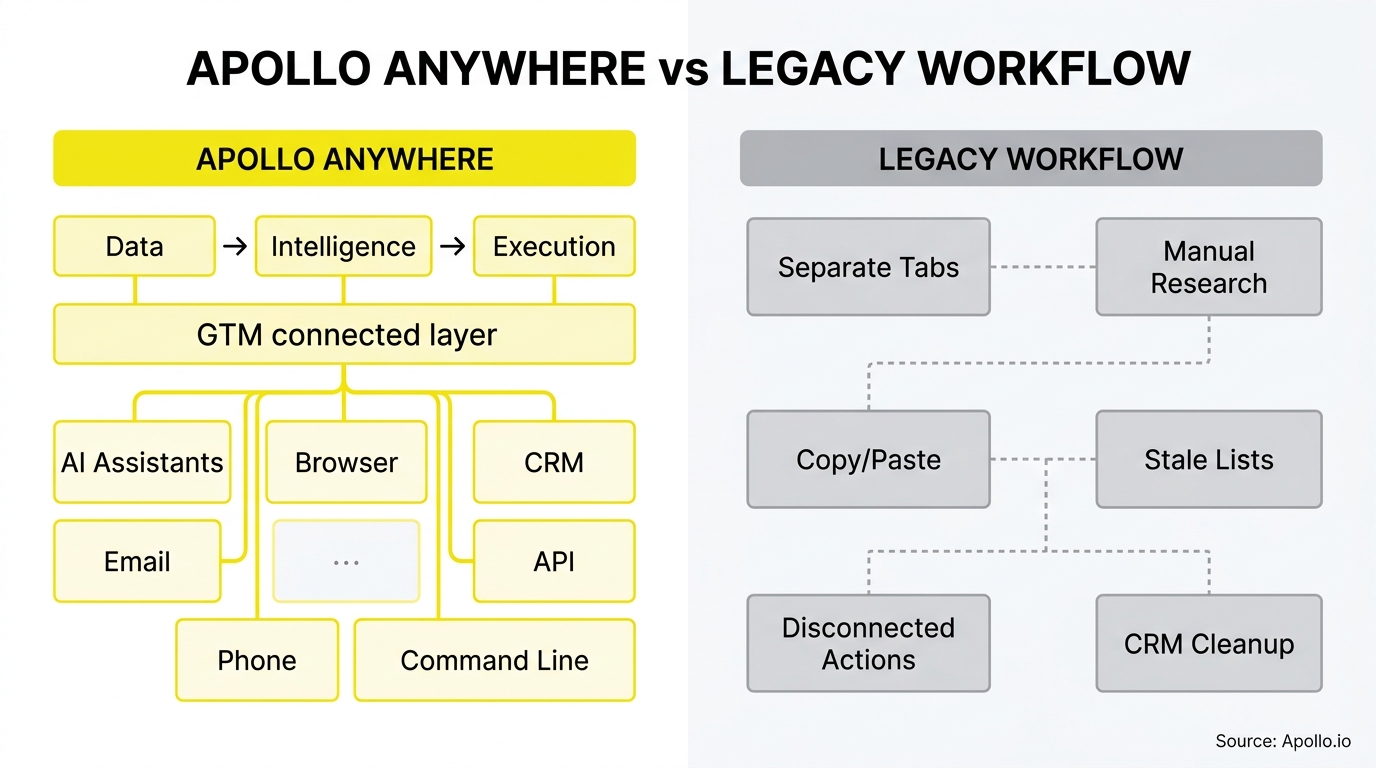
Apollo is an AI sales platform that unifies data, intelligence, and execution into one connected GTM system. Where Outscraper stops at data extraction, Apollo carries teams through the entire revenue motion: find and verify prospects, run multi-channel outreach, route and convert inbound leads, and keep CRM records enriched automatically.
The database spans 240M+ people and 30M+ companies, with contacts continuously validated and refreshed by Apollo's Living Data Network. With 65+ filters available on the Apollo search and prospecting tool, teams can build hyper-targeted lists using firmographic, technographic, and intent-based criteria. The platform's 98% email accuracy means fewer bounces and stronger sender reputation from day one.
Apollo Outbound covers the full build-execute-improve cycle. The AI Sequence Builder turns natural language prompts into multi-channel sequences across email, calls, and social outreach.
The Power Dialer and Parallel Dialer eliminate idle time between calls, while AI-generated call scripts, automatic voicemail drop, and CRM-pushed summaries keep reps focused on conversations. Apollo Inbound handles website visitor identification, form enrichment, and criteria-based routing, so no warm lead falls through the cracks.
For teams building headless GTM workflows, Apollo meets them where they work. Apollo MCP brings Apollo data directly into AI assistants like ChatGPT, Codex, Claude, and Perplexity. The Apollo CLI provides terminal-native access for advanced users and GTM engineers. The Chrome extension enables prospecting across the web without switching contexts, and the integrations marketplace connects to 50+ tools including Salesforce, HubSpot, Outreach, SalesLoft, and Marketo.
Apollo serves B2B GTM teams, GTM Engineers, and AI Builders building headless GTM workflows with the Apollo API, CLI, and MCP, alongside Sales Professionals, SDRs/BDRs, AEs, RevOps, Marketing, and Revenue Leaders.
Pricing (annual billing): Free plan includes 900 credits/year with basic filters. Basic is $49/user/month with 30,000 credits/year and CRM integrations. Professional is $79/user/month with 48,000 credits/year, US dialer, automated workflows, and AI research. Organization is $119/user/month (min 3 users) with 72,000 credits/year, international dialer, SSO, and advanced security.
According to Ramp's vendor data, Apollo holds a 39% adoption rate in its software category as of August 2026, up 6 percentage points year over year, and carries a 22% competitor switch rate, tied for the highest in the category. These figures come from real spend data across Ramp's customer base.
Looking at Ramp's Sales Data Providers category data as of August 2026, Apollo is the fastest-growing vendor in the category, averaging +0.6 percentage points per month in adoption, more than triple the growth rate of the next-fastest competitor in the segment.
"Apollo became the single source of truth for uswhere everything originates from and where all the data returns to.", Kevin Warner, CEO at Leadium
"Apollo enriches everything we have: contacts, leads, accounts...And we don't really have to touch it, it just works.", Mark Turner, VP of Revenue Operations at Built In
Apollo has earned a 4.7/5 G2 rating and the 2026 MarTech Breakthrough Award for "Best AI-Powered Sales Solution".
PhantomBuster

PhantomBuster is a cloud-based automation platform that runs pre-built workflows 24/7 to extract data, enrich contacts, and automate outreach across 15+ platforms including LinkedIn, Twitter, Instagram, and Facebook. It offers 100+ ready-made automations and targets sales teams and SDRs looking to capture real-time intent signals and automate personalized messaging without coding skills.
Key features include lead enrichment with job change and profile activity signals, AI-powered message writing, and CRM integrations via HubSpot, Zapier, Make, and n8n. Plans are priced by execution time and automation slots rather than per seat, making it a cost-effective option for small teams.
Pricing (official): Free trial available. Start plan is $70/month (or $56/month billed annually) with 500 email credits and 20h execution time. Grow is $160/month ($128/month annually) with 2,500 email credits and 80h execution time. Scale is $440/month ($352/month annually) with 10,000 email credits and 300h execution time.
- Pros: Broad platform coverage across social and professional networks; no-code automation with 100+ pre-built workflows; flat per-account pricing with unlimited users.
- Cons: Execution time caps can throttle high-volume campaigns; limited built-in CRM sync without third-party connectors; focused on data extraction and messaging, not full sales cycle management.
See how Apollo compares to PhantomBuster.
Thunderbit
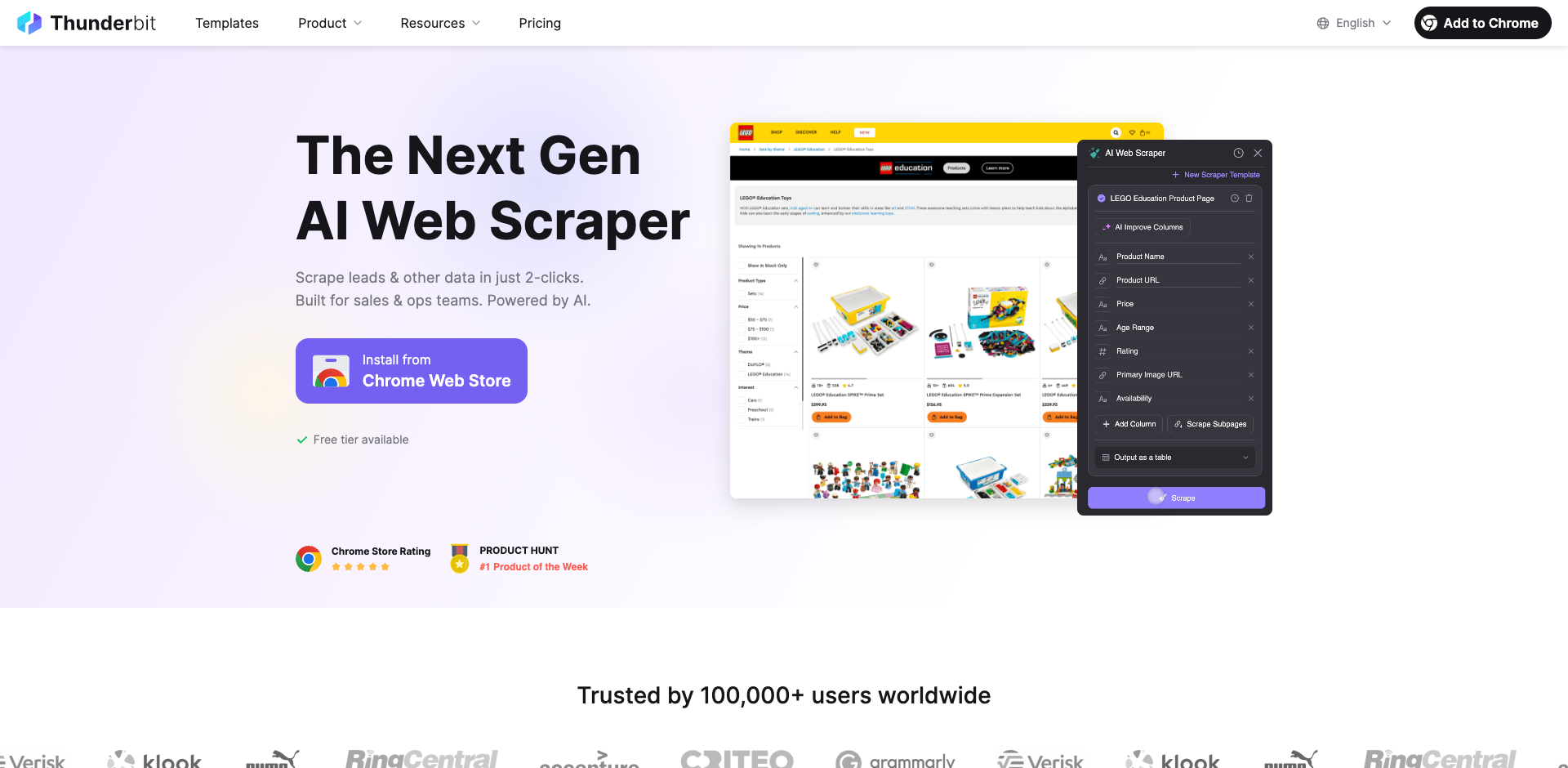
Thunderbit is an AI-assisted web scraper that extracts data from websites, PDFs, documents, and images using natural language processing, no CSS selectors or technical setup required.
It targets sales and operations teams that need to pull structured data from any public source quickly, with pre-built templates for sites like Google Maps, Amazon, and eBay.
Features include subpage scraping, bulk operations, scheduled monitoring, and direct integration with Google Sheets, Airtable, and Notion. It is a narrow-use tool suited for data collection tasks rather than end-to-end prospecting or engagement.
Pricing (official): Free tier includes 6 pages/month. Starter is $15/month (or $9/month billed annually, 5,000 credits/year). Pro is $38/month ($16.50/month annually, 30,000 credits/year). Business tier requires contacting sales for requested pricing.
- Pros: Truly no-code extraction from any website or document format; fast setup with AI-parsed fields; affordable entry price for light data collection needs.
- Cons: No native contact enrichment with verified business emails or phones; no outreach or engagement capabilities; credit limits constrain high-volume scraping on lower tiers.
Related reading:Apollo vs Thunderbit
Captain Data
Captain Data is a people and company data API designed primarily for AI agents and B2B SaaS platforms. It offers access to what Captain Data claims is 500M+ profiles, with endpoints for people enrichment (verified emails, work history), company enrichment (size, industry, funding), people search, company search, employee lists, and org mapping. The API is positioned as production-ready and integrable in hours.
It suits technical teams and product builders embedding enrichment into their own systems rather than sales reps doing day-to-day prospecting in a UI.
Pricing (official): 100 free credits to start. Base rate is €59.99 per 1,000 credits, dropping to €29.99 per 1,000 credits at 20,000 monthly credits (Silver tier). High-volume requested pricing available at approximately €5 per 1,000 credits for large commitments.
- Pros: API-first design suited for developers and AI agent workflows; volume discounts scale well for large data operations; covers people and company data across seven endpoints.
- Cons: No native UI for sales reps or SDRs; no built-in sequencing, dialer, or engagement tools; EUR-denominated pricing adds currency considerations for USD-based buyers.
Apollo vs Captain Data, here's everything you need to know.
TexAu

TexAu is a GTM automation engine offering waterfall enrichment across 32+ data providers, lead scoring, CRM sync, and 200+ ready-to-run automation actions. It targets GTM operators, GTM engineers, and agency owners who need flexible enrichment pipelines without building from scratch. The pay-on-match credit system, where failed lookups are automatically refunded, differentiates its pricing model.
TexAu supports bidirectional CRM sync with HubSpot, Salesforce, Pipedrive, Zoho, and GoHighLevel, plus a REST API, webhooks, and MCP server for AI agent integration.
Pricing (official): Solo is $99/month ($79/month annually, 1 seat, 2,500 credits/month). Starter is $249/month ($199/month annually, 3 seats, 8,000 credits/month). Teams is $649/month ($549/month annually, 5 seats, 25,000 credits/month). Enterprise is custom.
- Pros: Pay-on-match model means credits are only consumed for successful enrichment lookups; waterfall across 32+ providers maximizes coverage; MCP server supports AI agent workflows.
- Cons: No native email sequencing or dialer; higher per-seat cost at small team sizes compared to broader platforms; additional team members cost $99/member/month on Starter and Teams tiers.
Explore the Apollo vs TexAu breakdown.
Clay

Clay is a GTM orchestration layer that centralizes access to 200+ data and AI providers in one workflow environment. Its Claygent AI agents research target companies and people, while signal tracking monitors job changes, promotions, and web intent. Teams use Clay to build TAM lists, run waterfall enrichment, score leads, and trigger automated outbound campaigns, all without switching between tools.
Clay is popular with GTM engineers and technically minded operators who want to build custom revenue workflows rather than use a prescriptive platform.
Pricing (official): Free tier available (500 actions/month, 100 data credits/month). Launch starts at $60/month ($54/month annually). Growth starts at $205/month ($185/month annually). Enterprise pricing requires contacting sales. Actions and data credits are purchased separately and scale by volume.
- Pros: Access to 200+ data providers through a single interface reduces vendor management; Claygent AI research agents automate company and people intelligence; flexible for building custom GTM workflows.
- Cons: Dual-currency pricing model (actions + data credits) adds complexity when estimating total costs; no native dialer or built-in meeting routing; steeper learning curve for non-technical users.
Apollo vs Clay, here's everything you need to know.
Turn Funnel Guesswork Into Real Pipeline
Tired of watching quality leads stall before they ever become opportunities? Apollo surfaces in-market buyers the moment they're ready, so your forecast reflects reality. Nearly 5M users stopped guessing and started closing.
Start Free with Apollo →ZoomInfo

ZoomInfo is a B2B go-to-market intelligence platform offering contact and company data, buyer intent signals, CRM enrichment, and sales engagement tools. It serves sales, marketing, and recruiting teams with AI-assisted account prioritization, org chart data, technographic insights, and automated workflow capabilities across its platform modules.
ZoomInfo's pricing is not publicly displayed on their official website. According to Vendr, based on data from 1,569 purchases, the median buyer pays $33,500 per year, with a range from $7,200 to $155,280 depending on seat count, data credit allocation, and add-on modules.
- Pros: Extensive B2B database with org chart data, technographic insights, and buying intent signals; broad platform covering sales, marketing, and recruiting use cases; established enterprise integrations.
- Cons: Pricing is not publicly displayed, requiring direct sales engagement for quotes; median annual contract value of $33,500 creates a high entry cost for smaller teams; add-on modules for intent data and conversation intelligence increase total cost of ownership.
Here's a detailed comparison of Apollo vs ZoomInfo.

Cognism

Cognism is a B2B sales intelligence platform known for phone-verified contact data, with particular depth in European markets. It provides mobile numbers, emails, company data, and intent signals for revenue teams, along with CRM enrichment and Data-as-a-Service delivery via API or bulk export. Cognism emphasizes compliance with GDPR and CCPA frameworks, including DNC and TPS screening.
Cognism's pricing is not publicly displayed on their official website. According to Vendr, based on data from 108 purchases, the median buyer pays $36,000 per year. Plans start at 5 seats on Standard or Pro tiers, with all pricing requiring a sales conversation.
- Pros: Phone-verified mobile numbers with a focus on European market compliance; intent data and hiring/funding signals included in Pro tier; CRM enrichment available as standalone or add-on.
- Cons: Pricing is not publicly displayed; 5-seat minimum may not suit solo users or very small teams; engagement execution tools are not included in the core platform.
Related reading:Apollo vs Cognism
SalesLoft

SalesLoft is a Revenue Orchestration Platform that connects AI agents with revenue data to prioritize seller actions, automate engagement workflows, and drive predictable pipeline. Its Conductor AI system embeds across the platform to surface next-best actions, while Deals provides real-time pipeline visibility and deal risk scoring. Conversation Intelligence captures and analyzes calls with coaching insights tied directly to seller workflows.
SalesLoft's pricing is not publicly displayed on their official website. According to Vendr, based on data from 703 purchases, the median buyer pays $30,720 per year across 304 deals handled.
- Pros: Revenue orchestration across the full sales cycle including pipeline, coaching, and deal intelligence; Conductor AI automates prioritization and next-best actions; integrates with Salesforce and 180+ applications.
- Cons: Pricing is not publicly displayed; primary focus is on engagement and deal management rather than prospecting data or lead generation; better suited to teams that already have a data source in place.
Related reading:Apollo vs SalesLoft
Comparison Table
| Platform | Starting Price | Database / Data Access | Outreach / Engagement | AI Features | Free Tier |
|---|---|---|---|---|---|
| Outscraper (subject) | Not publicly displayed | Google Maps + 50+ public sources | None | Claude/MCP connector | Yes (limited) |
| Apollo | $49/user/month (annual) | 240M+ people, 30M+ companies, 98% email accuracy | Email, dialer, social, sequences | AI sequencing, research agent, dialer scripts, sentiment analysis | Yes (900 credits/year) |
| PhantomBuster | $56/month annually (Start) | 15+ platform sources via automation | Automated LinkedIn/social messaging | AI message personalization | Yes |
| Thunderbit | $9/month annually (Starter) | Any website, PDF, document, image | None | NLP-based field extraction | Yes (6 pages/month) |
| Captain Data | €29.99/1K credits (20K volume) | Claims 500M+ profiles via API | None (API only) | Real-time API automations | Yes (100 credits) |
| TexAu | $79/month annually (Solo) | Waterfall across 32+ providers | Limited (no native dialer) | AI lead scoring, AI Column personalization | No |
| Clay | $54/month annually (Launch) | 200+ data providers via marketplace | Email campaigns (Clay sequencer) | Claygent AI research, signal tracking | Yes |
| ZoomInfo | Median $33,500/year (Vendr) | Comprehensive B2B contact + company database | Sales engagement tools within platform | AI account prioritization, intent signals | No |
| Cognism | Median $36,000/year (Vendr) | Phone-verified contacts, European market focus | Not included in core platform | AI company research, intent signals (Pro) | No |
| SalesLoft | Median $30,720/year (Vendr) | No native prospecting database | Full engagement, conversation intelligence, deals | Conductor AI, deal risk scoring, coaching | No |
How to Choose the Right Outscraper Alternative
Start by identifying what's actually missing from your current setup. If Outscraper met your data extraction needs but you now need verified business contacts, email sequencing, and CRM enrichment in one place, Apollo's platform covers the full prospecting-to-pipeline motion, with the Living Data Network keeping records fresh automatically.
Teams that also need inbound routing, dialing, or AI-driven outreach will find the most leverage from a platform that connects all of those workflows rather than requiring separate point solutions.
If you're a developer or technical operator building AI agents or embedding enrichment into a product, Captain Data's API-first model or Clay's 200+ provider marketplace may be the right infrastructure layer. For no-code scraping of public websites without any engagement requirement, Thunderbit or PhantomBuster offer low-friction entry points. Teams focused on European markets with compliance requirements should evaluate Cognism. For enterprise revenue teams that have a data source and need deal intelligence, pipeline forecasting, and coaching alongside engagement, SalesLoft and ZoomInfo are built for that scope, though both carry significant median annual contract values based on Vendr data cited in their sections above.
For the broadest combination of data coverage, AI-powered outreach, and accessible pricing across SMB, mid-market, and enterprise teams, Apollo is the starting point worth evaluating first. Explore lead generation strategies and sales prospecting guides on Apollo's site to see how teams are using these capabilities in practice.
Frequently Asked Questions
What is the best Outscraper alternative for B2B sales teams?
Apollo is the most comprehensive alternative for B2B sales teams. As detailed above, Apollo serves B2B GTM teams, GTM Engineers, and AI Builders building headless GTM workflows with the Apollo API, CLI, and MCP, alongside Sales Professionals, SDRs/BDRs, AEs, RevOps, Marketing, and Revenue Leaders.
It combines prospecting data, outreach execution, and CRM enrichment in a single connected system, capabilities that Outscraper does not provide natively.
Are there free Outscraper alternatives?
Yes. Apollo, PhantomBuster, Thunderbit, Clay, and Captain Data all offer free tiers or trial credits.
Apollo's free plan includes 900 credits/year and basic filtering, making it accessible for teams evaluating the platform before committing. Thunderbit's free tier allows 6 pages per month.
Captain Data provides 100 trial credits to test its API endpoints.
Which Outscraper alternative is best for European market prospecting?
Cognism has a particular emphasis on phone-verified contact data for European markets and includes DNC and TPS screening. For teams that need verified mobile numbers across EMEA alongside a compliance-forward approach, Cognism is a notable option.
Apollo also covers global markets and supports international dialing on the Organization tier.
What should I look for when replacing a data scraping tool with a sales intelligence platform?
Evaluate whether the replacement covers not just data access but also data quality, enrichment automation, and outreach execution. Key factors include database size and verification methodology, CRM integration depth, whether engagement tools are native or require additional subscriptions, and total cost at your team's seat count. Platforms with AI-driven features, like automated research, intent signals, and personalized sequencing, tend to reduce manual work compared to tools that only deliver raw extracted data. Reviewing cold email best practices and data enrichment approaches can also help teams define what they need before selecting a platform.

Conclusion
Outscraper serves a specific need, real-time public data extraction, but most B2B sales teams eventually need more: verified contacts, automated outreach, CRM enrichment, and AI-driven pipeline intelligence. The nine alternatives in this guide range from lightweight no-code scrapers to full GTM platforms, covering a wide spectrum of use cases and budgets.
For teams that want to consolidate prospecting data, multi-channel engagement, and revenue intelligence into one platform, Apollo is the strongest starting point. It offers transparent, self-serve pricing starting at $49/user/month, a 240M+ person database backed by the Living Data Network, and AI capabilities that span from sequence building to call coaching, all in a single workspace that scales from individual contributors to enterprise GTM teams.
Ready to see what your team can do with a complete GTM platform? Start Free with Apollo
Prove Pipeline ROI Before Q Ends
Budget approval stuck on unclear metrics? Apollo delivers measurable pipeline impact fast — 46% more meetings with AI Research Agent. Join 600K+ companies with ROI leadership can actually see.
Start Free with Apollo →Don't miss these
Sales
Inbound vs Outbound Marketing: Which Strategy Wins?
Sales
What Is a Sales Funnel? The Non-Linear Revenue Framework for 2026
Sales
What Is a Go-to-Market Strategy? The 2026 GTM Playbook
See Apollo in action
We'd love to show how Apollo can help you sell better.
By submitting this form, you will receive information, tips, and promotions from Apollo. To learn more, see our Privacy Statement.
4.7/5 based on 9,690 reviews
