
Apollo vs SalesLoft (2026): Features, Pricing & Best Use Cases
Choosing between Apollo and SalesLoft comes down to a fundamental question: do you want a platform built around sales engagement workflows alone, or one where your contact data, sequencing, dialer, and analytics all live in one connected system? Both serve B2B sales teams, but they take meaningfully different approaches.
This comparison breaks down what each platform does, what it costs, and which teams get the most value from each.

Research Less, Pipeline More With Apollo
Tired of burning hours verifying contact info that goes nowhere? Apollo delivers 240M+ contacts with 98% email accuracy so your reps spend time selling, not searching. Start building pipeline today.
Start Free with Apollo →Key Takeaways
- Platform scope: Apollo is an AI GTM system that unifies prospecting data and sales engagement, while SalesLoft focuses primarily on revenue orchestration and sales engagement workflows.
- Data included: Apollo includes a 240M+ person B2B database, email verification at 98% accuracy, and enrichment tools natively; SalesLoft does not include a built-in prospecting database.
- Pricing model: Apollo offers transparent, publicly listed pricing starting at $49/user/month (annual billing) with a free tier; SalesLoft's pricing is not publicly displayed.
- Audience: Apollo serves B2B GTM teams, GTM Engineers, and AI Builders building headless GTM workflows with the Apollo API, CLI, and MCP, alongside Sales Professionals, SDRs/BDRs, AEs, RevOps, Marketing, and Revenue Leaders.
- AI capabilities: Both platforms invest heavily in AI, with Apollo covering AI sequencing, research agents, and scoring, while SalesLoft centers its AI on deal risk, forecast intelligence, and workflow prioritization.
What is Apollo?

Apollo is an AI GTM system that unifies data, intelligence, and execution into one connected GTM system. From a single workspace, users can identify prospects using 65+ filters across a 240M+ person database, launch multi-channel sequences, run power and parallel dialing, enrich CRM records, and measure pipeline performance. The platform carries a 4.7/5 G2 rating and was recognized with the 2026 MarTech Breakthrough Award for "Best AI-Powered Sales Solution".
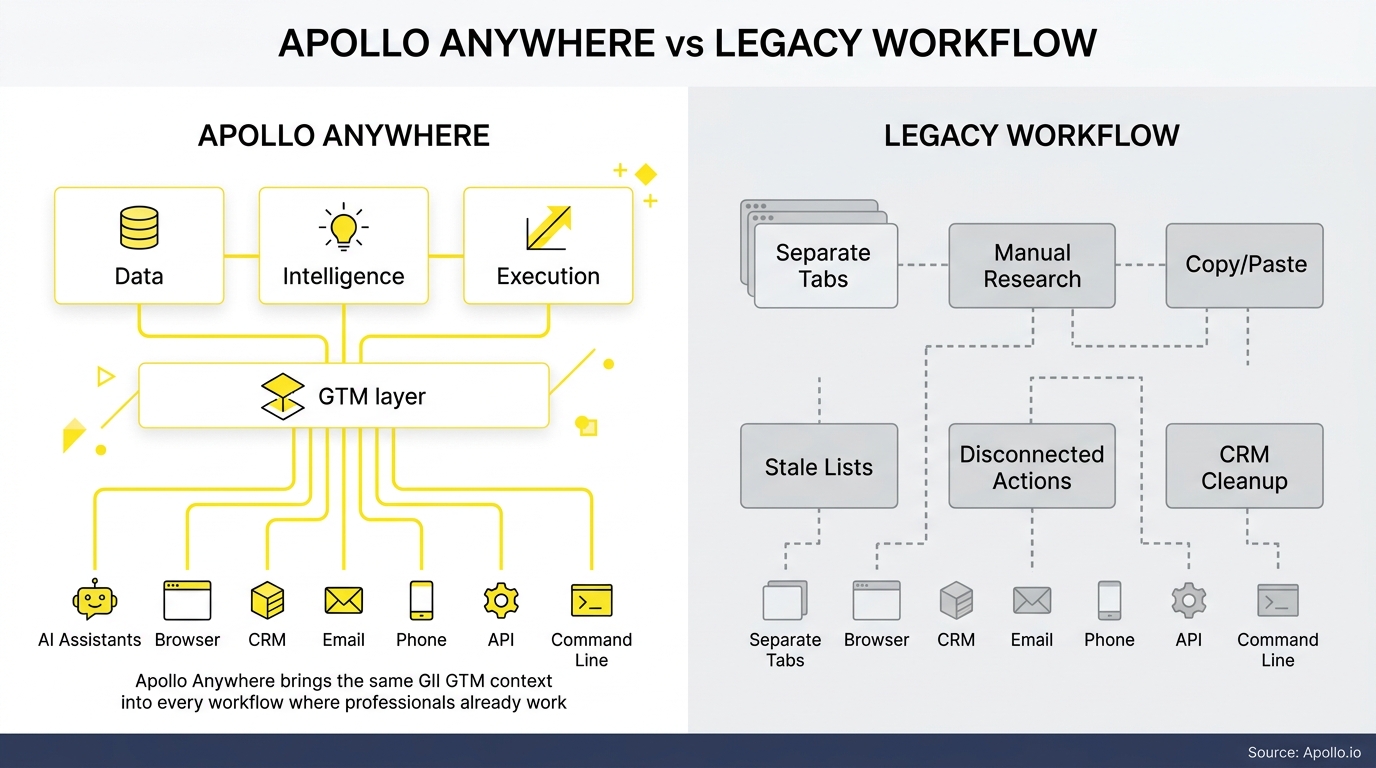
Apollo meets sellers inside the tools they already use. Apollo MCP, Apollo's Model Context Protocol, connects Apollo's data and workflows directly into AI assistants including ChatGPT, Codex, Claude, and Perplexity, so reps can prospect and research without switching contexts. The Chrome extension surfaces contact data and engagement tools across the web. For technical teams and GTM Engineers building headless workflows, Apollo CLI provides terminal-native access to Apollo's full API surface.
According to Ramp's vendor data, Apollo holds a 38% adoption rate among businesses using Sales Data Providers software as of July 2026, up 5 percentage points year-over-year, with a 34% new adopter share, meaning more than one in three teams buying into this software category for the first time are choosing Apollo.

Apollo offers transparent pricing starting at $49/user/month (annual billing), with a free tier available. Full pricing details are in the Pricing Comparison section below.
What is SalesLoft?

SalesLoft is a Revenue Orchestration Platform that combines sales engagement, deal management, conversation intelligence, revenue forecasting, and AI-driven workflow prioritization. It is designed for revenue teams that want a structured system for managing the full selling cycle, from prospecting cadences through deal close and forecast review.
The platform's core modules include Cadence for pipeline generation and lead nurture, Deals for opportunity management and risk visibility, Conversations for call recording and AI-driven coaching insights, Forecast for real-time pipeline prediction, and Rhythm, SalesLoft's adaptive workflow engine, which uses its embedded Conductor AI to surface the highest-priority seller actions at any moment. An AI Chat agent module converts website visitors into leads.
SalesLoft targets sales teams and revenue organizations, particularly those at companies with defined sales processes who want unified engagement and intelligence across the deal lifecycle. The platform integrates with Salesforce, Highspot, 6sense, DocuSign, and more than 180 additional applications.
It does not include a built-in B2B prospecting database; teams sourcing net-new contact data would use integrations with third-party data enrichment services alongside SalesLoft's engagement tools.
SalesLoft positions itself toward mid-market and larger revenue organizations that prioritize deal intelligence and forecast accuracy alongside engagement execution. According to Vendr, based on data from 701 purchases, the median annual contract value for SalesLoft is $30,760 per year. Pricing is not publicly displayed on SalesLoft's official website.
Feature Comparison
| Feature | Apollo | SalesLoft |
|---|---|---|
| Starting Price | $49/user/month (annual billing), Apollo Pricing | ~$60–$85/user/month observed (Essentials, 10–25 users), Vendr |
| B2B Database | 240M+ people, 30M+ companies | Not included natively; integrates with third-party data enrichment services |
| Email Accuracy | 98% | Not publicly stated |
| Sequences | Multi-channel (email, phone, social, tasks); AI Sequence Builder | Cadence module: email, phone, social sequences with AI-guided prioritization |
| Dialer | Power Dialer and Parallel Dialer included in Professional and Organization plans | Calling available within the platform |
| AI Capabilities | AI Research Agent, AI Sequence Builder, lead scoring, sentiment analysis, call summaries | Conductor AI for workflow prioritization, deal risk detection, forecast intelligence, AI coaching insights |
| Data Enrichment | Waterfall enrichment, CRM enrichment, CSV enrichment, API enrichment included | Enrichment via third-party integrations |
| Free Tier | Yes, 900 credits/year, 2 sequences, basic filters | No free tier publicly offered |
The clearest structural difference between the two platforms is data ownership. Apollo includes its B2B database natively, so teams can prospect and engage from the same system without additional data subscriptions. SalesLoft centers its differentiation on deal intelligence, forecast accuracy, and workflow orchestration for revenue teams managing complex pipelines. Teams comparing the two should consider whether their primary gap is in finding and reaching prospects or in managing and forecasting the deals already in motion. For teams that want a deeper look at how Apollo compares across multiple engagement platforms, see this three-way comparison of Apollo, SalesLoft, and Outreach.

Turn Weak Funnels Into Pipeline Fast
Pipeline forecasting a guessing game? Apollo surfaces high-intent prospects so your reps chase opportunities, not dead ends. Nearly 5M users trust Apollo to turn funnel gaps into predictable revenue.
Start Free with Apollo →Pricing Comparison
Apollo's pricing is publicly listed at apollo.io/pricing. All tiers are billed annually:
- Free: $0, 900 credits/year, 2 sequences, basic filters
- Basic: $49/user/month, 30,000 credits/year, unlimited sequences, CRM integrations, 6 intent topics
- Professional: $79/user/month, 48,000 credits/year, US dialer, 5 mailboxes, automated workflows, AI research
- Organization: $119/user/month (minimum 3 users), 72,000 credits/year, international dialer, 15 mailboxes, SSO, advanced security
SalesLoft's pricing is not publicly displayed on their official website. According to Vendr, based on data from 701 purchases, observed pricing ranges are: Essentials at $60–$85/user/month for 10–25 users (list: $75–$100), Advanced at $100–$130/user/month for 25–75 users (list: $125–$150), and Premier at $130–$170/user/month for 75+ users (list: $165–$200+). An Elite tier requires contacting sales for pricing. Add-ons including Conversations, Rhythm, and Deals carry additional costs of 15–40% on top of base tier pricing. Vendr reports a median annual contract value of $30,760 across 304 deals handled.
Multi-year agreements with SalesLoft typically unlock lower annual rates. Teams evaluating SalesLoft should factor in which add-ons their workflow requires when modeling total cost.
How Apollo Differs from SalesLoft
The most significant differentiator is that Apollo includes prospecting data and engagement execution in one system. Teams do not need a separate data subscription to fill their pipeline, the database, enrichment, sequencing, dialer, and analytics are all connected.
Customer Collin Stewart at Predictable Revenue described the consolidation directly:
"We reduced the complexity of three tools into one.", Collin Stewart, CEO at Predictable Revenue
Apollo's AI capabilities span the full prospecting motion: the AI Research Agent surfaces account-level context before outreach, the AI Sequence Builder generates sequences from natural language prompts, and AI-powered messaging has been linked to a 35% increase in bookings. SalesLoft's AI is oriented differently, toward deal risk signals, forecast variance, and coaching insights for deals already in the pipeline.
Apollo also offers headless GTM capabilities for technical teams. GTM Engineers can build automated workflows using the Apollo API, Apollo MCP, or the CLI, use cases SalesLoft does not natively address.
According to Ramp's Sales Data Providers category data as of July 2026, Apollo is the fastest-growing vendor in the category, averaging +0.7 percentage points of adoption per month, ahead of every other named vendor in the space. A 22% competitor switch rate, more than double ZoomInfo's 10%, reflects teams actively consolidating onto Apollo from other tools.

Frequently Asked Questions
Does Apollo replace SalesLoft?
For many teams, yes. Apollo includes multi-channel sequences, a built-in dialer, and engagement analytics alongside its prospecting database, covering the core use cases SalesLoft addresses in its Cadence module, plus native contact data and enrichment.
Teams that rely heavily on SalesLoft's deal management (Deals module), advanced forecasting, or conversation intelligence coaching may find those capabilities more developed in SalesLoft's platform. Teams focused on outbound prospecting and engagement execution often find Apollo covers both needs without a separate data subscription.
Is Apollo more affordable than SalesLoft?
Apollo's pricing is publicly listed starting at $49/user/month (annual billing), as detailed in the pricing section above. SalesLoft's pricing is not publicly displayed; Vendr data indicates observed pricing starting around $60–$85/user/month for smaller teams, with add-ons carrying additional cost. Each team's total cost will depend on seat count, plan tier, and which modules they require.
Does SalesLoft include a B2B contact database?
No. SalesLoft does not include a native B2B prospecting database.
Teams using SalesLoft for outbound prospecting typically integrate with third-party data enrichment services to source contacts. Apollo includes its contact and company database natively, as covered above.
Who is Apollo for?
Apollo serves B2B GTM teams, GTM Engineers, and AI Builders building headless GTM workflows with the Apollo API, CLI, and MCP, alongside Sales Professionals, SDRs/BDRs, AEs, RevOps, Marketing, and Revenue Leaders. With 100K+ paying customers and usage across 100+ Fortune 500 teams, Apollo is deployed across companies at every stage.
Can Apollo and SalesLoft be used together?
Yes. Apollo's integrations marketplace includes a native SalesLoft connector, so teams can use Apollo for prospecting and data enrichment while pushing contacts and activity data into SalesLoft's engagement workflows. That said, many teams find the overlap significant enough to consolidate onto Apollo alone, as noted in the customer outcomes above.

Conclusion
Apollo and SalesLoft serve related but distinct needs. SalesLoft is built for revenue teams that want structured deal management, forecast intelligence, and AI-guided workflow prioritization across an existing pipeline.
Apollo is built for teams that want data, engagement, and execution in one connected system, from first contact discovery through booked meeting.
For teams that want to consolidate prospecting data and sales engagement into a single platform, with transparent pricing and a free tier to start, Apollo offers a clear path. Trusted by companies including Anthropic, Redis, and Smartling, Apollo delivers pipeline generation and outreach execution without requiring a separate data subscription.
Try Apollo free today and see how your team's pipeline generation changes when data and engagement live in one place.
Scale Your Team. Prove ROI Fast.
ROI pressure killing your next tool renewal? Apollo gets new reps ramped and hitting pipeline faster — with scalable workflows built for growing teams. 600K+ companies prove the value from day one.
Start Free with Apollo →Don't miss these
Sales
Inbound vs Outbound Marketing: Which Strategy Wins?
Sales
What Is a Sales Funnel? The Non-Linear Revenue Framework for 2026
Sales
What Is a Go-to-Market Strategy? The 2026 GTM Playbook
See Apollo in action
We'd love to show how Apollo can help you sell better.
By submitting this form, you will receive information, tips, and promotions from Apollo. To learn more, see our Privacy Statement.
4.7/5 based on 9,690 reviews
