
Apollo vs Thunderbit (2026): Which Platform Is Right for Your Sales Team?
If you're evaluating sales technology tools in 2026, you've likely encountered both Apollo and Thunderbit. On the surface, both involve data collection and lead generation, but they serve meaningfully different purposes.
Apollo is a full GTM execution platform built for B2B sales teams. Thunderbit is a Chrome-based web scraping tool designed to extract data from websites without code.
Understanding where each fits in your workflow is what this comparison is about.

Research Less, Pipeline More With Apollo
Tired of burning hours verifying contact info instead of selling? Apollo delivers 240M+ contacts with 98% email accuracy so your team spends time closing, not hunting. Start building pipeline today.
Start Free with Apollo →Key Takeaways
- Platform scope: Apollo combines B2B sales intelligence, sequencing, dialing, and AI in one connected system. Thunderbit focuses on extracting data from websites via a Chrome extension.
- Audience fit: Apollo serves B2B GTM teams, GTM Engineers, and AI Builders building headless GTM workflows with the Apollo API, CLI, and MCP, alongside Sales Professionals, SDRs/BDRs, AEs, RevOps, Marketing, and Revenue Leaders. Thunderbit targets sales and operations teams needing to pull data from web pages and documents.
- AI capabilities: Apollo's AI spans prospecting, personalized sequencing, call scripts, and research automation. Thunderbit uses AI to interpret page structures and extract data using natural language commands.
- Engagement execution: Apollo includes native multi-channel sequences, a power dialer, and inbound routing. Thunderbit does not include outreach execution tools.
- Data foundation: Apollo provides a verified B2B contact database with 98% email accuracy. Thunderbit extracts data from whatever websites users point it at, without a proprietary verified database.
What is Apollo?

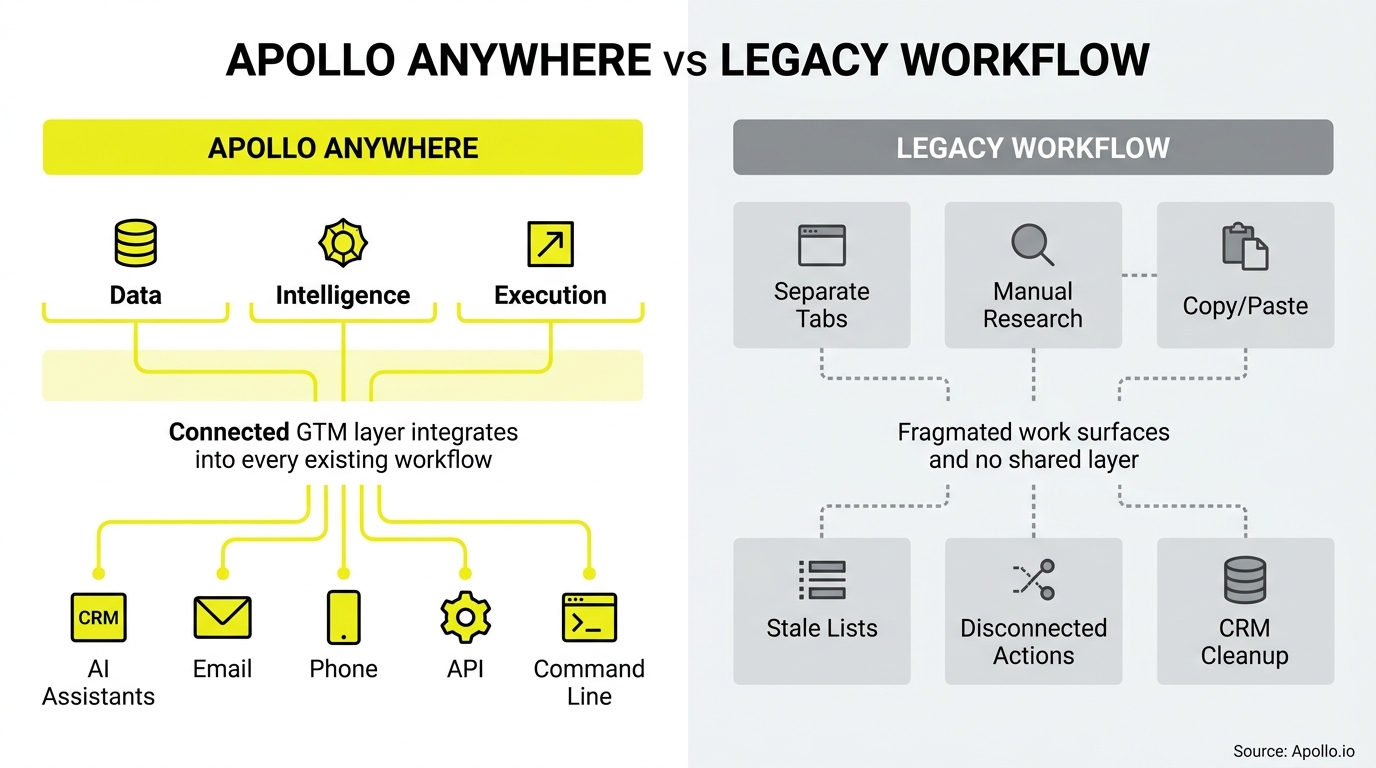
Apollo is an AI GTM system that unifies data, intelligence, and execution into one connected GTM system. It gives go-to-market teams the tools to find the right contacts, reach them across multiple channels, and act on real-time signals, without stitching together a stack of separate tools.
With 240M+ people and 30M+ companies in its database and 98% email accuracy, Apollo gives teams the data foundation to prospect with confidence.
Apollo meets sellers inside the tools they already use. Through Apollo MCP, Apollo's Model Context Protocol, teams can surface Apollo data directly inside AI assistants like ChatGPT, Codex, Claude, and Perplexity. The Apollo Chrome extension lets reps prospect from anywhere across the web. For technical and advanced users, the Apollo CLI provides terminal-native access for headless GTM workflows and API-driven automation.
According to Ramp's vendor data, as of July 2026, 38% of organizations purchasing software in the Sales Data Providers category use Apollo, a 5-percentage-point increase year over year, with 33% of first-time category buyers selecting Apollo as their first vendor in the space.

Apollo serves B2B GTM teams across the full revenue motion: outbound prospecting with multi-channel sequences and a built-in power and parallel dialer; inbound capture with website visitor identification, form enrichment, and smart routing; and data enrichment that keeps CRM records current via bi-directional sync with Salesforce and HubSpot. The platform also earned recognition in G2's 2026 Best Software Awards and carries a 4.7/5 rating on G2. Apollo offers transparent pricing starting at $49/user/month (annual billing), with a free tier available.
What is Thunderbit?
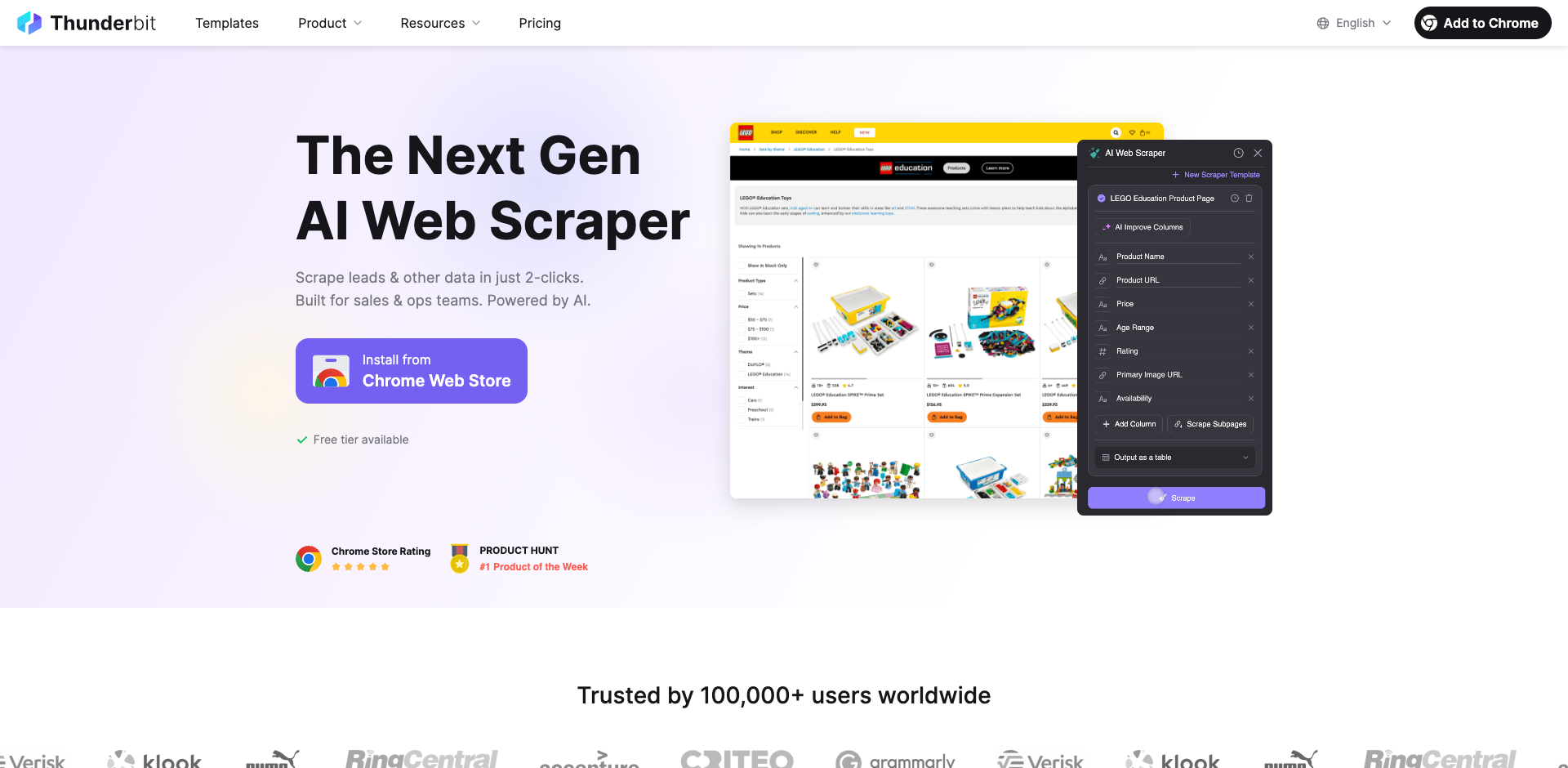
Thunderbit is an AI-powered web scraper built as a Chrome extension. It lets users extract data from websites, PDFs, documents, and images using natural language commands, without writing code or manually configuring CSS selectors. The tool identifies page structures automatically and pulls structured data in two clicks.
Thunderbit includes features like subpage scraping, bulk scraping with pagination, scheduled scraping and monitoring, pre-built templates for sites like Amazon and Zillow, and direct export to Google Sheets, Airtable, and Notion.
It also offers AI-driven data transformation, such as summarizing, categorizing, or translating extracted content, and a Web Scraper API for teams that want to embed scraping into their own applications.
The platform is designed for sales and operations teams who need to gather lead data, contact information, or other structured content from web pages without engineering support. Realtors pulling property listings, ops teams aggregating vendor data, or SDRs extracting contacts from directory pages are representative users.
Thunderbit does not include a proprietary B2B contact database, email or phone verification, outreach sequencing, a dialer, CRM enrichment workflows, or inbound routing. Teams that extract data with Thunderbit typically export it and work with it in other tools.
Thunderbit's pricing is credit-based. The free plan includes 6 pages per month at no cost.
Paid plans start at $9/month (annual billing) for the Starter tier and $16.50/month (annual billing, limited-time rate) for the Pro tier. A Business tier is available with requested pricing, which requires contacting their sales team for details.
Feature Comparison
| Feature | Apollo | Thunderbit |
|---|---|---|
| Starting Price | $49/user/month (annual billing); free tier available | $9/month (annual billing, Starter); free tier available |
| B2B Database | 240M+ people, 30M+ companies | No proprietary database; extracts data from user-specified websites |
| Email Accuracy | 98% | Not applicable; accuracy depends on source websites |
| Sequences | Multi-channel sequences (email, phone, social, tasks); AI Sequence Builder | Not included |
| Dialer | Power Dialer and Parallel Dialer; AI call scripts, voicemail drop, call summaries | Not included |
| AI Capabilities | AI prospecting, research agent, personalized messaging, sequence builder, call coaching | AI page structure interpretation, natural language extraction, AI data transformation |
| Data Enrichment | CRM enrichment (Salesforce, HubSpot), waterfall enrichment, CSV enrichment, API enrichment | Data export to Google Sheets, Airtable, Notion; no CRM enrichment workflows |
| Free Trial | Free tier with 900 credits/year | Free tier with 6 pages/month |
The table above reflects the fundamental difference between the two tools. Apollo covers the full arc from finding a contact to booking a meeting, logging a call, and enriching a CRM record. Thunderbit handles one specific step: extracting data from a web page. For teams that need to prospect and engage at scale, these are not equivalent alternatives.
Turn Funnel Guesswork Into Real Pipeline
Tired of watching marketing leads stall before they ever reach your pipeline? Apollo surfaces high-intent buyers so every rep works opportunities that actually close. 600K+ companies stopped guessing and started growing.
Start Free with Apollo →Pricing Comparison
Apollo's plans, as listed on the Apollo pricing page, are structured around annual billing:
- Free: $0, 900 credits/year, 2 sequences, basic filters
- Basic: $49/user/month, 30,000 credits/year, unlimited sequences, CRM integrations, 6 intent topics
- Professional: $79/user/month, 48,000 credits/year, US dialer, 5 mailboxes, AI research, automated workflows
- Organization: $119/user/month (minimum 3 users), 72,000 credits/year, international dialer, 15 mailboxes, SSO, advanced security
Thunderbit's annual billing plans, sourced from the official Thunderbit pricing page:
- Free: $0, 6 pages/month (max 30 credits per page)
- Starter: $9/month (annual billing), 5,000 credits/year
- Pro: $16.50/month (annual billing, limited-time rate), 30,000 credits/year
- Business: requested pricing; contact their team for details
The price difference between the two reflects the difference in scope. Thunderbit's lower entry cost covers web scraping only. Apollo's pricing includes the contact database, sequencing, dialing, AI research, enrichment, and analytics, capabilities that would otherwise require multiple separate tools and subscriptions. As Collin Stewart, CEO at Predictable Revenue, put it: "We reduced the complexity of three tools into one."

How Apollo Differs from Thunderbit
The most direct way to understand the gap between these two tools is to map them against a typical outbound sales workflow. A rep using Thunderbit might extract a list of contacts from a company directory, then export that list to a spreadsheet, then manually import it into a CRM, then use a separate tool to sequence outreach, and another to make calls.
Apollo handles that entire workflow natively, from finding and verifying contacts to running multi-channel sequences and logging outcomes back to the CRM automatically.
Apollo's AI capabilities go well beyond data extraction. The AI Research Agent finds and summarizes account-level context before outreach.
The AI Sequence Builder creates full email sequences from a natural language prompt. AI-generated call scripts personalize each conversation based on the prospect's firmographic and behavioral data.
These are execution tools, not just data tools.
According to Ramp's Sales Data Providers category data, as of July 2026, Apollo is the fastest-growing vendor in the Sales Data Providers category, averaging +0.7 percentage points of adoption per month, and holds a 22% competitor switch rate, meaning a significant share of Apollo's new customers previously used another vendor in the category before switching.

For teams building more technical GTM workflows, Apollo's API and CLI give developers the ability to automate enrichment, trigger sequences programmatically, or build internal tools on top of Apollo's data layer. Thunderbit offers a Web Scraper API as well, but it is scoped to extracting page content rather than operating within a broader sales workflow.
Apollo's MCP integration also means that GTM Engineers and AI Builders can bring Apollo's data directly into AI agent workflows without leaving the tools where they already work.
"Apollo enriches everything we have: contacts, leads, accounts...And we don't really have to touch it, it just works.", Mark Turner, VP of Revenue Operations at Built In
Frequently Asked Questions
Is Thunderbit a replacement for Apollo?
No. Thunderbit is a web scraping tool for extracting data from websites.
Apollo is a full GTM platform covering prospecting, engagement, dialing, enrichment, and analytics. They are not direct substitutes.
Some teams may use both, with Thunderbit as a data collection utility and Apollo for outreach execution, but Apollo includes its own verified B2B contact database that removes the need to scrape data manually for most sales use cases.
Who is Apollo best suited for?
Apollo serves B2B GTM teams, GTM Engineers, and AI Builders building headless GTM workflows with the Apollo API, CLI, and MCP, alongside Sales Professionals, SDRs/BDRs, AEs, RevOps, Marketing, and Revenue Leaders. As detailed in the pricing section above, Apollo has plans ranging from free to comprehensive, making it accessible across team sizes and stages.
Does Apollo have a web scraping feature?
Apollo does not function as a general-purpose web scraper. Instead, it provides a verified, continuously updated B2B contact and company database that teams can search using 65+ filters, eliminating the need to manually extract contact data from websites in most outbound workflows.
The Chrome extension lets reps capture contact data while browsing, which covers many of the same practical use cases sales teams reach for scraping tools to solve.
Can I use Thunderbit and Apollo together?
Yes, some teams use Thunderbit to extract data from specific web sources not covered by standard B2B databases, then import that data into Apollo or a CRM for enrichment and sequencing. That said, for standard B2B prospecting, Apollo's database and search tools handle contact discovery directly, without requiring a separate scraping step.
How does Apollo's free tier compare to Thunderbit's free tier?
As noted in the pricing comparison above, Apollo's free tier includes 900 credits/year, 2 sequences, and access to the core prospecting and filtering tools. Thunderbit's free tier provides 6 pages per month of web scraping with a maximum of 30 credits per page.
The two free tiers serve different purposes entirely: Apollo's is a starting point for sales outreach, while Thunderbit's is an introduction to its web data extraction tool.

Conclusion
Apollo and Thunderbit are not competing for the same job. Thunderbit is a utility for pulling data out of web pages.
Apollo is a full sales platform that covers finding, contacting, and converting prospects at scale. For B2B sales teams evaluating where to invest in their GTM stack, the comparison is less about which tool wins and more about which workflow you are actually trying to build.
If your team needs verified B2B contacts, multi-channel sequences, a built-in dialer, CRM enrichment, and AI-powered research in one place, Apollo is built for that. Try Apollo free today and see how much of your current stack it can consolidate.
Prove Pipeline ROI From Day One
ROI pressure killing your tool budget before it even gets approved? Apollo delivers measurable pipeline impact fast — 46% more meetings with AI Research Agent. See the wins leadership demands before your next renewal.
Start Free with Apollo →Don't miss these
Sales
Inbound vs Outbound Marketing: Which Strategy Wins?
Sales
What Is a Sales Funnel? The Non-Linear Revenue Framework for 2026
Sales
What Is a Go-to-Market Strategy? The 2026 GTM Playbook
See Apollo in action
We'd love to show how Apollo can help you sell better.
By submitting this form, you will receive information, tips, and promotions from Apollo. To learn more, see our Privacy Statement.
4.7/5 based on 9,690 reviews
