
Apollo vs Clay (2026): Features, Pricing & Which Platform Fits Your GTM Stack
Choosing between Apollo and Clay comes down to a fundamental question: do you need a platform that covers the full sales motion from data to conversation, or a workflow automation layer that pulls from many data sources? Both platforms address B2B prospecting, but they are built around different assumptions about how GTM teams operate.
This comparison breaks down the features, pricing, and real-world use cases so you can make an informed decision for your team in 2026.

Research Less, Close More With Apollo
Tired of burning hours hunting down contacts that bounce or go nowhere? Apollo delivers 240M+ verified contacts with 98% email accuracy so your team sells instead of searches. Start building real pipeline today.
Start Free with Apollo →Key Takeaways
- Platform scope: Apollo is an AI GTM system that covers data, sequences, dialing, and analytics in one connected system. Clay is focused on data enrichment workflows, pulling from 150+ providers and automating GTM data operations.
- Who each serves: Apollo serves B2B GTM teams, GTM Engineers, and AI Builders building headless GTM workflows with the Apollo API, CLI, and MCP, alongside Sales Professionals, SDRs/BDRs, AEs, RevOps, Marketing, and Revenue Leaders. Clay targets GTM teams, RevOps, and growth engineers who prioritize data orchestration.
- Execution built in: Apollo includes native sequences, a power dialer, and a parallel dialer alongside its database. Clay integrates with external sequencers for outreach execution.
- Pricing model: Apollo offers per-seat transparent pricing starting at $49/user/month (annual billing) with a free tier. Clay uses a hybrid pricing model combining action volume and data credit tiers, starting at $167/month (annual billing) for its Launch plan.
- AI capabilities: Both platforms invest in AI, with Apollo embedding AI into prospecting, research, sequencing, and dialing, and Clay offering its Claygent AI agent for web-based company and contact research.
What is Apollo?

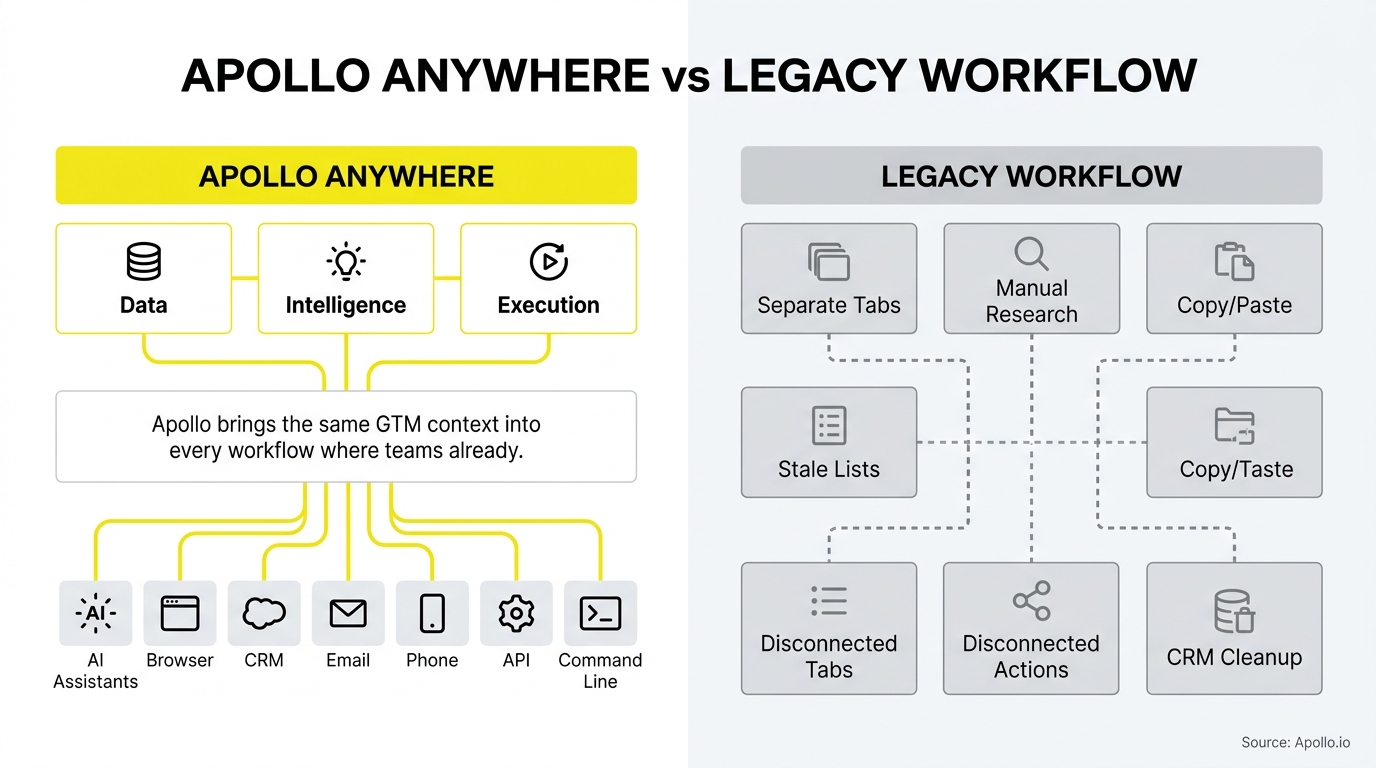
Apollo is an AI GTM system that unifies data, intelligence, and execution into one connected GTM system, serving teams that want to prospect, engage, and measure results without stitching together multiple tools. Apollo's database covers 240M+ people and 30M+ companies, with 98% email accuracy, and the platform spans the full outbound and inbound motion: from finding and enriching contacts to running multi-channel sequences, operating a built-in dialer, routing inbound leads, and tracking performance in a single workspace.
Apollo meets sellers where they already work. Apollo MCP, Apollo's Model Context Protocol, connects Apollo's data and workflows directly into AI assistants including ChatGPT, Codex, Claude, and Perplexity, so teams can surface contact intelligence without leaving their existing environment. The Chrome extension enables prospecting across the web. For technical and advanced users, Apollo CLI provides terminal-native access for headless GTM workflows and API-driven automation.
Market adoption reflects this momentum. According to Ramp's vendor data, as of July 2026, 38% of organizations that use any Sales Data Provider vendor use Apollo, up 5 percentage points year over year, with 34% of first-time category buyers choosing Apollo as their first vendor in the space.

Apollo is trusted by 100K+ paying customers, used by 100+ teams at Fortune 500 companies, and recognized as a 2026 MarTech Breakthrough Award Winner for "Best AI-Powered Sales Solution" and a G2 Leader across multiple categories. Apollo offers transparent pricing starting at $49/user/month (annual billing), with a free tier available. Full pricing details are in the Pricing Comparison section below.
What is Clay?

Clay is a GTM data infrastructure platform designed for teams that want to orchestrate enrichment workflows by pulling from many data sources simultaneously. The platform combines access to data from over 150 providers through a waterfall enrichment model, AI-assisted research via its Claygent agent, workflow automation, and integrations with CRM and sequencing tools.
Clay's core differentiator is its data marketplace approach: rather than maintaining a proprietary database, it routes enrichment requests across multiple external providers and returns the best available result. This multi-provider waterfall model appeals to teams that need broad data coverage across different geographies or verticals and want to control which sources are prioritized.
Key Clay features include:
- Claygent AI agent: Researches companies and people using web access, structured similarly to an AI research assistant embedded in the workflow.
- Waterfall enrichment: Sequences requests across 150+ data providers to maximize field coverage.
- Signals and intent tracking: Monitors job changes, promotions, company news, and web intent signals.
- Audiences: Centralizes first- And third-party data sources for targeted outreach lists.
- CRM auto-sync: Enriches and syncs records to Salesforce and other CRMs on a scheduled or real-time basis.
- Native sequencer: Provides email campaign and messaging automation within the platform.
- Ads integration: Syncs targeted audiences to ad platforms including LinkedIn, Meta, and Google.
- Sculptor: Enables workflow creation using natural language instructions.
Clay states it is used by over 500,000 GTM teams, including Stripe, Figma, and OpenAI. Its pricing uses a hybrid model that separates action volume from data credit volume, with both scaling independently.
Enterprise pricing requires a direct quote from their team.

Feature Comparison
| Feature | Apollo | Clay |
|---|---|---|
| Starting Price | $49/user/month (annual billing); free tier available, Apollo Pricing | $167/month (annual billing) for Launch; free tier available |
| B2B Database | 240M+ people, 30M+ companies (proprietary, continuously validated) | No proprietary database; routes enrichment across 150+ third-party providers |
| Email Accuracy | 98% | Varies by provider; dependent on waterfall results |
| Sequences | Multi-channel sequences (email, calls, social, tasks) built in; AI Sequence Builder included | Native email sequencer included; integrates with external sequencing platforms |
| Dialer | Power Dialer and Parallel Dialer included; AI call scripts, auto-logging, voicemail drop, real-time coaching | No native dialer; integrates with external calling tools |
| AI Capabilities | AI Research Agent, AI Sequence Builder, AI call summaries, AI sentiment analysis, 50K+ weekly AI users | Claygent AI agent for web research; Sculptor for natural-language workflow building |
| Data Enrichment | Waterfall enrichment, CRM enrichment, CSV enrichment, API enrichment, real-time form enrichment | Waterfall enrichment from 150+ providers, CRM auto-sync, HTTP API integrations |
| Free Trial | Free tier with 900 credits/year; no credit card required | Free tier with 100 data credits/month and 500 actions/month; 14-day paid trial available |
Apollo covers the full sales motion in one system, while Clay excels as a data orchestration layer for teams that already have sequencing and dialing tools in place or prefer to assemble their own stack. The key functional gap is calling: Apollo includes both a Power Dialer and a Parallel Dialer natively, while Clay does not offer a built-in dialer.
Turn Funnel Guesswork Into Real Pipeline
Tired of watching marketing leads stall before they ever reach your pipeline? Apollo surfaces in-market buyers with intent signals so your team acts at the right moment. Nearly 5M users stopped guessing and started closing.
Start Free with Apollo →Pricing Comparison
Apollo offers four plan tiers at transparent per-seat pricing(annual billing):
- Free: $0, 900 credits/year, 2 sequences, basic filters
- Basic: $49/user/month, 30,000 credits/year, unlimited sequences, CRM integrations, 6 intent topics
- Professional: $79/user/month, 48,000 credits/year, US dialer, 5 mailboxes, automated workflows, AI research
- Organization: $119/user/month (minimum 3 users), 72,000 credits/year, international dialer, 15 mailboxes, SSO, advanced security
Clay uses a hybrid pricing model that prices action volume and data credits separately, both scaling independently. Verified pricing from Clay's pricing page:
- Free: 500 actions/month and 100 data credits/month at no cost; unlimited seats
- Launch: Starting at $167/month (annual billing), combining 180,000 actions/year and 30,000 data credits/year. Monthly billing starts at $185/month.
- Growth: Starting at $446/month (annual billing), combining 480,000 actions/year and 72,000 data credits/year. Monthly billing starts at $495/month.
- Enterprise: requested pricing; contact Clay's team for a quote.
Clay's plan base prices represent minimums. Because actions and data credits are purchased separately and scale independently, total cost increases as volume grows.
Individual data credits start at $0.05 each and individual actions start at less than $0.01 each at entry-level volumes.
Apollo's credit model is per-seat with credits bundled at each tier, making per-user cost predictable as teams grow. Clay's seat count is unlimited across all plans, which is an advantage for teams with many users who primarily need data access without outreach execution requirements.
How Apollo Differs from Clay
The clearest difference between Apollo and Clay is what happens after data enrichment. Clay is built to get data into the right shape and into the right systems.
Apollo continues from there: once a contact is identified and enriched, reps can immediately sequence, call, and track the outcome within the same platform. Teams that use Clay for enrichment typically integrate it with a separate sequencer and a separate dialer to complete that workflow.
Ramp's Sales Data Providers category data, as of July 2026, shows Apollo as the fastest-growing vendor in the category, averaging +0.75 percentage points of adoption per month, compared to Clay's +0.34 percentage points per month. This sustained growth reflects adoption across team sizes, Apollo serves B2B GTM teams, GTM Engineers, and AI Builders building headless GTM workflows with the Apollo API, CLI, and MCP, alongside Sales Professionals, SDRs/BDRs, AEs, RevOps, Marketing, and Revenue Leaders segments where data orchestration and sales execution requirements often converge.

Additional differentiators worth noting:
- Proprietary database vs. Aggregated enrichment: Apollo maintains its own continuously validated database through its Living Data Network. Clay does not maintain a proprietary database and depends on results from external providers through its waterfall model.
- Native dialing: Apollo's Power Dialer and Parallel Dialer are included in the Professional and Organization plans. Clay does not include a native dialer.
- Inbound and form enrichment: Apollo's inbound tools include website visitor identification, form shortening, and real-time form enrichment to complete records at the moment of submission. Clay's enrichment is primarily outbound-oriented.
- AI embedded across the workflow: Apollo's AI capabilities span research, sequence creation, call scripting, sentiment analysis, and lead scoring. Clay's Claygent agent is focused on the research and enrichment phase.
- Headless and API access: Both platforms offer API access. Apollo also provides the Apollo CLI for terminal-native workflows and Apollo MCP for AI assistant integrations, making it accessible to technical GTM Engineers and AI Builders building automated pipelines.
"We reduced the complexity of three tools into one.", Collin Stewart, CEO at Predictable Revenue
Frequently Asked Questions
Is Apollo or Clay better for data enrichment?
Both platforms support data enrichment, but through different architectures. Apollo uses its own proprietary database with waterfall enrichment from multiple providers built in, covering CRM, CSV, API, and real-time form enrichment in one system.
Clay routes enrichment through 150+ external providers and is optimized for teams that want to orchestrate complex multi-source enrichment workflows. If your team also needs sequences and a dialer alongside enrichment, Apollo covers all of that in one platform.
If your primary need is flexible, multi-provider data orchestration that feeds other tools, Clay's model may fit that workflow.
What is the main pricing difference between Apollo and Clay?
Apollo uses transparent per-seat pricing, as detailed in the pricing section above, with credits bundled at each tier. Clay uses a hybrid model where actions and data credits are purchased separately and scale independently, with plans starting at $167/month (annual billing).
Apollo's model makes per-user costs predictable; Clay's model offers unlimited seats but variable total cost based on data volume used.
Does Apollo include a dialer?
Yes. Apollo includes both a Power Dialer and a Parallel Dialer, available on the Professional and Organization plans.
The dialer includes AI-researched call scripts, automatic call logging, voicemail drop, and real-time manager coaching. Clay does not include a native dialer.
Who should use Apollo?
Apollo serves B2B GTM teams, GTM Engineers, and AI Builders building headless GTM workflows with the Apollo API, CLI, and MCP, alongside Sales Professionals, SDRs/BDRs, AEs, RevOps, Marketing, and Revenue Leaders. Teams that want to run prospecting, enrichment, sequencing, and calling in a single connected system, without assembling multiple tools, are well-suited to Apollo.
Can Apollo and Clay be used together?
Some teams use Clay for upstream data orchestration and enrichment, then route enriched records into Apollo for sequencing and engagement. Apollo's API and CRM integrations support this setup.
That said, teams looking to consolidate often find that Apollo's native enrichment, as noted above, covers the core use cases without requiring a separate enrichment layer.

Conclusion
Apollo and Clay are both credible platforms for B2B GTM data work, but they are built for different operational philosophies. Clay is optimized for teams that want to orchestrate enrichment across many data sources and pipe results into their existing stack.
Apollo covers that enrichment layer and extends it forward: sequences, dialing, inbound routing, AI-assisted research, and analytics are all part of the same platform.
For teams that want to consolidate their sales tech stack and run the full GTM motion, from contact discovery through booked meeting, without managing multiple vendor integrations, Apollo is built for that workflow. Try Apollo free today and see how it fits your team's prospecting and engagement workflow.
Ramp Reps Faster, Prove ROI Sooner
Quota pressure mounting while new reps are still finding their footing? Apollo's unified platform cuts ramp time with guided workflows every rep can follow from day one. Teams like Leadium 3x'd revenue — see your ROI fast.
Start Free with Apollo →Don't miss these
Sales
Inbound vs Outbound Marketing: Which Strategy Wins?
Sales
What Is a Sales Funnel? The Non-Linear Revenue Framework for 2026
Sales
What Is a Go-to-Market Strategy? The 2026 GTM Playbook
See Apollo in action
We'd love to show how Apollo can help you sell better.
By submitting this form, you will receive information, tips, and promotions from Apollo. To learn more, see our Privacy Statement.
4.7/5 based on 9,690 reviews
