
What Is a Go-to-Market Strategy? The 2026 GTM Playbook
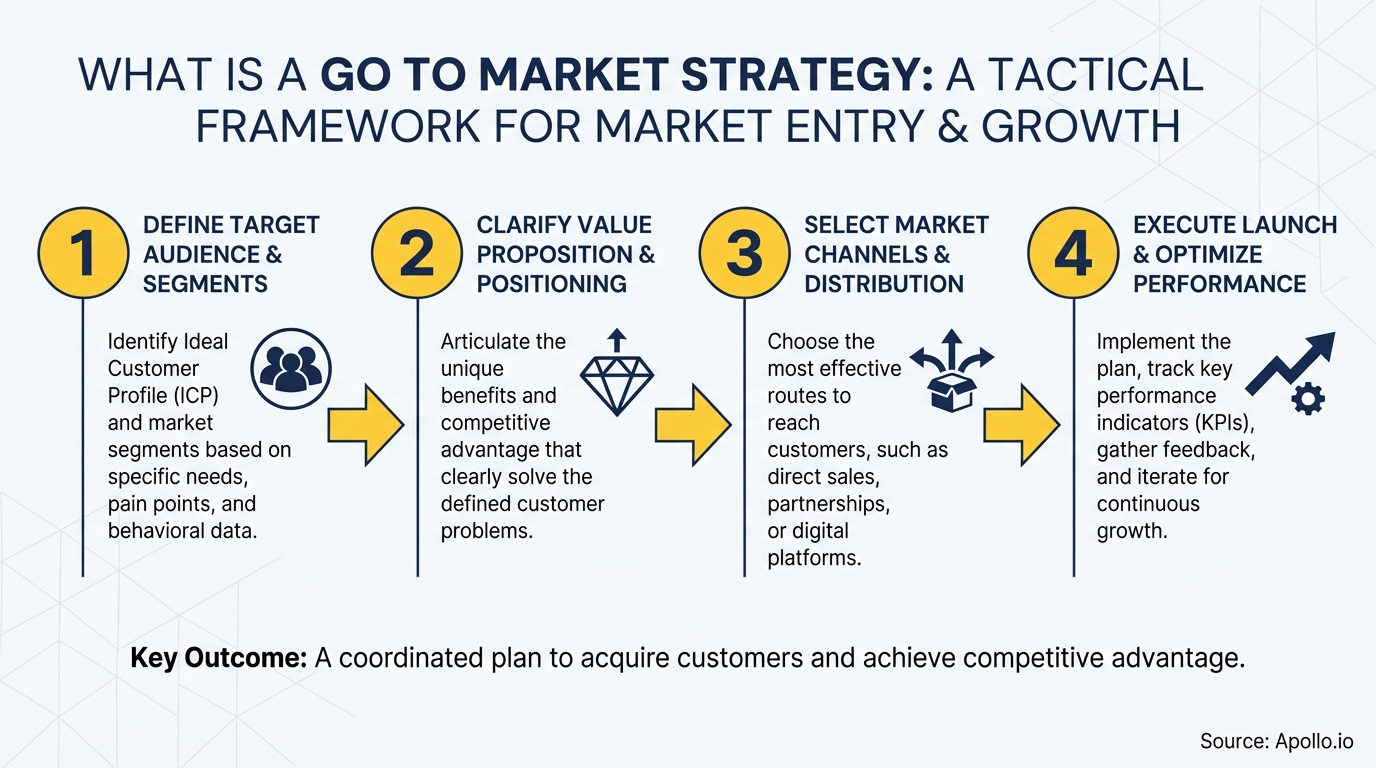
A go-to-market (GTM) strategy is a plan that defines how a company will bring a product or service to market, reach its target customers, and generate revenue. It answers four core questions: Who are we selling to?
What problem do we solve? How do we reach and convert buyers?
How do we measure success?
In 2026, GTM strategy has expanded well beyond launch plans and channel selection. Gartner now frames GTM as designing end-to-end buying experiences, including self-serve, sales-assist, and partner-led routes, not just campaigns. The companies winning today treat their GTM as an operating system, not a slide deck.

Your Reps Sell. Apollo Finds Leads.
Tired of your team burning hours on manual research instead of closing deals? Apollo delivers verified contacts instantly, so reps spend time selling — not searching. Join 550K+ companies building pipeline faster.
Start Free with Apollo →Key Takeaways
- A go-to-market strategy defines your target market, value proposition, channels, and revenue model in one coherent plan.
- According to Go To Market Alliance, B2B companies with a well-structured GTM strategy are 33% more likely to hit their revenue targets.
- Modern GTM must win the "Day One shortlist" before buyers ever contact a sales rep.
- Effective GTM in 2026 requires role-based messaging for multi-stakeholder buying groups, not one-size-fits-all campaigns.
- AI-assisted discovery means your GTM content must be structured for LLM retrieval, not just search engine ranking.
Go-to-Market Strategy Definition: What It Is and What It Isn't
A GTM strategy is a coordinated plan connecting your product, your ideal customer profile (ICP), your messaging, your sales motion, and your revenue metrics. It spans the full customer lifecycle: awareness, evaluation, purchase, and expansion.
What a GTM strategy IS NOT:
- A product roadmap or feature release plan
- A marketing campaign calendar
- A sales script or pitch deck
- A one-time launch activity
What a GTM strategy IS:
- A living operating model aligned across marketing, sales, and customer success
- A framework for how buyers discover, evaluate, and choose your product
- A measurement system tied to pipeline and revenue, not just leads
- A repeatable motion that scales across segments and geographies
Despite its importance, Devrix reports that 15.4% of companies still operate without a defined GTM strategy, leaving revenue to chance.
The 5 Core Components of a Go-to-Market Strategy
| Component | What to Define | Key Question |
|---|---|---|
| Ideal Customer Profile (ICP) | Firmographics, technographics, buying triggers | Who is most likely to buy and expand? |
| Value Proposition | Problem solved, differentiation, proof points | Why choose us over alternatives? |
| Sales Motion | Self-serve, sales-assist, partner-led, or hybrid | How do buyers want to buy? |
| Channel Strategy | Outbound, inbound, content, paid, partner, product-led | Where do buyers discover solutions? |
| Revenue Model | Pricing, packaging, expansion mechanics | How do we capture and grow revenue? |
For a deeper dive into building each component, see the full GTM strategy guide on Apollo.

Why Most GTM Strategies Fail in 2026
The biggest GTM failure mode today is building a strategy optimized for how sellers want to sell, not how buyers want to buy. Buyers now complete a significant portion of their evaluation before ever speaking to a rep. Research shows that 48% of B2B marketers say driving enough leads is a challenge, and 24% report difficulties converting leads to revenue. The problem is usually upstream: the wrong audience, the wrong message, or the wrong moment.
Three structural shifts are breaking traditional GTM playbooks:
- The shortlist is formed before first contact. Buyers rank preferred vendors before engaging sellers, meaning GTM must create preference pre-intent through category education, third-party validation, and community presence.
- Buying groups, not individuals, make decisions. Multiple stakeholders across economic, technical, user, and procurement functions must all be addressed in your GTM content and messaging.
- AI is now a primary discovery channel. Buyers use AI assistants to research solutions, so your GTM content must be structured for LLM retrieval, with clear claims, evidence, and entity associations, not just keyword density.
"Apollo gets us the people we need to speak to. Without that, there's no business."
Fill Your Funnel With Buyers Who Convert
Running out of qualified leads while your pipeline runs dry? Apollo surfaces in-market prospects matched to your ICP before your competitors reach them. Join 550K+ companies turning outreach into real opportunities.
Start Free with Apollo →GTM Motions: Choosing the Right Sales Model
Your GTM motion defines how revenue flows. In 2026, effective companies design multiple routes to revenue rather than betting on a single funnel. Understanding how sales and marketing align is foundational to choosing the right motion.
| GTM Motion | Best For | Primary Signal |
|---|---|---|
| Outbound Sales-Led | High ACV, defined ICP, complex deals | Intent data, firmographic fit |
| Inbound / Content-Led | Volume-driven, category awareness plays | Search, content engagement, web behavior |
| Product-Led Growth (PLG) | Self-serve, low ACV, high virality potential | Product usage, activation milestones |
| Partner-Led | New markets, ecosystem leverage, enterprise expansion | Partner referrals, co-sell signals |
| Hybrid (PLG + Sales Assist) | SMB self-serve with enterprise upsell path | Usage spikes, seat expansion triggers |
Ready to build your outbound motion? Automate multi-channel sequences with Apollo's sales engagement platform and reach your ICP across email, phone, and social outreach at scale.
Building a GTM Strategy for Multi-Stakeholder Buying Groups
Modern B2B purchases involve multiple decision-makers across functions. Your GTM content, outreach, and proof assets must address each stakeholder's specific concerns, not just the champion.
Map your GTM assets to the core buying roles:
- Economic Buyer: ROI calculators, business case templates, executive case studies
- Technical Evaluator: Security documentation, integration specs, architecture guides
- End User / Champion: Product demos, how-to content, community proof
- Procurement: Pricing transparency, contract terms, compliance summaries
- Legal / Security: Data handling documentation, risk mitigation materials
This multi-stakeholder approach connects directly to modern B2B digital marketing strategy, where content must serve different audiences simultaneously across a non-linear buyer journey.
"The thing that made me most excited as somebody who's been in sales development a long time was Apollo's integration between sales data and sales engagement and the magic that you can make happen when those two are together on the same platform."
GTM Metrics: What to Measure in 2026
Most GTM teams measure too late in the funnel. By the time a lead converts, the strategic work that won or lost the deal happened weeks earlier. According to Rendertribe, supporting revenue operations topped the list of priorities for marketing operations professionals in 2024, with 32% focusing on RevOps alignment. Align your GTM metrics across three horizons:
| Metric Horizon | Key Metrics | Why It Matters |
|---|---|---|
| Pre-Pipeline (Awareness) | Shortlist placement, share of voice, content reach by ICP segment | Measures influence before intent is visible |
| Pipeline (Demand) | Qualified pipeline created, conversion rate, win rate, deal velocity | Tracks execution quality of GTM motion |
| Post-Sale (Expansion) | NRR, churn rate, expansion revenue, CAC:LTV ratio | Validates ICP fit and long-term GTM efficiency |
For a complete breakdown, explore which B2B marketing metrics actually drive revenue growth. Building your GTM measurement framework starts with identifying the right accounts. Search Apollo's 224M+ verified contacts with 65+ filters to build precise ICP lists and track engagement from first touch to closed-won.
How to Execute Your GTM Strategy: A Practical Framework
GTM execution collapses when strategy, data, and tooling are disconnected. The most effective teams in 2026 run GTM as a unified operating system with shared signals, not siloed campaigns.
Here is the execution sequence that works:
- Define and validate your ICP using firmographic, technographic, and behavioral data.
- Build role-based messaging for each stakeholder in the buying group, with distinct proof points per persona.
- Select your primary GTM motion (outbound, inbound, PLG, partner) based on deal size and buyer behavior.
- Create ungated, self-serve content that builds preference before buyers engage your sales team.
- Instrument your funnel with pre-pipeline, pipeline, and post-sale metrics tied to shared revenue targets.
- Run signal-driven outreach using intent data, web behavior, and CRM triggers to prioritize the right accounts at the right moment.
- Align marketing, sales, and CS around the same ICP definition, pipeline definitions, and expansion playbooks.
For the channel-specific execution layer, the marketing frameworks that drive revenue in 2026 provide structured approaches for both inbound and outbound plays.
Conclusion: Your GTM Strategy Is a Buying Experience, Not a Plan
A go-to-market strategy is only as good as the buying experience it creates. In 2026, winning GTM teams design every touchpoint, from first content impression to contract signature, around how buyers actually discover, evaluate, and decide.
That means ungated content, role-specific proof, multi-channel engagement, and measurement that starts before the lead form.
Apollo gives you the unified platform to execute every layer of your GTM strategy: verified contact data to find your ICP, automated sequences to engage buying groups across channels, and deal management to track pipeline from first touch to close. More than 550K companies trust Apollo to turn GTM strategy into repeatable revenue.
Try Apollo Free and launch your GTM motion today.
Prove Pipeline ROI With Apollo
ROI pressure killing your next budget approval? Apollo delivers measurable pipeline outcomes your exec team can see — fast. Leadium 3x'd their annual revenue. Start your free trial and show results before the next QBR.
Start Free with Apollo →