
Apollo vs PhantomBuster (2026): Features, Pricing & Best Use Cases
Choosing between Apollo and PhantomBuster comes down to a fundamental question: do you need a workflow automation tool built around social data extraction, or a full GTM system that covers prospecting, engagement, enrichment, and analytics in one place? Both platforms address outbound sales workflows, but they approach the problem from very different angles.
This comparison breaks down what each platform actually does, what it costs, and which teams are best served by each.

Verified Contacts. Less Research. More Pipeline.
Tired of burning hours hunting down accurate emails and phone numbers? Apollo surfaces verified business contacts instantly, so your team sells instead of searches. Nearly 5M users trust Apollo to keep their pipeline full.
Start Free with Apollo →Key Takeaways
- Platform scope: Apollo is an AI GTM system covering the full GTM workflow, data, sequencing, dialing, enrichment, and analytics. PhantomBuster focuses on social automation and data extraction workflows.
- B2B database: Apollo provides a 240M+ person database with 98% email accuracy, while PhantomBuster's offering centers on extracting data from social and web sources rather than maintaining a proprietary verified database.
- Audience: Apollo serves B2B GTM teams, GTM Engineers, and AI Builders building headless GTM workflows with the Apollo API, CLI, and MCP, alongside Sales Professionals, SDRs/BDRs, AEs, RevOps, Marketing, and Revenue Leaders.
- Pricing transparency: Apollo offers transparent, self-serve pricing starting at $49/user/month (annual billing) with a free tier. PhantomBuster's pricing is not publicly displayed on their official website.
- AI capabilities: Apollo's AI features span research, sequence building, call scripts, sentiment analysis, and lead scoring across the full sales cycle.
What is Apollo?

Apollo is an AI GTM system that unifies data, intelligence, and execution into one connected GTM system. From a single workspace, teams can identify and enrich prospects from a database of 240M+ people and 30M+ companies, build and run multi-channel sequences across email, phone, and social, use the AI Dialer for efficient calling, and analyze pipeline performance, without switching between tools.
Apollo's 98% email accuracy is delivered through its Living Data Network, which continuously validates and refreshes contact records.
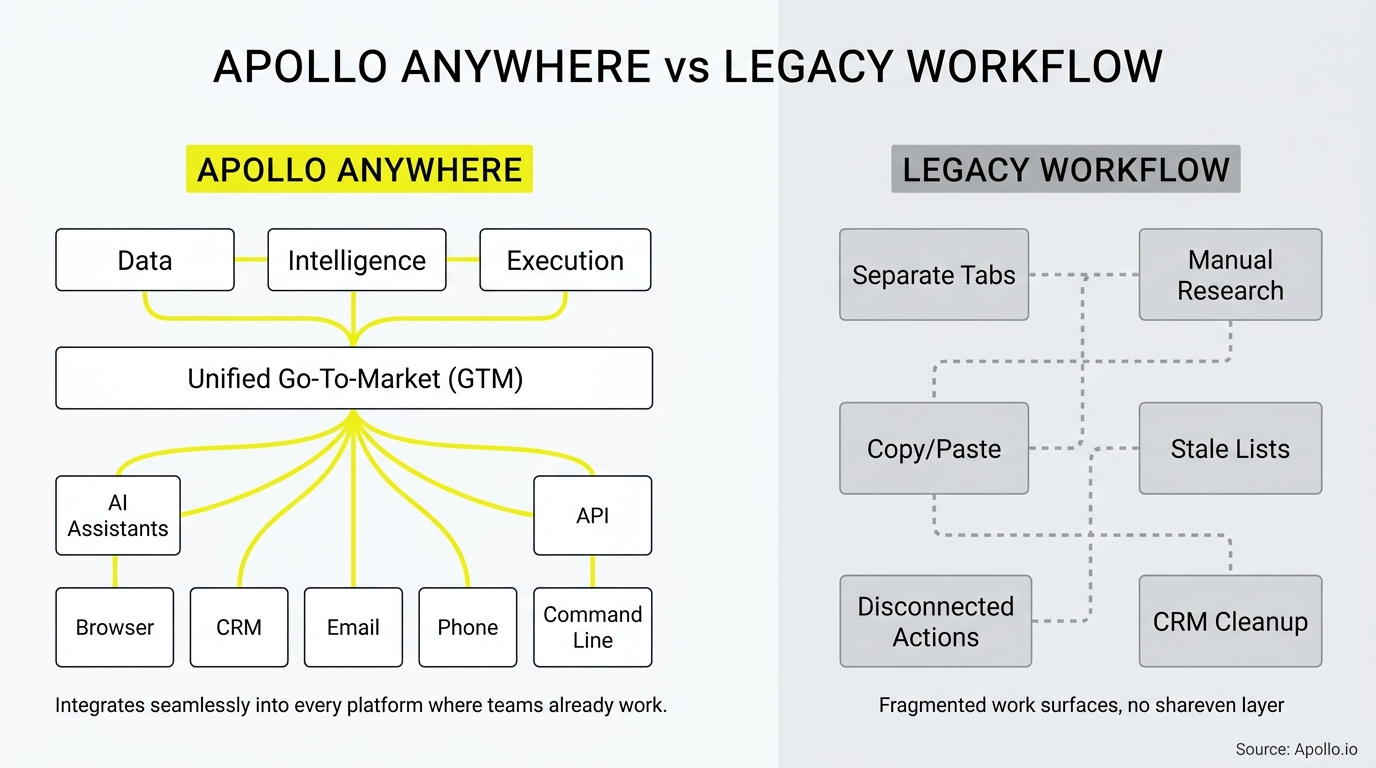
Apollo meets sellers inside the tools they already use. Apollo MCP, Apollo's Model Context Protocol, connects Apollo's data and workflows directly inside AI assistants including ChatGPT, Codex, Claude, and Perplexity. The Chrome extension enables prospecting across the web, and for technical teams, Apollo CLI provides terminal-native access for headless GTM workflows and API-driven automation at scale.
Market adoption reflects this momentum. According to Ramp's vendor data, Apollo holds a 38% adoption rate in the Sales Data Providers category as of July 2026, up 5 percentage points year-over-year, with 34% of businesses making their first purchase in this category choosing Apollo, ranking it #2 for new adopter capture.

Apollo is trusted by 100K+ paying customers and used by 100+ teams at Fortune 500 companies, including Anthropic, Redis, and Smartling. The platform holds a 4.7/5 rating on G2 and was recognized with the 2026 MarTech Breakthrough Award for "Best AI-Powered Sales Solution". Transparent pricing starts at $49/user/month (annual billing), with a free tier available.
What is PhantomBuster?

PhantomBuster is a no-code automation platform designed to extract data and automate actions across social networks and web sources. Its core concept centers on "Phantoms", individual automation scripts that perform specific tasks such as extracting profile lists, sending connection requests, or scraping search results from professional networks and other web platforms.
The platform is primarily used by B2B sales and marketing teams that want to automate repetitive social outreach steps and build prospect lists from social platforms without writing code. Users typically chain multiple Phantoms together into "Flows" to create multi-step automation sequences, such as extracting a list of profiles and then triggering a connection request or message.
PhantomBuster's value proposition is centered on social data extraction and action automation rather than a proprietary B2B contact database. Teams use it to pull publicly available data from professional networks, enrich those lists, and trigger outreach steps, often combining PhantomBuster outputs with other sales tools for email sending, CRM logging, or further enrichment.
The platform targets growth teams, marketers, and sales professionals comfortable with workflow automation. It integrates with tools including Google Sheets, Zapier, and various CRMs, allowing extracted data to flow into broader sales and marketing stacks.
PhantomBuster's pricing is not publicly displayed on their official website. Teams interested in pricing would contact their sales team directly for details.
Feature Comparison
| Feature | Apollo | PhantomBuster |
|---|---|---|
| Starting Price | $49/user/month (annual billing) | Not publicly displayed |
| B2B Database | 240M+ people, 30M+ companies | Extracts data from social and web sources; no proprietary verified database |
| Email Accuracy | 98% | Dependent on source platform data; no published accuracy figure |
| Sequences | Multi-channel sequences (email, phone, social, tasks); AI Sequence Builder | Social automation flows (Phantoms + Flows); limited to social/web channels |
| Dialer | Power Dialer and Parallel Dialer with AI call scripts, voicemail drop, CRM logging | No built-in dialer |
| AI Capabilities | AI research agent, lead scoring, sequence builder, call scripts, sentiment analysis | Automation scripts for social tasks; AI features not publicly documented |
| Data Enrichment | Waterfall enrichment, CRM enrichment, CSV enrichment, API enrichment with 65+ attributes | Enrichment via social data extraction; relies on third-party integrations for full enrichment |
| Free Trial | Free tier with 900 credits/year | Free trial available; details not publicly displayed |
The table above highlights a meaningful difference in platform scope. Apollo covers the full outbound workflow from data to dialing to analytics, while PhantomBuster's primary strength is social automation and extraction.
Teams that need both verified contact data and engagement execution in one system will find Apollo more self-contained, while teams focused specifically on social extraction workflows may find PhantomBuster's Phantoms model a fit for that narrower use case.

Pricing Comparison
Apollo's full pricing structure is available at apollo.io/pricing. All prices below are annual billing:
- Free: $0, 900 credits/year, 2 sequences, basic filters
- Basic: $49/user/month, 30,000 credits/year, unlimited sequences, CRM integrations, 6 intent topics
- Professional: $79/user/month, 48,000 credits/year, US dialer, 5 mailboxes, automated workflows, AI research
- Organization: $119/user/month (min 3 users), 72,000 credits/year, international dialer, 15 mailboxes, SSO, advanced security
PhantomBuster's pricing is not publicly displayed on their official website. Teams would contact their sales team directly for a quote.
This makes direct price comparisons difficult, and buyers evaluating PhantomBuster alongside Apollo should factor in the time needed to obtain pricing before making a decision.
Apollo's transparent, self-serve pricing model lets teams evaluate the platform, start on the free tier, and scale as needed without a sales call. For teams that value cost predictability and fast onboarding, this is a practical advantage.
Turn Funnel Guesswork Into Pipeline Clarity
Pipeline forecasting a guessing game because leads stall before they ever reach your AEs? Apollo surfaces high-intent prospects and moves them faster from first touch to opportunity. 600K+ companies finally have a funnel that converts.
Schedule a Demo →How Apollo Differs from PhantomBuster
The clearest difference is platform intent. PhantomBuster is an automation tool built primarily around extracting data from social networks and triggering social actions.
Apollo is built to cover the full B2B sales workflow, from identifying the right contacts with verified data, to running multi-channel outreach, to measuring pipeline outcomes. Where PhantomBuster produces lists and triggers social steps, Apollo closes the loop with dialing, sequencing, enrichment, CRM sync, and analytics in one place.
For teams running sales automationat scale, the difference in AI depth matters. Apollo's AI features span the entire workflow: the AI Research Agent surfaces contextual insights on accounts, the AI Sequence Builder generates sequences from natural language, and AI-powered call scripts are personalized per prospect. These are not isolated features, they connect across Apollo's data, sequencing, and dialer layers.
Customer outcomes illustrate the consolidation benefit directly. "We reduced the complexity of three tools into one.", Collin Stewart, CEO at Predictable Revenue. And from the data side:"Apollo enriches everything we have: contacts, leads, accounts...And we don't really have to touch it, it just works.", Mark Turner, VP of Revenue Operations at Built In.
Broader market data supports Apollo's growing role as the platform teams consolidate on. According to Ramp's Sales Data Providers category data, Apollo is the fastest-growing vendor in the category as of July 2026, averaging +0.75 percentage points of adoption per month, ahead of every other vendor tracked in the category.

For teams specifically evaluating social selling workflows, Apollo's social steps are integrated directly into multi-channel sequences alongside email and phone, not a separate tool or standalone automation layer. The Chrome extension enables social prospecting across the web, feeding contacts directly into Apollo's database, sequences, and CRM sync without requiring data export or additional workflow steps.
Frequently Asked Questions
Can Apollo replace PhantomBuster for social selling automation?
For most B2B sales teams, yes. Apollo includes social steps natively within its multi-channel sequences, and the Chrome extension supports prospecting across the web.
Teams that relied on PhantomBuster purely for social data extraction and outreach triggering will find Apollo handles those steps as part of a broader workflow that also includes verified contact data, email, dialing, and CRM sync.
Who is Apollo designed for?
Apollo serves B2B GTM teams, GTM Engineers, and AI Builders building headless GTM workflows with the Apollo API, CLI, and MCP, alongside Sales Professionals, SDRs/BDRs, AEs, RevOps, Marketing, and Revenue Leaders. It is used by startups through Fortune 500 teams across industries.
Does Apollo offer a free plan?
Yes. Apollo's free tier is available without a credit card and includes a meaningful credit allowance each year, as detailed in the pricing section above.
It supports core prospecting and sequencing features, making it accessible for teams that want to evaluate the platform before committing to a paid plan.
How does Apollo handle data enrichment compared to PhantomBuster?
Apollo provides native waterfall enrichment across CRM records, CSV lists, and API endpoints using its own verified database, as covered above. PhantomBuster's enrichment relies primarily on extracting data from social sources and routing it through third-party integrations.
Apollo's approach keeps enrichment, verification, and CRM sync inside a single workflow.
Is Apollo suitable for technical and API-driven GTM workflows?
Yes. Beyond the standard UI, Apollo provides a full REST API for bulk enrichment and programmatic prospecting, along with Apollo CLI for terminal-native access. GTM Engineers and AI Builders can also connect Apollo's data directly into AI assistant workflows via Apollo MCP, as noted earlier.

Conclusion
Apollo and PhantomBuster serve different primary use cases. PhantomBuster is a social automation and extraction tool suited to teams running narrow, script-driven workflows on social platforms.
Apollo is a full AI GTM system covering data, enrichment, multi-channel engagement, dialing, and analytics, with social steps built in as part of a broader GTM motion, not as a standalone layer.
For B2B sales teams that need verified contact data, AI-assisted outreach, and a measurable pipeline built from a single platform, Apollo offers more coverage with transparent pricing and a free tier to start immediately.
Try Apollo free today and see how it compares to your current stack.
Prove Pipeline ROI Before Next Quarter
ROI pressure killing your case for a new sales platform? Apollo delivers measurable pipeline impact from day one, so justifying the investment is straightforward. Leadium 3x'd their annual revenue — your board meeting just got easier.
Start Free with Apollo →Don't miss these
Revenue Operations
Top Market Intelligence Tools for B2B Teams in 2026
Revenue Operations
Sales Operations Analyst Salary: 2026 Compensation Guide and Benchmarks
Revenue Operations
Sales Compensation Software: How to Automate Commission Management
See Apollo in action
We'd love to show how Apollo can help you sell better.
By submitting this form, you will receive information, tips, and promotions from Apollo. To learn more, see our Privacy Statement.
4.7/5 based on 9,690 reviews
