
9 Top Bombora Alternatives for GTM Teams in 2026
Bombora is a B2B data company known for its Company Surge® Intent data, which tracks research activity across a consent-based Data Co-op to help teams spot in-market accounts. Alongside intent data, Bombora offers identity resolution, digital audience activation, and campaign measurement tools built primarily for marketing and ABM use cases.
Teams often start looking for Bombora alternatives when they need capabilities beyond intent signals alone, such as contact-level data, outbound execution, dialer functionality, or AI-driven account research. Bombora's Data Co-op model is strong for surfacing which accounts are researching a topic, but it doesn't natively include the prospecting, sequencing, or CRM enrichment workflows that many sales and RevOps teams need in a single tool.
That gap has pushed a growing number of GTM teams toward platforms that combine data, intelligence, and execution.
This guide compares nine Bombora alternatives, starting with Apollo, an AI GTM system that unifies data, intelligence, and execution, followed by data intelligence and revenue orchestration platforms including 6sense, Pocus, Common Room, MadKudu, Warmly, ZoomInfo, Cognism, and Salesloft. We'll look at features, pricing, and who each platform tends to fit best.

Apollo Ends Manual Lead Research For Good
Spending hours every week verifying emails and phone numbers by hand? Apollo hands your team verified contact data instantly, with 98% email accuracy built in. Nearly 5M users skip the busywork and get straight to selling.
Start Free with Apollo →Key Takeaways
- Sales Intelligence Capabilities: Apollo combines a large contact and company database with buyer intent signals, enrichment, and multi-channel execution in one connected system.
- AI Features: Platforms like Apollo, Pocus, Common Room, and Warmly lean heavily on AI agents for research, scoring, and personalized outreach, while 6sense and MadKudu focus AI on predictive account scoring.
- Customer Base: Apollo serves organizations from startups to enterprise GTM teams, while ZoomInfo, Cognism, and 6sense skew toward mid-market and enterprise budgets.
- Platform Scope: Apollo, Salesloft, and 6sense span research through execution, while tools like MadKudu and Warmly focus more narrowly on scoring or signal-based engagement.
- Pricing Transparency: Apollo publishes exact per-seat pricing on its pricing page, while most alternatives here use requested quotes models.
Apollo
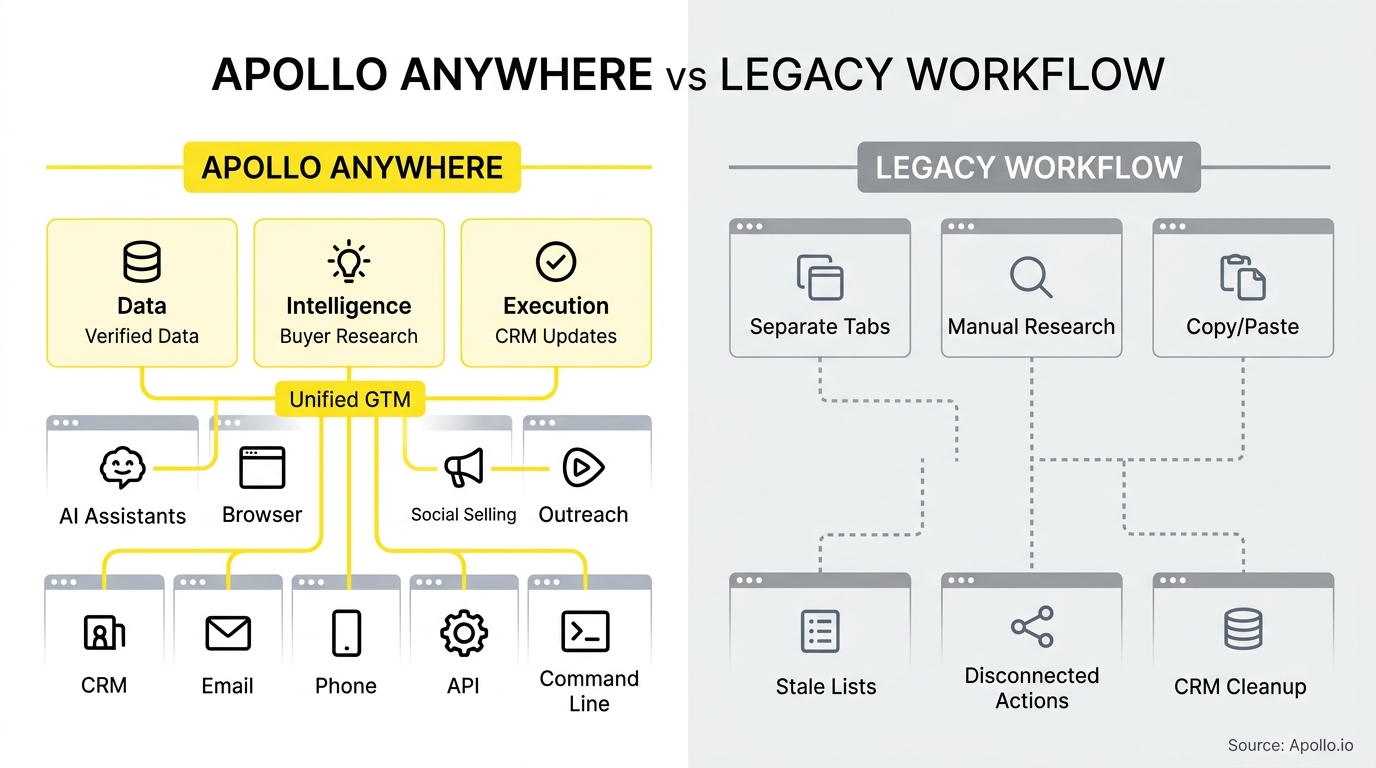
Apollo is an AI GTM system that unifies data, intelligence, and execution. Built open by design, Apollo meets sellers inside the tools they already use, from AI assistants like ChatGPT, Codex, Claude, and Perplexity via Apollo MCP, to the Chrome extension and Salesforce, rather than asking teams to switch contexts to get value. For technical and advanced users, Apollo CLI provides terminal-native access for headless GTM workflows.
Apollo's database includes 240M+ people and 30M+ companies, continuously validated through Apollo's Living Data Network rather than treated as a static list, with 98% email accuracy. On the outbound side, Apollo covers the full workflow: defining ICPs and letting AI Assistant find and rank accounts, running multi-channel sequences across email, calls, and social, and using the Power Dialer and Parallel Dialer to reduce manual calling. Apollo Inbound complements this by identifying website visitors, enriching short forms, and routing leads automatically, while Data Enrichment keeps CRM records current through waterfall enrichment across multiple vendors, all accessible via 65+ filters. Apollo also connects to Salesforce, HubSpot, Outreach, Salesloft, and more through a marketplace of 50+ integrations.
Pricing is published on Apollo's pricing page. Free is $0/year with 900 credits/year, 2 sequences, and basic filters.
Basic is $49/user/month (annual billing) with 30,000 credits/year, unlimited sequences, CRM integrations, and 6 intent topics. Professional is $79/user/month with 48,000 credits/year, a US dialer, 5 mailboxes, automated workflows, and AI research.
Organization is $119/user/month (minimum 3 users) with 72,000 credits/year, an international dialer, 15 mailboxes, SSO, and advanced security.
Customers describe real consolidation benefits. Kevin Warner, CEO at Leadium, said, "Apollo became the single source of truth for uswhere everything originates from and where all the data returns to." Sylvain Giuliani, Head of Growth & Operations at Census, noted, "We paid less for one tool than for two tools together...we cut our costs in half." And Mark Turner, VP of Revenue Operations at Built In, shared, "Apollo enriches everything we have: contacts, leads, accounts...And we don't really have to touch it, it just works."
According to Ramp's vendor data as of September 2026, Apollo holds the #1 new adopter rank in the Sales Data Providers category, capturing 27% of businesses making their first purchase in this category, with adoption spread across mid-market and enterprise company sizes. Separately, per Ramp's Sales Data Providers category data, Apollo is the fastest-growing vendor in the category as of September 2026, averaging the highest monthly adoption growth among all tracked vendors.


Apollo serves B2B GTM teams, GTM Engineers, and AI Builders building headless GTM workflows with the Apollo API, CLI, and MCP, alongside Sales Professionals, SDRs/BDRs, AEs, RevOps, Marketing, and Revenue Leaders. Apollo has earned a 4.7/5 G2 rating, 624 badges in G2's Winter 2026 Report, and the 2025 MarTech Breakthrough Award for "Best AI-Powered Sales Solution".
6sense
6sense is a B2B revenue intelligence and account-based marketing platform focused on turning buyer signals into actionable intelligence. Its Signalverse captures third-party buying signals, including anonymous web activity, keyword-level intent, job changes, and funding events, while predictive modeling identifies buying stage and account fit. 6sense also includes web deanonymization, an Audience Builder for dynamic segmentation, and AI Email Agents that generate and reply to personalized emails grounded in buyer signals.
6sense's pricing is not publicly displayed on its pricing page, which directs visitors to request a quote. According to Vendr, the median Avg Contract Value is $63,199 per year, with 204 deals handled based on data from 383 purchases. Vendr notes 6sense uses a requested quotes model driven by total addressable market size, selected modules, and contract term.
- Pros: Combines predictive scoring with intent data and advertising activation in one platform
- Pros: AI Email Agents can generate and respond to messages grounded in buyer signals
- Cons: requested quotes model means teams would contact their sales team for pricing details
- Cons: Module add-ons for advertising, data packages, and professional services can add to total cost
Apollo vs 6sense, here's everything you need to know.
Pocus
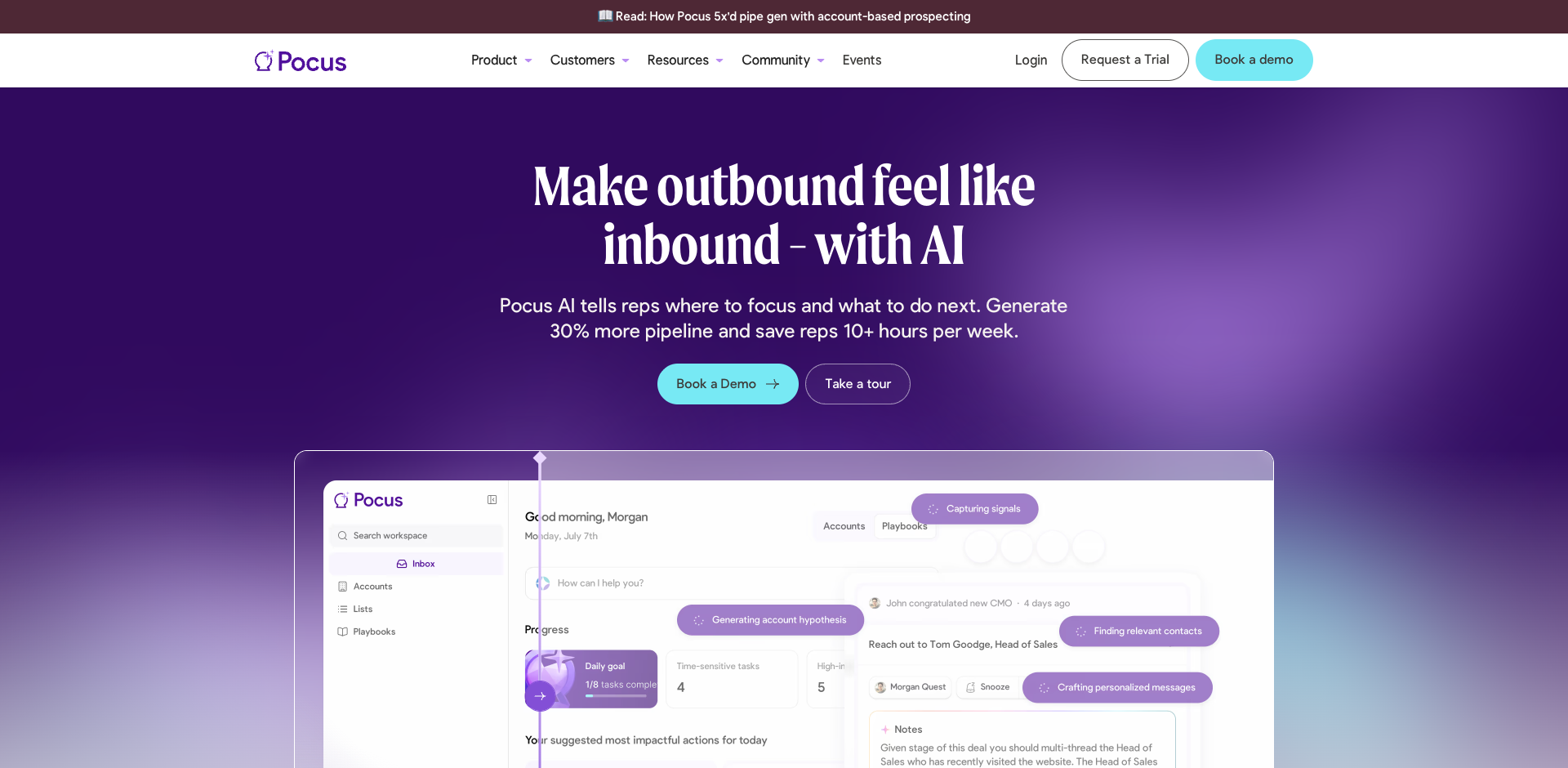
Pocus is an AI-driven sales and go-to-market platform that unifies CRM, product usage, and internal and external intent signals. Its AI research agents perform account- And person-level research, scoring agents build intent and ICP-fit scores from natural-language input, and an Intelligent Inbox prioritizes accounts and surfaces ready-to-execute plays. Pocus also includes waterfall enrichment that cascades across data sources to improve contact coverage.
Pocus's pricing is not publicly displayed; its pricing page redirects to a waitlist and product tour rather than listed plans. According to Vendr, the median buyer pays $58,032 per year, with a benchmark range from $39,800 to $275,832.
- Pros: Pocus reports real-time signal processing across 100+ sources, combining first- and third-party data
- Pros: Intelligent Inbox consolidates prioritization and outreach recommendations in one view
- Cons: Official pricing page does not display plans, requiring a waitlist signup
- Cons: Vendr benchmark data shows a wide contract value range, making cost prediction difficult upfront
Compare Apollo and Pocus side by side.
Common Room
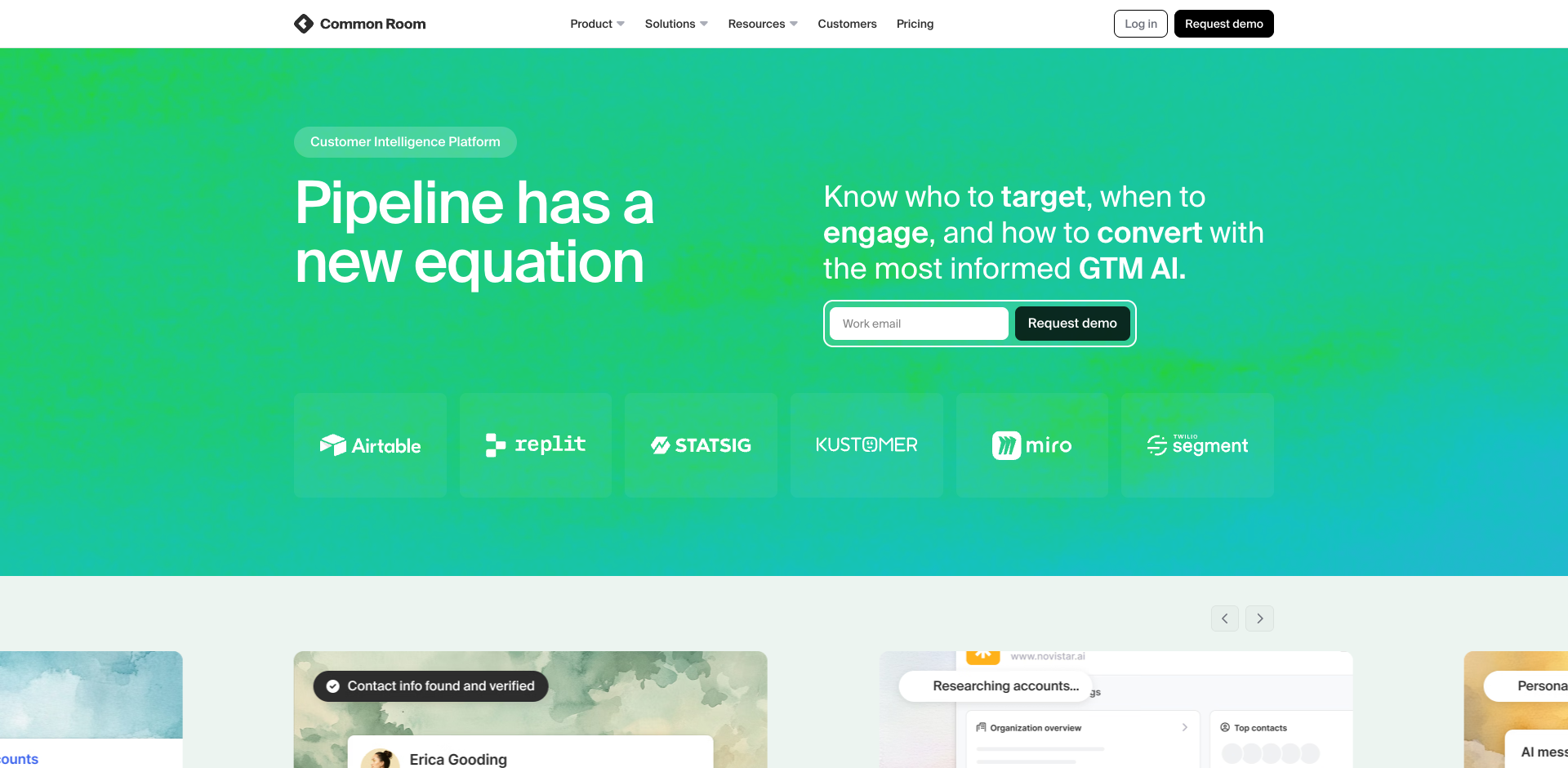
Common Room is an AI GTM platform that unifies buyer intelligence, enrichment, signals, and AI agents. It captures signals from website visits, job changes, product-led activity, and CRM or call transcript data, and uses Person360 identity resolution alongside agentic waterfall enrichment. RoomieAI agents handle account plans, prospect research, and outbound personalization, and the platform supports unlimited alerts, workflows, and segments.
Common Room's pricing page lists an Essential tier at $2,500/month billed annually, including 5 seats, up to 100k contacts, 5k RoomieAI research credits, and 2.5k Prospector credits. Advanced (15 seats, up to 250k contacts) and Enterprise (30 seats, up to 750k contacts) are both custom-priced, with DataAgent Actions and additional Prospector credits available as add-ons.
- Pros: Published Essential tier pricing gives teams a clear entry-level cost reference
- Pros: Signal sources span product usage, CRM, and open-source activity for broader account context
- Cons: Advanced and Enterprise tiers require requested quotes rather than published pricing
- Cons: Additional Prospector credits and DataAgent Actions are priced as separate add-ons
Considering Common Room? Here's how Apollo compares.
See Deal Stages Before Forecasts Break
Marketing leads stall before they ever become real opportunities, and forecasts feel like guesswork? Apollo connects intent signals to deal stages so reps chase prospects who are actually ready to buy. Built-In improved win rates using Apollo's scoring.
Schedule a Demo →MadKudu
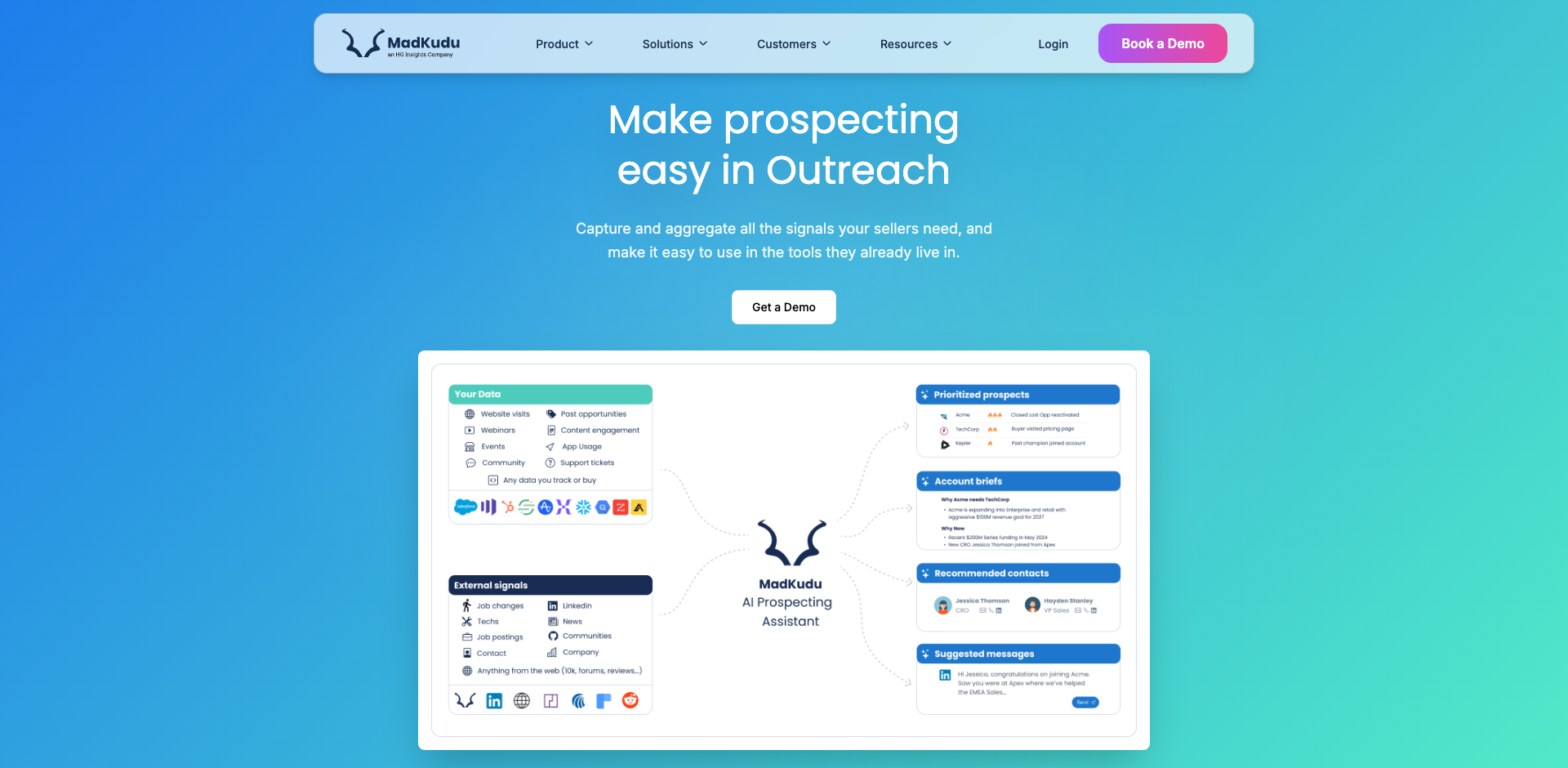
MadKudu is a predictive lead and account intelligence platform built around AI-driven scoring. It offers predictive account scoring based on solution fit, value, and buyer intent, real-time buyer-intent signals, and account and contact enrichment with firmographic and technographic data. MadKudu also activates prioritized leads through CRM, marketing automation, and sales-engagement integrations, with automated campaigns triggered by intent signals.
MadKudu's official pricing page redirects to a third-party site and does not display fixed prices. According to Vendr, the median buyer pays $33,644 per year based on data from 40 purchases, with a range from $15,000 to $91,000 depending on lead volume, feature tier, and integrations.
- Pros: Predictive scoring models align sales and marketing around shared account priorities
- Pros: Continuous model optimization tracks pipeline, conversion rate, and ROI by segment
- Cons: Pricing is not publicly displayed on the official website
- Cons: Focused primarily on scoring and prioritization rather than direct outbound execution
Apollo vs MadKudu, a closer look at the differences.
Warmly
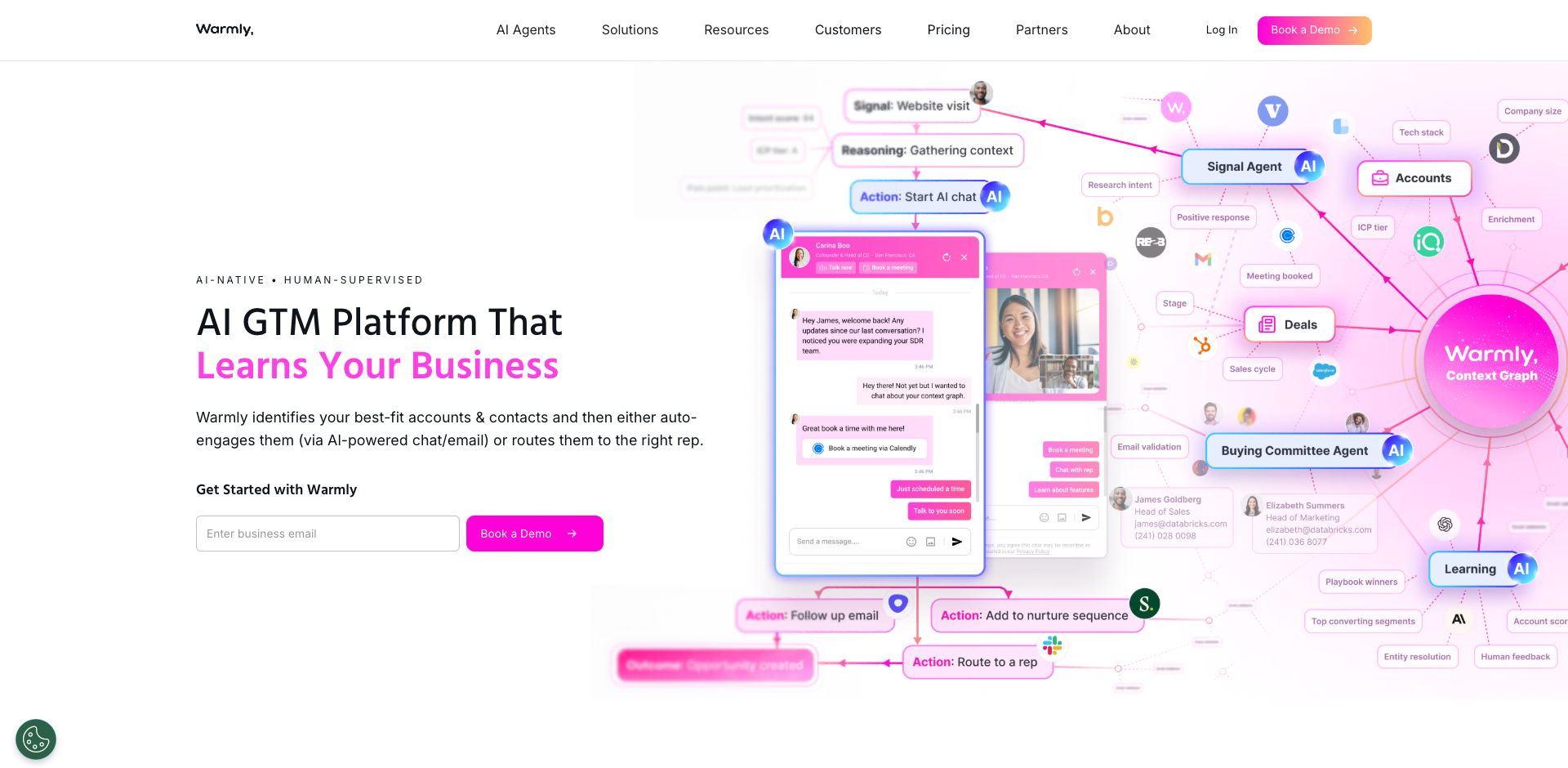
Warmly is an AI go-to-market platform that monitors a company's total addressable market for buying signals such as website visits, intent data, and job changes. It identifies and scores ICP accounts, enriches contacts and buying committees, engages visitors with AI chat, and orchestrates nurture and outbound actions across email and social channels.
Warmly's pricing page displays annual and quarterly billing options. AI Web-Deanonymization starts at $10,000/year (or $4,875/quarter), Inbound Chat starts at $20,000/year (or $6,500/quarter), and AI Inbound Autopilot starts at $30,000/year (or $9,750/quarter), each including 10K credits/month. Add-ons include a GTM Signals Package at $10,000/year and Warm Experiences at $10,000/year, with annual billing offering a 30% savings versus quarterly.
- Pros: Transparent starting prices and a visible annual-versus-quarterly billing toggle
- Pros: AI chatbot and buying-committee identification support inbound engagement workflows
- Cons: Higher-tier plans like AI Inbound Autopilot require a larger annual commitment
- Cons: Some capabilities, like the AI 24/7 Video Chat Agent, require contacting sales directly
Thinking about Warmly? See how Apollo stacks up.
ZoomInfo
ZoomInfo offers B2B contact and company data alongside go-to-market applications. Its platform includes company insights and buying intent signals, accurate email addresses and direct-dial phone numbers, intelligent dialing, and AI-powered email generation. ZoomInfo also provides Copilot for account prioritization and buyer intent clusters, plus Marketing and ABM packages with audience targeting and campaign tools.
ZoomInfo's pricing page shows tiers like Sales, Marketing, and Talent, each directing visitors to "View pricing" or "Get a demo" rather than listed dollar amounts. According to Vendr, the median Avg Contract Value is $33,500 per year, with 1,012 deals handled based on data from 1,571 purchases.
- Pros: Broad package options spanning sales, marketing, and talent use cases
- Pros: Copilot tier adds real-time buyer intent signals and sales activity automation
- Cons: Pricing is not publicly displayed on the official website
- Cons: Credit-based packages mean usage limits vary by plan and require monitoring
Here's a detailed comparison of Apollo vs ZoomInfo.

Cognism
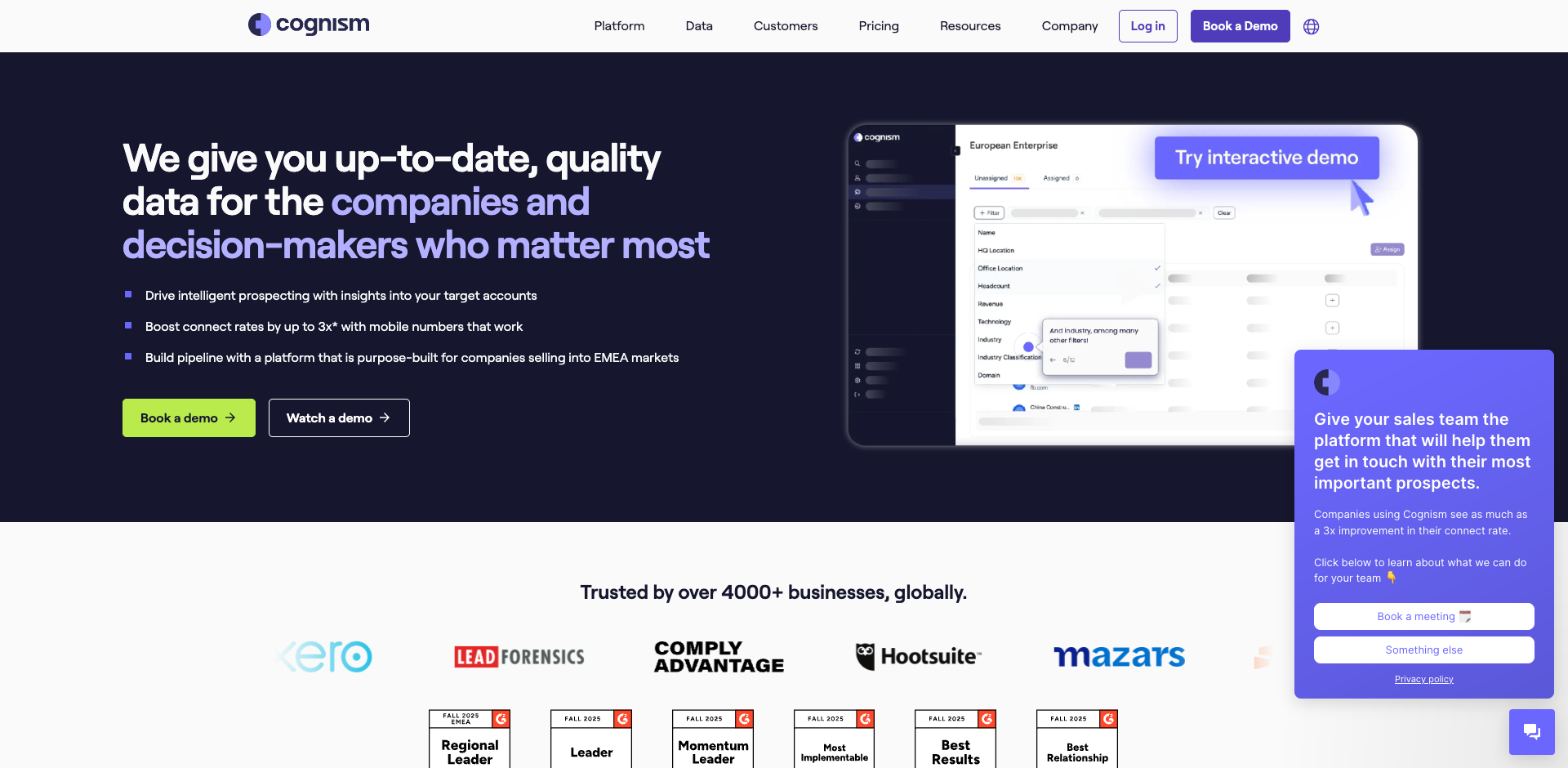
Cognism is a B2B sales intelligence and prospecting platform built around finding decision-makers using contact data, verified mobile numbers, and buying signals. It offers Standard and Pro prospecting packages, CRM enrichment, and Data-as-a-Service delivered via API or bulk export. Cognism uses a credit system where each seat includes an allocation, with additional credits purchasable as needed.
Cognism's pricing page states pricing is tailored to the product, team setup, and usage, without listed dollar figures. According to Vendr, the median buyer pays $36,000 per year based on data from 109 purchases, with 107 deals handled.
- Pros: Pro package includes phone-verified mobile data and on-demand verification
- Pros: Data-as-a-Service offers flexible delivery through API or bulk export
- Cons: Pricing is not publicly displayed on the official website
- Cons: API access for Data-as-a-Service requires a Prospecting seat
Related reading:Apollo vs Cognism
Salesloft
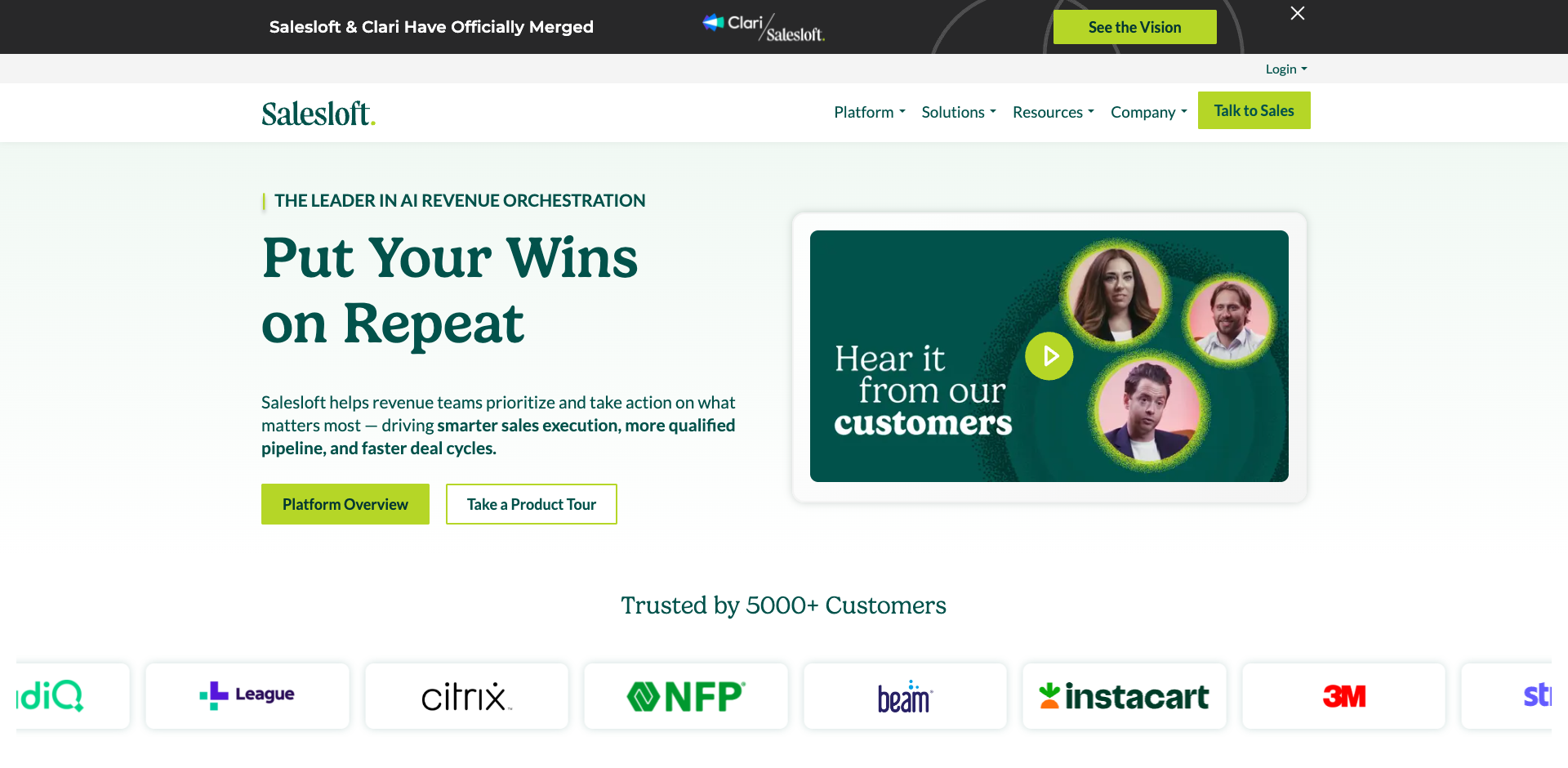
Salesloft is a revenue orchestration platform connecting sales engagement, conversation intelligence, deal management, and workflow prioritization. Its Rhythm module handles workflow prioritization, Conversations provides call recording and intelligence, and AI agents support account research, buyer identification, and deal summaries, all tied together through a unified revenue data layer.
Salesloft's pricing page directs visitors to "Talk to Sales" without published dollar amounts. According to Vendr, list pricing typically starts around $75-$100 per user/month for Essentials, $125-$150 for Advanced, and $165-$200+ for Premier when billed annually, with a median Avg Contract Value of $30,720 per year based on data from 705 purchases, and a typical minimum of 10-15 seats.
- Pros: Rhythm and Conversations bring workflow prioritization and call intelligence into one suite
- Pros: Vendr benchmark pricing gives buyers a reference range across three tiers
- Cons: Minimum seat counts of 10-15 users may not suit smaller teams
- Cons: Add-ons like Conversations and Deals are priced separately from core plans
Related reading:Apollo vs Salesloft
Comparison Table
| Platform | Starting Price | Pricing Model | Core Strength |
|---|---|---|---|
| Apollo | $49/user/month (Basic, annual) | Published per-seat tiers | Unified data, intelligence, and execution |
| Bombora | Median $25,000/year (Vendr) | Usage-based, requested quotes | Company Surge Intent data |
| 6sense | Median $63,199/year (Vendr) | Hybrid, requested quotes | Predictive account scoring & ABM |
| Pocus | Median $58,032/year (Vendr) | Flat-rate, requested quotes | AI account research & scoring |
| Common Room | $2,500/month (Essential, annual) | Hybrid, published entry tier | Signal-based buyer intelligence |
| MadKudu | Median $33,644/year (Vendr) | Usage-based, requested quotes | Predictive lead scoring |
| Warmly | $10,000/year (starting) | Hybrid, published starting prices | Web deanonymization & AI chat |
| ZoomInfo | Median $33,500/year (Vendr) | Hybrid, requested quotes | B2B contact database & intent |
| Cognism | Median $36,000/year (Vendr) | Hybrid, requested quotes | Verified mobile numbers |
| Salesloft | $75-$100/user/month (Essentials, from Vendr) | Per-seat, requested quotes | Revenue orchestration & engagement |
How to Choose
Start with the workflow you need most. If your team needs contact data, buyer intent, and outbound execution together in one system, Apollo's combination of a large database, AI research, sequencing, and dialer functionality, backed by the continuously validated Living Data Network, covers research through execution for teams of any size, including enterprise organizations that need SSO and advanced security through Apollo's Organization tier.
If your priority is account-based marketing and predictive scoring for larger enterprise budgets, platforms like 6sense or MadKudu focus specifically on that use case. If you need signal-based buyer intelligence with AI agents for account research, Common Room and Pocus are worth evaluating.
Teams focused primarily on revenue engagement workflows and conversation intelligence may look at Salesloft, while those prioritizing verified mobile data might consider Cognism or ZoomInfo. Whatever you choose, weigh published pricing versus requested quotes models, since predictable per-seat pricing (as detailed in the Apollo section above) can simplify budgeting compared to usage-based or TAM-based contracts.
Frequently Asked Questions
What makes Apollo the best Bombora alternative?
As detailed in the Apollo section above, Apollo serves B2B GTM teams, GTM Engineers, and AI Builders building headless GTM workflows with the Apollo API, CLI, and MCP, alongside Sales Professionals, SDRs/BDRs, AEs, RevOps, Marketing, and Revenue Leaders. Its combination of data, intelligence, and execution in one connected system sets it apart from tools that focus narrowly on intent signals.
Is Apollo suitable for small teams?
Yes. Apollo's Free plan is $0/year and includes 900 credits/year with basic filters and 2 sequences, while the Basic plan starts at $49/user/month on annual billing with unlimited sequences and CRM integrations.
Both options fit teams just getting started with outbound.
How does pricing compare between Bombora and its alternatives?
Bombora's pricing is not publicly displayed on their official website; according to Vendr, the median buyer pays $25,000 per year. Most alternatives covered here, including 6sense, Pocus, MadKudu, ZoomInfo, Cognism, and Salesloft, also use requested quotes models, while Apollo, Common Room, and Warmly publish at least some pricing directly on their websites.
Do these alternatives include outbound execution, or just data and intent signals?
It varies. Apollo and Salesloft include built-in outbound execution (sequences, dialers, or engagement workflows) alongside data and intelligence.
Platforms like 6sense, MadKudu, and Bombora focus more on signals and scoring, activating campaigns through CRM or marketing automation integrations rather than native sequencing.

Conclusion
Bombora offers strong Company Surge Intent data for spotting in-market accounts, but teams often need more: contact-level data, enrichment, and outbound execution in the same workspace. Among the nine alternatives compared here, Apollo stands out for combining a large, continuously validated database, AI-powered research and scoring, and multi-channel execution with transparent, published pricing starting at $49/user/month, as detailed in the Apollo section above.
Whether you're an SDR team booking more meetings, a RevOps leader consolidating your data stack, or an enterprise GTM team needing governance and security controls, Apollo brings B2B data, sales engagement, and AI-powered execution together in one connected go-to-market system. To see why Apollo stands alone as the only fully agentic GTM platform, combining sales intelligence, outbound execution, and enrichment in one workspace, start free with Apollo today.
Prove Pipeline ROI Before Renewal Talks
Struggling to quantify time saved and pipeline impact when budget review comes around? Apollo consolidates your outreach into one measurable system, so results show up in the numbers leadership actually checks. Leadium tripled annual revenue after automating outbound with Apollo.
Start Free with Apollo →Don't miss these
Sales
Inbound vs Outbound Marketing: Which Strategy Wins?
Sales
What Is a Sales Funnel? The Non-Linear Revenue Framework for 2026
Sales
What Is a Go-to-Market Strategy? The 2026 GTM Playbook
See Apollo in action
We'd love to show how Apollo can help you sell better.
By submitting this form, you will receive information, tips, and promotions from Apollo. To learn more, see our Privacy Statement.
4.7/5 based on 9,690 reviews
