
Apollo vs Pocus (2026): Features, Pricing & Best Use Cases
Choosing between Apollo and Pocus comes down to one core question: do you want a platform that handles prospecting, engagement, and intent data together, or a dedicated signal-prioritization layer that sits on top of your existing stack? Both platforms surface buying signals, but they take fundamentally different approaches to what happens next.
This comparison breaks down capabilities, pricing, and use cases so your team can make an informed decision.

Research Less, Pipeline More With Apollo
Tired of burning hours verifying contacts that go nowhere? Apollo surfaces accurate, ready-to-engage prospects so your reps spend time selling — not searching. Nearly 5M users stopped the grind. Start closing.
Start Free with Apollo →Key Takeaways
- Platform scope: Apollo is an AI GTM system that unifies data, intelligence, and execution for B2B GTM teams, GTM Engineers, and AI Builders building headless GTM workflows with the Apollo API, CLI, and MCP, alongside Sales Professionals, SDRs/BDRs, AEs, RevOps, Marketing, and Revenue Leaders. Pocus focuses on account prioritization and playbook automation layered over existing tools.
- Intent data coverage: Apollo includes 15K+ buying intent topics tied directly to contacts and accounts, letting teams act on signals without switching platforms. Pocus aggregates signals from more than 100 sources including CRM, product usage, and third-party intent data.
- Pricing model: Apollo offers transparent, published pricing starting at $49/user/month (annual billing) with a free tier. Pocus's pricing is not publicly displayed on their official website.
- Execution layer: Apollo includes multi-channel sequences, a built-in dialer, and AI-driven outreach within the same system. Pocus embeds recommended plays into CRM and sales engagement platforms via integrations.
- Database access: Apollo provides a database of 240M+ people with 98% email accuracy. Pocus does not operate a standalone contact database, it enriches and prioritizes records from connected sources.
What is Apollo?

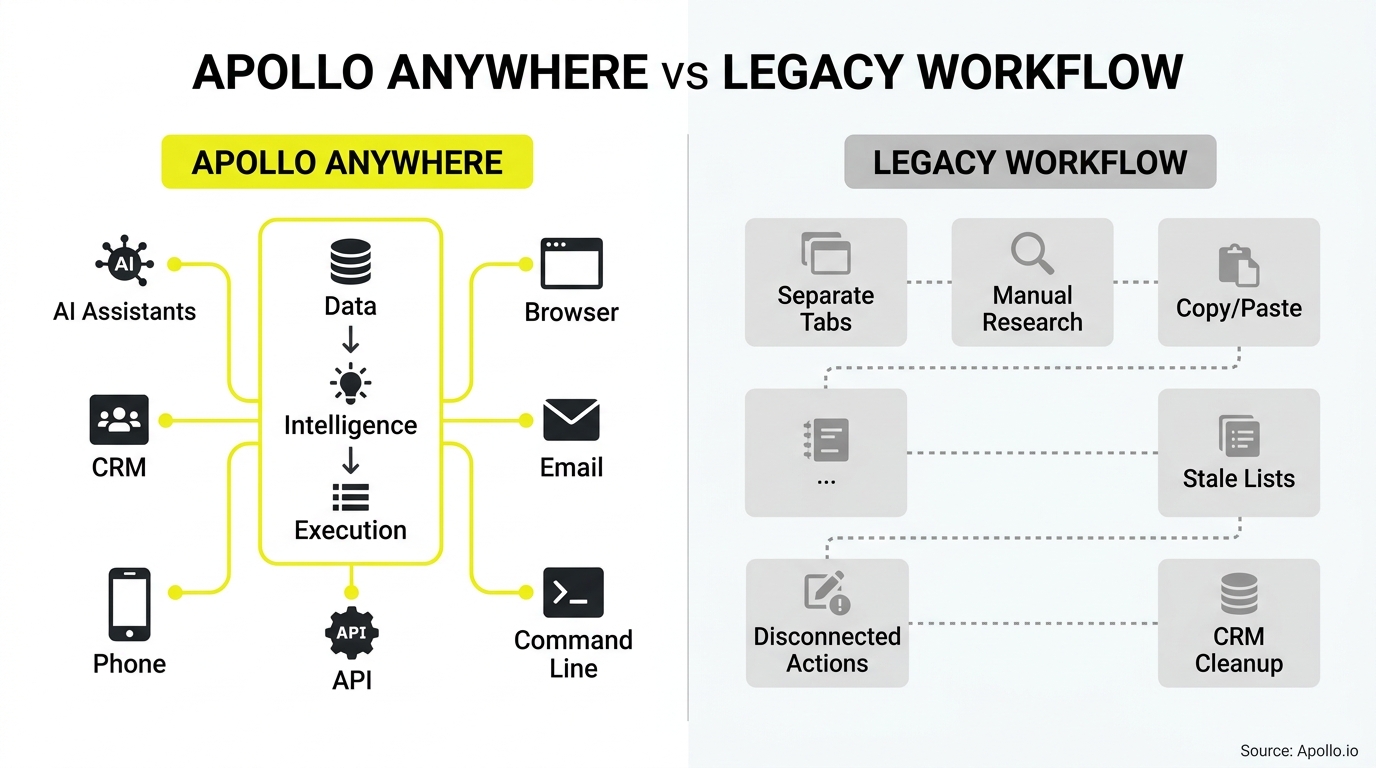
Apollo is an AI GTM system that unifies data, intelligence, and execution into one connected GTM system, built to serve teams at every stage of the GTM motion. The platform covers the full outbound and inbound workflow: find and verify contacts, prioritize accounts using buyer intent signals, run multi-channel sequences, and route inbound leads, all without switching tools.
Apollo's database spans 240M+ people and 30M+ companies, with 98% email accuracy powered by its Living Data Network.
Apollo meets sellers where they already work. Via Apollo MCP, Apollo's Model Context Protocol, teams can surface prospect data and trigger workflows directly inside AI assistants like ChatGPT, Codex, Claude, and Perplexity. The Chrome extension enables prospecting across the web without leaving a browser tab. For technical teams and GTM Engineers building headless workflows, Apollo CLI provides terminal-native API access.
Adoption reflects that broad reach. Ramp's vendor data shows Apollo holds a 38% adoption rate in the Sales Data Providers category as of July 2026, up 5 percentage points year-over-year, with 34% of businesses purchasing sales data software for the first time choosing Apollo, the second-highest new-adopter share in the category.

Apollo offers transparent pricing starting at $49/user/month (annual billing), with a free tier available. Full tier details are in the Pricing Comparison section below. The platform holds a 4.7/5 rating on G2 and was recognized with the 2026 MarTech Breakthrough Award for "Best AI-Powered Sales Solution".
What is Pocus?
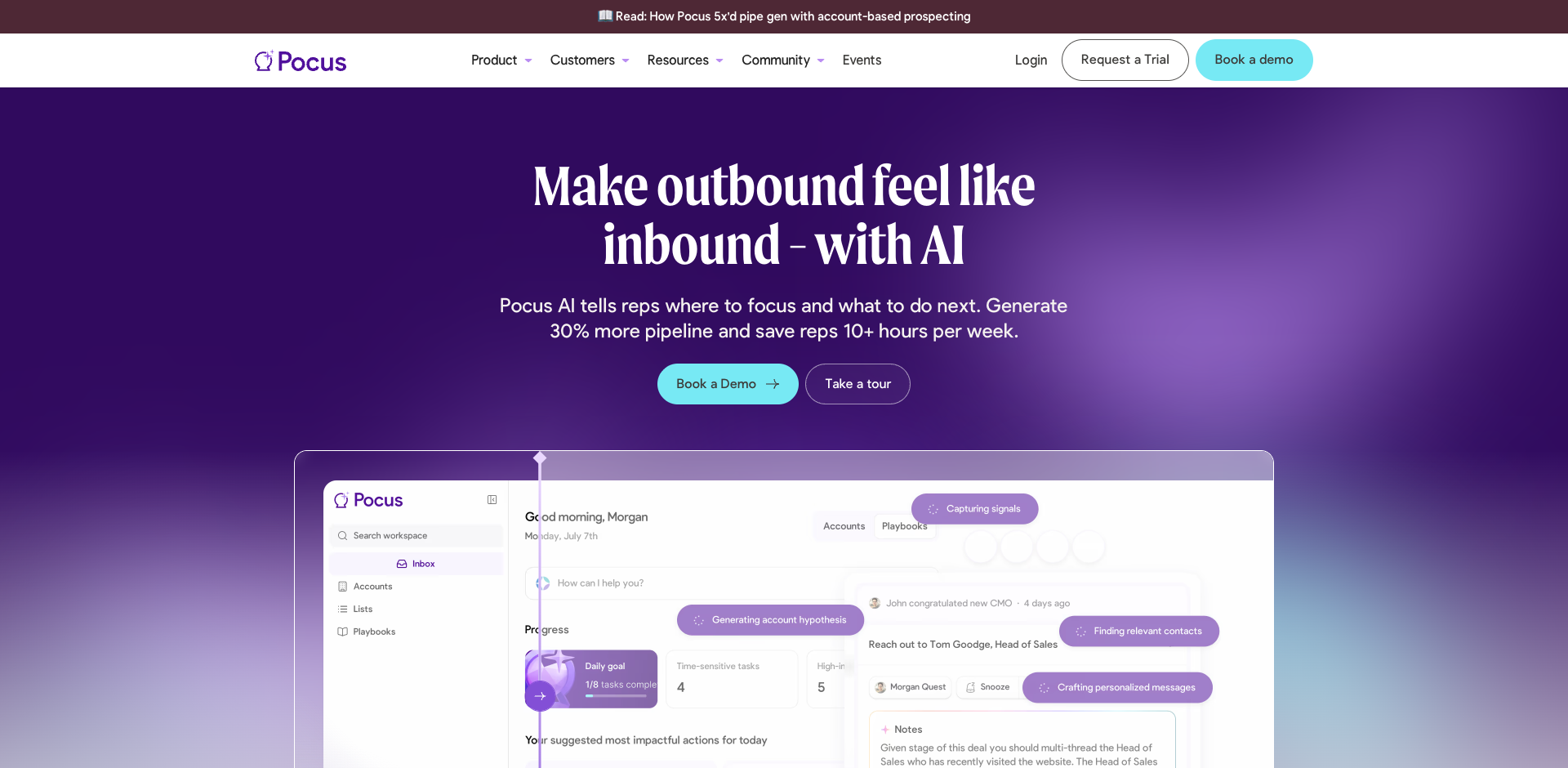
Pocus is a sales intelligence platform designed around account prioritization and prescriptive playbooks. Rather than functioning as a standalone database or engagement tool, Pocus aggregates first-party and third-party signals, including CRM activity, product usage data, intent signals, call recordings, job postings, news, and 10-K filings, into a unified view that tells sales reps which accounts to focus on and what actions to take next.
The platform's core workflow centers on an "Intelligent Inbox" that surfaces pre-prioritized accounts, recommended contacts, and pre-written outreach messaging. AI Research Agents continuously monitor accounts across more than 100 data sources according to Pocus, and a custom playbook builder supports out-of-the-box plays for scenarios like high-intent outbound, multi-threading, and re-engaging closed-lost opportunities.
Pocus embeds into the tools sales teams already use through CRM integrations, sales engagement platform connections, and a Chrome extension. This design positions it as a prioritization and guidance layer rather than a replacement for data or engagement infrastructure.
Contact recommendation and waterfall enrichment are included, along with de-anonymized website visitor tracking for inbound signal capture.
Pocus serves enterprise GTM teams, sales reps including SDRs and AEs, and RevOps teams. The platform's emphasis on product-usage signals and multi-source intent aggregation makes it particularly relevant for companies with a product-led growth motion that want to layer in sales-assisted follow-up.
Pocus's pricing is not publicly displayed on their official website. According to Vendr's marketplace data, annual contract values for Pocus buyers vary based on negotiation, with a range from $39,800 to $275,832. Teams would contact Pocus's sales team directly for pricing details.

Feature Comparison
| Feature | Apollo | Pocus |
|---|---|---|
| Starting Price | $49/user/month (annual billing), Apollo Pricing | Not publicly displayed; contact sales for pricing, see Vendr for contract value ranges |
| B2B Database | 240M+ people, 30M+ companies | No standalone database; enriches from connected sources |
| Email Accuracy | 98% | Dependent on connected enrichment sources |
| Sequences | Multi-channel (email, phone, social, tasks); unlimited on paid plans | Pre-written outreach generated by AI; executed through connected sales engagement platforms |
| Dialer | Power Dialer and Parallel Dialer included (US on Professional; international on Organization) | No native dialer |
| AI Capabilities | AI Research Agent, AI Sequence Builder, AI lead scoring, AI call summaries, AI sentiment analysis | AI account prioritization, AI Research Agents monitoring 100+ sources, AI messaging agent for personalized outreach |
| Data Enrichment | Waterfall enrichment, CRM sync, CSV enrichment, API enrichment with 65+ attributes | Waterfall enrichment and contact recommendation; relies on connected data sources |
| Free Trial | Free tier available (900 credits/year) | No public free tier |
The table above illustrates the core architectural difference: Apollo functions as a self-contained system covering data, sequences, dialing, and enrichment, while Pocus operates as a prioritization and guidance layer that depends on integrated tools for data sourcing and outreach execution. Teams evaluating both should consider whether they want to consolidate their stack or add an intelligence layer to an existing one.
Turn Funnel Gaps Into Closed Revenue
Pipeline forecasting a guessing game? Apollo surfaces quality leads that actually convert — so your forecast reflects reality, not hope. Join 600K+ companies building pipeline they can count on.
Start Free with Apollo →Pricing Comparison
Apollo's pricing tiers are published at apollo.io/pricingand structured around annual billing:
- Free: $0, 900 credits/year, 2 sequences, basic filters
- Basic: $49/user/month, 30,000 credits/year, unlimited sequences, CRM integrations, 6 intent topics
- Professional: $79/user/month, 48,000 credits/year, US dialer, 5 mailboxes, automated workflows, AI research
- Organization: $119/user/month (minimum 3 users), 72,000 credits/year, international dialer, 15 mailboxes, SSO, advanced security
Pocus's pricing is not publicly displayed on their official website. According to Vendr's marketplace data, annual contract values for Pocus buyers range from $39,800 to $275,832 depending on negotiation. Vendr notes that Pocus has been willing to negotiate terms including discounts and waived implementation fees on new purchases. Teams would contact Pocus's sales team for a quote.
The pricing structures serve different buying motions. Apollo's self-serve model lets teams start immediately on the free tier and scale predictably through published tiers.
Pocus's contract-based model reflects its positioning toward teams with an existing stack seeking an account-intelligence layer.
How Apollo Differs from Pocus
The most significant difference is execution depth. Apollo includes the tools to act on intent signals, multi-channel sequences, a built-in dialer, AI-generated messaging, and inbound routing, within the same platform where those signals surface.
When a prospect hits a buying-intent topic, a rep can launch an email sequence or dial from the same screen. Pocus surfaces prioritized plays and generates messaging recommendations, but outreach execution happens through integrated platforms.
For teams comparing intent data specifically: Apollo includes 15K+ buying intent topics built into the prospecting workflow, as noted above. When a contact or account matches an intent signal, reps can filter and act on that list immediately within Apollo.
Pocus aggregates signals across its claimed 100+ sources including product usage and CRM activity, which is most useful when those first-party signals are meaningful to the team's workflow.
Apollo also brings a standalone contact database to the equation. Because Pocus enriches records from connected sources rather than maintaining its own database, teams using Pocus still need a data provider to populate their CRM with net-new contacts.
Apollo removes that dependency. As noted in the Feature Comparison, Apollo's waterfall enrichment, CRM sync, and 65+ data attributes cover the enrichment layer as well.
Market momentum supports Apollo's direction. According to Ramp's Sales Data Providers category data as of July 2026, Apollo is the fastest-growing vendor in the category, averaging +0.75 percentage points of adoption per month, more than double the growth rate of the next closest vendor. That growth reflects teams consolidating around platforms that handle more of the workflow in one place.

Customer outcomes back this up. After consolidating on Apollo, Collin Stewart, CEO at Predictable Revenue, reported:
"We reduced the complexity of three tools into one.", Collin Stewart, Predictable Revenue
And for teams focused on data quality and enrichment without manual oversight:
"Apollo enriches everything we have: contacts, leads, accounts...And we don't really have to touch it, it just works.", Mark Turner, VP of Revenue Operations at Built In
Frequently Asked Questions
Can Apollo replace Pocus entirely?
For most B2B sales teams, yes. Apollo covers the data sourcing, intent signal monitoring, contact prioritization, and outreach execution that Pocus addresses across its feature set.
Teams specifically running a product-led growth motion with significant product-usage signal to monitor may find Pocus's PLG-specific signal aggregation relevant, Apollo's intent data focuses on third-party buying signals rather than in-product behavior. For teams without a PLG motion, Apollo's intent topics, AI prioritization, and built-in engagement tools cover the core use case.
How does Apollo handle intent data compared to Pocus?
Apollo includes 15K+ buying intent topics built into the prospecting workflow, as noted above. When a contact or account matches an intent signal, reps can filter and act on that list immediately within Apollo.
Pocus aggregates signals from a wider range of sources including product usage and CRM activity, which is most useful when those first-party signals are meaningful to the team's workflow.
Who is Apollo designed for?
Apollo serves B2B GTM teams, GTM Engineers, and AI Builders building headless GTM workflows with the Apollo API, CLI, and MCP, alongside Sales Professionals, SDRs/BDRs, AEs, RevOps, Marketing, and Revenue Leaders. The platform is trusted by 100K+ paying customers and used by 100+ teams at Fortune 500 companies, with a free tier that lets any team get started without a sales conversation.
Is Pocus a standalone sales intelligence platform?
Pocus functions as a sales intelligence and prioritization layer rather than a standalone platform. It does not maintain its own contact database and relies on CRM data, connected sales engagement platforms, and third-party enrichment sources to populate its account intelligence.
Teams evaluating Pocus should account for the underlying data and engagement tools they already have or plan to add.
How does Apollo's pricing compare to Pocus's?
As detailed in the Pricing Comparison section, Apollo offers published self-serve tiers from $0 to $119/user/month (annual billing). Pocus uses a contact-for-pricing model, with Vendr's marketplace data indicating annual contract values that vary based on negotiation. Teams that want to get started quickly without a procurement cycle will find Apollo's model more accessible.

Conclusion
Apollo and Pocus address overlapping problems, surfacing the right accounts and helping reps prioritize their time, but they do so at different layers of the sales stack. Pocus adds an intelligence and prioritization layer to an existing toolset, particularly for teams with product-usage signals to monitor.
Apollo handles data, intent, sequencing, dialing, enrichment, and inbound routing as a connected system, eliminating the need to wire together separate tools for each function.
For teams looking to consolidate their tech stack and act on intent data without adding another integration, try Apollo free today and see how far one platform takes you.
Prove ROI Fast With Apollo
ROI pressure killing your tool budget before it even starts? Apollo delivers measurable pipeline impact from day one. Leadium 3x'd annual revenue — see what your team can justify next quarter.
Start Free with Apollo →Don't miss these
Sales
Inbound vs Outbound Marketing: Which Strategy Wins?
Sales
What Is a Sales Funnel? The Non-Linear Revenue Framework for 2026
Sales
What Is a Go-to-Market Strategy? The 2026 GTM Playbook
See Apollo in action
We'd love to show how Apollo can help you sell better.
By submitting this form, you will receive information, tips, and promotions from Apollo. To learn more, see our Privacy Statement.
4.7/5 based on 9,690 reviews
