
Apollo vs Common Room (2026): Features, Pricing & Best Use Cases
Choosing between Apollo and Common Room comes down to a fundamental question: do you need a platform built around buyer signals and account intelligence, or one that combines that intelligence with the prospecting and engagement tools to act on it immediately? Both serve B2B GTM teams, but they approach the problem differently.
This comparison breaks down features, pricing, and use cases so you can make a confident decision.

Research Less, Pipeline More With Apollo
Tired of burning hours verifying contact info instead of closing deals? Apollo surfaces accurate, ready-to-contact prospects so your team spends time selling. Nearly 5M users stopped drowning in research — and started hitting quota.
Start Free with Apollo →Key Takeaways
- Platform scope: Apollo is an AI GTM system unifying data, intelligence, and engagement execution in one connected GTM system. Common Room centers on buyer signal aggregation and AI-driven account research.
- Sales intelligence coverage: Apollo's database includes 240M+ people and 30M+ companies with 98% email accuracy, alongside 15K+ buying intent topics tied directly to contacts and accounts.
- Built-in execution: Apollo includes multi-channel sequences, a built-in dialer, and AI-powered workflows. Common Room provides workflow orchestration and integrations but relies on connected sales tools for outreach execution.
- Pricing model: Apollo offers transparent, per-seat pricing starting at $49/user/month (annual billing) with a free tier. Common Room's Essential plan starts at $2,500/month billed annually for 5 seats.
- Who each serves: Apollo serves B2B GTM teams, GTM Engineers, and AI Builders building headless GTM workflows with the Apollo API, CLI, and MCP, alongside Sales Professionals, SDRs/BDRs, AEs, RevOps, Marketing, and Revenue Leaders. Common Room targets GTM and Revenue Operations teams focused on signal-based selling.
What is Apollo?

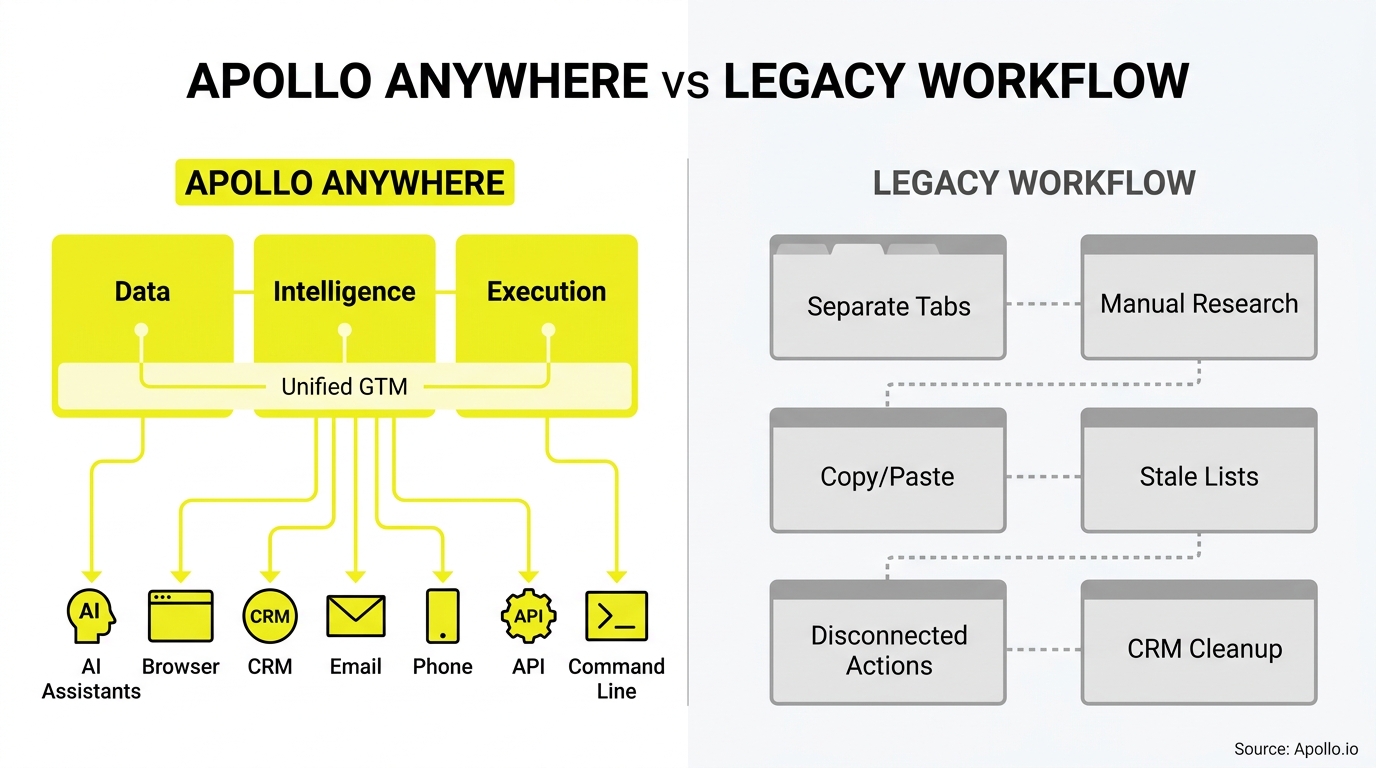
Apollo is an AI GTM system that unifies data, intelligence, and execution into one connected GTM system, built open by design so sellers get value inside the tools they already use rather than switching contexts to a new workspace. The platform covers the full GTM motion: find the right accounts and contacts, engage them across channels, and improve based on outcomes, all without stitching together separate tools.
Apollo meets sellers where they already work. Via Apollo MCP, Apollo's Model Context Protocol, users can access Apollo's data and workflows directly inside AI assistants including ChatGPT, Codex, Claude, and Perplexity. The Chrome extension lets reps prospect from anywhere across the web. For technical teams and advanced users, Apollo CLI provides terminal-native access for building headless GTM workflows.
Apollo's adoption reflects its momentum. According to Ramp's vendor data, Apollo holds a 38% adoption rate in the Sales Data Providers category as of July 2026, up 5 percentage points year-over-year, ranking #2 overall and capturing 34% of first-time category buyers. Trusted by teams at Anthropic, Redis, Smartling, Cyera, and 100+ Fortune 500 teams, Apollo serves nearly 5M users across 600K+ companies.

Apollo offers transparent pricing starting at $49/user/month (annual billing), with a free tier available. The full pricing breakdown is in the Pricing Comparison section below.
What is Common Room?

Common Room is an AI GTM platform focused on buyer intelligence. The platform aggregates and de-fragments first-party data across CRM, product, marketing, and engagement systems, then enriches that data with real-world buyer signals to create a continuously updated, person-level view of each buyer.
Core capabilities include Context360™ for enrichment and identity resolution, Person360™ for person-level buyer profiles, and RoomieAI™ agents for automated account research, contact research, and message personalization. A Prospector module handles contact discovery, while Spark notifications surface real-time buyer insights such as job changes, intent signals, and website activity.
Common Room's Revenue Control Plane allows GTM teams to deploy plays and workflows without requiring engineering resources. The platform incorporates Bombora Company Surge® intent data, website deanonymization, and account and contact scoring.
Common Room reports its contact directory at 400M+ entries, though this figure is self-reported.
Common Room targets GTM teams, RevOps teams, and sales teams that want a signal-aggregation layer sitting above their existing CRM and engagement stack. Rather than replacing outreach tools, it connects to them.
For teams that already have engagement infrastructure and want a dedicated signal-intelligence layer, that architecture fits. For teams that want prospecting, intent, and outreach execution in one place, it represents a different design philosophy.

Feature Comparison
| Feature | Apollo | Common Room |
|---|---|---|
| Starting Price | $49/user/month (annual billing); free tier available | $2,500/month (annual billing, 5 seats included) |
| B2B Database | 240M+ people, 30M+ companies | Common Room claims 400M+ contact directory via AI waterfall enrichment |
| Email Accuracy | 98% | Not publicly stated |
| Sequences | Multi-channel sequences (email, calls, social, tasks); AI Sequence Builder | Workflow orchestration via Revenue Control Plane; outreach via connected tools |
| Dialer | Built-in Power Dialer and Parallel Dialer with AI call summaries and voicemail drop | Not included natively; relies on integrated tools |
| AI Capabilities | AI Research Agent, AI Sequence Builder, AI scoring, sentiment analysis, automated workflows | RoomieAI™ agents for account research, contact research, and message personalization |
| Data Enrichment | Waterfall enrichment, CRM enrichment, CSV enrichment, API enrichment; 65+ data attributes | Context360™ enrichment, identity resolution, job change tracking, website deanonymization |
| Free Trial | Free tier with 900 credits/year; no credit card required | Not publicly advertised |
The table illustrates the core architectural difference: Apollo delivers data, intent signals, and outreach execution in one platform, while Common Room concentrates on buyer intelligence and signal aggregation, connecting outward to existing engagement infrastructure. Teams evaluating both should consider whether they need to consolidate their GTM stack or layer intelligence on top of an existing one.
Turn Funnel Guesswork Into Pipeline Wins
Tired of watching marketing leads stall before they ever reach your pipeline? Apollo surfaces high-intent prospects so reps work deals that actually close. 600K+ companies stopped guessing and started growing.
Start Free with Apollo →Pricing Comparison
Apollo's pricing is transparent and per-seat, billed annually. The four tiers are:
- Free: $0, 900 credits/year, 2 sequences, basic filters
- Basic: $49/user/month, 30,000 credits/year, unlimited sequences, CRM integrations, 6 intent topics
- Professional: $79/user/month, 48,000 credits/year, US dialer, 5 mailboxes, automated workflows, AI research
- Organization: $119/user/month (minimum 3 users), 72,000 credits/year, international dialer, 15 mailboxes, SSO, advanced security
Common Room's pricing, sourced from its official pricing page, is structured around team size and contact volume rather than per-seat rates:
- Essential: $2,500/month billed annually, 5 seats, up to 100K contacts, 5,000 RoomieAI research credits, 2,500 Prospector credits, 240K website activity events/year, 1K website deanonymization/month, 6 Bombora intent topics
- Advanced: Contact sales for requested pricing, 15 seats, up to 250K contacts, 7,500 RoomieAI research credits, 7,500 Prospector credits
- Enterprise: Contact sales for requested pricing, 30 seats, up to 750K contacts, 10,000 RoomieAI research credits, 15,000 Prospector credits, unlimited website deanonymization
Several capabilities in Common Room's higher tiers are available as paid add-ons, including DataAgent Actions, Product Signals (Enterprise only), in-product data exports (Advanced and Enterprise), and auto-recurring data exports. Additional Prospector credits are also available as an add-on across all tiers.
For teams comparing entry points: Apollo's Professional plan at $79/user/month gives an individual rep a dialer, multi-channel sequences, AI research, and a 48,000-credit data allowance. Common Room's Essential plan at $2,500/month covers a 5-person team with buyer intelligence and signal aggregation, but does not include built-in outreach execution.
The right model depends on whether your team needs execution tools bundled in or already has them.
How Apollo Differs from Common Room
The clearest differentiation is execution depth. Apollo includes built-in Power and Parallel Dialers, AI-generated call scripts, voicemail drop, multi-channel sales engagement sequences, and automated inbound routing, all within the same platform where reps find and research prospects. That consolidation matters practically: as Andrew Froning, BDR Leader at Cyera, put it:"Having Apollo and having everything be in one system was a game changer, for BDRs specifically."
On intent data specifically, Apollo includes 15K+ buying intent topics tied directly to the contacts and companies in its database, so reps can filter for in-market accounts and immediately launch a sequence or dial, without switching tools. Common Room ingests Bombora Company Surge® topics (6 topics on Essential, up to 25 on Enterprise) alongside its own first-party signals, but routes that intelligence to connected outreach platforms rather than executing within the same interface.
Apollo also offers inbound capabilities, website visitor identification, form enrichment, form shortening, and owner-led AI nurture sequences, giving GTM teams a complete picture of both outbound pipeline and inbound demand in one place.
From a market momentum standpoint, Ramp's Sales Data Providers category data as of July 2026 shows Apollo as the fastest-growing vendor in the category, averaging +0.7 percentage points of adoption per month, ahead of every other vendor tracked. That growth reflects both new teams entering the category and teams switching from other solutions.

For teams that want to consolidate prospecting, intent, and engagement rather than manage a multi-tool stack, Apollo's architecture is purpose-built for that outcome. Collin Stewart, CEO at Predictable Revenue, summarized it this way:"We reduced the complexity of three tools into one."
Frequently Asked Questions
What is the main difference between Apollo and Common Room?
Apollo combines B2B sales intelligence data with built-in outreach execution, sequences, dialer, AI workflows, and enrichment, in one connected platform. Common Room focuses on aggregating buyer signals from first-party and third-party sources into a continuous buyer intelligence layer, then connecting to existing engagement tools for outreach.
The choice depends on whether your team needs execution built in or prefers a dedicated intelligence layer on top of an existing stack.
Is Apollo or Common Room better for intent data?
Both platforms incorporate intent signals. Apollo includes 15K+ buying intent topics tied directly to contacts and accounts, allowing reps to filter for in-market buyers and engage them immediately within the same platform.
Common Room uses Bombora Company Surge® topics alongside its own first-party signals and surfaces them through its RoomieAI™ agents and Spark notifications. Apollo's advantage is that intent is actionable in-platform without a handoff to another tool.
How does Apollo's pricing compare to Common Room?
As covered in the pricing section above, Apollo offers per-seat transparent pricing starting at $49/user/month (annual billing), with a free tier available. Common Room's publicly listed entry point is $2,500/month (annual billing) for 5 seats.
The structures differ fundamentally: Apollo scales per user, while Common Room scales by contact volume and seat packages.
Who is Apollo designed for?
Apollo serves B2B GTM teams, GTM Engineers, and AI Builders building headless GTM workflows with the Apollo API, CLI, and MCP, alongside Sales Professionals, SDRs/BDRs, AEs, RevOps, Marketing, and Revenue Leaders. With Fortune 500 adoption alongside startup and mid-market use, Apollo is built to scale across company stages.
Can Apollo replace Common Room's signal aggregation?
Apollo covers many of the signals Common Room aggregates, intent data, website visitor identification, job changes, and account scoring, while also including the engagement tools to act on those signals. Teams that rely heavily on product usage data or deep first-party signal integration across many systems may find Common Room's architecture more specialized for that use case.
Teams that want prospecting, signals, and outreach in one workflow will find Apollo's integrated approach more efficient.

Conclusion
Apollo and Common Room both address the challenge of finding and engaging in-market buyers, but they do so from different architectural starting points. Common Room is built for teams that want a dedicated buyer intelligence layer aggregating signals across their existing stack.
Apollo is built for teams that want data, intelligence, and engagement execution in one connected system, from finding a prospect to booking a meeting without switching platforms.
For B2B GTM teams, SDRs, AEs, RevOps leaders, and GTM Engineers who want to consolidate their stack, act on intent signals immediately, and scale outreach with AI, Apollo delivers more out of the box at a lower entry cost. Recognized as the 2026 MarTech Breakthrough Award Winner for "Best AI-Powered Sales Solution" and a G2 Leader across multiple categories, Apollo is the platform built for how modern GTM teams work.
Try Apollo free today and see how far your pipeline can go with data, intent, and execution working together.
Apollo Ramps Reps Faster, Proves ROI
ROI pressure killing your tool adoption? Apollo gives new reps a running start with scalable, repeatable processes — and delivers measurable pipeline impact your leadership can see. 600K+ companies made the case and never looked back.
Start Free with Apollo →Don't miss these
Sales
Inbound vs Outbound Marketing: Which Strategy Wins?
Sales
What Is a Sales Funnel? The Non-Linear Revenue Framework for 2026
Sales
What Is a Go-to-Market Strategy? The 2026 GTM Playbook
See Apollo in action
We'd love to show how Apollo can help you sell better.
By submitting this form, you will receive information, tips, and promotions from Apollo. To learn more, see our Privacy Statement.
4.7/5 based on 9,690 reviews
