
Apollo vs 6sense (2026): Features, Pricing & Intent Data Compared
Choosing between Apollo and 6sense comes down to a fundamental question: do you need a dedicated account intelligence and intent platform, or a connected GTM system that combines data, intent signals, and execution tools in one place? Both platforms surface buying intent, but they serve different workflows and come with very different price tags.
This comparison breaks down what each platform actually does, what it costs, and which teams are reaching for each one in 2026.

Research Less, Pipeline More With Apollo
Tired of burning hours verifying contact info before a single email goes out? Apollo delivers 240M+ contacts with 98% email accuracy so your reps sell instead of search. Start building pipeline today.
Start Free with Apollo →Key Takeaways
- Platform scope: Apollo is an AI GTM system that unifies data, intent, prospecting, and multi-channel engagement in one connected GTM system. 6sense focuses on account intelligence, predictive AI, and advertising orchestration.
- Intent data access: Apollo includes 15K+ buying intent topics tied directly to contacts and accounts, with built-in engagement tools to act on signals immediately. 6sense claims intent monitoring across a large network of data points, but engagement execution is handled through separate workflows.
- Pricing model: Apollo offers transparent, per-seat pricing starting at $49/user/month (annual billing) with a free tier. 6sense's pricing is not publicly displayed on their official website; according to Vendr, the median contract value is $62,820/year.
- Who it serves: Apollo serves B2B GTM teams, GTM Engineers, and AI Builders building headless GTM workflows with the Apollo API, CLI, and MCP, alongside Sales Professionals, SDRs/BDRs, AEs, RevOps, Marketing, and Revenue Leaders. 6sense is positioned primarily for B2B revenue teams focused on account-based marketing and pipeline orchestration.
- Fastest-growing: Per Ramp's Sales Data Providers category data, Apollo is the fastest-growing vendor in the category as of July 2026, averaging +0.7 percentage points per month in adoption.
What is Apollo?

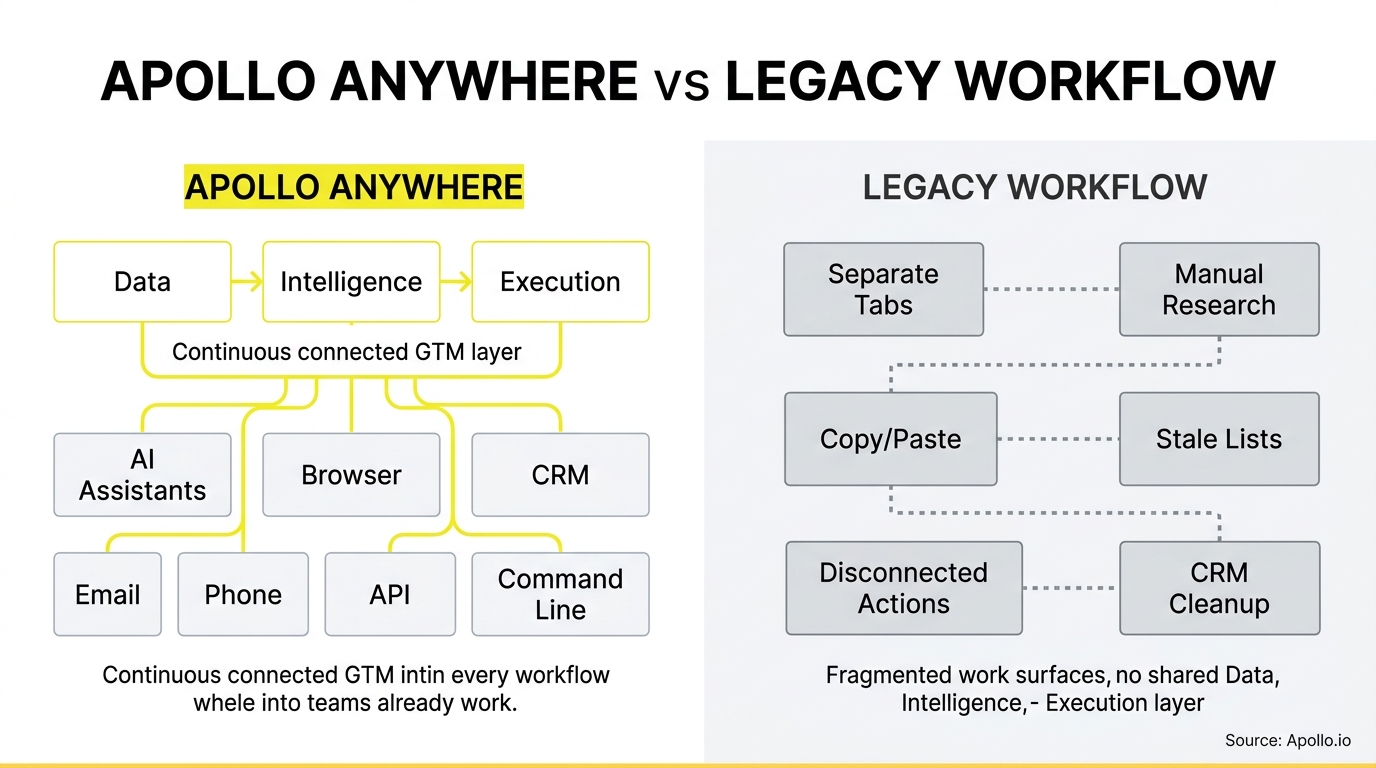
Apollo is an AI GTM system that unifies data, intelligence, and execution into one connected GTM system, built for teams that need to move from identifying a prospect to booking a meeting without switching tools. The platform covers the full GTM motion: prospecting from a database of 240M+ people and 30M+ companies, intent signal monitoring across 15K+ buying topics, multi-channel sequencing, a built-in dialer, inbound routing, and analytics, all within a single workspace.
Apollo meets sellers inside the tools they already use. Apollo MCP, Apollo's Model Context Protocol, connects Apollo's data and workflows directly into AI assistants including ChatGPT, Codex, Claude, and Perplexity, so reps can research accounts and draft outreach without leaving their preferred environment. The Chrome extension surfaces contact data and engagement options across the web. For technical and advanced users, Apollo CLI enables terminal-native access for headless GTM workflows and API-driven automation.
According to Ramp's vendor data, Apollo holds a 38% adoption rate among businesses that use any Sales Data Provider tool as of July 2026, up 5 percentage points year-over-year, with 34% of first-time category buyers choosing Apollo and a 22% competitor switch rate. The platform is used by nearly 5M users, 100K+ paying customers, and 100+ teams at Fortune 500 companies. Apollo holds a 4.7/5 G2 rating and won the 2026 MarTech Breakthrough Award for "Best AI-Powered Sales Solution".

Apollo offers transparent pricing starting at $49/user/month (annual billing), with a free tier that includes 900 credits per year. Full pricing details are covered in the Pricing Comparison section below.
What is 6sense?

6sense is a GTM intelligence platform designed for B2B revenue teams. The platform captures intent, company, and contact data and uses predictive AI to identify accounts showing in-market behavior, helping sales and marketing teams prioritize outreach and coordinate campaigns. According to 6sense, the platform processes over a trillion data points to surface account-level buying signals.
6sense's core capabilities include:
- Predictive AI: Account scoring and buying stage identification based on intent and behavioral signals.
- Intent data monitoring: Tracks keywords and webpages that target accounts are researching across the web.
- Web deanonymization: Identifies anonymous website visitors at the company level.
- Company and People Search: Contact data including business emails and direct phone numbers, accessed via data credits.
- AI Email Agents: Personalized outreach at scale through automated email workflows.
- Advertising: Display, social, and connected TV advertising orchestration for account-based campaigns.
- RevvyAI: Conversational AI for account research and meeting preparation.
- Chrome Extension: Sales intelligence surfaced across prospect websites and CRMs.
- Intelligent Workflows: Automated coordination across sales and marketing functions.
6sense serves B2B revenue teams, sales professionals, BDRs, marketing teams, and CMOs, with particular depth in account-based marketing use cases. Its paid tiers are structured around three options: Sales Intelligence + Data Credits + Predictive AI, Sales Intelligence + Data Credits, and Sales Intelligence + Predictive AI.
Each tier requires a demo and sales conversation for pricing. The platform also offers a free tier with 50 data credits per month, covering Company and People Search, Sales Alerts, a List Builder, and a Chrome Extension.
6sense's pricing is not publicly displayed on their official website. Pricing details are covered in the Pricing Comparison section below.

Feature Comparison
| Feature | Apollo | 6sense |
|---|---|---|
| Starting Price | $49/user/month (annual billing), see Apollo Pricing | Not publicly displayed, median contract value $62,820/year per Vendr |
| B2B Database | 240M+ people, 30M+ companies | 6sense claims intent and contact data from over a trillion data points; specific contact database size not disclosed |
| Email Accuracy | 98% | not publicly displayed |
| Sequences | Multi-channel sequences (email, calls, social, tasks); AI Sequence Builder included | AI Email Agents for automated email outreach; Intelligent Workflows for cross-channel coordination |
| Dialer | Power Dialer and Parallel Dialer with AI call scripts, voicemail drop, and CRM auto-logging | Not listed as a native feature on 6sense's official product pages |
| AI Capabilities | AI Research Agent, AI Sequence Builder, AI-generated call summaries, AI lead scoring, 15K+ intent topics | Predictive AI for account prioritization, RevvyAI for research, AI Email Agents, AI account summaries |
| Data Enrichment | Waterfall enrichment, CRM enrichment (Salesforce, HubSpot), CSV enrichment, API enrichment, 65+ data attributes | Contact and company data acquisition via data credits; CRM enrichment supported |
| Free Trial | Free tier available (900 credits/year) | Free tier available (50 data credits/month) |
The table highlights a clear structural difference: Apollo is built to cover data, intent, and execution in one system, while 6sense concentrates on account intelligence, predictive prioritization, and advertising orchestration. Teams that want to act on intent signals immediately, through dialing, sequencing, or enrichment, will find those tools already present in Apollo.
Teams prioritizing account-based advertising and deep predictive scoring will find 6sense's architecture oriented around that use case.
Turn Funnel Guesswork Into Pipeline Wins
Tired of watching marketing leads stall before they ever reach your pipeline? Apollo surfaces in-market buyers at the right moment so reps act on real signals, not gut feel. Nearly 5M users stopped guessing and started closing.
Start Free with Apollo →Pricing Comparison
Apollo's pricing is transparent and listed publicly at apollo.io/pricing. All prices below are annual billing:
- Free: $0, 900 credits/year, 2 sequences, basic filters
- Basic: $49/user/month, 30,000 credits/year, unlimited sequences, CRM integrations, 6 intent topics
- Professional: $79/user/month, 48,000 credits/year, US dialer, 5 mailboxes, automated workflows, AI research
- Organization: $119/user/month (min 3 users), 72,000 credits/year, international dialer, 15 mailboxes, SSO, advanced security
6sense's pricing is not publicly displayed on their official website. Paid tiers require a demo conversation to receive a quote. According to Vendr, based on data from 380 purchases across 204 deals handled, the median average contract value for 6sense is $62,820/year. Vendr's data shows a low of $11,534/year and a high of $175,320/year, with small to mid-market deployments typically ranging from $50,000 to $120,000/year and mid-market to companies ranging from $120,000 to $250,000/year. Additional implementation and onboarding fees of $10,000 to $50,000+ may apply.
Both platforms use a credit-based model for data access. Apollo's credit amounts and per-tier allocations are listed publicly; 6sense's credit amounts for paid tiers are not publicly displayed.
How Apollo Differs from 6sense
The most significant functional difference is execution depth. Apollo connects intent signals directly to the outreach tools needed to act on them: a prospect showing buying intent can move into a sequence, receive a call from the Power or Parallel Dialer, and have their record enriched, all without leaving Apollo.
This closed loop between signal and action is where Apollo's architecture differs from platforms built primarily around intelligence delivery.
Apollo's buying intent data includes 15K+ topics tied directly to contacts and accounts, available starting on the Basic plan. Teams can filter prospects by intent signal, prioritize outreach queues, and trigger automated sequences based on intent activity. This intent-to-action workflow is embedded in the same system used for day-to-day prospecting and engagement.
For inbound use cases, Apollo's website visitor identification, form enrichment, and inbound routing tools complement the outbound motion. A rep can identify anonymous visitors, enrich incomplete form submissions, and route qualified leads to the right owner, all within the same platform. Apollo's AI sales automation capabilities extend this further with AI-driven research, lead scoring, and automated follow-up sequences triggered on form submission.
According to Ramp's Sales Data Providers category data as of July 2026, Apollo is the fastest-growing vendor in the category, averaging +0.7 percentage points per month in adoption, outpacing all other vendors tracked. This growth reflects teams actively choosing Apollo as their primary sales data and engagement platform.

Customer outcomes reflect what the platform consolidation delivers in practice:
"We reduced the complexity of three tools into one.", Collin Stewart, CEO at Predictable Revenue
"Apollo enriches everything we have: contacts, leads, accounts...And we don't really have to touch it, it just works.", Mark Turner, VP of Revenue Operations at Built In
Frequently Asked Questions
Can Apollo replace 6sense for intent data?
Apollo includes 15K+ buying intent topics that surface which companies are researching relevant keywords and solutions, tied directly to the contacts and accounts in your prospecting workflow. Teams that need intent data as one input into a broader prospecting and engagement motion will find Apollo's intent capabilities sufficient and immediately actionable.
Teams whose primary use case is account-based advertising orchestration or deep predictive scoring as a standalone product may find 6sense's architecture more specialized for that use case.
How does Apollo's pricing compare to 6sense?
As detailed in the pricing section above, Apollo offers published per-seat pricing starting at $49/user/month (annual billing). 6sense's pricing is not publicly displayed; teams would contact their sales team for pricing details. Vendr's data indicates a median contract value of $62,820/year for 6sense, based on 380 purchases.
Who is Apollo for?
Apollo serves B2B GTM teams, GTM Engineers, and AI Builders building headless GTM workflows with the Apollo API, CLI, and MCP, alongside Sales Professionals, SDRs/BDRs, AEs, RevOps, Marketing, and Revenue Leaders. The platform is used by nearly 5M users across 600K+ companies, including 100+ teams at Fortune 500 companies.
Does Apollo have a free plan?
Yes. Apollo's free tier includes basic prospecting, search filters, and credits for data access, with no credit card required to get started. 6sense also offers a free tier with 50 data credits per month, covering company and people search, sales alerts, a list builder, and a Chrome extension.
How does Apollo handle data enrichment compared to 6sense?
Apollo offers waterfall enrichment that pulls from multiple sources and verifies results, with scheduled or real-time CRM sync, CSV enrichment for event lists, and a REST API for bulk enrichment into external systems. Enrichment is available across all paid tiers and is built into the same workflow used for prospecting. 6sense provides contact and company data acquisition via data credits within its platform, with CRM enrichment supported, though the depth of enrichment attributes and waterfall sourcing is not publicly detailed on their official site.

Conclusion
Apollo and 6sense approach GTM intelligence from different angles. 6sense is built around account-level predictive AI and advertising orchestration, making it a fit for teams running account-based programs that need to coordinate across marketing and sales channels. Apollo is built to cover the full motion: verified contact data, intent signals, outbound sequences, a built-in dialer, inbound routing, and enrichment, all connected so that acting on a signal takes seconds, not tool-switching.
For B2B GTM teams that want intent data they can act on immediately, transparent pricing, and a platform that grows with them from first sequence to enterprise-scale automation, Apollo delivers the complete system. Try Apollo free today and see how intent, data, and execution work better together.
Ramp Reps Faster, Prove ROI Sooner
Quota pressure mounting while new reps take months to ramp? Apollo gives every rep a repeatable playbook from day one. Teams like Leadium tripled annual revenue — see your ROI before the trial ends.
Start Free with Apollo →Don't miss these
Sales
Inbound vs Outbound Marketing: Which Strategy Wins?
Sales
What Is a Sales Funnel? The Non-Linear Revenue Framework for 2026
Sales
What Is a Go-to-Market Strategy? The 2026 GTM Playbook
See Apollo in action
We'd love to show how Apollo can help you sell better.
By submitting this form, you will receive information, tips, and promotions from Apollo. To learn more, see our Privacy Statement.
4.7/5 based on 9,690 reviews
