
Best Gong Alternatives for Sales Leaders: 9 Options in 2026
Gong is a revenue intelligence platform built around conversation analysis, recording calls, transcribing meetings, and surfacing deal insights from customer interactions. For teams that need deep coaching visibility into what's being said on calls, it has been a go-to tool. But Gong's pricing is not publicly displayed on their official website, and according to Vendr, based on data from 1,126 purchases, the median buyer pays $54,900 per year, a significant commitment for a platform focused primarily on conversation intelligence rather than the full GTM stack.
Sales teams looking for alternatives typically fall into one of a few camps: they want a platform that goes beyond call recording into prospecting and outreach execution; they need more transparent, accessible pricing; or they want conversation intelligence bundled with data enrichment, sequencing, and pipeline management in one place. Whatever the reason, the market offers strong options.
This guide covers 9 alternatives, ranked with Apollo first, to help you find the right fit for your team in 2026.

Research Less, Pipeline More With Apollo
Tired of your reps burning hours verifying contact info instead of selling? Apollo delivers 240M+ contacts with 98% email accuracy so your team hits the phones faster. Start building pipeline today.
Start Free with Apollo →Key Takeaways
- Apollo: AI sales platform combining a 240M+ person database, outbound sequencing, dialing, inbound routing, and enrichment, with transparent pricing starting at $49/user/month.
- Chorus.ai: Conversation intelligence platform (now part of ZoomInfo) with call recording, AI coaching recommendations, and deal pipeline visibility.
- Avoma: AI meeting assistant with built-in scheduling, coaching, and revenue intelligence add-ons at transparent per-seat pricing.
- Fathom: Lightweight meeting note-taking and transcription tool with a free tier and bot-free capture option.
- Clari: Revenue orchestration platform focused on forecasting accuracy, pipeline management, and AI-driven deal inspection.
- ZoomInfo: B2B sales intelligence platform with contact data, intent signals, and integrated engagement and conversation intelligence modules.
- Cognism: B2B prospecting platform known for phone-verified mobile numbers (Diamond Data) and GDPR/CCPA-oriented data sourcing.
- Salesloft: Revenue orchestration platform with AI-assisted sales engagement, forecasting, conversation intelligence, and pipeline analytics.
- Clay: GTM data infrastructure platform that aggregates 200+ data providers with AI-assisted research (Claygents) and workflow automation.
Apollo

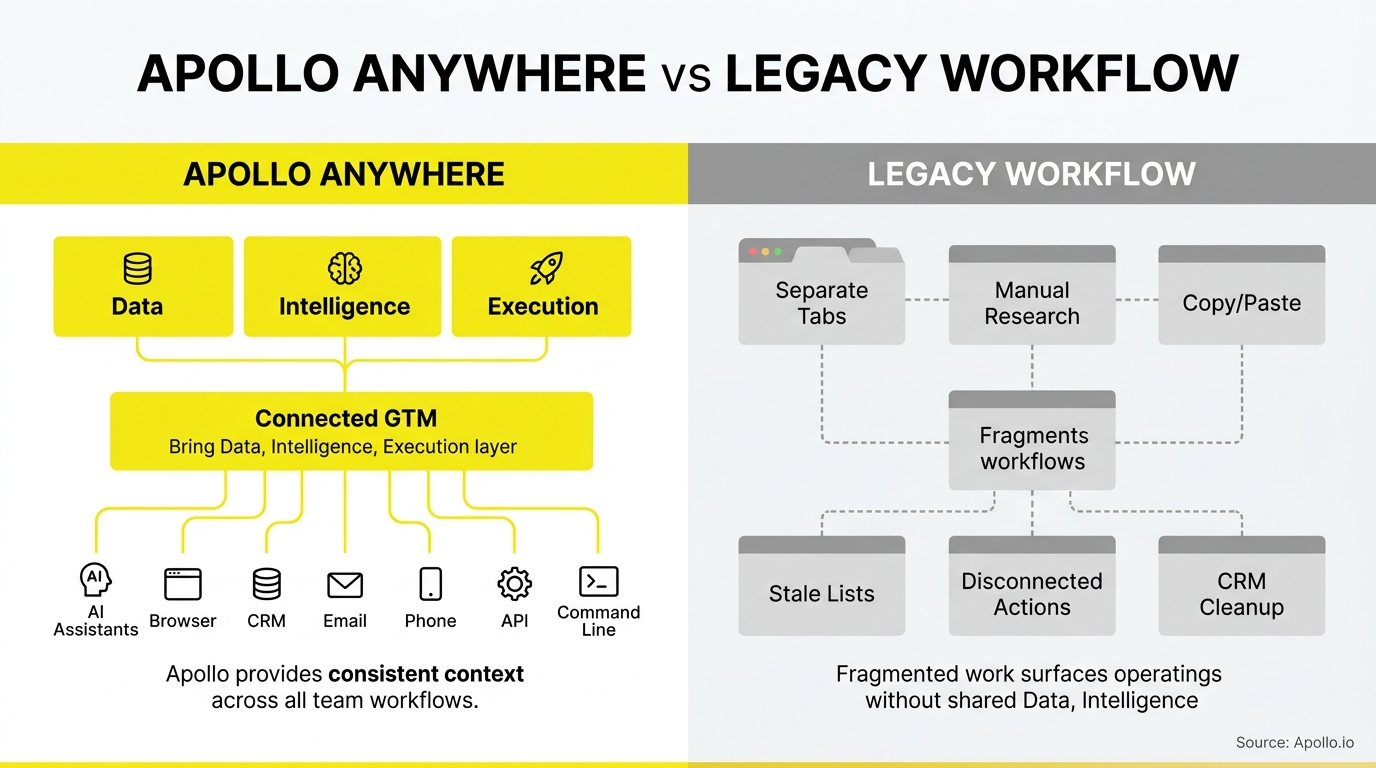
Apollo is an AI sales platform that unifies data, intelligence, and execution into one connected GTM system. Where Gong focuses on what happens during the call, Apollo covers the entire motion, finding the right contacts, reaching them across channels, and converting interest into pipeline.
Apollo's database includes 240M+ people and 30M+ companies, continuously validated through Apollo's Living Data Network rather than sitting as a static snapshot. With 65+ filters for prospecting, teams can build tightly targeted lists and move directly into multi-channel sequences, email, calls, and social, without switching tools. The AI Dialer (Power and Parallel modes) eliminates manual dialing, and AI-generated call summaries are auto-logged to CRM. For inbound, Apollo handles form enrichment, website visitor identification, and intelligent routing with round-robin and criteria-based assignment.
Apollo serves B2B GTM teams, GTM Engineers, and AI Builders building headless GTM workflows with the Apollo MCP, Apollo API, and Apollo CLI, alongside Sales Professionals, SDRs/BDRs, AEs, RevOps, Marketing, and Revenue Leaders. It meets sellers inside the tools they already use, from AI assistants like ChatGPT, Claude, Codex, and Perplexity via Apollo MCP, to the Chrome extension and Salesforce, rather than asking them to switch contexts to get value.
Apollo's sales engagement layer includes AI Sequence Builder (sequences from natural language), sentiment analysis, outbound analytics dashboards, and automated workflow triggers. Data enrichment runs bi-directionally with Salesforce and HubSpot, with waterfall enrichment pulling from multiple vendors and writing back on a schedule or in real time. Apollo integrates with 50+ tools including Outreach, Salesloft, Orum, Marketo, and Zoho CRM.
Recognition reflects the platform's momentum: Apollo won the 2026 MarTech Breakthrough Award for "Best AI-Powered Sales Solution" and holds a 4.7/5 G2 rating across multiple categories.
Customer outcomes reflect real consolidation:
"We reduced the complexity of three tools into one.", Collin Stewart, CEO at Predictable Revenue
And on data quality:
"Apollo enriches everything we have: contacts, leads, accounts...And we don't really have to touch it, it just works.", Mark Turner, VP of Revenue Operations at Built In
Pricing (Apollo pricing page, annual billing): Free ($0, 900 credits/year); Basic ($49/user/month, 30,000 credits/year, CRM integrations); Professional ($79/user/month, 48,000 credits/year, US dialer, AI research, automated workflows); Organization ($119/user/month, min 3 users, 72,000 credits/year, international dialer, SSO, advanced security).
According to Ramp's vendor data, Apollo holds a 39% adoption rate in the Sales Data Providers category as of August 2026, up 6 percentage points year-over-year, and carries a 22% competitor switch rate, more than double ZoomInfo's 10%, indicating active movement toward the platform from competing tools.
At the category level, Ramp's Sales Data Providers category data shows Apollo is the fastest-growing vendor in the segment as of August 2026, averaging +0.6 percentage points of adoption per month, ahead of every other vendor tracked in the category.
Chorus.ai

Chorus.ai is a conversation intelligence platform, now part of ZoomInfo, that captures and analyzes customer calls, meetings, and emails. It uses 14 proprietary machine learning patents to deliver transcription, AI-assisted coaching recommendations, and deal pipeline visibility to sales and revenue enablement teams.
Key capabilities include unlimited call recordings with minutes-after-call delivery, contextual trackers for topics like pricing and objections, proactive coaching recommendations delivered to the inbox, Relationship Intelligence with automated CRM syncing, and 20+ out-of-the-box analytics reports. Market Intelligence surfaces competitive insights and win/loss patterns from recorded conversations.
Because Chorus.ai is now part of ZoomInfo, no standalone Chorus.ai pricing page is available. Teams would contact their sales team for pricing details.
Pros:
- Conversation depth: AI contextual trackers cover next steps, pricing objections, and competitive mentions with pattern-level granularity.
- ZoomInfo integration: Native access to ZoomInfo's contact database and intent data for teams already on that platform.
- Coaching delivery: Proactive recommendations pushed to manager and rep inboxes without requiring manual review sessions.
Cons:
- Pricing opacity: No public pricing; requires direct engagement with sales for all quotes.
- Scope: Focused on conversation intelligence; prospecting and outreach execution are addressed through broader ZoomInfo modules.
- Standalone availability: As an acquired product, roadmap and packaging decisions are tied to ZoomInfo's platform direction.
Here's a detailed comparison of Apollo vs Chorus.ai.
Avoma

Avoma is an AI meeting assistant and conversation intelligence platform that automates note-taking, scheduling, coaching, and forecasting. It targets customer-facing teams that want to reduce administrative overhead while surfacing revenue intelligence from their meetings.
Core features include automatic video recording and transcription, AI-generated summary notes, an AI Copilot ("Ask Avoma") for querying meeting content, group and round-robin scheduling, and a Lead Router for inbound qualification. Conversation Intelligence and Revenue Intelligence are available as modular add-ons, adding call scoring, AI win-loss analysis, deal risk alerts, and forecasting on top of the base meeting assistant.
Pricing (Avoma pricing page): Startup plan starts at $19/recorder seat/month (annual); Organization at $29/recorder seat/month (annual); Enterprise at $39/recorder seat/month (annual, minimum 10 seats). Conversation Intelligence and Revenue Intelligence add-ons are each $29/seat/month billed annually.
Pros:
- Transparent pricing: Publicly listed tiers with clear per-seat costs and modular add-ons.
- Scheduling built in:1:1, group, and round-robin scheduling without a separate calendar tool.
- Free viewers: Collaborators and viewers are always free, keeping costs contained for larger teams.
Cons:
- Add-on stacking: Full revenue intelligence capability requires layering multiple paid add-ons onto the base plan.
- No prospecting layer: No built-in contact database or outbound sequencing; focused on meeting intelligence only.
- Enterprise seat minimum: Requires minimum 10 seats and a demo call for Enterprise access.
Apollo vs Avoma, here's everything you need to know.
Fathom

Fathom is an AI meeting note-taking and conversation intelligence platform that automatically records, transcribes, and summarizes meetings. It offers a bot-free capture option (in beta for Mac), integrates with popular CRMs, and provides AI-generated action items and follow-up emails. It serves individuals and small teams looking for lightweight, low-friction meeting intelligence.
Notable features include a conversational AI assistant for querying past meetings, ChatGPT and Claude integrations for surfacing meeting context in LLM workflows, CRM field sync for automatic post-call updates, and coaching metrics with AI scorecards available on the Business tier.
Pricing (Fathom pricing page): Free ($0, unlimited recordings and transcriptions); Premium ($16/user/month annual, $20 monthly); Team ($15/user/month annual, $19 monthly, 2-user minimum); Business ($25/user/month annual, $34 monthly, 2-user minimum); Enterprise (contact sales).
Pros:
- Accessible free tier: Unlimited recordings and AI summaries at no cost, with no seat limits on the individual plan.
- Bot-free option: Record meetings without a visible bot joining the call (Mac beta).
- LLM integrations: Native ChatGPT and Claude integrations let teams surface meeting context in their AI workflows.
Cons:
- Limited team scope: CRM sync and coaching metrics are gated to the Business tier ($25/user/month).
- No prospecting or engagement: Purely a meeting intelligence tool with no contact data or sequencing capabilities.
- 2-user minimum for team plans: Solo users must use the individual tiers, which lack team collaboration features.
Get a full breakdown of how Apollo compares to Fathom.
Clari

Clari is an AI Revenue Orchestration Platform that provides end-to-end pipeline coverage with AI agents monitoring deals across all sales motions. It focuses on making revenue data trustworthy by aggregating signals from CRM, email, calendar, and calls into a single forecasting and pipeline management surface.
Key features include AI Revenue Agents that connect data and workflows, pipeline management with deal health scoring, automatic data capture (eliminating manual CRM entry), revenue forecasting with real-time visibility, conversation intelligence through Clari Copilot, and early churn risk detection for customer retention. Modules include Clari Forecast, Clari Groove, Clari Copilot, and Clari Align.
Pricing: Clari's pricing is not publicly displayed on their official website. According to Vendr, the median contract value is $76,000 per year, based on data from 291 purchases, with a range of $19,065 to $415,001.
Pros:
- Forecasting depth: AI-consolidated revenue signals from CRM, ERP, email, and calls provide high-confidence pipeline forecasts.
- Automatic data capture: Reduces manual CRM entry by capturing activity from email and calendar automatically.
- Modular architecture: Teams can deploy specific modules (Copilot, Forecast, Groove) based on their current needs.
Cons:
- High contract values: Median ACV of $76,000 makes Clari one of the more expensive options in this category.
- No prospecting layer: Focused on pipeline management and forecasting; does not include a contact database or outbound prospecting tools.
- Quote-only pricing: All modules require direct sales engagement with no public list pricing.
Considering Clari? Here's how Apollo compares.

ZoomInfo

ZoomInfo is a B2B go-to-market intelligence platform that combines contact and company data with AI-driven buyer intent signals, automated enrichment, and integrated engagement tools. It serves sales, marketing, talent, and revenue operations functions within a single platform.
Core features include verified business contact data with mobile numbers, AI-powered account prioritization, real-time buying signals and company event tracking, organizational charts, dynamic territory management, automated lead routing, and AI-generated account summaries. Chorus conversation intelligence and a chat/visitor identification module are available within the platform.
Pricing: ZoomInfo's pricing is not publicly displayed on their official website. According to Vendr, the median contract value is $33,500 per year, based on data from 1,568 purchases.
Pros:
- Data breadth: Contact and company data spans multiple GTM functions including sales, marketing, and talent.
- Intent signals: Buyer intent data and real-time company event tracking help teams prioritize high-fit accounts.
- Platform breadth: Engagement, enrichment, and conversation intelligence are all available within one vendor relationship.
Cons:
- Pricing opacity: No public list pricing; all tiers require a quote request.
- Credit model complexity: Data exports consume credits, and overage fees apply when contracted limits are exceeded.
- Contract commitments: Annual contracts with price escalation clauses (typically 5–10%) are standard.
Here's a detailed comparison of Apollo vs ZoomInfo.
Turn Weak Leads Into Pipeline Confidence
Tired of marketing leads that never convert to real opportunities? Apollo surfaces in-market buyers with intent signals so your team reaches the right prospects at right moment. Nearly 5M users trust Apollo to build predictable pipeline.
Start Free with Apollo →Cognism

Cognism is a B2B sales intelligence and prospecting platform that provides contact data, company information, and intent signals to revenue teams. It is known for its Diamond Data offering, phone-verified mobile numbers that Cognism reports deliver up to 3x higher connect rates, and for its GDPR/CCPA-oriented data sourcing approach with ISO 27001 and SOC 2 Type II certification.
Key features include decision-maker data, AI-powered company research and persona builder, CRM enrichment at scale, intent data powered by Bombora (up to 12 topics from 11,000+ options), job change signals, and a credit-based model where 1 credit equals one contact reveal that stays redeemed for the contract term.
Pricing: Cognism's pricing is not publicly displayed on their official website. According to Vendr, the median contract value is $36,000 per year, based on data from 108 purchases.
Pros:
- Phone-verified data: Diamond Data offers manually verified mobile numbers for markets where connect rates on standard data are low.
- Compliance focus: Built-in DNC and TPS screening with GDPR/CCPA-oriented data sourcing processes.
- Credit efficiency: Revealed contacts stay unlocked for the contract term, so teams don't re-spend credits on contacts they've already accessed.
Cons:
- No outbound execution layer: Contact data and enrichment are the core; outbound sequencing and dialing are not built into the base platform.
- Pricing opacity: All tiers require contacting sales; no public list pricing is available.
- Add-on costs: Intent data and CRM enrichment are priced as separate modules, increasing total cost for teams needing the full stack.
Related reading:Apollo vs Cognism
Salesloft

Salesloft is a revenue orchestration platform that connects AI agents with sales workflows to help B2B teams create pipeline, manage deals, and close revenue. Its Conductor AI layer prioritizes seller actions, surfaces deal risks, and automates next-best-action recommendations across the sales funnel.
Features include AI-assisted sales engagement with buyer signal prioritization, bi-directional CRM sync (Salesforce and others), conversation intelligence with call recording and AI insights, deal management and pipeline analytics, revenue forecasting, and workflow automation for repetitive tasks. Engagement, coaching, and forecasting capabilities are available across its tiered packaging.
Pricing: Salesloft's pricing is not publicly displayed on their official website. According to Vendr, the median contract value is $30,720 per year, based on data from 703 purchases.
Pros:
- Workflow breadth: Engagement, coaching, forecasting, and pipeline analytics are available in one platform relationship.
- Conductor AI: AI-driven action prioritization helps sellers focus on the highest-value next steps without manual triage.
- CRM fidelity: Bi-directional sync keeps CRM records current without manual data entry.
Cons:
- No native prospecting database: Contact discovery requires integration with a separate data provider.
- Pricing opacity: No public list pricing; all tiers require a demo request.
- Contract minimums: Deployments typically require 10–15 users minimum, limiting accessibility for smaller teams.
Related reading:Apollo vs Salesloft
Clay

Clay is a GTM data infrastructure and orchestration platform that centralizes first- and third-party data from 200+ providers. It enables AI-assisted research through Claygents, automates waterfall enrichment, tracks real-time signals like job changes, and orchestrates GTM workflows across CRM, email, ads, and data warehouses.
Key features include a multi-provider waterfall enrichment engine, Claygents (AI agents for company and people research), real-time job change and intent signal tracking, CRM auto-sync, data warehouse integration, HTTP API and webhook automation, and a native email sequencer. Clay pricing is usage-based across two dimensions: data credits and actions.
Pricing (Clay pricing page): Free (no monthly fee, 100 credits/month, 500 actions/month); Launch (starts at $54/month annual, 30,000 credits/year); Growth (starts at $185/month annual, 72,000 credits/year); Enterprise (custom pricing, 100,000+ credits/month).
Pros:
- Data provider breadth: Access to 200+ data providers through one interface reduces the need to manage multiple vendor contracts.
- Claygents: AI research agents automate account and contact research at scale, useful for high-personalization workflows.
- Flexible pricing: Usage-based model with transparent public pricing and credit rollover on paid plans.
Cons:
- Learning curve: The waterfall and workflow builder requires technical familiarity; less accessible for reps who want a point-and-click prospecting experience.
- No native conversation intelligence: No call recording, transcription, or coaching features.
- Cost scaling: High-volume enrichment workflows can become expensive as credit and action tiers stack up.
Apollo vs Clay, here's everything you need to know.
Comparison Table
| Platform | Primary Function | Key AI Features | Starting Price | Free Tier |
|---|---|---|---|---|
| Gong (subject) | Conversation intelligence, revenue forecasting | Call analysis, deal risk, pipeline insights | Vendr median $54,900/yr; per-seat, quote required | No |
| Apollo | Sales intelligence, engagement, data enrichment, inbound routing | AI Sequence Builder, AI Dialer, AI research, sentiment analysis, living data validation | $49/user/month (annual); Free tier available | Yes (900 credits/year) |
| Chorus.ai | Conversation intelligence (part of ZoomInfo) | Contextual trackers, coaching recommendations, deal intelligence | Pricing not publicly displayed; contact sales | No |
| Avoma | AI meeting assistant, conversation & revenue intelligence | AI notes, Ask Avoma copilot, AI call scoring, win-loss analysis | $19/recorder seat/month (annual) | No (14-day trial) |
| Fathom | AI meeting notes and transcription | AI summaries, action items, conversational assistant, LLM integrations | Free; Team from $15/user/month (annual) | Yes |
| Clari | Revenue orchestration, forecasting, pipeline management | AI Revenue Agents, deal health scoring, churn risk detection | Vendr median $76,000/yr; quote required | No |
| ZoomInfo | B2B sales intelligence, intent data, engagement | AI account prioritization, intent signals, AI account summaries | Vendr median $33,500/yr; quote required | No |
| Cognism | B2B contact data, phone-verified mobiles, CRM enrichment | AI persona builder, AI company research, intent via Bombora | Vendr median $36,000/yr; quote required | No |
| Salesloft | Sales engagement, pipeline analytics, forecasting | Conductor AI, deal risk signals, conversation intelligence | Vendr median $30,720/yr; quote required | No |
| Clay | GTM data infrastructure, waterfall enrichment, workflow automation | Claygents AI research agents, multi-provider waterfall | Free; Launch from $54/month (annual) | Yes |
How to Choose
Start by identifying your primary gap. If you're looking to replace Gong's call recording and coaching capabilities with something more connected to your broader GTM stack, Apollo's AI Dialer with auto-logged call summaries, AI-generated scripts, and real-time coaching sits inside the same platform as your prospecting database, eliminating the need to stitch separate systems together.
Apollo's Living Data Network keeps contact and company records current, so you're not coaching reps on stale data.
If your team's primary need is lightweight, low-cost meeting transcription, particularly for individual contributors or small teams, Fathom offers a capable free tier and bot-free capture. For teams that want meeting intelligence plus scheduling in a modular, publicly priced package, Avoma adds coaching and revenue intelligence as opt-in add-ons.
If your primary challenge is revenue forecasting and pipeline inspection rather than prospecting, Clari is purpose-built for that use case, though at a significantly higher median contract value. For teams that need a prospecting database alongside intent data and conversation intelligence in one vendor relationship, ZoomInfo or Salesloft offer broad coverage, both with quote-based pricing. For RevOps and GTM engineers who need flexible data infrastructure across 200+ providers without a rigid per-seat model, Clay is worth evaluating.
For teams at any stage, from early-stage founders to Fortune 500 GTM teams, Apollo's Organization tier includes advanced governance, SSO, international dialing, and admin controls alongside the same prospecting, engagement, and enrichment capabilities available across all plans. The full GTM surface means fewer vendor relationships to manage and one place where data, outreach, and results connect.
Frequently Asked Questions
What is the main difference between Gong and its alternatives?
Gong is focused primarily on conversation intelligence, recording, transcribing, and analyzing sales calls to improve coaching and forecast accuracy. Most alternatives in this list go beyond that scope.
Apollo, for example, covers the entire GTM motion: finding contacts, running multi-channel outreach, dialing, routing inbound leads, and enriching CRM data, with call intelligence built into the same workflow rather than as a standalone layer.
Is there a free alternative to Gong?
Yes. Fathom offers a free individual plan with unlimited recordings and AI summaries.
Apollo also has a free tier with access to the database, sequences, and core features, as detailed in the Apollo section above. Neither requires a credit card to start.
What is the most affordable Gong alternative for small teams?
Fathom's Team plan starts at $15/user/month (annual), and Apollo's Basic plan starts at $49/user/month. Both offer public pricing without requiring a sales conversation. Avoma's Startup plan starts at $19/recorder seat/month annually. For comparison, according to Vendr, Gong's median contract is $54,900/year based on 1,126 purchases, making any of these alternatives substantially more accessible for smaller teams.
Can Apollo replace Gong entirely?
If your Gong use case centers on call coaching, deal intelligence, and CRM activity logging, Apollo covers that ground with its AI Dialer, AI-generated call summaries, real-time manager coaching, and automatic CRM sync. Where Gong goes deeper is in conversation analytics at enterprise scale for large revenue teams running dedicated coaching programs.
For teams that also want prospecting, sequencing, enrichment, and inbound routing, not just call intelligence, Apollo provides a broader surface, as covered in the Apollo section above.

Conclusion
The Gong alternatives market in 2026 spans a wide range of use cases: from lightweight meeting transcription (Fathom, Avoma) to full revenue orchestration (Clari, Salesloft) to prospecting-led GTM platforms (Apollo, ZoomInfo, Cognism) to data infrastructure for technical teams (Clay). The right choice depends on whether you need to replace Gong's call intelligence specifically, or whether you're taking the opportunity to consolidate more of your GTM stack at the same time.
For most B2B sales teams, Apollo offers the clearest path: transparent pricing starting at $49/user/month, a 240M+ person database continuously validated through Apollo's Living Data Network, built-in outbound sequencing and dialing, inbound routing, and CRM enrichment, all in one connected system. It's the choice that addresses what Gong does and extends into the full pipeline-building motion your team needs to hit quota.
Ready to see it in action? Start Free with Apollo, no credit card required.
Prove Pipeline ROI With Apollo
ROI pressure killing your tool budget? Apollo delivers measurable pipeline impact from day one — 46% more meetings with AI Research Agent. Stop guessing on value and start showing results.
Start Free with Apollo →Don't miss these
Sales
Inbound vs Outbound Marketing: Which Strategy Wins?
Sales
What Is a Sales Funnel? The Non-Linear Revenue Framework for 2026
Sales
What Is a Go-to-Market Strategy? The 2026 GTM Playbook
See Apollo in action
We'd love to show how Apollo can help you sell better.
By submitting this form, you will receive information, tips, and promotions from Apollo. To learn more, see our Privacy Statement.
4.7/5 based on 9,690 reviews
