
Apollo vs Fathom (2026): Features, Pricing & Best Use Cases
Choosing between Apollo and Fathom comes down to one fundamental question: do you need a meeting notetaker, or do you need an end-to-end system for finding, engaging, and converting prospects? Both platforms use AI to help sales teams work more efficiently, but they solve meaningfully different problems.
This comparison walks through each platform's capabilities, pricing, and best-fit scenarios so you can make an informed decision.

Apollo Turns Research Hours Into Pipeline
Tired of your reps burning the day on manual research instead of selling? Apollo surfaces verified contacts instantly so your team spends time closing, not digging. Nearly 5M users already made the switch.
Start Free with Apollo →Key Takeaways
- Platform scope: Apollo is an AI GTM system covering prospecting, engagement, dialing, and analytics. Fathom focuses on meeting recording, transcription, and post-call summaries.
- B2B database: Apollo includes a native database of 240M+ people and 30M+ companies. Fathom does not include a prospecting database.
- Conversation intelligence: Both platforms offer AI-generated call summaries and CRM sync, but Apollo's calling capabilities are built directly into a broader outbound workflow.
- Who Apollo serves: Apollo serves B2B GTM teams, GTM Engineers, and AI Builders building headless GTM workflows with the Apollo API, CLI, and MCP, alongside Sales Professionals, SDRs/BDRs, AEs, RevOps, Marketing, and Revenue Leaders.
- Pricing model: Apollo's transparent pricing starts at $49/user/month (annual billing) with a free tier. Fathom offers a free tier and paid plans starting at $15/user/month (annual billing).
What is Apollo?

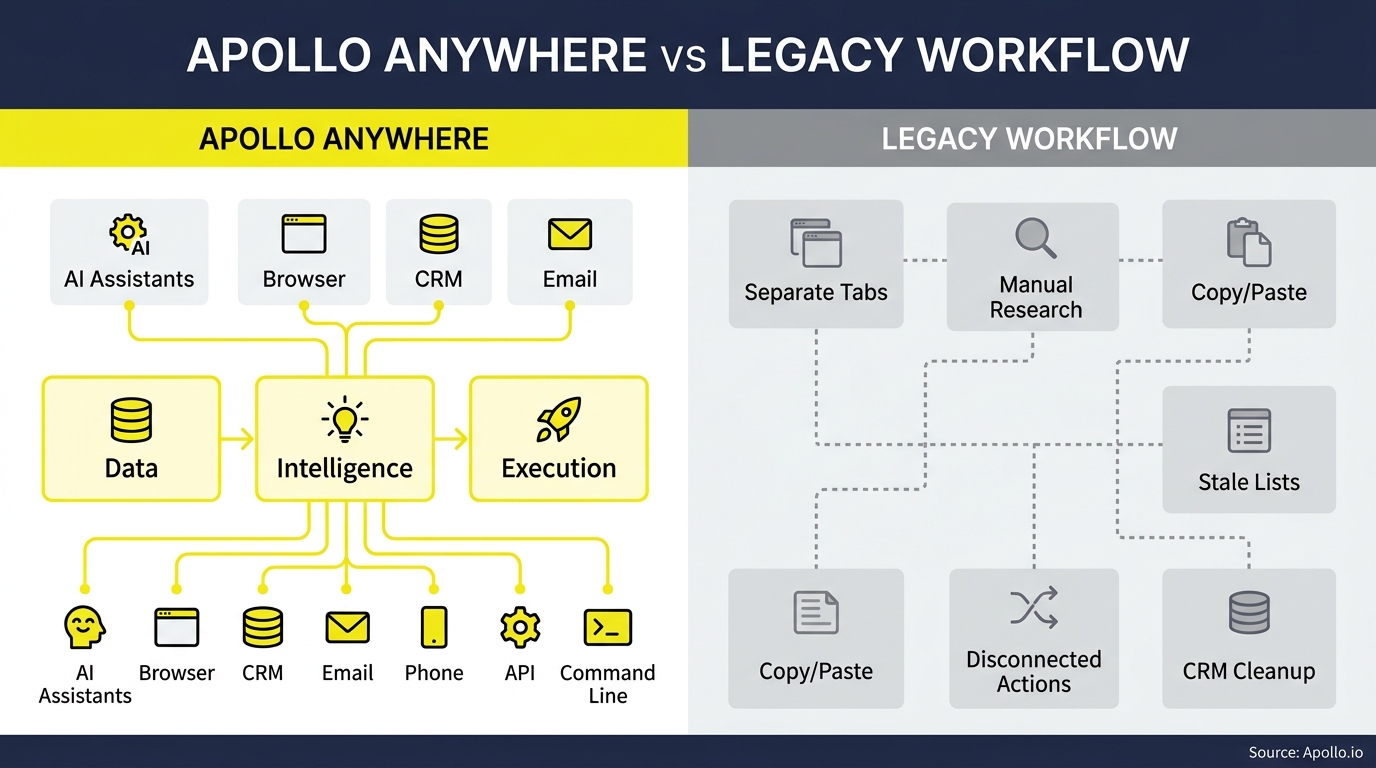
Apollo is an AI GTM system that unifies data, intelligence, and execution into one connected GTM system. From identifying the right accounts to running multi-channel sequences, logging calls, and enriching CRM records, Apollo is built so sales teams do not need to stitch together separate tools for each stage of the outbound process.
Apollo's database covers 240M+ people and 30M+ companies, with 98% email accuracy. The platform's advanced search and prospecting tools let teams filter by firmographic, technographic, and intent signals, then move directly into sequences, dialing, and deal tracking without leaving the workspace. Apollo also provides data enrichment that keeps CRM records clean and current across Salesforce, HubSpot, and other CRMs.
Apollo meets sellers inside the tools they already use. Apollo MCP, Apollo's Model Context Protocol, connects Apollo data and workflows to AI assistants including ChatGPT, Codex, Claude, and Perplexity. The Chrome extension supports prospecting from anywhere across the web. For technical and advanced users, Apollo CLI provides terminal-native access for headless GTM workflows and API-driven automation.
According to Ramp's vendor data, Apollo holds a 38% adoption rate in the Sales Data Providers category as of July 2026, up 5 percentage points year-over-year, with 34% of first-time category buyers choosing Apollo as their first platform. Apollo is trusted by 100K+ paying customers and used by 100+ teams at Fortune 500 companies, and has earned the 2026 MarTech Breakthrough Award for "Best AI-Powered Sales Solution". Apollo's transparent pricing starts at $49/user/month (annual billing), with a free tier available.

What is Fathom?

Fathom is an AI-assisted meeting notetaker that records, transcribes, and summarizes video calls on Zoom, Google Meet, and Microsoft Teams. The platform is designed to eliminate manual note-taking so participants can remain focused during conversations while receiving automated summaries, action items, and CRM field updates after calls end.
Fathom offers both bot-free and traditional bot-based call capture. After a meeting, users receive instant AI summaries, automatically generated action items, and a searchable meeting database through its Ask Fathom conversational assistant.
Team plans add global search across calls, collaboration features such as shared folders and keyword alerts, and shared playlists of call highlights.
Fathom's Business tier introduces CRM field sync, Deal View for summarizing deal insights, and AI scorecards for coaching and performance metrics. The platform integrates with Salesforce and HubSpot for automatic post-call CRM updates, and also connects to Slack, Notion, Asana, Zapier, ChatGPT, and Claude.
An Enterprise tier adds SSO and SCIM provisioning, organization-wide security controls, custom data retention, and dedicated onboarding support.
Fathom is positioned for sales teams, customer success teams, and marketing teams that want to improve meeting capture and coaching without expanding their broader sales stack. Pricing is publicly available at Fathom's pricing page. A free tier is available with unlimited recordings and transcriptions. Paid individual plans start at $16/user/month (annual billing), and team plans start at $15/user/month (annual billing, 2-user minimum).
Feature Comparison
| Feature | Apollo | Fathom |
|---|---|---|
| Starting Price | $49/user/month (annual billing) | $15/user/month (annual billing, Team plan, 2-user min) |
| B2B Database | 240M+ people, 30M+ companies | Not included |
| Email Accuracy | 98% | Not applicable |
| Sequences | Multi-channel (email, phone, social, tasks); AI Sequence Builder | Not included |
| Dialer | Power Dialer and Parallel Dialer with AI call scripts and summaries | Not included |
| AI Capabilities | AI research agent, AI-generated sequences, call summaries, AI scoring, lead scoring | AI call summaries, action items, AI scorecards, conversational meeting assistant |
| Data Enrichment | CRM, CSV, waterfall, and API enrichment | CRM field sync post-call (Business and above) |
| Free Tier | Yes, 900 credits/year, basic filters, 2 sequences | Yes, unlimited recordings and transcriptions |
The table illustrates how these platforms address different parts of the sales workflow. Fathom is focused on capturing and summarizing conversations that have already begun, while Apollo covers the full arc from identifying prospects through executing outreach and logging outcomes.
Turn Funnel Guesswork Into Real Pipeline
Tired of watching marketing leads stall before they ever reach your pipeline? Apollo surfaces verified, in-market contacts so your team builds real opportunities — not wishful forecasts. 600K+ companies already know what's next.
Start Free with Apollo →Pricing Comparison
Apollo's full pricing breakdown (annual billing) is available at apollo.io/pricing:
- Free: $0, 900 credits/year, 2 sequences, basic filters
- Basic: $49/user/month, 30,000 credits/year, unlimited sequences, CRM integrations, 6 intent topics
- Professional: $79/user/month, 48,000 credits/year, US dialer, 5 mailboxes, automated workflows, AI research
- Organization: $119/user/month (3-user minimum), 72,000 credits/year, international dialer, 15 mailboxes, SSO, advanced security
Fathom's pricing (annual billing) from the official pricing page:
- Free: $0, unlimited recordings and transcriptions, bot-free or bot capture, instant AI summaries
- Premium: $16/user/month, adds AI-generated action items, conversational meeting assistant, custom meeting bot
- Team: $15/user/month (2-user minimum), adds global search, playlists, and collaboration features
- Business: $25/user/month (2-user minimum), adds CRM field sync, Deal View, coaching metrics, and AI scorecards
- Enterprise: Contact sales, adds SSO, SCIM, custom data retention, dedicated success manager, and priority support
On a per-seat basis, Fathom's entry paid tiers are lower than Apollo's. However, the two platforms address different budgeting decisions. Fathom pricing covers meeting capture and coaching capabilities. Apollo's pricing includes a native B2B database, sequencing engine, dialer, enrichment, and analytics, meaning teams that also need those capabilities would otherwise assemble them from separate tools. As Collin Stewart, CEO at Predictable Revenue, noted: "We reduced the complexity of three tools into one."

How Apollo Differs from Fathom
Fathom and Apollo share a narrow slice of overlap: both use AI to summarize calls and push data to CRMs. The difference is what surrounds that capability.
Apollo's call intelligence sits inside a platform that also finds the contacts, runs the sequences, powers the dialer, and keeps the CRM enriched. Fathom starts and ends at the conversation layer.
For teams running outbound, Apollo's Power Dialer and Parallel Dialer reduce idle time between calls and connect reps only when a prospect picks up. Call scripts are AI-researched per prospect, outcomes are auto-logged, and summaries push directly to the CRM, the same workflow Fathom handles at the recording stage, but integrated with the prospecting and sequencing data that preceded the call. Apollo's sales engagement capabilities also extend beyond calls to email and social outreach in coordinated multi-channel sequences.
For teams building more technical workflows, Apollo's API and AI capabilities support GTM Engineers and AI Builders who want programmatic access to prospecting data, enrichment, and sequencing logic. Fathom does not offer a comparable API-first or headless deployment path.
According to Ramp's Sales Data Providers category data, Apollo is the fastest-growing vendor in the category as of July 2026, averaging +0.75 percentage points of adoption growth per month. Teams in the market for sales data infrastructure are choosing Apollo at an accelerating rate across segments from SMB through enterprise.

Frequently Asked Questions
Can Apollo replace Fathom for meeting notetaking?
Apollo includes AI-generated call summaries, auto-logged outcomes, and CRM sync for calls made through its dialer. For calls made outside Apollo's dialer, such as video calls on Zoom or Google Meet, Fathom's bot-based or bot-free recording covers those.
Teams that primarily use video conferencing platforms for discovery calls may find value in Fathom specifically for that use case, while Apollo covers the dialing and sequencing workflow end-to-end.
Does Fathom include a B2B prospecting database?
No. Fathom does not include a contact or company database.
It is designed to capture and analyze conversations with contacts you are already meeting with. Apollo includes a native database as detailed in the feature comparison above, allowing teams to move from prospecting to outreach to call intelligence within one platform.
Who is Apollo designed for?
Apollo serves B2B GTM teams, GTM Engineers, and AI Builders building headless GTM workflows with the Apollo API, CLI, and MCP, alongside Sales Professionals, SDRs/BDRs, AEs, RevOps, Marketing, and Revenue Leaders. The platform is used by teams across startups, growing companies, and organizations with 100+ Fortune 500 teams.
Does Fathom offer CRM integration?
Yes. Fathom's Business plan includes CRM field sync with Salesforce and HubSpot, automatically updating records after meetings.
Apollo also offers CRM sync and goes further with bi-directional enrichment, real-time and scheduled enrichment jobs, and data writing rules, as covered in the feature comparison section above.
Is Apollo worth it if I already use Fathom?
If your team is only looking for meeting capture and post-call summaries, Fathom addresses that need directly. If you also need outbound prospecting, sequencing, enrichment, or dialing capabilities, Apollo consolidates those into one platform.
Teams often evaluate Apollo when they want to reduce the number of separate tools in their stack, as detailed in the pricing section above.

Conclusion
Apollo and Fathom serve distinct roles in the sales technology stack. Fathom is a focused meeting intelligence tool for teams that want automated transcription, summaries, and coaching metrics from their video calls.
Apollo is an AI GTM system built for teams that need the full pipeline motion, from finding the right contacts and running multi-channel outreach to dialing, call intelligence, and CRM enrichment.
For teams evaluating both and looking to consolidate their stack into one connected GTM system, Apollo covers the Fathom use case at the calling layer while also providing the prospecting, engagement, and data infrastructure that Fathom does not. Try Apollo free today and see how data, intelligence, and execution work together in one place.
Ramp Reps Faster, Prove ROI Sooner
Quota pressure mounting while new reps are still finding their footing? Apollo gives your team a repeatable outbound process from day one. Leadium 3x'd their revenue — see your ROI before the quarter ends.
Start Free with Apollo →Don't miss these
Sales
Inbound vs Outbound Marketing: Which Strategy Wins?
Sales
What Is a Sales Funnel? The Non-Linear Revenue Framework for 2026
Sales
What Is a Go-to-Market Strategy? The 2026 GTM Playbook
See Apollo in action
We'd love to show how Apollo can help you sell better.
By submitting this form, you will receive information, tips, and promotions from Apollo. To learn more, see our Privacy Statement.
4.7/5 based on 9,690 reviews
