
Top 9 Chili Piper Alternatives for Sales Teams in 2026
Chili Piper built its reputation on meeting scheduling and lead routing, helping revenue teams book qualified meetings faster and qualify inbound leads in real time. But as GTM teams scale, many find that scheduling and routing alone aren't enough. Sales and RevOps leaders need prospecting, data enrichment, multi-channel outreach, dialing, and pipeline analytics working together, not just a booking layer bolted onto a broader tech stack.
That gap is why so many teams start searching for Chili Piper alternatives. Some want a platform that combines scheduling with outbound prospecting and sales intelligence.
Others need clearer, more transparent pricing, since Chili Piper's pricing is not publicly displayed on its official website. And many are simply trying to reduce the number of point solutions their reps have to juggle every day.
This guide breaks down nine Chili Piper alternatives for 2026, starting with Apollo, an AI GTM system that unifies data, intelligence, and execution, and continuing through platforms like HubSpot, Calendly, ZoomInfo, Cognism, SalesLoft, Clay, Outreach, and Lusha. We'll cover features, pricing, and where each tool fits so you can make an informed decision for your team.

Skip The Research, Apollo Finds Buyers Fast
Sinking hours into manual lead research and chasing bad emails. Apollo hands your reps verified contact data instantly, so selling time stops shrinking. 98% email accuracy means fewer bounces and more real conversations.
Start Free with Apollo →Key Takeaways
- Apollo: An AI GTM system combining sales intelligence, multi-channel outreach, a built-in dialer, and data enrichment, with pricing starting at $49/user/month.
- HubSpot: An agentic customer platform unifying marketing, sales, and service on a Smart CRM with built-in AI agents.
- Calendly: A scheduling platform with lead routing and round-robin meeting distribution, which the company reports is used by 20 million professionals.
- ZoomInfo: A go-to-market intelligence platform with B2B contact data, intent signals, and sales automation tools.
- Cognism: A sales intelligence and data enrichment platform focused on phone-verified contact data for European and global markets.
- SalesLoft: A Revenue Orchestration Platform combining cadence automation, conversation intelligence, and pipeline analytics.
- Clay: A GTM platform for building automated prospecting and multi-provider data enrichment workflows.
- Outreach: A sales engagement platform for B2B sales and marketing teams.
- Lusha: A B2B data platform offering credit-based access to verified contacts and buying signals.
Apollo

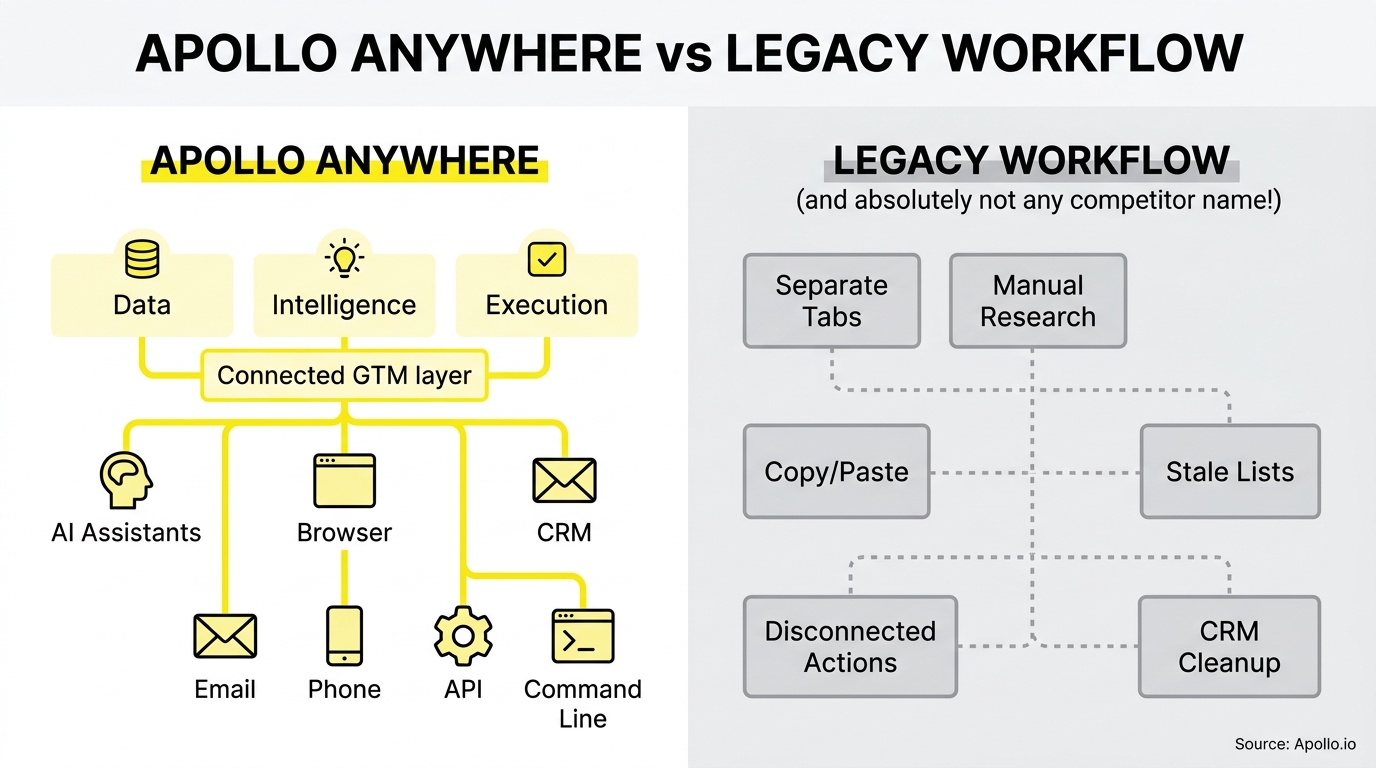
Apollo is an AI GTM system that unifies data, intelligence, and execution. Built open by design, Apollo meets sellers inside the tools they already use, from AI assistants like ChatGPT, Codex, Claude, and Perplexity via Apollo MCP, Apollo's Model Context Protocol, to the Chrome extension and Salesforce, rather than asking teams to switch contexts to get value. For technical and advanced users, Apollo CLI provides terminal-native access for headless GTM workflows.
On the outbound side, Apollo helps teams define an ICP, let AI research and rank accounts, verify emails and phones, and run multi-channel sequences across email, calls, and social, backed by a Power Dialer and Parallel Dialer for efficient calling. On the inbound side, Apollo captures website visitor intent, enriches and shortens forms, and routes leads through configurable inbound routers with round-robin and criteria-based booking, supported by 65+ filters for precise targeting. Apollo's Data Enrichment suite adds waterfall enrichment, CRM enrichment, CSV enrichment, and API access, with contacts continuously validated and refreshed by Apollo's Living Data Network rather than sitting static in a database.
Apollo's database includes 240M+ people and 30M+ companies, with 98% email accuracy. The platform connects with Salesforce, HubSpot, Zoho CRM, Pipedrive, Outreach, SalesLoft, and 50+ tools in its integrations marketplace.
Pricing is available on the Apollo pricing page with annual billing options. The Free plan is $0 with 900 credits/year and basic filters. Basic is $49/user/month with 30,000 credits/year, unlimited sequences, and CRM integrations. Professional is $79/user/month, adding a US dialer, 5 mailboxes, and AI research. Organization is $119/user/month (minimum 3 users), with an international dialer, 15 mailboxes, SSO, and advanced security.
Customers report measurable impact from consolidating their stack into Apollo. As Kevin Warner, CEO at Leadium, put it:
"Apollo became the single source of truth for uswhere everything originates from and where all the data returns to.", Kevin Warner, LeadiumCollin Stewart, CEO at Predictable Revenue, shared a similar outcome:
"We reduced the complexity of three tools into one.", Collin Stewart, Predictable RevenueMark Turner, VP of Revenue Operations at Built In, described Apollo's enrichment this way:
"Apollo enriches everything we have: contacts, leads, accounts...And we don't really have to touch it, it just works.", Mark Turner, Built In
According to Ramp's vendor data, drawn from real spend across American businesses, Apollo is the fastest-growing vendor in the Sales Data Providers category as of August 2026, with adoption up 6 percentage points year-over-year and a 22% competitor switch rate, more than double ZoomInfo's 10%. Per Ramp's Sales Data Providers category data, Apollo also ties for the highest share of first-time category adopters, an indicator that teams evaluating sales intelligence tools for the first time are choosing Apollo at high rates.
Apollo holds a 4.7/5 G2 rating and is recognized as a G2 Leader across multiple categories, plus the 2026 MarTech Breakthrough Award for "Best AI-Powered Sales Solution". Apollo serves B2B GTM teams, GTM Engineers, and AI Builders building headless GTM workflows with the Apollo API, CLI, and MCP, alongside Sales Professionals, SDRs/BDRs, AEs, RevOps, Marketing, and Revenue Leaders. This breadth, combined with a single workspace for data, engagement, and analytics, is why Apollo tops this list of Chili Piper alternatives.
HubSpot

HubSpot is an agentic customer platform that unites marketing, sales, and customer service on a Smart CRM. It provides connected data and AI-assisted tools, including a Customer Agent, Prospecting Agent, and Data Agent, to help teams attract leads, close deals, and scale operations across Marketing Hub, Sales Hub, Service Hub, and other modules.
HubSpot's pricing starts with a Free tier for up to 2 users. Marketing Hub Starter is $20/month per seat billed monthly, or $7/month per seat billed annually, including 500 HubSpot Credits and 1,000 marketing contacts. Professional runs $890/month billed monthly or $800/month billed annually with 3 core seats and 3,000 credits, plus a one-time $3,000 onboarding fee. Enterprise starts at $3,600/month with 5 core seats, 5,000 credits, and a one-time $7,000 onboarding fee. Additional seats and HubSpot Credits ($9 per 1,000 credits annually) are billed separately.
Pros:
- Combines marketing, sales, and service data in a single Smart CRM
- Built-in AI agents automate customer inquiries and data analysis
- Extensive ecosystem of hubs covering content, data, and revenue operations
Cons:
- Professional and Enterprise tiers carry mandatory onboarding fees on top of subscription costs
- Costs scale quickly with additional core seats and marketing contacts
- Credit-based AI agent usage adds another variable to budget for
Get a full breakdown of how Apollo compares to HubSpot.
Calendly
Calendly is a scheduling platform that automates meeting coordination, syncing with existing calendars, automating reminders, and integrating with 100+ tools. Calendly reports it is used by 20 million professionals and 100,000+ organizations, including 86% of Fortune 500 companies, for scheduling and lead routing workflows.
Calendly's pricing includes a free tier with one event type. Standard is an undisclosed price/seat/month billed monthly or an undisclosed price/seat/month billed annually, adding unlimited event types and integrations like HubSpot and Stripe. Teams is $20/seat/month billed monthly or $16/seat/month billed annually, adding Salesforce integration, round-robin meetings, and lead routing, with SSO available as an add-on. Enterprise starts at $15,000/year and requires contacting sales, adding Salesforce lookup routing, Microsoft Dynamics integration, and audit logs.
Pros:
- Simple, widely adopted scheduling experience with a free tier
- Round-robin and lead routing available on the Teams tier
- Broad calendar and video conferencing integrations
Cons:
- Limited built-in prospecting or data enrichment capabilities
- Advanced routing and CRM lookup features require the higher-cost Teams or Enterprise tier
- Enterprise pricing requires a $15,000/year minimum commitment and a sales conversation
Apollo vs Calendly, here's everything you need to know.
ZoomInfo

ZoomInfo is an AI-assisted go-to-market intelligence platform providing B2B contact and company data, intent signals, and sales automation tools across its SalesOS, MarketingOS, TalentOS, and OperationsOS products. It supports account prioritization, CRM enrichment, and technographic tracking for sales and marketing teams.
ZoomInfo's pricing is not publicly displayed on their official website. According to Vendr, the Median Avg Contract Value is $33,500 per year, with 1,012 deals handled, based on data from 1,570 purchases. Pricing depends on user licenses, platform selection, data credits, and contract length, with multi-year and volume commitments typically unlocking larger discounts.
Pros:
- Broad contact and company database with intent signals and technographic data
- Multiple product lines (SalesOS, MarketingOS, TalentOS, OperationsOS) covering different GTM functions
- Conversation intelligence available through its Chorus add-on
Cons:
- Pricing requires a requested quotes, making budget planning less predictable
- Add-ons like intent data and conversation intelligence increase total contract cost
- Credit and export limits can create overage fees if usage exceeds contracted allocations
Here's a detailed comparison of Apollo vs ZoomInfo.

Cognism

Cognism provides B2B data for pipeline generation, offering phone-verified contact data and sales intelligence signals like funding events, hiring surges, and leadership changes. The platform includes CRM enrichment and Data-as-a-Service add-ons for API or bulk data delivery.
Cognism's pricing page lists two tiers, Standard and Pro, each including 5 seats, using a credit-based model where one credit is consumed per contact reveal. No dollar figures are published; both tiers require contacting sales. According to Vendr, the Median Avg Contract Value is $36,000 per year, with 107 deals handled, based on data from 108 purchases.
Pros:
- Cognism reports phone-verified mobile data with up to 3x higher connect rates
- Signal-based filtering covers intent, hiring, and funding events
- Automatic suppression against Do-Not-Call and TPS lists
Cons:
- Cognism's pricing is not publicly displayed, requiring a sales call for exact costs
- Premium mobile data (Diamond Data) is priced separately from standard contact data
- Credit-based reveals mean heavy prospecting volumes can exhaust allocations quickly
Related reading:Apollo vs Cognism
See Deal Stages Clearly, Forecast With Confidence
Forecasting off gut feel because deal stages are a black box until it's too late. Apollo gives you real-time pipeline visibility and buyer signals, so you catch stalled deals before they die. Built-In grew win rates and deal size using Apollo's scoring.
Schedule a Demo →SalesLoft

SalesLoft is a Revenue Orchestration Platform combining AI-assisted workflow automation, conversation intelligence, cadence management, and pipeline analytics. Its Conductor AI and Rhythm modules deliver next-best-action recommendations, while Deals provides pipeline visibility and forecasting.
SalesLoft's pricing is not publicly displayed on their official website. According to Vendr, the Median Avg Contract Value is $30,740, with 304 deals handled, based on data from 704 purchases. Three tiers exist: Essentials, Advanced, and Premier, with Conversations, Rhythm, and Deals available as add-ons.
Pros:
- Cadence automation and structured workflows built for pipeline generation
- Conversation intelligence through its Conversations module, including call recording and transcription
- AI-powered workflow automation via Rhythm for next-best-action recommendations
Cons:
- Add-on modules like Conversations and Rhythm are priced separately from the base platform
- Onboarding and professional services are quoted separately
Related reading:Apollo vs SalesLoft
Clay

Clay is a GTM platform for building automated prospecting and data enrichment workflows. It centralizes first- And third-party data sources, runs multi-provider data waterfalls, and uses its AI agent, Claygent, for web research and custom data generation, with CRM and data warehouse sync.
Clay's pricing includes a Free tier with 500 actions/month and 100 data credits/month. Launch starts at $167/month billed annually (or $185/month billed monthly), covering 15,000 actions and 2,500 data credits/month as base allocations. Growth starts at $446/month billed annually (or $495/month billed monthly), covering 40,000 actions and 6,000 data credits/month. Enterprise is custom-priced with SSO and role-based access control.
Pros:
- Multi-provider enrichment waterfalls let teams pull from several data sources in one workflow
- Claygent AI agent supports custom research beyond standard database lookups
- Free tier available with unlimited seats and tables for smaller-scale testing
Cons:
- Actions and data credits are billed as separate allocations, adding pricing complexity
- Costs can rise quickly as action and credit packages scale with usage
- Free tier's 200-row table limit restricts larger prospecting workflows
Apollo vs Clay, here's everything you need to know.
Outreach

Outreach is a sales engagement platform built for B2B sales and marketing teams, supporting outreach workflows and pipeline execution. Outreach's pricing is not publicly displayed on their official website, and teams would contact their sales team for pricing details.
Pros:
- Established sales engagement platform used across B2B sales organizations
- Supports structured outbound workflows for sales and marketing teams
Cons:
- Outreach's pricing is not publicly displayed, requiring direct contact for cost details
- Lack of public pricing makes it harder to compare costs upfront against other platforms
Related:Apollo vs Outreach
Lusha

Lusha is a B2B data and intelligence platform providing verified contact and company information. Lusha claims access to 290M+ verified contacts and 26M+ companies with 77 verified fields, enriched with buying signals like funding events and hiring surges, and integrates with CRMs and AI assistants via API and MCP.
Lusha's pricing uses a credit-based model. Free includes 40 credits/month for 1 seat. Starter is $49.90/month billed monthly or $37.45/month billed annually, with 4,800 credits/year. Pro is $69.90/month billed monthly or $48.95/month billed annually, with 7,200 credits/year and 2 seats. Premium is $399.90/month billed monthly or $259.95/month billed annually, with 40,800 credits/year and 5 seats. Scale is custom-priced with 50%+ off the per-credit rate.
Pros:
- Credit-based model with transparent per-action pricing (1 credit = 1 email, 5 credits = 1 phone)
- Free tier available with no credit card required
- API and MCP support for AI assistants like Claude and ChatGPT
Cons:
- Phone number reveals consume 5x more credits than email reveals, which can deplete allocations quickly
- Higher-cost actions like conversation intelligence (8 credits per call) add up for heavy users
- Teams larger than 5 seats must contact sales rather than self-serve upgrade
Explore the Apollo vs Lusha breakdown.
Comparison Table
| Platform | Starting Price | Pricing Model | Key Strength |
|---|---|---|---|
| Apollo | $49/user/month (Basic) | Per-seat + credits | Sales intelligence, engagement, dialer, and enrichment in one system |
| Chili Piper | Not publicly displayed | requested quotes | Meeting scheduling and inbound lead routing |
| HubSpot | $7/month/seat (Starter, annual) | Per-seat + credits | Unified marketing, sales, and service CRM with AI agents |
| Calendly | $10/seat/month (Standard, annual) | Per-seat | Scheduling automation and meeting routing |
| ZoomInfo | Vendr: $33,500 median ACV | requested quotes | B2B contact database and intent signals |
| Cognism | Vendr: $36,000 median ACV | Credit-based, requested quotes | Phone-verified data and compliance-focused signals |
| SalesLoft | Vendr: $30,740 median ACV | Per-seat, requested quotes | Cadence automation and revenue orchestration |
| Clay | $167/month (Launch, annual) | Actions + data credits | Multi-provider enrichment waterfalls and AI research |
| Outreach | Not publicly displayed | requested quotes | Sales engagement workflows |
| Lusha | $37.45/month (Starter, annual) | Credit-based | Verified contact data with transparent per-credit pricing |
How to Choose the Right Chili Piper Alternative
Start by mapping what your team actually needs beyond scheduling. If reps need prospecting, enrichment, dialing, and engagement in the same workspace, prioritize platforms that combine sales intelligence with execution tools rather than stitching together several point solutions.
Apollo's Living Data Network, for example, keeps contact and company records validated on an ongoing basis rather than static, which matters if your team runs high outbound volumes.
Next, weigh pricing transparency against your procurement process. Platforms like Calendly, Clay, and Lusha publish clear per-seat or credit-based pricing on their websites, making budgeting easier.
Others, including ZoomInfo, Cognism, SalesLoft, and Outreach, require a sales conversation, which can work for teams with dedicated procurement resources but adds friction for smaller teams evaluating quickly.
Finally, think about where your team sits today and where it's headed. RevOps and enterprise teams often need SSO, governance, and admin controls, all available on Apollo's Organization tier as detailed above, while SDR and AE teams prioritize execution speed: dialer quality, sequence automation, and AI-assisted research.
Whatever your stage, evaluate how each tool's data coverage, automation depth, and integration ecosystem align with your GTM motion before signing a multi-year contract.
Frequently Asked Questions
What makes Apollo the best Chili Piper alternative?
As detailed in the Apollo section above, Apollo serves B2B GTM teams, GTM Engineers, and AI Builders building headless GTM workflows with the Apollo API, CLI, and MCP, alongside Sales Professionals, SDRs/BDRs, AEs, RevOps, Marketing, and Revenue Leaders. Its combination of sales intelligence, engagement, dialing, and enrichment in a single workspace addresses the gaps teams often hit when relying on a scheduling-focused tool alone.
Is Chili Piper's pricing publicly available?
No. Chili Piper's pricing is not publicly displayed on their official website, so teams need to contact Chili Piper directly for cost details.
Which Chili Piper alternative has the most transparent pricing?
As covered in the comparison table, Calendly, Clay, HubSpot, and Lusha all publish clear pricing tiers on their websites. Apollo also publishes full tier pricing, as detailed in the Apollo section above, without requiring a sales call for standard plans.
Do I need a separate scheduling tool if I switch to Apollo?
Apollo's Inbound capabilities include routing and booking features such as round-robin, multi-host, and criteria-based booking, alongside outbound prospecting and enrichment, so teams evaluating alternatives to a scheduling-first tool can consolidate routing and outreach into a single system.

Conclusion
Chili Piper solves scheduling and lead routing well, but most GTM teams need more: prospecting, enrichment, multi-channel engagement, and dialing working together with clear reporting. Platforms like HubSpot, Calendly, ZoomInfo, Cognism, SalesLoft, Clay, Outreach, and Lusha each address pieces of that puzzle, from contact data to conversation intelligence to enrichment workflows, with pricing models ranging from transparent per-seat plans to requested quotes.
Apollo stands out by bringing sales intelligence, multi-channel outreach, a built-in dialer, and data enrichment into one system, backed by transparent pricing starting at $49/user/month and used across SDR, AE, RevOps, and GTM engineering teams alike. For teams ready to consolidate their GTM stack instead of adding another point solution, Apollo is worth a serious look.
Prove ROI Fast, Scale Outreach With Apollo
Struggling to justify tool spend before leadership loses patience? Apollo replaces scattered point solutions with one platform, so reps send more outreach without adding headcount. See pipeline impact in weeks, not quarters.
Start Free with Apollo →Don't miss these
Sales
Inbound vs Outbound Marketing: Which Strategy Wins?
Sales
What Is a Sales Funnel? The Non-Linear Revenue Framework for 2026
Sales
What Is a Go-to-Market Strategy? The 2026 GTM Playbook
See Apollo in action
We'd love to show how Apollo can help you sell better.
By submitting this form, you will receive information, tips, and promotions from Apollo. To learn more, see our Privacy Statement.
4.7/5 based on 9,690 reviews
