
Apollo vs HubSpot (2026): Features, Pricing & Best Use Cases
Choosing between Apollo and HubSpot comes down to a fundamental question: do you need a platform built around sales intelligence and outbound execution, or a broader customer platform spanning marketing, sales, and service? Both tools serve B2B revenue teams, but they are built for different starting points.
This comparison breaks down capabilities, pricing, and use cases so you can make an informed decision.

Research Less, Close More With Apollo
Tired of burning hours verifying contacts that go nowhere? Apollo delivers 240M+ accurate business contacts so your reps spend time selling, not searching. Start building real pipeline today.
Start Free with Apollo →Key Takeaways
- Platform Focus: Apollo is an AI GTM system centered on prospecting, outbound execution, and sales intelligence. HubSpot is a multi-hub customer platform covering marketing, sales, service, content, and data management.
- Built-in B2B Data: Apollo includes a B2B database of 240M+ people and 30M+ companies with 98% email accuracy, no separate data subscription required. HubSpot does not offer a comparable built-in prospecting database.
- Audience: Apollo serves B2B GTM teams, GTM Engineers, and AI Builders building headless GTM workflows with the Apollo API, CLI, and MCP, alongside Sales Professionals, SDRs/BDRs, AEs, RevOps, Marketing, and Revenue Leaders.
- AI Capabilities: Apollo includes AI research agents, sequence builders, call scripts, and buyer intent signals natively. HubSpot offers AI assistance through its Breeze AI suite across marketing, sales, and service workflows.
- Pricing Model: Apollo offers transparent, per-seat pricing starting at $49/user/month (annual billing). HubSpot's pricing varies significantly by hub and tier, with mandatory onboarding fees at Professional and Enterprise levels.
What is Apollo?

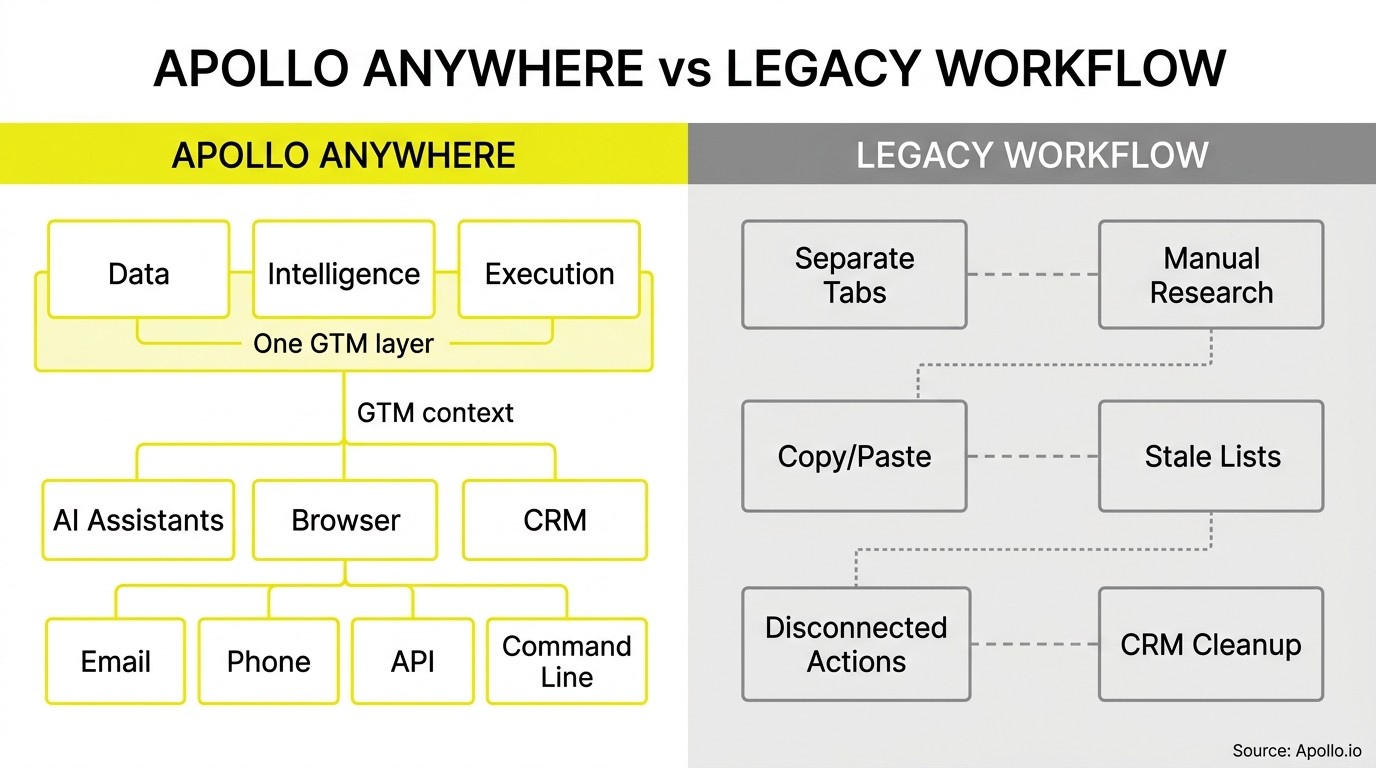
Apollo is an AI GTM system that unifies data, intelligence, and execution into one connected GTM system. It combines a verified B2B database with outbound sequencing, a built-in dialer, inbound routing, data enrichment, and AI-powered research, so sales teams can find, contact, and convert prospects without switching between tools. Apollo serves B2B GTM teams, GTM Engineers, and AI Builders building headless GTM workflows with the Apollo API, CLI, and MCP, alongside Sales Professionals, SDRs/BDRs, AEs, RevOps, Marketing, and Revenue Leaders. It is used by 100K+ paying customers, trusted by 100+ teams at Fortune 500 companies, and recognized with the 2026 MarTech Breakthrough Award for "Best AI-Powered Sales Solution".
Apollo meets sellers where they already work. Apollo MCP, Apollo's Model Context Protocol, connects Apollo's data and workflows directly into AI assistants including ChatGPT, Codex, Claude, and Perplexity, so reps can surface contact data or trigger sequences without leaving their AI environment. The Chrome extension enables prospecting across the web. For technical and advanced users, Apollo CLI provides terminal-native access for headless GTM workflows and API-driven automation.
Market adoption reflects this momentum. According to Ramp's vendor data, 34% of businesses making their first purchase in the Sales Data Providers category chose Apollo as of July 2026, the second-highest new-adopter share in the category, with overall adoption up 5 percentage points year over year.

Apollo offers transparent pricing starting at $49/user/month (annual billing), with a free tier available. Full pricing details are covered in the Pricing Comparison section below.
What is HubSpot?

HubSpot is an AI-assisted customer platform that unites marketing, sales, and customer service teams under a shared Smart CRM. Its modular structure includes dedicated hubs for Marketing, Sales, Service, Content, Data, and Revenue operations, with AI agents and assistants, collectively called Breeze AI, available across those hubs to automate tasks, generate content, and assist with reporting.
The Marketing Hub covers email marketing, social media management, ad management, SEO, and marketing automation. The Sales Hub includes pipeline management, conversation intelligence, forecasting, a sales workspace, and CPQ tools.
The Service Hub provides ticketing, a knowledge base, customer feedback surveys, and SLA management. The Content Hub adds an AI content writer, website builder, and blog tools.
The Data Hub handles data sync, data quality, and programmable automation. The Revenue Hub covers quoting, invoicing, subscriptions, and payment processing.
HubSpot's Breeze AI suite includes a Customer Agent for automated service interactions, a Prospecting Agent for outreach suggestions, and a Data Agent for smart properties and record enrichment. These AI tools operate within the HubSpot ecosystem and draw on CRM data already stored in the platform.
HubSpot is well-suited for teams that need marketing and sales aligned on a single CRM, particularly those running content-driven inbound programs alongside outbound sales motions. Its broad hub structure means a marketing team and a sales team can operate from the same platform with shared contact and pipeline data.
HubSpot offers a free tier for up to 2 users, with paid plans ranging from $7/seat/month (Starter, annual billing) to $3,600/month for Marketing Hub Enterprise. Professional and Enterprise tiers include mandatory one-time onboarding fees. Full pricing is available on HubSpot's pricing page.
Feature Comparison
| Feature | Apollo | HubSpot |
|---|---|---|
| Starting Price | $49/user/month (annual billing), view Apollo pricing | $7/seat/month, Starter (annual billing); Marketing Hub Professional $800/month (annual billing) |
| B2B Database | 240M+ people, 30M+ companies, built in, no extra subscription | No native B2B prospecting database; relies on imported contacts and Breeze AI Prospecting Agent |
| Email Accuracy | 98% | Not applicable, HubSpot does not publish a standalone email accuracy rate for contact data |
| Sequences | Multi-channel sequences (email, phone, social, tasks); AI Sequence Builder; unlimited on paid plans | Email sequences in Sales Hub; automation workflows in Marketing Hub |
| Dialer | Power Dialer and Parallel Dialer with AI call scripts, auto-logging, voicemail drop, and manager coaching | Calling available in Sales Hub; integrated with CRM records |
| AI Capabilities | AI Research Agent, AI Sequence Builder, AI call scripts, buyer intent signals, AI sentiment analysis | Breeze AI: Customer Agent, Prospecting Agent, Data Agent, AI content generation, AI summarization |
| Data Enrichment | Waterfall enrichment, CRM enrichment, CSV enrichment, API enrichment with 65+ data attributes | Data Hub includes data sync, smart properties, and data quality tools; AI Data Agent for enrichment |
| Free Trial | Free tier with 900 credits/year; no credit card required | Free tier for up to 2 users with basic features across hubs |
The clearest structural difference is that Apollo includes a built-in B2B contact database, outbound sequencing, and a native dialer as core features across its plans. HubSpot's strength is breadth, connecting marketing, sales, service, and content teams on a shared CRM.
Teams that primarily need outbound prospecting and engagement will find Apollo's native data and execution capabilities purpose-built for that workflow, while teams running complex inbound and marketing programs may find HubSpot's hub structure more relevant.
Turn Funnel Gaps Into Pipeline With Apollo
Tired of watching marketing leads stall before they ever reach your pipeline? Apollo surfaces high-intent prospects and arms your team with the context to convert faster. 600K+ companies trust Apollo to keep forecasts accurate and funnels full.
Start Free with Apollo →Pricing Comparison
Apollo's pricing is available at apollo.io/pricingand uses transparent, per-seat annual billing:
- Free: $0, 900 credits/year, 2 sequences, basic filters
- Basic: $49/user/month (annual billing), 30,000 credits/year, unlimited sequences, CRM integrations, 6 intent topics
- Professional: $79/user/month (annual billing), 48,000 credits/year, US dialer, 5 mailboxes, automated workflows, AI research
- Organization: $119/user/month (annual billing, min 3 users), 72,000 credits/year, international dialer, 15 mailboxes, SSO, advanced security
HubSpot's pricing structure is more complex due to its multi-hub model. The Starter tier is $7/seat/month (annual billing) or $20/seat/month (monthly billing).
Marketing Hub Professional is $800/month (annual billing) or $890/month (monthly billing), includes 3 Core Seats and 2,000 marketing contacts, and requires a one-time Professional Onboarding fee of $3,000. Marketing Hub Enterprise is $3,600/month (annual billing), includes 5 Core Seats and 10,000 marketing contacts, and requires a one-time Enterprise Onboarding fee of $7,000.
Sales Hub Professional is $90/seat/month (annual billing) with a one-time onboarding fee of $1,500. Sales Hub Enterprise is $150/seat/month (annual billing) with a one-time onboarding fee of $3,500.
Additional marketing contacts are sold in increments of 1,000 from $50/month. HubSpot Credits are available at $9.00 per 1,000 credits (annual billing), with usage consumed by AI agents, for example, 100 credits per recommended outreach for one lead via the Prospecting Agent.
Teams evaluating total cost of ownership should account for HubSpot's onboarding fees, contact-tier pricing, and the potential need to subscribe to multiple hubs to match a workflow that Apollo covers in a single plan.

How Apollo Differs from HubSpot
Apollo's most significant differentiator is that sales intelligence and execution are built into the same system. Reps prospect from the same platform where they run sequences, make calls, and track deal progress.
There is no need to export lists to a separate engagement tool or subscribe to a third-party data provider to populate CRM records.
Apollo's AI capabilities are built around the outbound motion specifically: the AI Research Agent surfaces context on prospects before calls, the AI Sequence Builder creates personalized sequences from natural language prompts, and buyer intent signals surface in-market accounts directly in the prospecting workflow. These are native features, not add-ons priced separately.
According to Ramp's Sales Data Providers category data, Apollo is the fastest-growing vendor in the category as of July 2026, averaging +0.7 percentage points in adoption per month, outpacing all other vendors in the category. A 22% competitor switch rate (more than double ZoomInfo's 10%) reflects teams actively consolidating onto Apollo from other tools.

For teams using HubSpot as their CRM, Apollo integrates directly with HubSpot via bi-directional sync, enriching records, routing inbound leads, and pushing sequence activity back into HubSpot without replacing it. Apollo can function as the prospecting and engagement layer on top of HubSpot's CRM.
"Apollo consolidates prospecting, engagement, and analytics, reducing the need for multiple separate tools.", Collin Stewart, CEO at Predictable Revenue
"Apollo enriches everything we have: contacts, leads, accounts...And we don't really have to touch it, it just works.", Mark Turner, VP of Revenue Operations at Built In
Frequently Asked Questions
Can Apollo replace HubSpot as a CRM?
Apollo includes CRM functionality for managing contacts, accounts, deals, and pipeline, and integrates bi-directionally with HubSpot via Apollo Integrations. Teams that rely heavily on HubSpot's marketing automation, service ticketing, or content tools typically run both platforms together, using Apollo for prospecting and outbound while keeping HubSpot as the CRM of record. Teams whose primary need is outbound sales may find Apollo sufficient as a standalone system.
Does HubSpot include a B2B contact database for prospecting?
HubSpot does not include a native B2B prospecting database comparable to Apollo's. The Breeze AI Prospecting Agent can suggest outreach, but it operates from contacts already in your HubSpot CRM rather than pulling from an external database.
Teams that need to build prospect lists from scratch typically supplement HubSpot with a separate data source.
Who is Apollo designed for?
Apollo serves B2B GTM teams, GTM Engineers, and AI Builders building headless GTM workflows with the Apollo API, CLI, and MCP, alongside Sales Professionals, SDRs/BDRs, AEs, RevOps, Marketing, and Revenue Leaders. It is used by teams across company sizes, from early-stage startups to 100+ teams at Fortune 500 companies.
Is Apollo's data accurate enough for outbound at scale?
As detailed in the feature comparison above, Apollo publishes a 98% email accuracy rate. Apollo's Living Data Network continuously validates and refreshes contact records. Users on G2 consistently note data quality as a primary reason for choosing Apollo for outbound workflows.
Which platform is better for marketing teams?
HubSpot's Marketing Hub is purpose-built for marketing teams, offering email campaigns, social media management, ad management, SEO tools, and advanced marketing automation. Apollo's marketing capabilities focus on outbound sequences, inbound lead routing, and form enrichment.
Teams running content-driven inbound programs will find HubSpot's Marketing Hub more feature-complete for that use case. Teams focused on outbound demand generation will find Apollo's native data and sequencing more directly applicable.

Conclusion
Apollo and HubSpot serve different primary use cases. HubSpot is a multi-hub customer platform built to align marketing, sales, and service teams on a shared CRM.
Apollo is an AI GTM system built to accelerate outbound pipeline generation, with B2B data, sequencing, dialing, and AI research in one connected system. The two platforms are not mutually exclusive, many teams run Apollo on top of HubSpot to add prospecting and engagement capabilities to their existing CRM.
For teams whose primary goal is finding and converting more B2B pipeline, Apollo's native data, AI-powered execution, and transparent pricing make it the purpose-built choice. Try Apollo free today and see how it fits your GTM workflow.
Prove Pipeline ROI Before Next Quarter
Quota pressure mounting while leadership demands clearer ROI on every tool? Apollo delivers measurable pipeline impact from day one. Teams like Leadium 3x'd annual revenue — your board meeting just got easier.
Schedule a Demo →Don't miss these
Sales
Inbound vs Outbound Marketing: Which Strategy Wins?
Sales
What Is a Sales Funnel? The Non-Linear Revenue Framework for 2026
Sales
What Is a Go-to-Market Strategy? The 2026 GTM Playbook
See Apollo in action
We'd love to show how Apollo can help you sell better.
By submitting this form, you will receive information, tips, and promotions from Apollo. To learn more, see our Privacy Statement.
4.7/5 based on 9,690 reviews
