
Apollo vs Lusha (2026): Features, Pricing & Which Platform Wins for B2B Sales
Choosing between Apollo and Lusha comes down to one fundamental question: do you need a B2B data source, or do you need a complete go-to-market system? Both platforms give sales teams access to verified contact data, but they diverge sharply in scope, execution tools, and pricing model.
This guide breaks down what each platform actually offers so you can decide which fits your workflow.

Research Less, Pipeline More With Apollo
Tired of burning hours verifying contacts that go nowhere? Apollo delivers 240M+ business contacts with 98% email accuracy so your reps spend time selling, not searching. Start building real pipeline today.
Start Free with Apollo →Key Takeaways
- Platform scope: Apollo is an AI GTM system combining data, sequencing, dialing, and analytics in one connected GTM system. Lusha focuses on contact and company data with some engagement features at higher tiers.
- Database coverage: Apollo provides a database of 240M+ people and 30M+ companies with 98% email accuracy. Lusha claims a database of 300M+ contacts and 30M+ company profiles.
- Built-in engagement: Apollo includes multi-channel sequences, a power and parallel dialer, and automated workflows across all paid plans. Lusha includes automated email sequences on its free tier and conversation intelligence at higher credit costs.
- Audience: Apollo serves B2B GTM teams, GTM Engineers, and AI Builders building headless GTM workflows with the Apollo API, CLI, and MCP, alongside Sales Professionals, SDRs/BDRs, AEs, RevOps, Marketing, and Revenue Leaders.
- Pricing transparency: Apollo publishes all plan prices publicly. Lusha also publishes pricing for its Starter, Pro, and Premium tiers, with Scale tier pricing available on request.
What is Apollo?

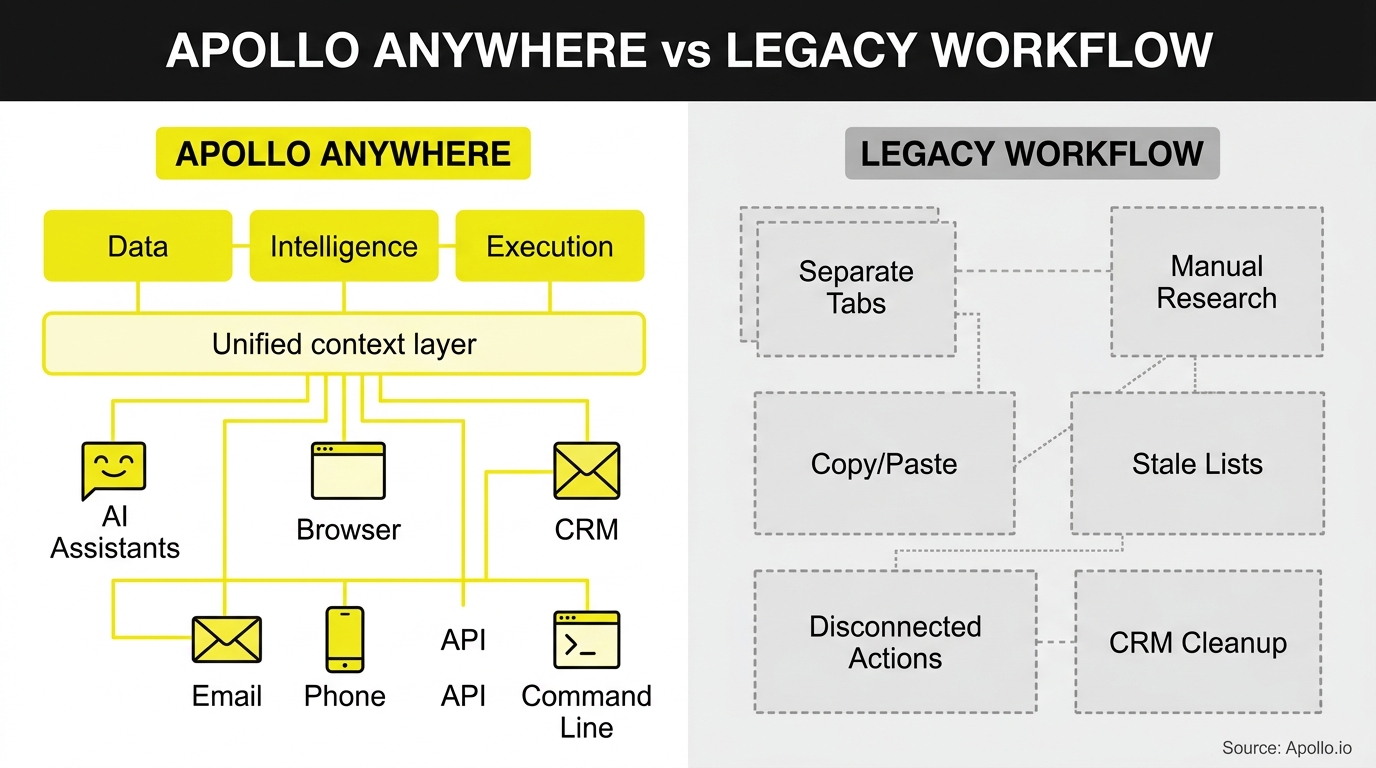
Apollo is an AI GTM system that unifies data, intelligence, and execution into one connected GTM system, serving B2B GTM teams, GTM Engineers, and AI Builders alongside Sales Professionals, SDRs/BDRs, AEs, RevOps, Marketing, and Revenue Leaders. With a database of 240M+ people and 30M+ companies, Apollo gives teams the contact data, prospecting filters, engagement tools, and analytics they need without stitching together separate subscriptions. Apollo has earned recognition as a 2026 MarTech Breakthrough Award winner for "Best AI-Powered Sales Solution" and holds a 4.7/5 G2 rating with 100K+ paying customers across 600K+ companies, including 100+ teams at Fortune 500 companies.
Apollo meets sellers where they already work. Apollo MCP, Apollo's Model Context Protocol, connects the platform directly to AI assistants including ChatGPT, Codex, Claude, and Perplexity, so sellers can pull prospect data and trigger outreach without leaving the tools they use daily. The Chrome extension lets reps surface contact details across the web, and for technical users and GTM Engineers building headless workflows, Apollo CLI provides terminal-native access to the full Apollo platform.
According to Ramp's vendor data, as of July 2026, Apollo holds a 38% adoption rate among businesses that have purchased a Sales Data Provider tool, up 5 percentage points year-over-year, reflecting consistent growth in real-world spend across Ramp's customer base.

Apollo offers transparent pricing starting at $49/user/month (annual billing), with a free tier available to test the platform before committing.
What is Lusha?

Lusha is a B2B data and intelligence platform designed for GTM teams and AI agents. The platform provides access to contact and company data enriched with buying signals and business context, with the goal of helping teams identify and connect with decision-makers.
Lusha claims a database of 300M+ contacts and 30M+ company profiles, with firmographic and technographic data available alongside verified emails and direct dials. The platform includes a Chrome extension for revealing contact details while browsing, native CRM integrations with Salesforce, HubSpot, Zoho, and Monday.com, and API plus webhook access for grounding AI agents and CRM workflows in B2B data.
Lusha also offers compatibility with AI tools including ChatGPT, Claude, Gemini, and Perplexity, along with automation support through Zapier, Make, n8n, and Clay.
On the intelligence side, Lusha includes predictive features for ICP scoring, lookalike modeling, and account prioritization. The GTM Workspace feature is designed to help teams manage prospect lists and unify CRM data.
At higher tiers, Lusha adds buying intent topics (up to 25 on the Scale tier), AI recommendations, conversation intelligence for recorded calls, and team management capabilities.
Lusha's credit model applies different credit costs depending on the data type: verified emails cost 1 credit each, phone numbers cost 5 credits each, and conversation intelligence for a recorded call costs 8 credits. This tiered credit pricing means phone and call data can consume credits significantly faster than email-only workflows.
Lusha's platform carries security and compliance certifications including GDPR, CCPA, ISO 31700, and SOC 2 Type 2. It serves SDRs, BDRs, and GTM teams ranging from small businesses to companies requiring Scale-tier custom arrangements.
Pricing for Lusha's Starter, Pro, and Premium tiers is publicly listed at Lusha's pricing page, starting at $37.45/month billed yearly for a single seat. The Scale tier requires contacting their sales team for customized pricing.

Feature Comparison
| Feature | Apollo | Lusha |
|---|---|---|
| Starting Price | $49/user/month (annual billing); Free tier available | $37.45/month billed yearly (Starter, 1 seat); Free tier available (40 credits/month) |
| B2B Database | 240M+ people, 30M+ companies | Lusha claims 300M+ contacts, 30M+ company profiles |
| Email Accuracy | 98% | Lusha claims 98% email accuracy |
| Sequences | Multi-channel sequences (email, phone, social) on all paid plans; 2 sequences on free tier | Automated email sequences included on free tier; multi-channel engagement at higher tiers |
| Dialer | Power Dialer and Parallel Dialer included on Professional and Organization plans | Conversation intelligence for recorded calls (8 credits per call); dialing capabilities vary by plan |
| AI Capabilities | AI Research Agent, AI Sequence Builder, AI-generated call summaries, AI sentiment analysis, 500% YoY AI platform growth | AI assistant (Starter+), AI search, AI recommendations, ICP scoring, lookalike modeling |
| Data Enrichment | Waterfall enrichment, CRM enrichment, CSV enrichment, API enrichment; bi-directional sync with Salesforce and HubSpot | Bulk enrichment (Starter+), CSV enrichment (Pro+), API enrichment (Pro+), Signals and sales intelligence enrichment (1 credit per data point) |
| Free Trial | Free tier with 900 credits/year; no credit card required | Free tier with 40 credits/month; no credit card required |
The table above highlights one clear structural difference: Apollo bundles prospecting data, multi-channel sequences, and a dialer into its paid plans, while Lusha's engagement depth increases with plan tier and credit consumption. Teams that need both data and execution in one workflow will find Apollo's structure more consolidated.
Teams focused primarily on data lookup and enrichment will find both platforms offer a comparable starting point, with differences emerging as usage scales.
Turn Funnel Guesswork Into Real Pipeline
Pipeline forecasting a guessing game because leads stall before they ever reach your reps? Apollo surfaces in-market buyers the moment they're ready, turning top-of-funnel chaos into predictable revenue. Nearly 5M users already know the difference.
Start Free with Apollo →Pricing Comparison
Apollo's full pricing breakdown (annual billing) is available at apollo.io/pricing:
- Free: $0, 900 credits/year, 2 sequences, basic filters
- Basic: $49/user/month, 30,000 credits/year, unlimited sequences, CRM integrations, 6 intent topics
- Professional: $79/user/month, 48,000 credits/year, US Power and Parallel Dialer, 5 mailboxes, automated workflows, AI research
- Organization: $119/user/month (min. 3 users), 72,000 credits/year, international dialer, 15 mailboxes, SSO, advanced security controls
Lusha's pricing tiers (annual billing), sourced from Lusha's pricing page:
- Free: $0, 40 credits/month, 1 seat, no credit card required
- Starter: $37.45/month billed yearly, 4,800 credits/year, 1 seat, includes bulk enrichment and AI assistant
- Pro: $52.45/month billed yearly, 7,200 credits/year, 2 seats, adds API and CSV enrichment
- Premium: $299.95/month billed yearly, 40,800 credits/year, 5 seats, adds API Advanced and team management
- Scale: Contact sales, custom credits and seats, 50%+ off price per credit, 25 buying intent topics, SSO, unlimited results
One important factor in comparing credit volumes: Lusha's phone numbers cost 5 credits each, and conversation intelligence for a recorded call costs 8 credits. Teams doing significant call-based outreach will consume credits faster than email-focused workflows.
Apollo's Professional plan includes the Power and Parallel Dialer as part of the plan itself, without additional per-call credit deductions. Both platforms use credit-based models for data enrichment, so reviewing per-action credit costs alongside plan volumes is essential when evaluating total cost at your expected usage.
How Apollo Differs from Lusha
The most meaningful difference between Apollo and Lusha is what happens after you find a contact. Apollo connects prospecting directly to execution: once a rep identifies a prospect, they can add that contact to a multi-channel sequence, queue them for a Power or Parallel Dialer session, and track engagement outcomes all within the same workspace. There is no context switch to a separate engagement tool. As Collin Stewart, CEO at Predictable Revenue, put it: "We reduced the complexity of three tools into one."
Apollo's AI layer goes beyond data lookup. The AI Research Agent automates pre-call and pre-email research.
The AI Sequence Builder generates sequences from natural language prompts. AI-generated call summaries push automatically to the CRM, and AI sentiment analysis surfaces which prospects are most engaged.
These capabilities are built into the platform's paid plans rather than gated behind separate modules.
For teams building automated GTM workflows, Apollo's API, Apollo MCP, and CLI give technical users programmatic access to data enrichment, prospecting, and engagement at scale. Lusha also offers API and MCP access, but Apollo's architecture is designed around GTM Engineers and AI Builders as a primary audience, not just as an add-on capability.
Market adoption data reinforces Apollo's momentum. According to Ramp's Sales Data Providers category data, as of July 2026, Apollo is the fastest-growing vendor in the Sales Data Providers category, averaging +0.7 percentage points of adoption per month, and captured 34% of first-time buyers entering the category in the same period.

Apollo's inbound capabilities also extend beyond what a data-only platform offers. Website visitor identification, form enrichment, form shortening, and owner-led AI nurture sequences are built into the platform, turning Apollo into a tool for both outbound prospecting and inbound pipeline capture.
Teams building a full GTM motion, from finding prospects outbound to converting inbound visitors, can run both workflows from one place.
Frequently Asked Questions
Is Apollo better than Lusha for outbound sales?
For teams running multi-channel outbound, Apollo provides more built-in execution. As detailed in the feature comparison above, Apollo includes sequences, a Power and Parallel Dialer, and automated workflows on paid plans.
Lusha's engagement features grow with plan tier and credit availability. If outbound execution is central to your workflow, Apollo consolidates that stack in one platform.
Can I try Apollo before paying?
Yes. Apollo offers a free tier with no credit card required.
As covered in the pricing section above, the free plan includes 900 credits per year and access to core prospecting and filtering features. Lusha also offers a free tier with 40 credits per month.
How do Apollo and Lusha compare for data enrichment?
Both platforms support CRM enrichment, CSV enrichment, and API-based enrichment. Apollo's waterfall enrichment runs records through multiple validation sources in a customizable order.
Lusha charges 1 credit per Signals and sales intelligence enrichment point, with phone reveals costing 5 credits each. The right choice depends on your data volume, enrichment frequency, and whether you need enrichment integrated with engagement triggers.
Who is Apollo built for?
Apollo serves B2B GTM teams, GTM Engineers, and AI Builders building headless GTM workflows with the Apollo API, CLI, and MCP, alongside Sales Professionals, SDRs/BDRs, AEs, RevOps, Marketing, and Revenue Leaders. The platform scales from individual contributors testing outbound to teams running coordinated, automated GTM programs.
Does Apollo integrate with my existing CRM?
Apollo integrates with Salesforce, HubSpot, Zoho CRM, and Pipedrive, along with 50+ tools through its integrations marketplace. Bi-directional CRM sync with data writing rules is available on paid plans.

Conclusion
Apollo and Lusha both offer B2B contact data with verified emails, phone numbers, and enrichment capabilities. Where they diverge is in what surrounds that data.
Lusha is built around data access, with engagement features growing as you move up tiers. Apollo is built as an AI GTM system where data, engagement, and analytics operate as a single connected system from the start.
For teams that need verified contact data alongside sequences, dialing, AI-assisted research, and inbound capture without managing multiple tools, Apollo delivers that in one place. For teams that have strong engagement tools in place and need a standalone data layer, Lusha is a focused option worth evaluating at its lower entry tiers.
If you want to see how a unified data-and-execution platform performs for your team, try Apollo free today with no credit card required.
Ramp Reps Faster, Hit Quota Sooner
ROI pressure mounting while new reps take months to ramp? Apollo gives every rep a repeatable playbook from day one. Teams like Leadium tripled annual revenue by building scalable outreach that works at any team size.
Start Free with Apollo →Don't miss these
Sales
Inbound vs Outbound Marketing: Which Strategy Wins?
Sales
What Is a Sales Funnel? The Non-Linear Revenue Framework for 2026
Sales
What Is a Go-to-Market Strategy? The 2026 GTM Playbook
See Apollo in action
We'd love to show how Apollo can help you sell better.
By submitting this form, you will receive information, tips, and promotions from Apollo. To learn more, see our Privacy Statement.
4.7/5 based on 9,690 reviews
