
Apollo vs Calendly (2026): Features, Pricing & Which Platform Wins for Sales Teams
When evaluating Apollo vs Calendly, you are looking at two platforms that solve different problems in the sales workflow. Calendly handles scheduling.
Apollo handles the entire go-to-market motion: finding prospects, engaging them across channels, and converting interest into pipeline. For teams evaluating where to invest their sales tech budget in 2026, understanding the scope difference matters.
This comparison covers features, pricing, and the key questions B2B sales teams are asking when they search for the right platform.

Research Less, Close More With Apollo
Tired of burning hours verifying contact info that goes nowhere? Apollo delivers 240M+ accurate business contacts so your reps spend time selling, not searching. Nearly 5M users have already made the switch.
Start Free with Apollo →Key Takeaways
- Platform Scope: Calendly is a scheduling tool; Apollo is an AI GTM system that covers prospecting, engagement, dialing, and analytics in one connected GTM system.
- Sales Intelligence: Apollo includes a 240M+ person B2B database with 98% email accuracy; Calendly does not offer contact data or sales intelligence.
- AI Capabilities: Apollo offers AI-powered sequencing, lead scoring, call summaries, and research agents; Calendly's AI features focus on routing and scheduling automation.
- Who Each Platform Serves: Calendly serves individual professionals through Fortune 500 scheduling teams; Apollo serves B2B GTM teams, GTM Engineers, and AI Builders building headless GTM workflows with the Apollo API, CLI, and MCP, alongside Sales Professionals, SDRs/BDRs, AEs, RevOps, Marketing, and Revenue Leaders.
- Complementary vs. Competitive: Many teams use both tools, with Calendly handling booking links and Apollo driving outbound prospecting and engagement.
What is Apollo?

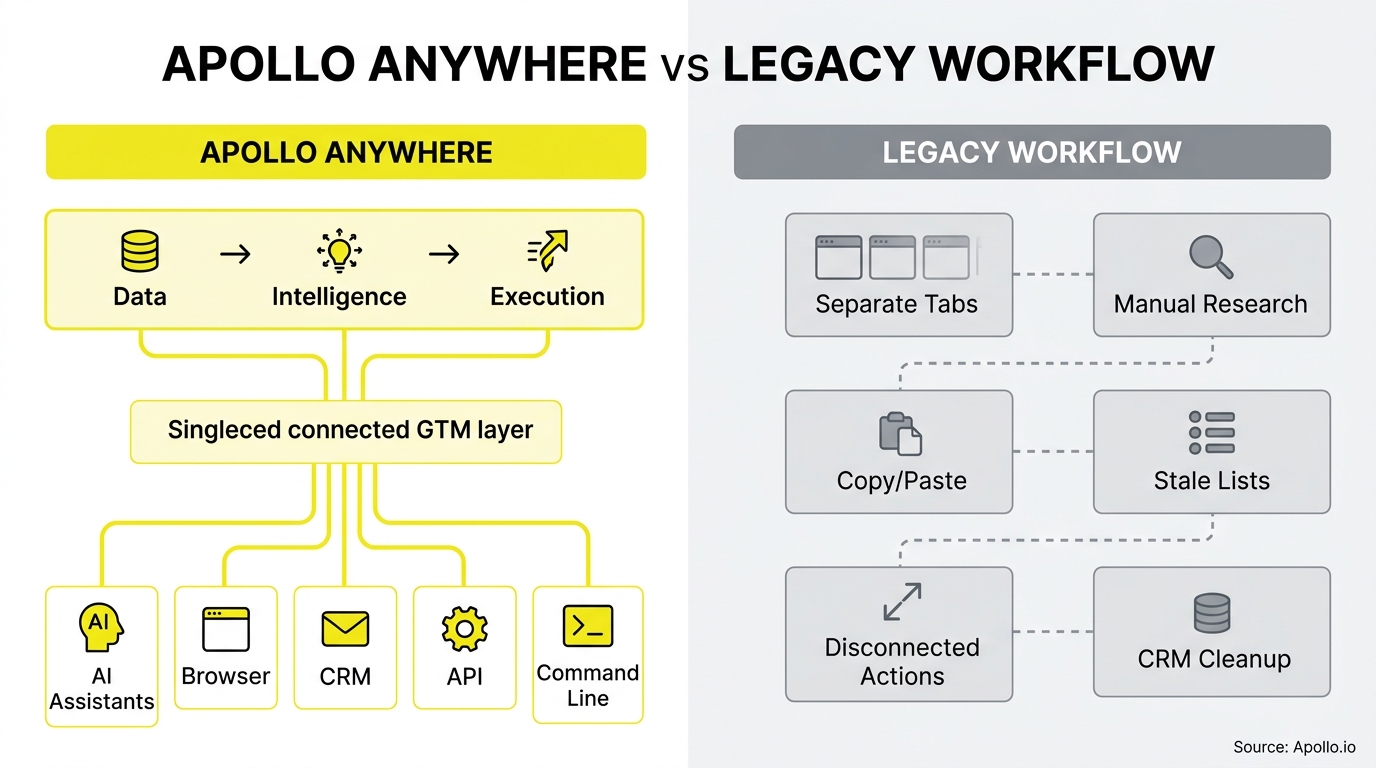
Apollo is an AI GTM system that unifies data, intelligence, and execution into one connected GTM system, built open by design so sellers get value without switching contexts. The platform covers the full outbound motion: building targeted prospect lists from a database of 240M+ people and 30M+ companies, executing multi-channel sequences across email, phone, and social, and improving performance through AI-driven analytics. With AI sales automation baked into every stage, Apollo also powers inbound conversion through form enrichment, routing, and owner-led nurture sequences.
Apollo meets sellers where they already work. Through Apollo MCP, Apollo's Model Context Protocol, sales and GTM teams can surface prospect data and trigger workflows directly inside AI assistants like ChatGPT, Codex, Claude, and Perplexity. The Chrome extension brings prospecting intelligence across the web. For technical and advanced users, Apollo CLI provides terminal-native access for headless GTM workflows and API-driven automation.
According to Ramp's vendor data, Apollo holds a 38% adoption rate among businesses purchasing in the Sales Data Providers category as of July 2026, up 5 percentage points year-over-year, with 33% of first-time category buyers choosing Apollo. Apollo is trusted by nearly 5M users across 600K+ companies, including 100+ teams at Fortune 500 companies, and has earned the 2026 MarTech Breakthrough Award for "Best AI-Powered Sales Solution" and recognition as a G2 Leader across multiple categories.

Apollo offers transparent pricing starting at $49/user/month (annual billing), with a free tier available. The full pricing breakdown is covered in the Pricing Comparison section below.
What is Calendly?
Calendly is an automated scheduling platform that eliminates back-and-forth emails by allowing users to share their availability through booking links. The platform connects with up to six calendars to show real-time availability and automates meeting reminders and follow-ups via email and SMS.
Calendly's core feature set includes customizable event types (one-on-one, group, round-robin, and collective meetings), routing forms that qualify and direct website visitors to the appropriate booking page, and payment collection during booking through Stripe and PayPal integrations. The platform integrates with 100+ business tools including Zoom, Salesforce, HubSpot, Marketo, Pardot, and Zapier.
On the team coordination side, Calendly supports round-robin distribution, multi-host meetings, meeting polls for group scheduling, and admin management tools for oversight. Enterprise-tier features include Salesforce lookup routing, Microsoft Dynamics 365 integration, SSO and SAML, domain control, audit logs, and a data deletion API.
Calendly is positioned as a scheduling layer that works on top of existing sales and marketing workflows. It does not include a B2B contact database, outbound sequencing, a dialer, or sales intelligence capabilities.
Teams using Calendly for sales typically combine it with separate prospecting and engagement tools to run a complete outbound motion.
Calendly serves individual professionals, small teams, and larger organizations across industries. Its free tier supports personal use with one event type, while paid plans unlock team scheduling, CRM integrations, and routing logic.

Feature Comparison
| Feature | Apollo | Calendly |
|---|---|---|
| Starting Price | $49/user/mo (annual billing) | $10/seat/mo (annual billing) |
| B2B Database | 240M+ people, 30M+ companies | Not included |
| Email Accuracy | 98% | Not applicable |
| Sequences | Multi-channel email, phone, social sequences with AI builder | Automated meeting reminders and follow-up workflows |
| Dialer | Power Dialer and Parallel Dialer with AI call summaries | Not included |
| AI Capabilities | AI research agent, lead scoring, sequence builder, call coaching, sentiment analysis | Routing logic and scheduling automation |
| Data Enrichment | Waterfall enrichment, CRM sync, CSV and API enrichment | Not included |
| Free Trial | Free tier with 900 credits/year (no time limit) | Free tier (1 event type) + 14-day trial of paid plans |
The comparison above highlights that Apollo and Calendly operate in adjacent but distinct spaces. Calendly delivers scheduling automation with solid CRM and video conferencing integrations.
Apollo covers the full pipeline-generation motion: identifying prospects, executing outreach, calling, enriching data, and optimizing performance. Teams evaluating these platforms are often asking whether they need a scheduling layer, a prospecting and engagement engine, or both.
Turn Funnel Chaos Into Forecast Confidence
Pipeline forecasting a guessing game? Apollo surfaces in-market buyers before they go cold, turning weak top-of-funnel into real opportunities. Top sales teams close with confidence — not crossed fingers.
Schedule a Demo →Pricing Comparison
Apollo's full pricing breakdown (annual billing, per Apollo's pricing page):
- Free: $0, 900 credits/year, 2 sequences, basic filters
- Basic: $49/user/month, 30,000 credits/year, unlimited sequences, CRM integrations, 6 intent topics
- Professional: $79/user/month, 48,000 credits/year, US dialer, 5 mailboxes, automated workflows, AI research
- Organization: $119/user/month (min 3 users), 72,000 credits/year, international dialer, 15 mailboxes, SSO, advanced security
Calendly's pricing breakdown (per Calendly's pricing page, annual billing):
- Free: Always free, 1 event type, 1 calendar connection
- Standard: $10/seat/month (annual), $12/seat/month (monthly), unlimited event types, up to 6 calendars, HubSpot and Zapier integrations, automated reminders
- Teams: $16/seat/month (annual), $20/seat/month (monthly), Salesforce integration, round-robin meetings, lead routing, HubSpot/Marketo/Pardot form integrations, SSO available as an add-on
- Enterprise: Starts at $15,000/year, contact sales for full details, includes Salesforce lookup routing, Microsoft Dynamics 365, SSO and SAML, audit logs, dedicated onboarding
The platforms serve different purchasing decisions. Calendly's Standard and Teams tiers are priced per seat at a lower per-user cost, reflecting its narrower scheduling focus.
Apollo's pricing includes a credit-based model for data enrichment and contact exports, and each paid tier bundles prospecting data, engagement execution, and analytics together. For teams that would otherwise purchase a data provider, a sequencing tool, and a dialer separately, Apollo consolidates that spend into one platform.
"We paid less for one tool than for two tools together...we cut our costs in half.", Sylvain Giuliani, Head of Growth & Operations at Census
How Apollo Differs from Calendly
The core difference is platform scope. Calendly solves one specific problem: making it easy for prospects or customers to book time on your calendar.
Apollo is built to generate that demand in the first place. Where Calendly starts when someone is already interested enough to book, Apollo starts at the top of the funnel: identifying who to reach, enriching their contact data, building personalized outreach sequences, and calling through prioritized lists with AI-researched scripts.
For outbound-driven sales teams, Apollo's sales engagement platform handles multi-channel sequences, Power and Parallel Dialers, AI sentiment analysis, and outbound analytics in one workspace. Apollo also covers inbound conversion through form enrichment, intelligent routing, and automated nurture sequences triggered on form submission. Calendly's routing forms serve a similar inbound qualification function at a lighter depth.
According to Ramp's Sales Data Providers category data as of July 2026, Apollo is the fastest-growing vendor in the category, averaging +0.7 percentage points in adoption per month, ahead of all other vendors tracked. That growth reflects teams actively consolidating their sales data and engagement tooling rather than running point solutions in parallel.

Apollo also integrates with Calendly for teams that want to keep both. Apollo sequences can include booking link steps, and Calendly meetings can feed back into CRM workflows Apollo manages.
The platforms are not mutually exclusive, but Apollo provides the broader GTM infrastructure that makes those Calendly meetings possible in the first place.
"We reduced the complexity of three tools into one.", Collin Stewart, CEO at Predictable Revenue
Frequently Asked Questions
Is Apollo a replacement for Calendly?
Not directly. Calendly is a dedicated scheduling tool; Apollo is an AI GTM system that covers prospecting, engagement, data enrichment, and analytics.
Teams can use both together: Apollo to generate demand and run outbound sequences, and Calendly to handle booking links within those sequences. However, Apollo's inbound routing features do overlap with some Calendly routing functionality, so teams should evaluate based on their specific scheduling complexity.
Does Apollo include scheduling features?
Apollo includes inbound routing capabilities such as round-robin booking, multi-host meetings, and criteria-based routing, which handle many of the same use cases as Calendly's Teams-tier features. For teams whose scheduling needs are tied directly to their sales funnel, Apollo's built-in routing may be sufficient.
Teams with more complex, cross-departmental scheduling requirements may still find value in a dedicated scheduling tool.
Who is Apollo best suited for?
Apollo serves B2B GTM teams, GTM Engineers, and AI Builders building headless GTM workflows with the Apollo API, CLI, and MCP, alongside Sales Professionals, SDRs/BDRs, AEs, RevOps, Marketing, and Revenue Leaders. The platform scales from early-stage teams running lean outbound motions to organizations requiring SSO, advanced security, and comprehensive admin controls through the Organization tier.
How does Apollo's free tier compare to Calendly's free plan?
Both platforms offer permanent free tiers. Calendly's free plan supports one event type and one calendar connection, which works for individual professionals managing their own booking page.
Apollo's free tier provides contact database access, basic sequencing, and credits for prospecting, as detailed in the pricing section above. The two free tiers serve different functions: scheduling convenience vs.
Sales prospecting.
Can Apollo and Calendly be used together?
Yes. Many sales teams use Apollo for outbound prospecting and sequence execution, and include Calendly booking links as a step in those sequences.
When a prospect books through Calendly, that activity can flow back into CRM records Apollo manages through integrations with Salesforce and HubSpot. The two platforms complement each other rather than conflict.

Conclusion
Apollo and Calendly occupy different positions in the sales stack. Calendly is a focused scheduling tool that makes it easier for prospects to book time.
Apollo is an AI GTM system that creates the pipeline, runs the outreach, and converts interest into meetings at every stage of the funnel. For teams asking whether they need better scheduling or better prospecting and engagement infrastructure, the answer often depends on where their biggest bottleneck sits.
For B2B sales teams looking to consolidate their data, engagement, and analytics into one platform built for the full GTM motion, try Apollo free today.
Ramp Reps Faster, Hit Quota Sooner
Quota slipping while new reps take months to ramp? Apollo gives every rep a scalable playbook, verified contacts, and AI-powered outreach from day one. 600K+ companies see ROI fast.
Start Free with Apollo →Don't miss these
Sales
Inbound vs Outbound Marketing: Which Strategy Wins?
Sales
What Is a Sales Funnel? The Non-Linear Revenue Framework for 2026
Sales
What Is a Go-to-Market Strategy? The 2026 GTM Playbook
See Apollo in action
We'd love to show how Apollo can help you sell better.
By submitting this form, you will receive information, tips, and promotions from Apollo. To learn more, see our Privacy Statement.
4.7/5 based on 9,690 reviews
