
Top 6 Zoho Alternatives for Revenue Teams in 2026
Zoho CRM is a customer relationship management platform built for organizing leads, contacts, deals, and sales activities, with capabilities spanning sales-force automation, lead management, process automation, AI, and analytics for small businesses through mature sales organizations. It's a common starting point for teams that need a low-cost CRM, but as revenue teams scale, many find they need deeper sales intelligence, built-in data enrichment, and multi-channel execution tools that go beyond core CRM record-keeping.
That's when teams start evaluating Zoho alternatives. The right replacement depends on what you're optimizing for: some teams need a sales intelligence database with verified contact data, others need engagement and dialer tools baked in, and others want a single system that unifies prospecting, outreach, and CRM data without stitching together multiple vendors.
Budget matters too, since per-seat pricing, credit systems, and add-on costs vary widely across the market.
This guide compares six platforms revenue teams evaluate as Zoho alternatives in 2026, starting with Apollo, an AI GTM system that unifies data, intelligence, and execution, followed by five more tools with genuinely different strengths depending on your team's size and workflow.

Apollo Ends Hours Of Manual Lead Research
Still buried in spreadsheets hunting for accurate emails and phone numbers? Apollo verifies contact data instantly with 98% email accuracy, so reps spend time selling, not searching. Join 600K+ companies building pipeline faster.
Start Free with Apollo →Key Takeaways
- Sales Intelligence Capabilities: Apollo combines a large contact and company database with built-in enrichment, while other alternatives specialize in either data (ZoomInfo) or CRM workflow (Pipedrive, Attio).
- AI Features: Apollo's AI Assistant, AI Sequence Builder, and AI dialer scripts sit alongside AI agents from HubSpot, Pipedrive, and Attio, each built for different parts of the sales process.
- Customer Base: Apollo serves B2B GTM teams, GTM Engineers, and AI Builders building headless GTM workflows with the Apollo API, CLI, and MCP, alongside Sales Professionals, SDRs/BDRs, AEs, RevOps, Marketing, and Revenue Leaders, while others like HighLevel focus on agencies and Attio targets startups scaling revenue operations.
- Platform Scope: Apollo unifies prospecting, engagement, dialing, and enrichment; ZoomInfo splits its offering across Sales, Marketing, and Talent packages; HubSpot centers on marketing and CRM with credit-based AI add-ons.
Apollo
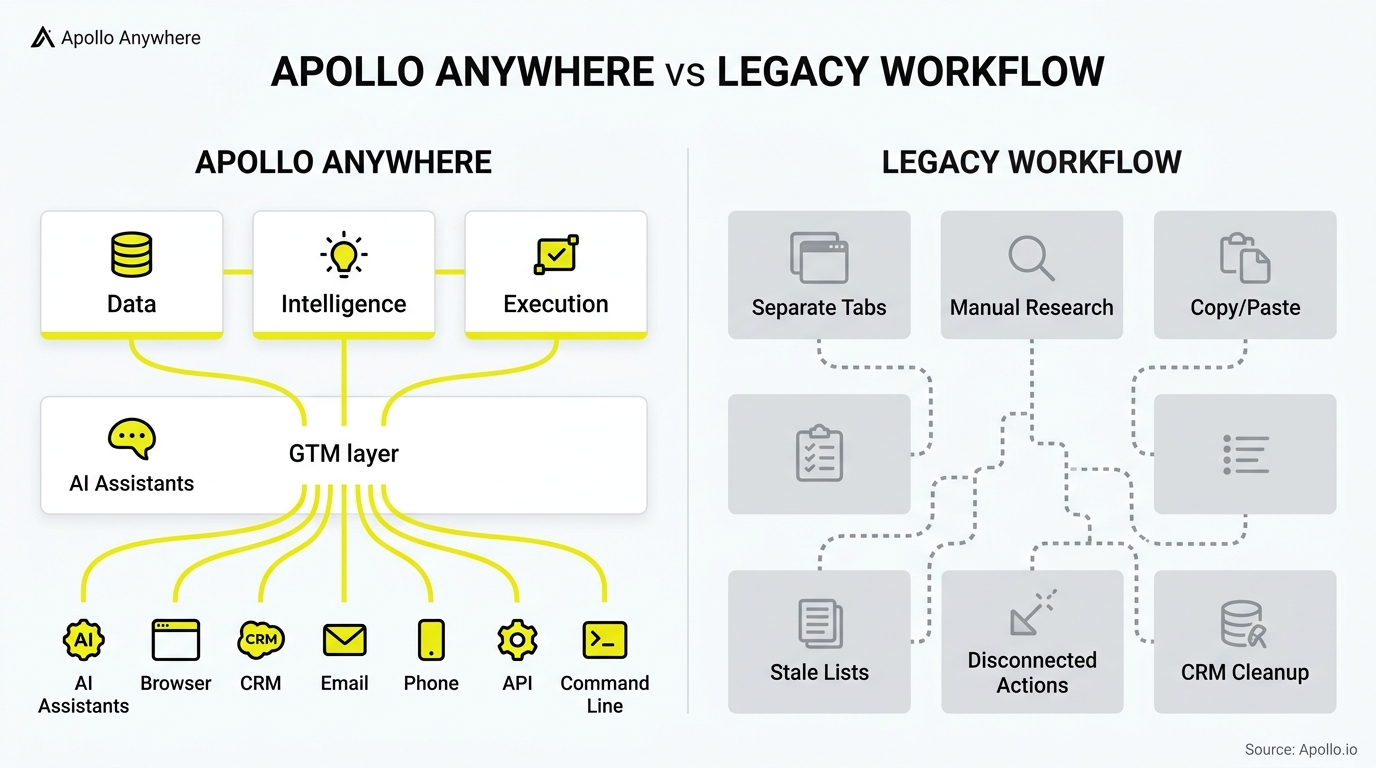
Apollo is an AI GTM system that unifies data, intelligence, and execution. Built open by design, Apollo meets sellers inside the tools they already use, from AI assistants like ChatGPT, Codex, Claude, and Perplexity via Apollo MCP, Apollo's Model Context Protocol, to the Chrome extension and Salesforce, rather than asking teams to switch contexts to get value. For technical and advanced users, Apollo CLI provides terminal-native access for headless GTM workflows.
Apollo's database includes 240M+ people and 30M+ companies with 98% email accuracy, continuously validated by Apollo's Living Data Network rather than treated as a static list. On the outbound side, Apollo helps teams define an ICP, let the AI Assistant find and rank accounts, verify contact data, and run multi-channel sequences across email, calls, and social with a Power Dialer and Parallel Dialer built in. On the inbound side, Apollo Inbound captures website visitors, enriches short forms, and routes leads automatically. Data Enrichment rounds things out with waterfall enrichment, CRM sync, CSV enrichment, and API access for bulk jobs, using 65+ filters for precise targeting.
Pricing is structured across four tiers on annual billing: Free at $0 with 900 credits per year, 2 sequences, and basic filters; Basic at $49/user/month with 30,000 credits/year, unlimited sequences, and CRM integrations; Professional at $79/user/month adding a US dialer, 5 mailboxes, and AI research; and Organization at $119/user/month (minimum 3 users) with international dialing, 15 mailboxes, SSO, and advanced security. Full details are available on Apollo's pricing page. Apollo integrates with Salesforce, HubSpot, Zoho CRM, Pipedrive, Outreach, SalesLoft, and more, with 50+ tools in its marketplace.
Customers describe the impact of consolidating their stack around Apollo. Kevin Warner, CEO at Leadium, said: "Apollo became the single source of truth for uswhere everything originates from and where all the data returns to." Collin Stewart, CEO at Predictable Revenue, added: "We reduced the complexity of three tools into one." Mark Turner, VP of Revenue Operations at Built In, noted: "Apollo enriches everything we have: contacts, leads, accounts...And we don't really have to touch it, it just works."
According to Ramp's vendor data, Apollo holds the #1 new adopter rank among Sales Data Providers with a 30% new adopter share as of September 2026, and mid-market companies represent Apollo's largest customer segment by company size. Enterprise adoption rose from 26% in January 2026 to 31% in July 2026. Apollo serves B2B GTM teams across startups, growing teams, mid-market, and enterprise. Separately, Ramp's Sales Data Providers category data shows Apollo as the fastest-growing vendor in the category, averaging the highest month-over-month adoption growth of any tracked vendor as of September 2026.


Apollo holds a 4.7/5 G2 rating and earned 624 badges in G2's Winter 2026 Report, along with the 2025 MarTech Breakthrough Award for "Best AI-Powered Sales Solution". Apollo serves B2B GTM teams, GTM Engineers, and AI Builders building headless GTM workflows with the Apollo API, CLI, and MCP, alongside Sales Professionals, SDRs/BDRs, AEs, RevOps, Marketing, and Revenue Leaders, giving it a broader footprint than tools built for a single function or team size.
HubSpot

HubSpot is an agentic customer platform with tools for marketing, sales, and customer service, built around an AI-assisted Smart CRM. Marketing Hub helps teams generate leads and automate campaigns, while the broader platform unifies customer data across the customer journey.
Key features include unified customer data, email marketing, live chat, marketing automation, ad management, and Agent Hub for AI agents. Pricing on the official pricing page starts with a Free tier for up to 2 users, then Starter at $20/mo/seat monthly ($7/mo/seat annually) with 500 HubSpot Credits, Professional starting at $890/mo monthly ($800/mo annually) including 3 core seats and 3,000 credits plus a required one-time $3,000 onboarding fee, and Enterprise starting at $3,600/mo with 5 core seats, 5,000 credits, and a required $7,000 onboarding fee. HubSpot also sells AEO tracking separately at $50/mo ($45/mo annually) for prompt tracking across answer engines.
- Pros: Free tier available for small teams; unifies marketing, sales, and service data in one Smart CRM; Agent Hub adds AI agents for customer-facing workflows.
- Pros: Extensive marketplace of marketing integrations and campaign tools.
- Cons: Professional and Enterprise tiers carry mandatory one-time onboarding fees on top of subscription costs.
- Cons: Credit-based usage for AI features (Customer Agent, Data Agent) adds a layer of cost tracking beyond the seat price.
Get a full breakdown of how Apollo compares to HubSpot.
Pipedrive
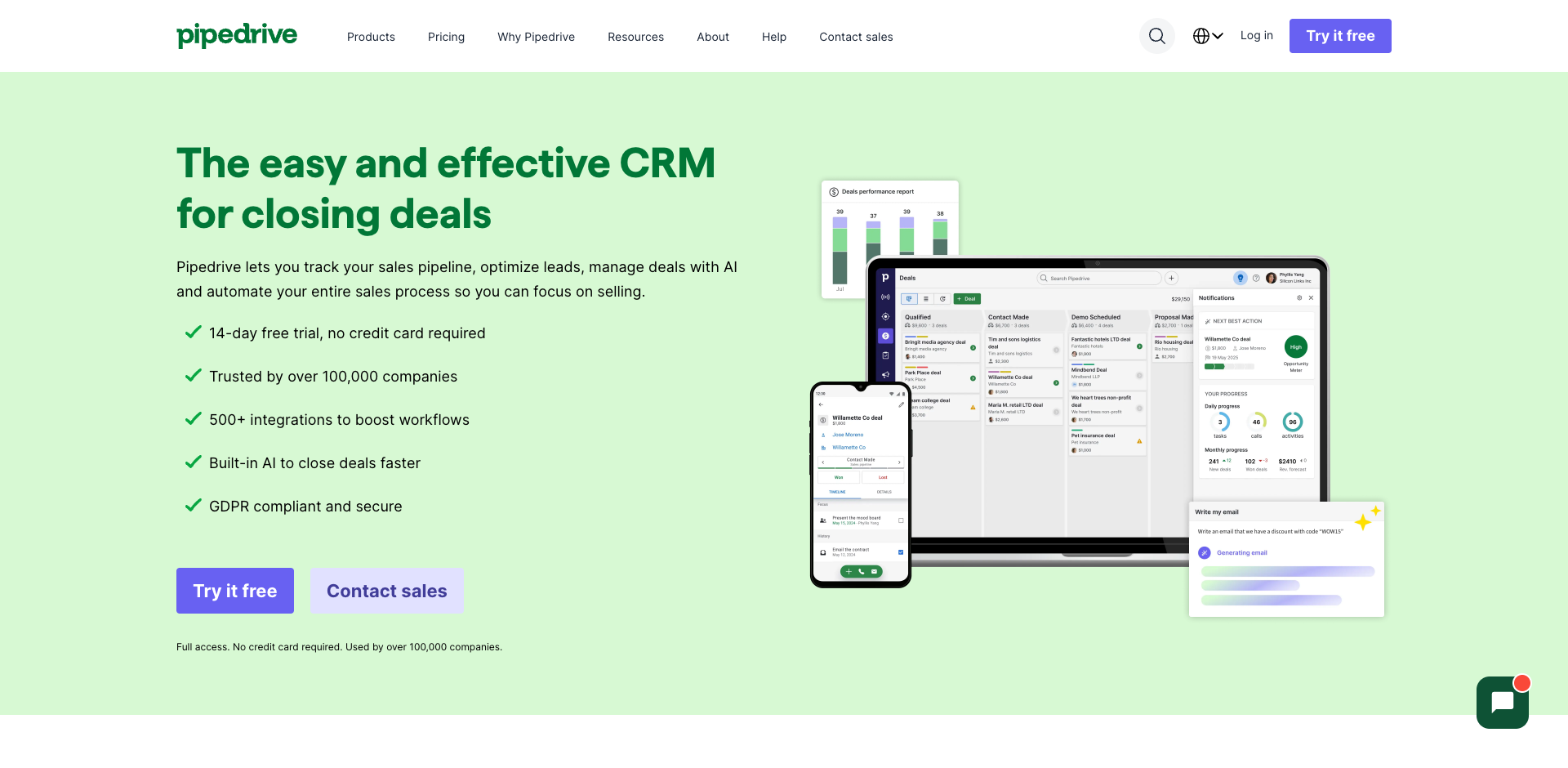
Pipedrive is a CRM built around activity-based selling, helping teams organize leads and deals, visualize and customize pipelines, automate workflows, and use AI and reporting features to move opportunities toward close.
Key features include visual pipeline management, lead qualification and prioritization, workflow automation, email sync and tracking, an AI sales assistant, and 500+ integrations. According to the official pricing page, billed annually, Lite is $14/seat/month, Growth is $39/seat/month, Premium is $59/seat/month (marked most popular), and Ultimate is $79/seat/month; monthly billing runs from $24 to $99/seat/month across the same tiers. Add-ons like LeadBooster (from $32.50), Projects (from $16), and Campaigns (from $13.33) carry separate charges.
- Pros: Visual, customizable pipeline interface with a 14-day free trial and no credit card required.
- Pros: AI-powered report creation and email tools included at multiple tiers.
- Cons: Lead generation and data enrichment features are reserved for the Premium and Ultimate tiers, not included at entry-level pricing.
- Cons: Add-ons like LeadBooster and Web Visitors carry additional monthly charges beyond the base subscription.
Related:Apollo vs Pipedrive

Attio
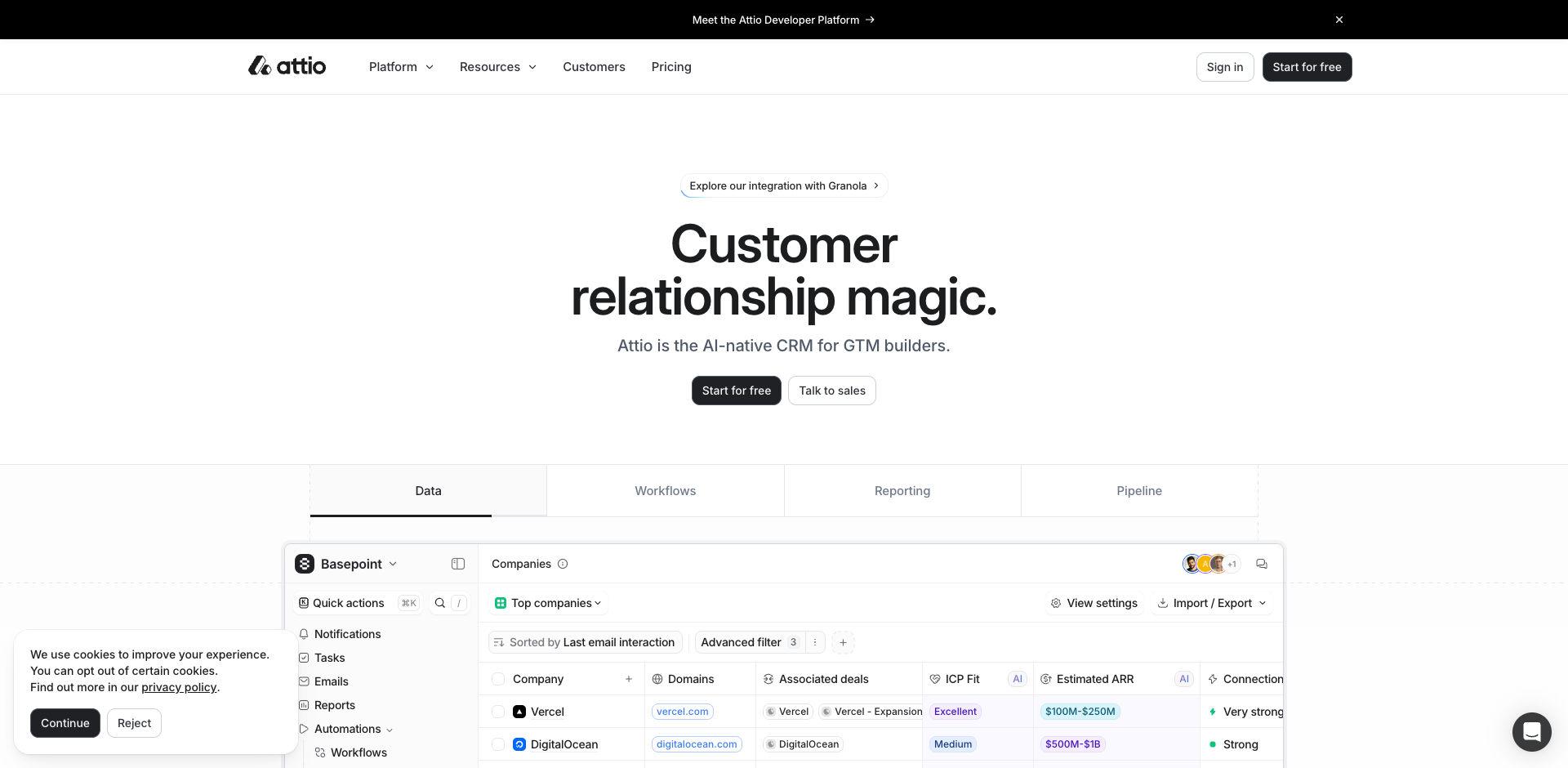
Attio is a CRM for agentic revenue that helps teams build pipeline, advance deals, and grow accounts, with contact syncing, enrichment, sales intelligence, reporting, workflows, and AI agents built for go-to-market work.
Key features include real-time contact syncing, automatic data enrichment, Call Intelligence and sequences, permission controls, and advanced reporting. Per the official pricing page, Free is $0/user/month for up to 3 seats with 100 seat credits per user, Plus is $35/user/month annually (up to 10 seats, 500 seat credits), Pro is $79/user/month annually (unlimited seats, 1,000 seat credits, Call Intelligence and sequences), and Enterprise pricing is available by requested quote, with unlimited objects, teams, and security controls. Additional workspace credits can be purchased starting at $85/month.
- Pros: Real-time contact syncing and automatic enrichment included from the Free tier.
- Pros: Credit-based system scales with usage, and Pro tier unlocks Call Intelligence and sequences.
- Cons: Free and Plus tiers cap seats at 3 and 10 respectively, limiting growth before upgrading.
- Cons: Workspace and seat credit limits require add-on purchases once usage grows past included allotments.
Apollo vs Attio, here's everything you need to know.
Turn Cold Leads Into Sales-Ready Deals
Good leads dying before they ever hit a rep's calendar? Apollo scores and routes prospects the moment buying signals appear, so marketing's best leads actually convert. Built-In saw win rates climb using Apollo's signals and guidance.
Start Free with Apollo →HighLevel
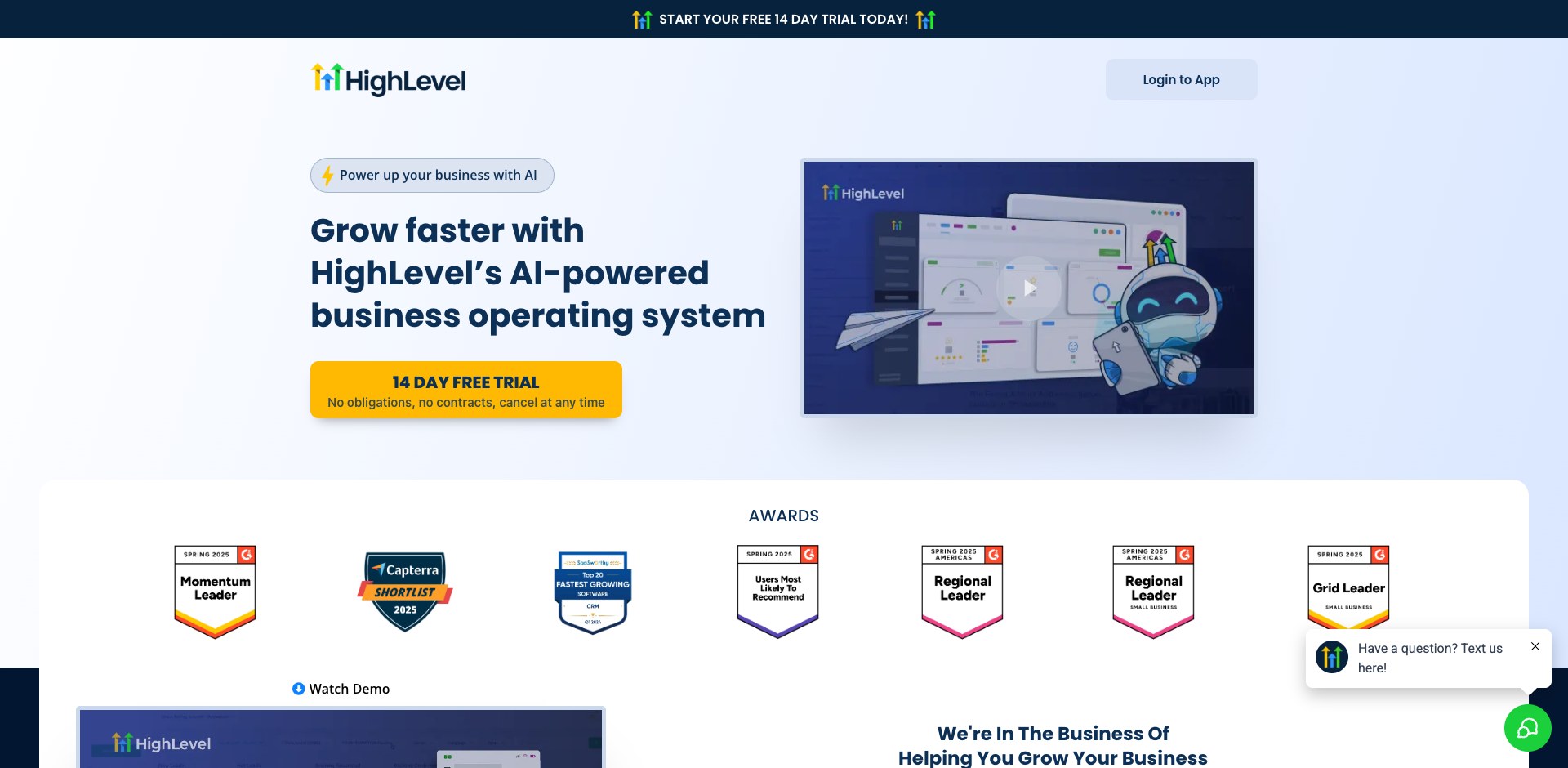
HighLevel describes itself as an AI-assisted business operating system, combining CRM, marketing automation, funnels, messaging, scheduling, reputation management, and payments in one platform for businesses and agencies.
Key features include Conversation AI, Voice AI, a website and funnel builder, CRM and pipelines, and unified conversations across channels. Per the official pricing page, Starter is $97/month ($970/year) with 3 sub-accounts and unlimited users, Unlimited is $297/month ($2,970/year) with unlimited sub-accounts and no-markup phone/email rebilling, and Agency Pro is $497/month ($4,970/year) with SaaS Mode and automated sub-account creation. Usage-based charges apply for telecom and premium AI services, and numerous add-ons (AI Employee plans, HIPAA compliance, white label mobile app) carry separate fees.
- Pros: Unlimited users and contacts included even at the Starter tier.
- Pros: Broad feature set spanning funnels, messaging, and reputation management for agencies managing multiple client accounts.
- Cons: Usage-based charges for phone, SMS, and AI features add variable costs on top of the flat subscription.
- Cons: Many capabilities (premium prospecting, SEO, dedicated IPs) are sold as separate paid add-ons rather than included in the base plans.
ZoomInfo
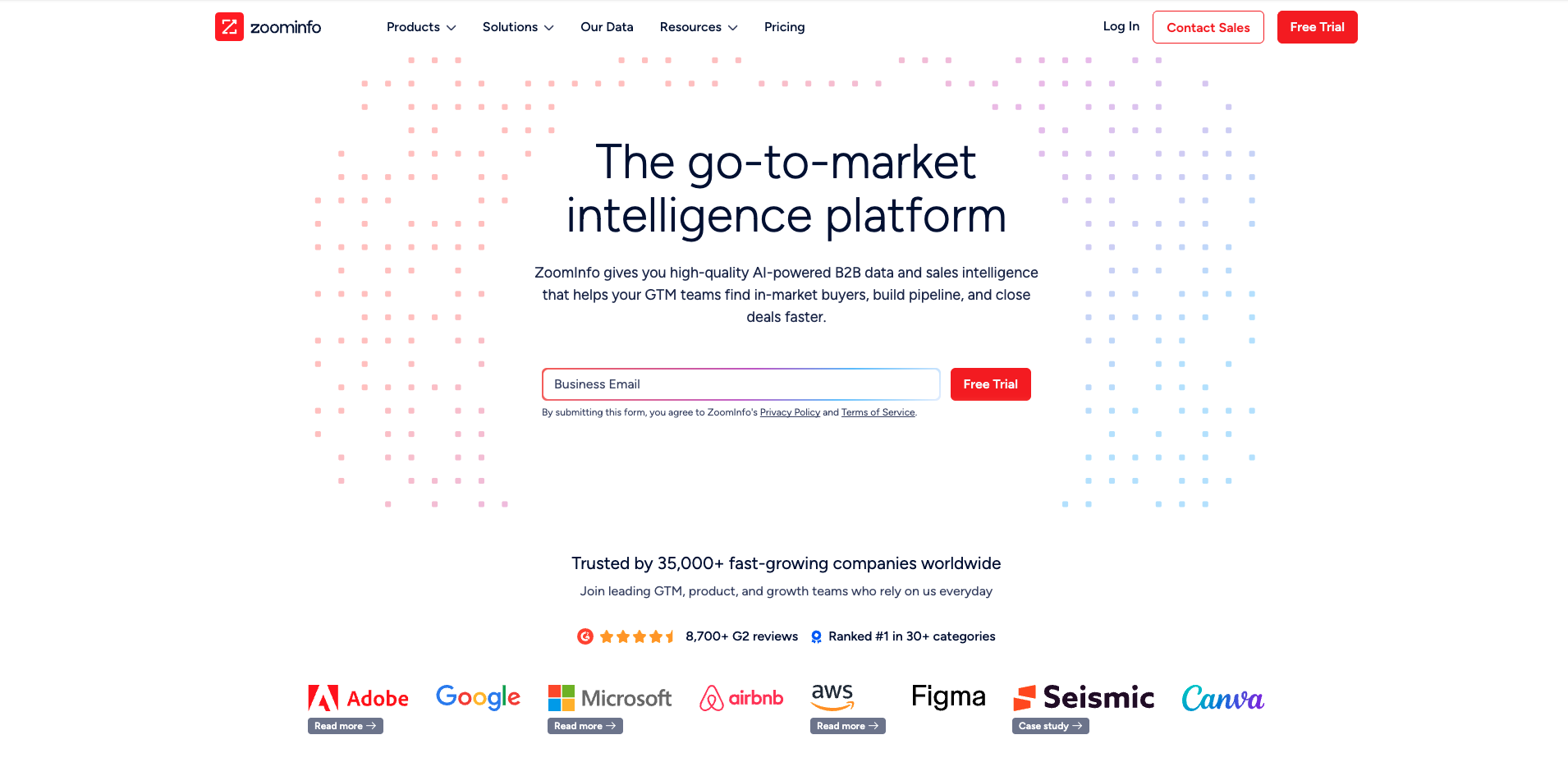
ZoomInfo offers flexible packages spanning B2B contact and company data and go-to-market applications, helping teams identify, connect with, and engage buyers using contact data, company intelligence, intent signals, and AI capabilities.
Key features include comprehensive contact and company profiles, buying intent signals, tailored prospect lists with alerts, and AI-powered email generation and dialing. ZoomInfo's official pricing page displays "View pricing" and "Get a demo" prompts rather than published figures across its Sales, Marketing, and Talent packages, so ZoomInfo's pricing is not publicly displayed. According to Vendr, the median Avg Contract Value is $33,500, based on 1,012 deals handled and data from 1,571 purchases.
- Pros: Extensive contact and company database with intent signals and account scoring through its Copilot tier.
- Pros: Separate Sales, Marketing, and Talent packages let teams pick the applications relevant to their function.
- Cons: ZoomInfo's pricing is not publicly displayed, requiring a sales conversation for exact quotes.
- Cons: Multiple package tiers (Professional, Copilot, Copilot Enterprise) can make it harder to determine which features are included at what cost upfront.
Here's a detailed comparison of Apollo vs ZoomInfo.
Comparison Table
| Platform | Starting Price | Free Tier | Sales Intelligence | Dialer Included | AI Features |
|---|---|---|---|---|---|
| Apollo | $49/user/month (annual) | Yes ($0, 900 credits/year) | 240M+ people, 30M+ companies, 98% email accuracy | Yes (Power/Parallel Dialer) | AI Assistant, AI Sequence Builder, AI research |
| Zoho | $14/user/month (annual, Standard) | Yes (3 users) | Lead management, omnichannel engagement | Built-in calling (Standard+) | AI agents (Professional+) |
| HubSpot | $7/mo/seat (annual, Starter) | Yes (up to 2 users) | Smart CRM, marketing contacts | No (native dialer not listed) | Agent Hub, Customer/Data Agents (credit-based) |
| Pipedrive | $14/seat/month (annual, Lite) | No (14-day trial) | Company data enrichment (Premium+) | No (add-on required) | AI sales assistant, AI email/report tools |
| Attio | $35/user/month (annual, Plus) | Yes ($0, up to 3 seats) | Automatic data enrichment, Call Intelligence (Pro) | Yes (Pro tier) | AI agents, automations |
| HighLevel | $97/month (Starter) | No (14-day trial) | CRM and pipelines, native CRM record data | Voice AI (add-on pricing) | Conversation AI, Voice AI |
| ZoomInfo | Not publicly displayed (Vendr: $33,500 median ACV) | No | Contact/company database, intent signals | Intelligent dialing (Copilot tiers) | AI email generation, account summaries |
Zoho's Standard tier starts at $14/user/month billed annually ($20/user/month billed monthly), scaling to Professional at $23/user/month and Enterprise at $40/user/month, per Zoho's pricing page.
How to Choose the Right Zoho Alternative
Start with what your team actually needs to execute, not just store. If your priority is a connected system that handles prospecting, enrichment, multi-channel outreach, and dialing without stitching together multiple vendors, Apollo's structure, with its Living Data Network for continuously validated contact data, spanning Free through Organization tiers, fits startups, mid-market teams, and enterprise organizations that need SSO and advanced security.
If your primary need is marketing automation layered onto a CRM, HubSpot's Marketing Hub tiers are worth evaluating, though budget for onboarding fees at the Professional and Enterprise levels. Teams focused purely on visual pipeline management with lighter data needs may find Pipedrive's activity-based structure sufficient, while startups wanting an agentic CRM with built-in enrichment from day one should look at Attio.
Agencies managing multiple client accounts under one roof often gravitate toward HighLevel's sub-account model. And teams whose primary requirement is a large, dedicated contact and company database with intent signals, separate from CRM or engagement tooling, often evaluate ZoomInfo's packages directly.
Whatever you choose, map your evaluation to actual workflows: how leads get captured, enriched, routed, and worked, not just what a pricing page promises. For further reading on execution mechanics, see Apollo's guides on sales prospecting and lead generation strategies.
Frequently Asked Questions
Why do teams look for Zoho alternatives?
Teams often outgrow Zoho CRM's core record-keeping functions when they need deeper sales intelligence, built-in data enrichment, or multi-channel outreach execution rather than a general-purpose CRM layer alone.
What makes Apollo the best Zoho alternative?
As detailed in the Apollo section above, Apollo serves B2B GTM teams, GTM Engineers, and AI Builders building headless GTM workflows with the Apollo API, CLI, and MCP, alongside Sales Professionals, SDRs/BDRs, AEs, RevOps, Marketing, and Revenue Leaders, combining data, intelligence, and execution in one connected system.
Is Apollo affordable for small teams?
Apollo offers a Free tier at $0/month for teams getting started, and a Basic tier at $49/user/month on annual billing for teams that need unlimited sequences and CRM integrations. Full tier details are outlined in the Apollo section above.
How does pricing compare across these Zoho alternatives?
Pricing models vary significantly: some, like Attio and HubSpot, offer free tiers with credit-based usage limits; others, like ZoomInfo, require contacting sales for a quote. As covered in the comparison table above, per-seat pricing for entry tiers ranges from roughly $14 to $97 per month depending on the platform and billing cycle.
Which Zoho alternative includes a built-in dialer?
Apollo includes a Power Dialer and Parallel Dialer starting at the Professional tier, as noted in the Apollo section above. Attio includes Call Intelligence at its Pro tier, and ZoomInfo offers intelligent dialing through its Copilot packages.

Conclusion
Zoho CRM works well as a low-cost starting point for record management, but revenue teams that need sales intelligence, enrichment, and multi-channel execution together typically look elsewhere. Among the six alternatives compared here, HubSpot, Pipedrive, Attio, HighLevel, and ZoomInfo each solve for specific pieces of the GTM puzzle, whether that's marketing automation, pipeline visualization, agentic CRM workflows, agency operations, or dedicated contact data.
Apollo stands out by bringing data, intelligence, and execution together in one connected go-to-market system, backed by a large, continuously validated database, AI-powered research and dialing tools, and flexible pricing from Free through Organization tiers. Combined with its open design that meets sellers inside the AI tools, browsers, and CRMs they already use, Apollo gives revenue teams a foundation that scales from startup to enterprise without demanding a rebuild every time the team grows.
Turn Tool Spend Into Measurable Pipeline
Struggling to prove ROI before the next budget review? Apollo replaces scattered point solutions with one platform your team actually adopts fast. Leadium tripled annual revenue after automating outbound with Apollo.
Start Free with Apollo →Don't miss these
Sales
Inbound vs Outbound Marketing: Which Strategy Wins?
Sales
What Is a Sales Funnel? The Non-Linear Revenue Framework for 2026
Sales
What Is a Go-to-Market Strategy? The 2026 GTM Playbook
See Apollo in action
We'd love to show how Apollo can help you sell better.
By submitting this form, you will receive information, tips, and promotions from Apollo. To learn more, see our Privacy Statement.
4.7/5 based on 9,690 reviews
