
Apollo vs Attio (2026): Features, Pricing & Best Use Cases
Choosing between Apollo and Attio comes down to a fundamental question: do you need a CRM that manages relationships, or a GTM platform that finds, engages, and converts prospects? Both tools include AI-assisted workflows and pipeline management, but they are built for different jobs.
This comparison covers features, pricing, and real differentiators so you can make the right call for your team.

Apollo Turns Hours of Research Into Seconds
Tired of burning your best selling hours on manual lead research and dead-end contact data? Apollo surfaces verified contacts instantly so your team spends time closing, not digging. Nearly 5M users have already made the switch.
Start Free with Apollo →Key Takeaways
- Platform scope: Apollo is an AI GTM system combining a 240M+ person B2B database, sequences, dialer, and analytics. Attio is a CRM focused on relationship tracking, pipeline visibility, and workflow automation.
- Built-in prospecting: Apollo includes a native B2B database with 98% email accuracy so teams can find and contact new prospects without a separate data subscription. Attio enriches existing contacts but does not include outbound prospecting data.
- Engagement tools: Apollo includes multi-channel sequences, a power dialer, and a parallel dialer. Attio's Pro plan includes call intelligence and sequences, focused on managing existing pipeline.
- Audience: Apollo serves B2B GTM teams, GTM Engineers, and AI Builders building headless GTM workflows with the Apollo API, CLI, and MCP, alongside Sales Professionals, SDRs/BDRs, AEs, RevOps, Marketing, and Revenue Leaders. Attio targets growing startups and scale-ups managing customer relationships.
- Pricing model: Apollo offers transparent public pricing starting at $49/user/month (annual billing) with a free tier. Attio also publishes pricing starting at $29/user/month (annual billing) with a free tier of up to 3 seats.
What is Apollo?

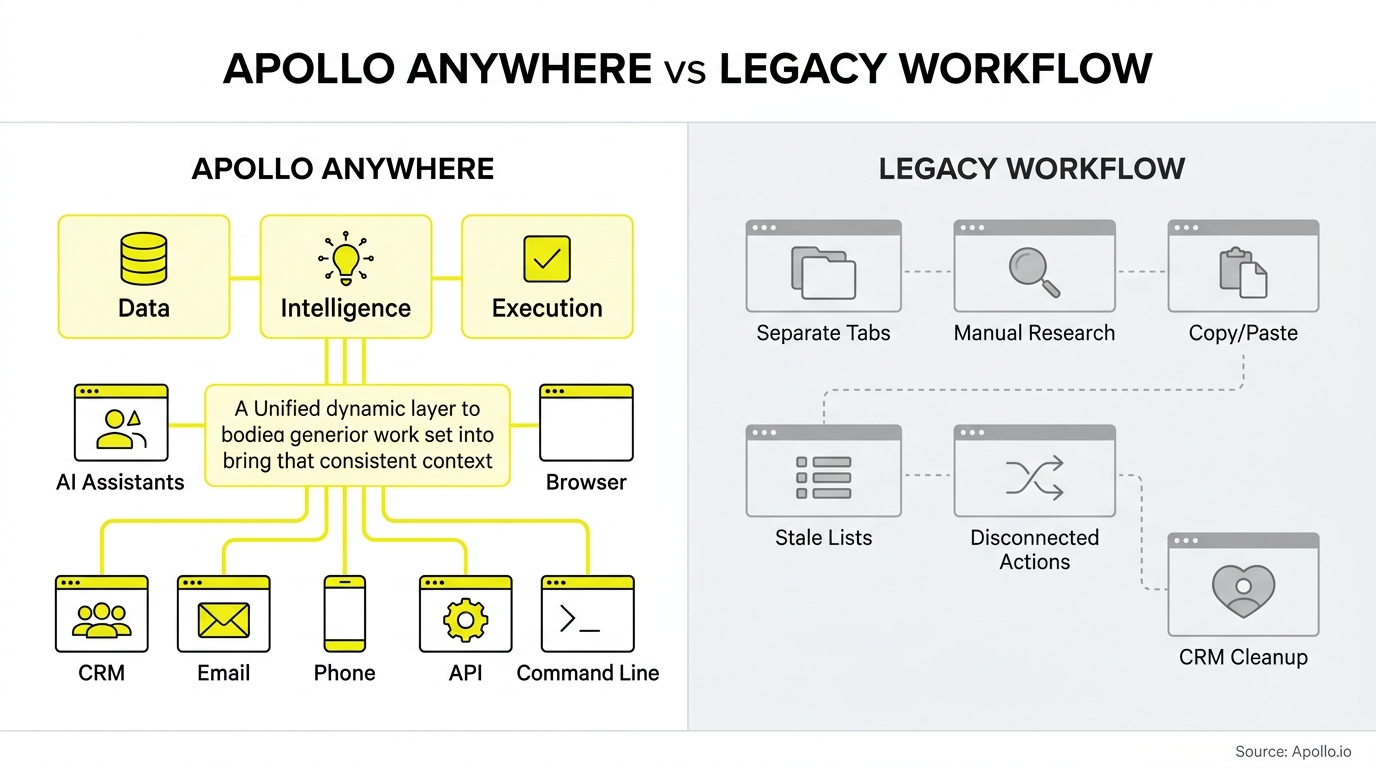
Apollo is an AI GTM system that unifies data, intelligence, and execution into one connected GTM system, built for teams that need to generate pipeline and convert prospects, not just track them. The platform covers the full outbound motion: finding verified contacts, running multi-channel sequences, dialing prospects, enriching CRM records, and measuring results, all from a single workspace.
Apollo's database includes 240M+ people and 30M+ companies, with 98% email accuracy verified through the platform's Living Data Network. Trusted by Anthropic, Redis, Smartling, and 100K+ paying customers, Apollo is used across teams of every size. Users on G2 have awarded Apollo a 4.7/5 rating, and the platform received the 2026 MarTech Breakthrough Award for "Best AI-Powered Sales Solution".
Apollo meets sellers where they already work. Apollo MCP, Apollo's Model Context Protocol, connects Apollo data and workflows directly into AI assistants including ChatGPT, Codex, Claude, and Perplexity, so reps can prospect and research without switching tools. The Chrome extension lets users pull contact data and start sequences from anywhere across the web. For technical users and GTM Engineers building headless workflows, Apollo CLI provides terminal-native access to the full Apollo platform.
According to Ramp's vendor data, Apollo holds a 38% adoption rate in its software category as of July 2026, up 5 percentage points year-over-year, with 34% of first-time category buyers choosing Apollo, and a 22% competitor switch rate reflecting active momentum across market segments.

Apollo offers transparent pricing starting at $49/user/month (annual billing), with a free tier available.
What is Attio?

Attio is an AI-assisted CRM platform designed for growing startups and scale-ups. The product centers on a flexible, customizable data model that lets teams define their own objects, attributes, and relationships, making it adaptable to different business models and sales processes.
Attio's core capability is its Universal Context layer, which creates a unified view of customer data by syncing email and calendar activity in real time. This gives revenue teams a consolidated record of every interaction without requiring manual data entry.
The platform includes automated workflows for lead routing, nurturing, and follow-ups, as well as a reporting suite covering funnel analytics and revenue metrics.
On the Pro plan and above, Attio includes call intelligence with automatic call recording, transcription, and analysis, along with sequences for managing outreach to existing contacts. The platform also offers automatic data enrichment from connected email and calendar accounts.
Attio includes AI features through its Ask Attio assistant, which provides business insights and answers from within the platform. The product supports native integrations with email, calendar, data warehouses, and billing systems, along with sales engagement tools.
Enterprise security features include ISO 27001 certification, SSO, and SCIM provisioning.
Attio's pricing is publicly available at attio.com/pricing. The Free plan supports up to 3 seats with 250 workspace credits per month. The Plus plan starts at $29/user/month (annual billing) or $36/user/month billed monthly. The Pro plan is $69/user/month (annual billing) or $86/user/month billed monthly and adds call intelligence, sequences, and advanced permissions. Enterprise pricing requires contacting Attio's sales team for a requested quotes.
Attio is primarily positioned for sales teams at early-stage and growth-stage companies that want a CRM they can configure to match their process, rather than adapting their process to fit a rigid tool.
Feature Comparison
| Feature | Apollo | Attio |
|---|---|---|
| Starting Price | $49/user/month (annual billing), see full pricing | $29/user/month (annual billing) |
| B2B Database | 240M+ people, 30M+ companies, native, no separate subscription | No outbound prospecting database; enriches existing contacts via email/calendar sync |
| Email Accuracy | 98% | Not publicly stated |
| Sequences | Multi-channel sequences (email, phone, social, tasks) on all paid plans; 2 sequences on free | Available on Pro plan and above ($69/user/month annual) |
| Dialer | Power Dialer and Parallel Dialer included on Professional and above | Call intelligence (recording, transcription, analysis) on Pro and above; no outbound dialer |
| AI Capabilities | AI Research Agent, AI Sequence Builder, AI scoring, call summaries, 46% more meetings reported with AI Research Agent | Ask Attio AI assistant, revenue agents for pipeline automation, Universal Context data layer |
| Data Enrichment | Waterfall enrichment, CRM enrichment, CSV enrichment, API enrichment with 65+ attributes | Automatic enrichment from email and calendar; workspace credits govern enrichment volume |
| Free Trial | Free tier available with 900 credits/year | Free tier available, up to 3 seats, 250 workspace credits/month |
The table above highlights the central difference: Apollo is built to help teams find and reach new prospects, while Attio is built to help teams manage and track existing relationships. Teams that need native outbound prospecting, a dialer, and multi-channel sequences will find Apollo more complete out of the box.
Teams prioritizing a flexible, configurable CRM for pipeline visibility and relationship management may find Attio's data model a better fit.
Turn Funnel Guesswork Into Pipeline Clarity
Pipeline forecasting a guessing game because leads stall before they ever become opportunities? Apollo surfaces in-market buyers with verified contact data so your funnel moves — not stalls. 600K+ companies trust it to forecast with confidence.
Schedule a Demo →Pricing Comparison
Apollo's four tiers at annual billing are:
- Free: $0 with 900 credits/year, 2 sequences, and basic filters
- Basic: $49/user/month with 30,000 credits/year, unlimited sequences, CRM integrations, and 6 intent topics
- Professional: $79/user/month with 48,000 credits/year, US dialer, 5 mailboxes, automated workflows, and AI research
- Organization: $119/user/month (minimum 3 users) with 72,000 credits/year, international dialer, 15 mailboxes, SSO, and advanced security
Attio's tiers at annual billing are:
- Free: $0/user/month, up to 3 seats, 250 workspace credits/month, 50,000 records
- Plus: $29/user/month (annual) or $36/user/month (monthly), 1,500 workspace credits/month, 250,000 records
- Pro: $69/user/month (annual) or $86/user/month (monthly), 10,000 workspace credits/month, 1,000,000 records, call intelligence and sequences
- Enterprise: requested pricing, contact Attio's sales team
Attio also offers add-on workspace credits for Plus, Pro, and Enterprise plans, ranging from $70/month (annual) for 5,000 additional credits to $475/month (annual) for 50,000 additional credits. Both platforms use a credit-based model to govern data enrichment and AI feature usage.
On a per-seat basis, Attio's Plus plan is lower than Apollo's Basic plan. However, Attio's pricing does not include a native B2B prospecting database.
Teams using Attio for outbound prospecting would need a separate data source. Apollo's Basic plan bundles data access, enrichment, and unlimited sequences at $49/user/month, making the value comparison dependent on what capabilities each team actually needs.

How Apollo Differs from Attio
The most significant difference is prospecting. Apollo includes a built-in B2B database that lets teams find net-new contacts by searching across 65+ filters including job title, industry, technology stack, and buying intent signals.
Attio enriches contact records that already exist in the CRM but does not provide outbound prospecting data. For SDRs and BDRs building pipe from scratch, this is a meaningful distinction.
Apollo's dialer capabilities also set it apart. The Power Dialer and Parallel Dialer, available on the Professional plan, let reps work through call lists without manual dialing, with AI-generated call scripts, automatic voicemail drop, and CRM-synced call summaries.
Attio's call intelligence on the Pro plan handles recording, transcription, and analysis of calls, but does not include an outbound dialer.
Apollo integrates with Salesforce, HubSpot, Zoho, Pipedrive, and 50+ tools via its integrations marketplace, meaning teams can use Apollo as their prospecting and engagement layer while maintaining their existing CRM. Attio is designed to be the CRM itself, with its own pipeline and contact management. These are complementary rather than competing architectures for some teams, but for teams that want a single system covering data, outreach, and CRM sync, Apollo's approach consolidates more of the workflow.
According to Ramp's Sales Data Providers category data as of July 2026, Apollo is the fastest-growing vendor in the Sales Data Providers category, averaging +0.7 percentage points of adoption per month. This growth reflects demand for platforms that combine data access and execution in a single system rather than requiring teams to assemble separate tools for each job.

"We reduced the complexity of three tools into one.", Collin Stewart, CEO at Predictable Revenue
"Apollo enriches everything we have: contacts, leads, accounts...And we don't really have to touch it, it just works.", Mark Turner, VP of Revenue Operations at Built In
Frequently Asked Questions
Is Apollo a CRM?
Apollo is not a standalone CRM. It is an AI GTM system that integrates with CRMs like Salesforce and HubSpot to keep records clean and current through bi-directional sync.
Apollo handles prospecting, outreach, and enrichment while syncing data into your existing CRM. Teams that need a standalone CRM with flexible data modeling may evaluate Apollo alongside a dedicated CRM tool, or use Apollo's engagement and data capabilities with their existing CRM.
Can Apollo replace Attio?
If your team primarily needs CRM features like pipeline visibility, contact relationship tracking, and customizable objects, Attio is purpose-built for that job. If your team needs to find net-new prospects, run multi-channel outreach, dial contacts at scale, and enrich CRM records automatically, Apollo covers more of that workflow natively.
Some teams use both: Apollo for prospecting and engagement, and a CRM like Attio for relationship management and pipeline tracking.
Does Attio include outbound prospecting data?
No. Attio enriches contacts that are already in the system using data from connected email and calendar accounts, and through its credit-based enrichment system.
It does not include a searchable B2B database for finding net-new contacts. Teams that need to prospect for new leads would need a separate data source alongside Attio.
Who uses Apollo?
Apollo serves B2B GTM teams, GTM Engineers, and AI Builders building headless GTM workflows with the Apollo API, CLI, and MCP, alongside Sales Professionals, SDRs/BDRs, AEs, RevOps, Marketing, and Revenue Leaders. As detailed above, Apollo has nearly 5M users and is trusted by companies including Anthropic, Redis, and Smartling, as well as 100+ teams at Fortune 500 companies.
How do Apollo's and Attio's free tiers compare?
Apollo's free tier includes 900 credits per year and 2 active sequences, giving teams access to the database and core engagement features at no cost. Attio's free tier supports up to 3 seats, 50,000 records, and 250 workspace credits per month, with limits on objects and reporting.
Both free tiers are suited for individuals evaluating the platforms rather than full sales teams.

Conclusion
Apollo and Attio serve different primary functions. Attio is a configurable CRM designed to help growing teams track relationships, manage pipeline, and automate follow-ups within their existing contact base.
Apollo is an AI GTM system that covers the full GTM motion, from finding verified prospects in a 240M+ person database to running multi-channel sequences, dialing at scale, and enriching CRM records automatically.
For teams that need to generate net-new pipeline rather than manage existing contacts, Apollo delivers more capability in a single platform. For teams whose primary need is a flexible CRM to organize relationships and visualize pipeline, Attio is worth evaluating directly.
If you want to consolidate your prospecting, engagement, and data enrichment into one connected system, try Apollo free today.
Scale Your Team Without the Ramp Pain
ROI pressure mounting while new reps take months to hit quota? Apollo gets teams producing faster with scalable workflows built for growth. 600K+ companies already see the returns.
Start Free with Apollo →Don't miss these
Sales
Inbound vs Outbound Marketing: Which Strategy Wins?
Sales
What Is a Sales Funnel? The Non-Linear Revenue Framework for 2026
Sales
What Is a Go-to-Market Strategy? The 2026 GTM Playbook
See Apollo in action
We'd love to show how Apollo can help you sell better.
By submitting this form, you will receive information, tips, and promotions from Apollo. To learn more, see our Privacy Statement.
4.7/5 based on 9,690 reviews
