
Best Warmly Alternatives for GTM Teams: 7 Options in 2026
Warmly built its name on website visitor identification and intent-based warm outreach, giving revenue teams a way to spot anonymous traffic and turn it into pipeline. But as sales orgs scale, many teams find they need more than visitor intelligence and AI chat widgets.
They need a system that unifies prospecting, enrichment, multi-channel outreach, and dialing without stitching together five different subscriptions. That's when the search for Warmly alternatives usually starts.
The right alternative depends on what you're actually trying to fix. Some teams want deeper sales intelligence and a bigger contact database.
Others want AI-driven account scoring, intent data at scale, or a platform that combines outbound execution with enrichment in one place. This guide breaks down seven Warmly alternatives, starting with Apollo, an AI GTM system built to unify data, intelligence, and execution, followed by six other platforms worth evaluating: 6sense, Bombora, Pocus, Common Room, MadKudu, and ZoomInfo.
Before you commit to a new tool, it helps to compare not just features but how each platform prices itself, who it's built for, and how much of your GTM motion it can actually run end to end. Below, we break down the strengths, pricing, and trade-offs of each option so you can make an informed call.

Skip The Research Grind With Apollo
Still spending hours manually researching leads and chasing down phone numbers that don't connect. Apollo hands your team verified contact data instantly, with 98% email accuracy built in. Get back to selling instead of searching.
Start Free with Apollo →Key Takeaways
- Apollo: An AI GTM system combining sales intelligence, multi-channel outreach, a built-in dialer, and data enrichment, with plans starting at $49/user/month.
- 6sense: Focuses on intent data and predictive AI for account prioritization, with enterprise pricing that scales into six figures according to Vendr.
- Bombora: Specializes in B2B intent data sourced from a publisher cooperative, best suited for teams layering intent signals onto existing sales stacks.
- Pocus: An AI-driven playbook tool that unifies CRM, product usage, and intent signals to guide rep prioritization.
- Common Room: A community and signal intelligence platform for teams tracking buyer engagement across digital channels.
- MadKudu: A predictive lead scoring platform aimed at aligning sales and marketing on qualification criteria.
- ZoomInfo: A large-scale B2B data and go-to-market intelligence platform with modular pricing across sales, marketing, and talent products.
Apollo

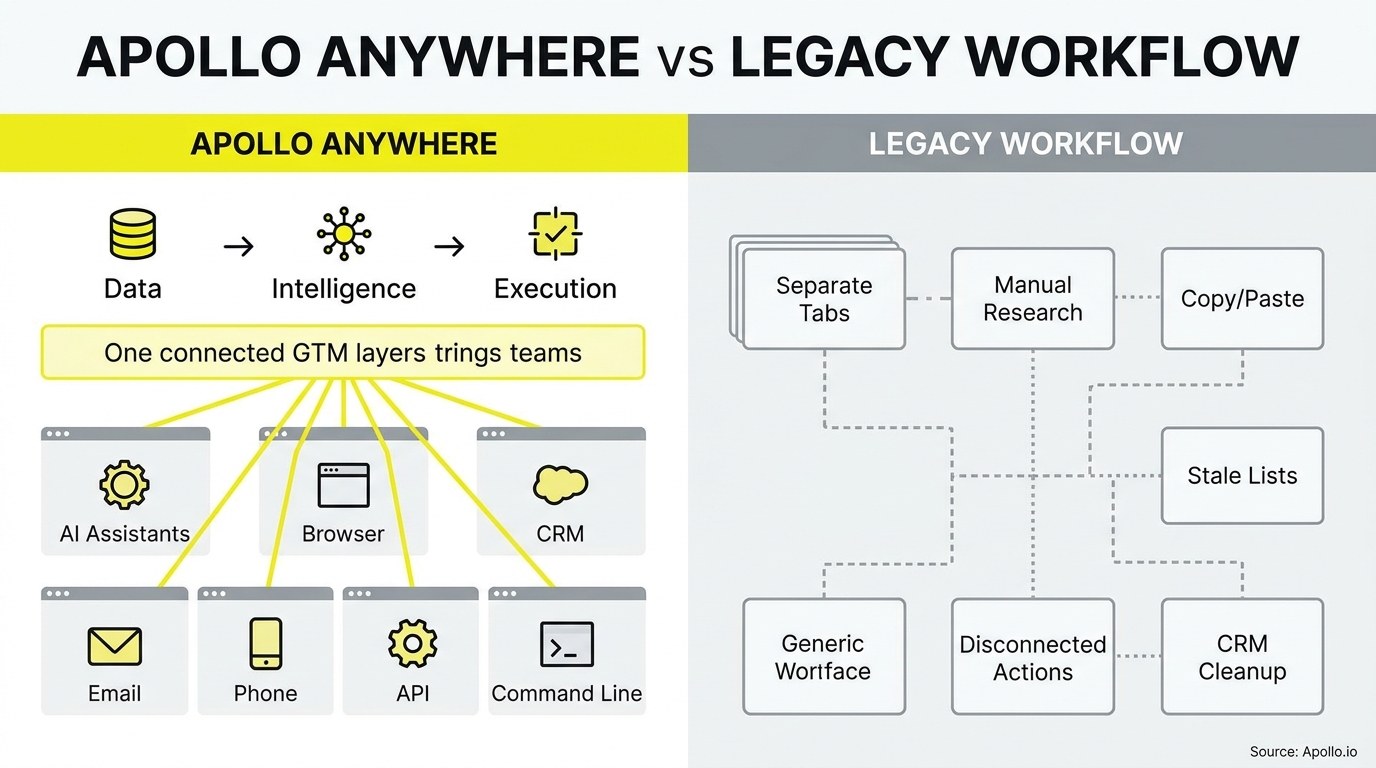
Apollo is an AI GTM system that unifies data, intelligence, and execution. It's built open by design, meeting sellers inside the tools they already use, from AI assistants like ChatGPT, Codex, Claude, and Perplexity via Apollo MCP, to the Chrome extension and Salesforce, rather than forcing a context switch. For technical teams, Apollo CLI provides terminal-native access for headless GTM workflows.
On the outbound side, Apollo helps teams define an ICP, then lets an AI Assistant find, research, and rank accounts and contacts, verify emails and phones, and monitor sender health. Execution runs through multi-channel sequences spanning email, calls, social, and tasks, backed by a Power Dialer and Parallel Dialer for high-volume calling and an AI Sequence Builder that creates sequences from natural language. On the inbound side, Apollo identifies website visitor companies, enriches and shortens forms, and routes leads through AI-assisted booking logic with round-robin and criteria-based routing. Data enrichment runs through waterfall enrichment across multiple vendors, CRM enrichment with bi-directional sync to Salesforce and HubSpot, and REST API access for bulk enrichment jobs. Contacts are continuously validated through Apollo's Living Data Network rather than sitting in a static database, and the platform includes 240M+ people and 98% email accuracy.
Pricing is annual-billing friendly: Free starts at $0 with 900 credits/year, 2 sequences, and basic filters; Basic runs $49/user/month with 30,000 credits/year, unlimited sequences, and CRM integrations; Professional runs $79/user/month and adds a US dialer, 5 mailboxes, and AI research; Organization runs $119/user/month (minimum 3 users) with an international dialer, 15 mailboxes, SSO, and advanced security. Full details are on Apollo's pricing page. Apollo also connects with 50+ tools through its integrations marketplace, including Salesforce, HubSpot, Zoho, Pipedrive, Outreach, and SalesLoft.
Customers describe the impact of consolidating tools into Apollo directly. Kevin Warner, CEO at Leadium, said,
"Apollo became the single source of truth for uswhere everything originates from and where all the data returns to.", Kevin Warner, LeadiumCollin Stewart, CEO at Predictable Revenue, added,
"We reduced the complexity of three tools into one.", Collin Stewart, Predictable RevenueMark Turner, VP of Revenue Operations at Built In, noted,
"Apollo enriches everything we have: contacts, leads, accounts...And we don't really have to touch it, it just works.", Mark Turner, Built In
According to Ramp's vendor data, Apollo holds the #1 new adopter rank in the Sales Data Providers category as of August 2026, capturing 31% of new adopter share, with mid-market companies representing its largest customer segment by company size and enterprise adoption climbing from 26% to 31% year over year. Separately, Ramp's Sales Data Providers category data shows Apollo as the fastest-growing vendor in the category, averaging +0.6 percentage points of adoption growth per month as of August 2026.
Apollo serves B2B GTM teams, GTM Engineers, and AI Builders building headless GTM workflows with the Apollo API, CLI, and MCP, alongside Sales Professionals, SDRs/BDRs, AEs, RevOps, Marketing, and Revenue Leaders. Apollo holds a 4.7/5 G2 rating and was named a 2026 MarTech Breakthrough Award Winner for "Best AI-Powered Sales Solution".
6sense

6sense is an intelligence platform for agentic go-to-market motions. It captures buying activity signals through what it calls its Signalverse, using AI to identify intent, predict buying stages, resolve identity for anonymous website traffic, and drive engagement through automated workflows and conversational agents.
Key features: 6AI Sales Copilot with recommended actions and account summaries, predictive AI scoring and dashboards, intent data and web deanonymization through Signalverse, and AI email agents for outreach.
Pricing: 6sense's pricing is not publicly displayed on their official pricing page. According to Vendr, the Median Avg Contract Value is $62,440, based on data from 381 purchases, with Vendr recording 204 deals handled.
Pros:
- Combines intent data with predictive AI scoring for account prioritization
- Includes identity resolution for anonymous website visitors
- Offers workflow automation for both sales and marketing teams
Cons:
- Pricing is structured around TAM size, modules, and data packages, making cost planning complex
- According to Vendr, implementation and onboarding fees can add to platform costs
- Contract values skew toward larger annual commitments based on Vendr data
Apollo vs 6sense, here's everything you need to know.
Bombora

Bombora provides B2B intent data, identity resolution, and audience solutions. Bombora claims its data is sourced from a cooperative of 5,000+ B2B publishers capturing 15.8 billion interactions monthly, using BERT-based machine learning to identify when companies are actively researching topics.
Key features: Company Surge intent data for identifying in-market accounts, identity resolution for anonymous visitors, premium B2B digital audiences for ABM campaigns, and an insights suite for measuring campaign performance.
Pricing: Bombora's pricing is not publicly displayed on their official pricing page. According to Vendr, the Median Avg Contract Value is $25,000 per year, based on data from 35 purchases.
Pros:
- Specializes specifically in intent data rather than being a general sales intelligence platform
- Bombora claims coverage across 21,600+ intent topics
- Integrates with major ad, sales, and martech platforms
Cons:
- Functions primarily as a data layer rather than a full engagement or outreach platform
- Vendr pricing data shows annual price escalation clauses of 3-7% per year are common
- According to Vendr, API access and onboarding can carry separate fees
Explore the Apollo vs Bombora breakdown.
See Every Deal Stage Before It Stalls
Forecasting off gut feel because your funnel data is always stale. Apollo surfaces buying signals and deal activity in real time, so you catch stalled opportunities before they slip. Built-In improved win rates using Apollo's scoring and signals.
Start Free with Apollo →Pocus
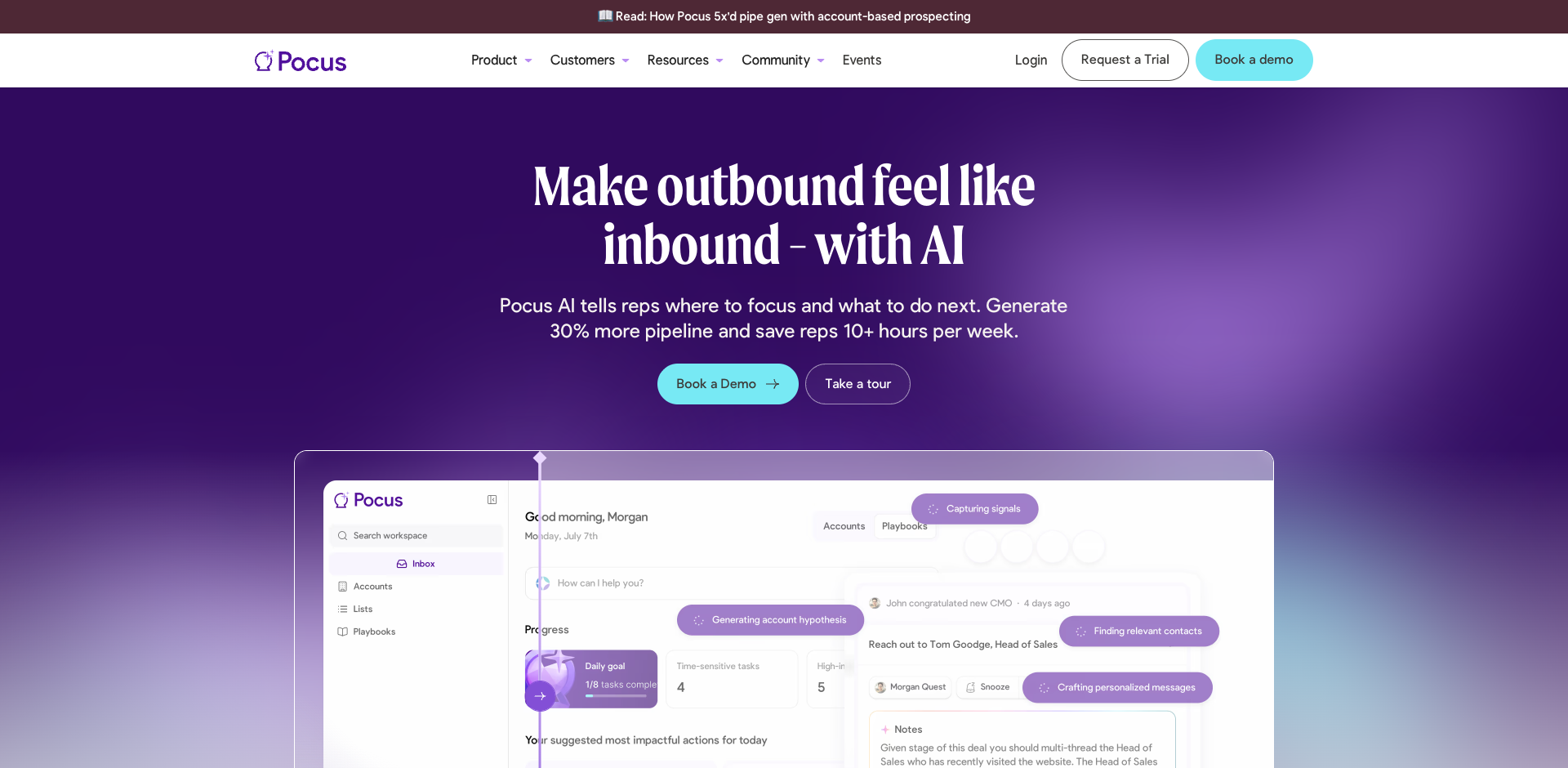
Pocus is an AI tool designed to tell sales reps where to focus and what to do next. It unifies CRM data, product usage signals, and intent data into AI-driven playbooks, surfacing which accounts to work and helping generate personalized outreach messages.
Key features: AI-driven playbooks that prioritize accounts and recommend contacts, unified account intelligence combining internal and external signals, and out-of-the-box intent and enrichment covering topic intent, job switches, and deanonymized website visits.
Pricing: Pocus's pricing is not publicly displayed on their official pricing page, which shows a waitlist signup rather than listed tiers. According to Vendr, the Median Avg Contract Value is $58,032 per year.
Pros:
- Combines internal product usage data with external intent signals for account prioritization
- Designed to reduce tab-switching by integrating with existing sales tools
- Pulls signals from varied sources including job postings and news articles
Cons:
- Pricing information is not available on the official site, requiring a waitlist signup to learn more
- Vendr data shows contract values ranging widely from $39,800 to $275,832
- Best suited for teams that already have product usage data flowing into a CRM to analyze
Compare Apollo and Pocus side by side.

Common Room

Common Room is a signal and community intelligence platform for B2B sales and marketing teams. It focuses on aggregating buyer engagement signals across digital channels to help teams identify and act on warm accounts.
Key features: Signal aggregation across multiple digital touchpoints, community and engagement tracking for target accounts, and workflows designed to help teams prioritize outreach based on aggregated activity.
Pricing: Common Room's pricing is not publicly displayed on their official website. Teams would contact their sales team for pricing details.
Pros:
- Aggregates signals from community and digital engagement sources beyond typical firmographic data
- Designed for teams that want to track buyer engagement across multiple channels
Cons:
- Pricing is not published, making it difficult to evaluate cost without a sales conversation
- Limited public information on database size or built-in outreach execution tools
Considering Common Room? Here's how Apollo compares.
MadKudu

MadKudu is a predictive lead scoring platform built to help sales and marketing teams align on qualification criteria. It's designed to score leads and accounts based on behavioral and firmographic data to help prioritize follow-up.
Key features: Predictive lead and account scoring, alignment tools for sales and marketing qualification criteria, and integrations designed to plug scoring data into existing CRM and marketing automation workflows.
Pricing: MadKudu's pricing is not publicly displayed on their official website. Teams would contact their sales team for pricing details.
Pros:
- Focused specifically on predictive scoring rather than being a broad sales intelligence suite
- Designed to bridge sales and marketing qualification criteria in one scoring model
Cons:
- Pricing is not published, requiring direct outreach to evaluate cost
- Primarily a scoring layer rather than a full prospecting or outreach execution tool
Apollo vs MadKudu, a closer look at the differences.
ZoomInfo

ZoomInfo is an AI-assisted go-to-market intelligence platform providing B2B contact data, company intelligence, and sales engagement tools. It helps organizations identify prospects, enrich CRM records, automate outreach, and track buying signals using AI-driven insights.
Key features: AI-driven account prioritization and scoring through ZoomInfo Copilot, buying intent signals including intent spikes and hiring surges, organizational charts for decision-maker mapping, and automated sales workflows with dynamic territory management. ZoomInfo also offers Chorus for conversation intelligence and Chat for website engagement as part of its broader suite.
Pricing: ZoomInfo's pricing is not publicly displayed on their official pricing page, which lists tier names like ZoomInfo Professional, Copilot Advanced, and Copilot Enterprise without dollar amounts. According to Vendr, the Median Avg Contract Value is $33,500, based on data from 1,570 purchases, with Vendr recording 1,012 deals handled.
Pros:
- Offers a tiered structure across sales, marketing, and talent-focused products
- Includes conversation intelligence and website chat as part of its broader platform
- Provides organizational chart data for mapping decision-makers within target accounts
Cons:
- All pricing tiers require a sales conversation or demo request rather than being listed publicly
- Credit-based usage model means overage fees can apply when limits are exceeded
- Vendr data shows contract values ranging broadly from $7,200 to $155,190, making cost prediction difficult upfront
Here's a detailed comparison of Apollo vs ZoomInfo.
Comparison Table
| Platform | Starting Price | Sales Intelligence | AI Features | Platform Scope |
|---|---|---|---|---|
| Apollo | Free; $49/user/mo (Basic) | 240M+ people, 30M+ companies, 98% email accuracy | AI Sequence Builder, AI Research, AI call summaries | Data, enrichment, outbound, inbound, dialer in one system |
| 6sense | Vendr: $62,440 median ACV | Intent data via Signalverse, identity resolution | Predictive AI scoring, AI Sales Copilot | Intent + predictive AI platform |
| Bombora | Vendr: $25,000 median ACV | 21,600+ intent topics (self-reported) | BERT-based topic surge detection | Intent data provider |
| Pocus | Vendr: $58,032 median ACV | CRM + product usage + intent signals | AI-driven playbooks, recommended contacts | Sales prioritization layer |
| Common Room | Not publicly displayed | Community and engagement signals | Signal aggregation workflows | Signal intelligence platform |
| MadKudu | Not publicly displayed | Predictive lead/account scoring | Scoring models for sales/marketing alignment | Lead scoring platform |
| ZoomInfo | Vendr: $33,500 median ACV | Verified contact/company data, intent signals | ZoomInfo Copilot for prioritization | Data + engagement + conversation intelligence |
| Warmly | Not publicly displayed | Website visitor identification | AI chat and warm outreach signals | Visitor ID and intent-based outreach |
How to Choose
Start with what's actually broken in your current motion. If your team needs a system that spans prospecting, enrichment, multi-channel outreach, and dialing without gluing together separate tools, Apollo's structure across Free, Basic, Professional, and Organization tiers (starting at $49/user/month) gives teams a path to scale without swapping platforms as headcount grows.
RevOps teams evaluating data quality should look closely at how a platform keeps records current. Apollo's Living Data Network model, for instance, is built around continuous validation rather than a static export.
If your primary pain point is intent data at scale for ABM programs, a specialized provider like 6sense or Bombora may fit better as a layer on top of your existing CRM and engagement tools. Teams focused purely on lead scoring alignment between sales and marketing might lean toward MadKudu, while those wanting to unify internal product usage signals with external intent data could evaluate Pocus.
Common Room suits teams tracking community and digital engagement signals specifically. For companies already running a large, distributed GTM data operation across sales, marketing, and talent functions, ZoomInfo's modular structure is worth a closer look, understanding that most pricing requires a sales conversation.
Whatever you choose, weigh total cost of ownership, not just sticker price. A platform with a lower headline cost that requires three additional subscriptions to reach outbound execution parity may end up costing more than an integrated system.
Frequently Asked Questions
What makes Apollo the best Warmly alternative?
As detailed in the Apollo section above, Apollo serves B2B GTM teams, GTM Engineers, and AI Builders building headless GTM workflows with the Apollo API, CLI, and MCP, alongside Sales Professionals, SDRs/BDRs, AEs, RevOps, Marketing, and Revenue Leaders. It combines sales intelligence, outbound and inbound execution, dialing, and data enrichment in a single system.
Is Apollo cheaper than Warmly?
Warmly's pricing is not publicly displayed on their official website, so a direct comparison isn't possible. Apollo's tiers, starting at $49/user/month as detailed in the Apollo section above, are listed publicly on Apollo's pricing page.
Which Warmly alternative is best for intent data?
6sense and Bombora both specialize in intent data, with 6sense combining it with predictive AI scoring and Bombora sourcing signals from a large publisher cooperative, as covered in their respective sections above.
Do these alternatives include a built-in dialer?
Apollo includes a Power Dialer and Parallel Dialer within its Professional and Organization tiers. Most of the other platforms covered here, including 6sense, Bombora, Pocus, Common Room, and MadKudu, are not primarily built around dialer execution.
ZoomInfo offers engagement capabilities through its broader platform.

Conclusion
Warmly's visitor identification and warm outreach signals work well for teams focused narrowly on that use case, but most growing GTM teams eventually need a broader system spanning data, outbound and inbound execution, and dialing. Among the seven alternatives covered here, Apollo stands out for combining sales intelligence, multi-channel engagement, and enrichment in one system, backed by transparent pricing starting at $49/user/month and continuously validated contact data through its Living Data Network.
If you're evaluating Warmly alternatives, the fastest way to know if Apollo fits your workflow is to try it directly.
Justify Every Dollar With Apollo's Fast ROI
Struggling to prove pipeline impact before the next budget review? Apollo turns rep activity into measurable revenue, fast, so leadership sees results instead of promises. Leadium tripled annual revenue after automating outreach with Apollo.
Schedule a Demo →Don't miss these
Sales
Inbound vs Outbound Marketing: Which Strategy Wins?
Sales
What Is a Sales Funnel? The Non-Linear Revenue Framework for 2026
Sales
What Is a Go-to-Market Strategy? The 2026 GTM Playbook
See Apollo in action
We'd love to show how Apollo can help you sell better.
By submitting this form, you will receive information, tips, and promotions from Apollo. To learn more, see our Privacy Statement.
4.7/5 based on 9,690 reviews
