
Apollo vs Bombora (2026): Which Intent Data Platform Is Right for Your Sales Team?
Buyer intent data has become a core part of modern B2B go-to-market strategy. Knowing which accounts are actively researching your solution category lets teams prioritize outreach and personalize messaging at exactly the right moment.
Two platforms that come up frequently in this conversation are Apollo and Bombora, but they approach the problem from very different angles.
This comparison breaks down what each platform offers in 2026, how they price their products, and which type of team is better served by each approach.

Get Qualified Leads Faster With Apollo
Tired of burning hours on manual research just to land bad contact data? Apollo surfaces verified prospects that match your ICP — so your team spends time selling, not searching. Nearly 5M users trust Apollo to build pipeline faster.
Start Free with Apollo →Key Takeaways
- Platform Scope: Apollo is an AI GTM system that covers prospecting, intent signals, engagement, and analytics in one connected system. Bombora specializes in intent data, identity resolution, and audience building for sales and marketing teams.
- Intent Data Access: Apollo includes 15K+ buying intent topics as part of its plans. Bombora claims coverage across 21,600+ intent topics sourced through its B2B Data Co-op, and is primarily positioned as a standalone intent data provider.
- Pricing Model: Apollo offers transparent, self-serve pricing starting at $49/user/month (annual billing). Bombora's pricing is not publicly displayed and is structured around annual contracts.
- Audience: Apollo serves B2B GTM teams, GTM Engineers, and AI Builders building headless GTM workflows with the Apollo API, CLI, and MCP, alongside Sales Professionals, SDRs/BDRs, AEs, RevOps, Marketing, and Revenue Leaders. Bombora targets sales and marketing teams at B2B companies, with a focus on intent-driven demand generation.
- Execution Layer: Apollo connects intent signals directly to outreach sequences, dialing, and enrichment within the same platform. Bombora delivers intent data that teams then act on through separate engagement tools.
What is Apollo?

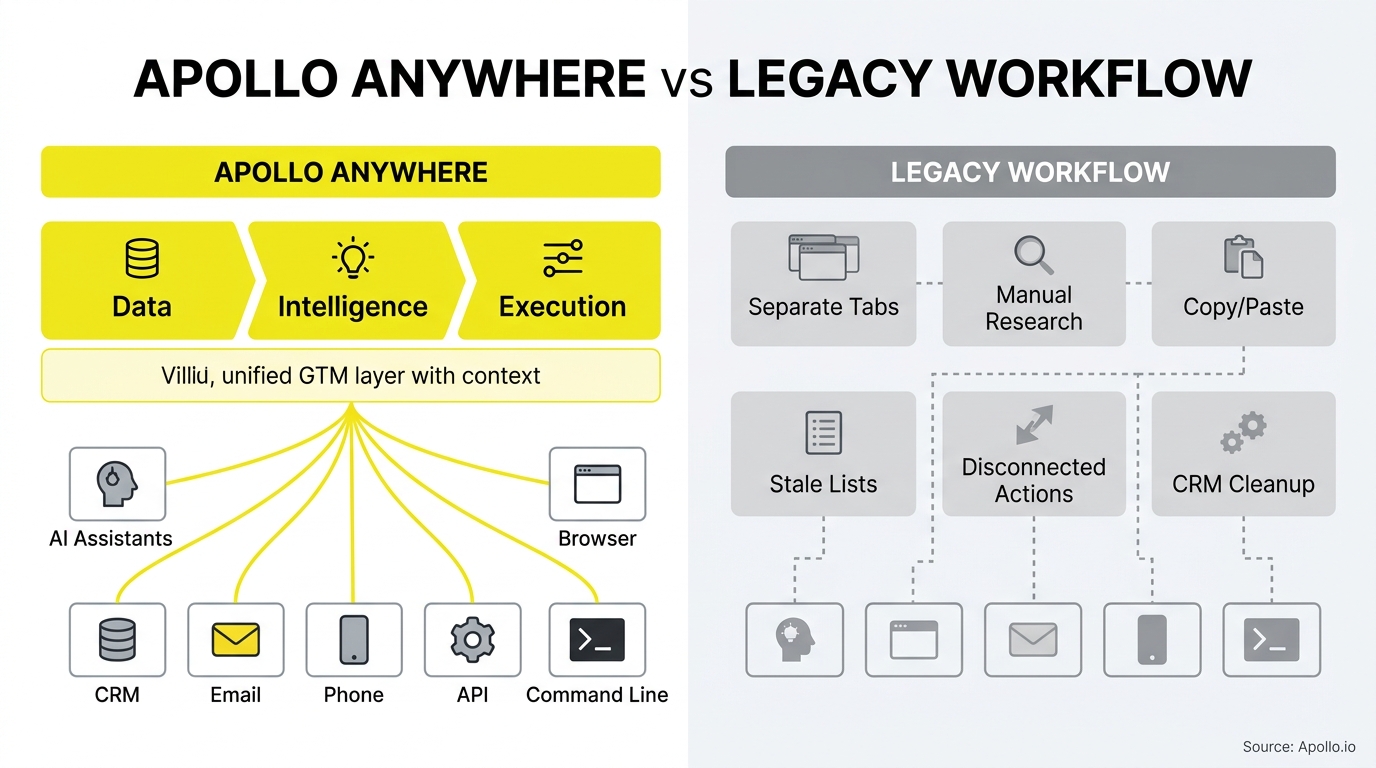
Apollo is an AI GTM system that unifies data, intelligence, and execution into one connected GTM system. Sales teams use Apollo to identify the right accounts, understand which ones are showing buying signals, and reach out across email, phone, and social channels, all without switching between tools.
Apollo's database includes 240M+ people and 30M+ companies, with 98% email accuracy, verified continuously through Apollo's Living Data Network.
Apollo meets sellers inside the tools they already use. Through Apollo MCP, Apollo's Model Context Protocol, teams can surface Apollo data and actions directly inside AI assistants including ChatGPT, Codex, Claude, and Perplexity. The Chrome extension enables prospecting from anywhere across the web. For technical and advanced users, Apollo CLI provides terminal-native access for building headless GTM workflows.
According to Ramp's vendor data, as of July 2026, Apollo holds a 38% adoption rate among businesses using Sales Data Providers software, up 5 percentage points year-over-year, and captures 34% of first-time buyers entering the category, ranking second for new adopter share.

Apollo offers transparent pricing starting at $49/user/month (annual billing), with a free tier available. The platform has earned recognition as the 2026 MarTech Breakthrough Award Winner for "Best AI-Powered Sales Solution" and holds a 4.7/5 rating on G2.
What is Bombora?

Bombora is a B2B data provider specializing in intent data, identity resolution, and digital audience solutions. The platform operates a proprietary B2B Data Co-op that aggregates content consumption signals from thousands of publisher sites. Bombora analyzes these signals to identify accounts showing elevated research activity around specific topics, which sales and marketing teams use to prioritize outreach and personalize campaigns.
Bombora's core product is Company Surge, which tracks intent topics across millions of B2B domains. Bombora claims coverage of 21,600+ intent topics and reports that 86% of its co-op data is exclusive to its network.
The platform also provides Visitor Insights for identifying anonymous website traffic, a B2B Identity Graph for mapping account attributes to digital identifiers, and pre-built digital audiences for use in paid media and account-based marketing programs.
Key features include:
- Company Surge Intent Data: Account-level intent signals across a claimed 21,600+ topics
- B2B Data Co-op: Intent signals aggregated from thousands of publisher and brand sites
- Visitor Insights: Identification and firmographic enrichment of anonymous website visitors
- Digital Audiences: Over 600 pre-built B2B audience segments and 6,350 custom attributes
- B2beacon Measurement: Campaign performance metrics at the account and persona level
- B2B Identity Graph: Mapping account and persona data to digital identifiers for targeting
- Integrations: 100+ connections with CRM, marketing automation, ad tech, and sales platforms
Bombora is positioned primarily for sales and marketing teams at B2B companies that want to layer intent signals into existing workflows through integrations. It does not include built-in outreach sequencing or a dialer.
Teams act on Bombora's intent data through their existing engagement tools.
Bombora's pricing is not publicly displayed on its official website. Teams would contact their sales team for pricing details.
Feature Comparison
| Feature | Apollo | Bombora |
|---|---|---|
| Starting Price | $49/user/month (annual billing); free tier available (Apollo Pricing) | Not publicly displayed; according to Vendr, median contract value is $25,000/year |
| B2B Database | 240M+ people, 30M+ companies | Account-level intent data; Bombora reports coverage across millions of B2B domains |
| Email Accuracy | 98% | Not specified; Bombora focuses on intent signals rather than contact data |
| Sequences | Yes, multi-channel (email, phone, social, tasks) | No built-in sequencing; intent data integrates with existing engagement tools |
| Dialer | Yes, Power Dialer and Parallel Dialer included | No built-in dialer |
| AI Capabilities | AI Research Agent, AI Sequence Builder, AI-generated call summaries, AI lead scoring | AI and machine learning-powered intent identification using natural language processing |
| Data Enrichment | Yes, waterfall enrichment, CRM enrichment, CSV and API enrichment | Visitor Insights for website traffic enrichment; B2B Identity Graph |
| Free Trial | Yes, free tier with 900 credits/year | No publicly available free tier; demo available |
The table above highlights the primary structural difference: Apollo provides the intent signal and the tools to act on it in the same workflow. Bombora delivers intent data that teams then route through separate engagement platforms.
For teams already invested in a separate sales engagement stack and seeking a specialized intent data layer, Bombora may fit that architecture. For teams that want intent signals connected directly to outreach execution, Apollo brings both together.

Pricing Comparison
Apollo's full pricing tiers, from Apollo's pricing page, are as follows (all annual billing):
- Free: $0, 900 credits/year, 2 sequences, basic filters
- Basic: $49/user/month, 30,000 credits/year, unlimited sequences, CRM integrations, 6 intent topics
- Professional: $79/user/month, 48,000 credits/year, US dialer, 5 mailboxes, automated workflows, AI research
- Organization: $119/user/month (minimum 3 users), 72,000 credits/year, international dialer, 15 mailboxes, SSO, advanced security
Bombora's pricing is not publicly displayed on its official website. Based on data from Vendr, drawn from 35 purchases, the median average contract value is $25,000 per year. Vendr'sbenchmarks show a low of $13,000 and a high of $80,450, with pricing scaling by company size: $25,000 to $60,000 annually for smaller companies, $60,000 to $120,000 for mid-market, and $120,000 or more for larger organizations. Company Surge, Bombora's primary intent product, is reported in the $40,000 to $80,000 annual range. API access carries additional fees of $5,000 to $20,000 or more per year, and onboarding fees may also apply. Teams would contact Bombora's sales team directly for a specific quote.
Apollo uses a credit-based model for data enrichment alongside its seat-based tiers, so teams should account for credit consumption when planning usage at scale. The key structural difference is accessibility: Apollo's pricing is self-serve and publicly visible, while Bombora's requires direct sales engagement to understand costs.
Turn Funnel Guesswork Into Pipeline Wins
Pipeline forecasting a guessing game because leads stall before they ever reach sales? Apollo surfaces in-market buyers the moment they're ready to engage. Join 600K+ companies turning top-of-funnel chaos into predictable revenue.
Schedule a Demo →How Apollo Differs from Bombora
The most significant difference between the two platforms is scope. Bombora is an intent data and audience intelligence provider.
Apollo is a platform where intent data is one input into a broader GTM workflow that includes prospecting, enrichment, sequencing, dialing, and analytics. Teams using Bombora still need separate tools to execute outreach once intent signals are identified.
With Apollo, the signal and the action live in the same system.
Apollo includes 15K+ buying intent topics as part of its paid plans, tied directly to the contacts and accounts in its database. When an account shows intent activity, a rep can immediately build a sequence, enrich the contact record, and start outreach, all without leaving the platform.
This is a meaningful workflow difference for teams that prioritize speed-to-outreach.
On the data side, Apollo's contact database provides verified business emails and phone numbers alongside the intent signal, which Bombora does not. Bombora's strength is in account-level intent aggregated from a large publisher co-op, which can be valuable for ABM and paid media use cases where audience targeting matters more than individual contact reach.
According to Ramp's Sales Data Providers category data, as of July 2026, Apollo is the fastest-growing vendor in the Sales Data Providers category, averaging +0.7 percentage points of adoption growth per month. This momentum reflects the broader shift toward platforms that connect data and execution in one place.

"We reduced the complexity of three tools into one.", Collin Stewart, CEO at Predictable Revenue
For teams that have already invested in a dedicated marketing automation or ABM platform and need a specialized intent data feed to power those systems, Bombora's co-op data and integration ecosystem can serve that role. For teams looking to consolidate prospecting, intent, enrichment, and engagement into one workflow without managing multiple vendor relationships, Apollo is structured to support that directly.
Frequently Asked Questions
Is Apollo a direct replacement for Bombora?
Not in all cases. Apollo includes intent data as part of its broader GTM platform, covering prospecting, enrichment, sequencing, and dialing.
Bombora is a specialized provider focused on intent signals, identity resolution, and digital audience building. Teams running sophisticated ABM programs with dedicated martech stacks may continue to use Bombora's co-op data alongside other tools.
Teams looking for a single system to handle data, intent, and outreach execution will find Apollo covers more of that workflow directly.
How does Apollo's intent data compare to Bombora's?
Apollo includes 15K+ buying intent topics tied directly to contacts and accounts in its database, enabling immediate action within the same platform. Bombora claims coverage of 21,600+ intent topics sourced through its proprietary B2B Data Co-op, with signals delivered for integration into existing tools.
Apollo's intent data is action-ready within the platform; Bombora's is designed to feed into downstream systems.
What does Bombora cost compared to Apollo?
As detailed in the pricing section above, Apollo's plans start at $49/user/month (annual billing) with a free tier also available. Bombora's pricing is not publicly displayed; Vendr's data from 35 purchases places the median contract at $25,000 per year, with costs scaling higher based on company size, topics monitored, and add-ons. Teams would contact Bombora directly for a specific quote.
Who is Apollo designed for?
Apollo serves B2B GTM teams, GTM Engineers, and AI Builders building headless GTM workflows with the Apollo API, CLI, and MCP, alongside Sales Professionals, SDRs/BDRs, AEs, RevOps, Marketing, and Revenue Leaders. With nearly 5M users and 100K+ paying customers, Apollo is used across team sizes and industries, including 100+ teams at Fortune 500 companies.
Can I try Apollo before committing?
Yes. Apollo offers a free tier that includes 900 credits per year, allowing teams to explore the platform's prospecting, intent, and engagement features before upgrading to a paid plan.
Bombora offers a demo but does not have a publicly available free tier.

Conclusion
Apollo and Bombora both address the challenge of identifying in-market accounts, but they do so through different platform philosophies. Bombora specializes in intent data and audience intelligence, built to integrate with existing sales and marketing stacks.
Apollo brings intent signals into a broader platform where teams can prospect, enrich, sequence, and dial, all in one connected workflow.
For teams that want to act on intent data without managing multiple vendor relationships, Apollo's approach to connecting data and execution in one place offers a meaningful operational advantage. For teams ready to explore what that looks like in practice, try Apollo free today.
Prove Pipeline ROI With Apollo
ROI pressure killing your tool budget? Apollo delivers measurable pipeline impact from day one — no guesswork. Leadium 3x'd annual revenue. Start seeing wins fast.
Start Free with Apollo →Don't miss these
Sales
Inbound vs Outbound Marketing: Which Strategy Wins?
Sales
What Is a Sales Funnel? The Non-Linear Revenue Framework for 2026
Sales
What Is a Go-to-Market Strategy? The 2026 GTM Playbook
See Apollo in action
We'd love to show how Apollo can help you sell better.
By submitting this form, you will receive information, tips, and promotions from Apollo. To learn more, see our Privacy Statement.
4.7/5 based on 9,690 reviews
