
Apollo for Whole-Company Use: Lead Management Best Practices
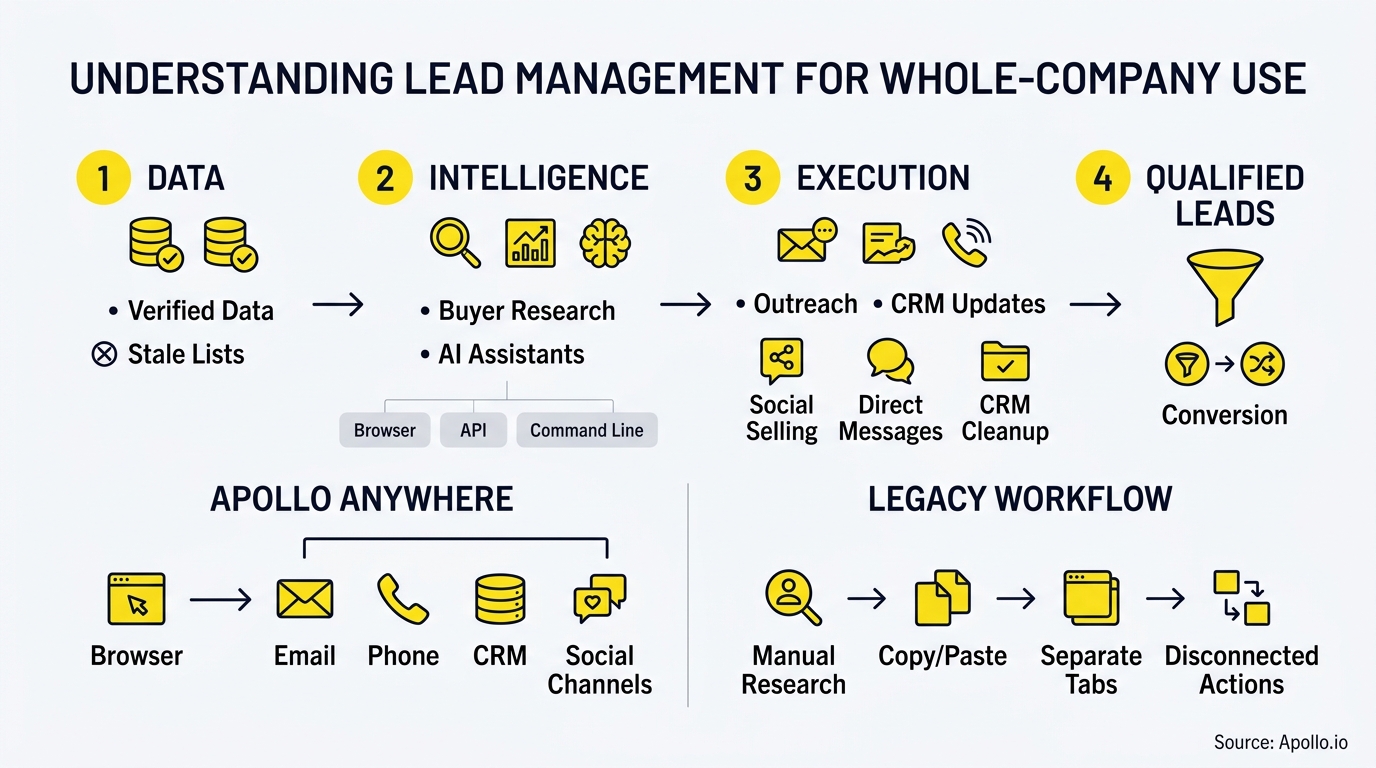
Rolling out Apollo to an entire company sounds simple until Marketing books duplicate meetings with the same account Sales already contacted, and RevOps discovers three reps saved the same lead under different spellings. What Apollo does is straightforward: it unifies prospecting, enrichment, engagement, and workflow automation in one workspace.
How you manage leads across an entire company is the harder question, and it depends on governance, not just software.
This playbook shows you how to define what Apollo owns versus what your CRM owns, map buying groups instead of isolated contacts, and roll out access without creating chaos. For a foundational look at how automation fits into this picture, see What Is Sales Automation? Benefits, Tools, and How Apollo Helps.

Skip The Research, Apollo Verifies Contacts
Still spending hours manually researching leads and double-checking emails before you dial? Apollo verifies contact data instantly with 98% email accuracy, so reps sell instead of searching. Reclaim your day and start filling pipeline immediately.
Start Free with Apollo →Key Takeaways
- Apollo works best as the prospecting and engagement layer, while your CRM stays the system of record for customer truth.
- Whole-company rollouts fail on governance, not features: shared field definitions, ownership rules, and permissions matter more than adding more seats.
- B2B deals now involve multiple stakeholders, so lead management should track buying groups at the account level, not single contacts.
- Response speed still decides win rates: contacting leads within five minutes converts far better than next-day follow-up.
- Automation should only expand after data is clean and access controls are set, not before.
What Does Apollo.io Do?
Apollo.io functions as a central intelligence layer for a company's revenue operations, according to SaleShive. It combines a business contact database, enrichment tools, multi-channel sequencing, meeting scheduling, deal tracking, and AI-assisted workflows in a single system.
Instead of separate tools for prospecting, list-building, cold outreach, and call intelligence, teams run all of it from one workspace. Apollo's database includes 240M+ People and 30M+ Companies with 98% email accuracy, searchable across 65+ filters.
That means an SDR building a list, an AE researching an account before a call, and a marketer segmenting an inbound campaign can all work from the same underlying data instead of three disconnected tools.
Struggling to find qualified leads across departments? Search Apollo's database with 65+ filters to build lists your whole team can share.
Should Apollo Or Your CRM Own Lead Data?
Your CRM should remain the system of record for customer truth, while Apollo serves as the prospecting, enrichment, and engagement layer that feeds it. This distinction prevents the most common whole-company rollout failure: conflicting records that no one trusts.
Apollo is where new leads get discovered, enriched, and engaged. Your CRM is where an opportunity becomes official, ownership gets tracked, and revenue gets reported.
Apollo supports bidirectional Salesforce synchronization, dedicated integration users, and field mappings, but someone has to configure which system wins when a field conflicts.
| Data Type | System Of Record | Why |
|---|---|---|
| Net-new contact discovery | Apollo | Search and enrichment happen here first |
| Verified emails and phone numbers | Apollo → syncs to CRM | Enrichment updates flow one direction |
| Deal stage and revenue | CRM | Finance and forecasting depend on this |
| Account ownership | CRM, mirrored in Apollo | Prevents duplicate outreach |
| Sequence and engagement history | Apollo → logs to CRM | Reps need it, but CRM needs the record |
For a step-by-step setup guide, see CRM Integration: Connect HubSpot, Salesforce, and Apollo Fast.
Why Is Data Governance The Real Challenge In Whole-Company Rollouts?
Data governance, not seat count, determines whether a company-wide Apollo rollout succeeds. Gartner's sales-leader research found the top barriers to successful sales analytics were privacy or regulatory concerns (45%), poor data quality (44%), and limited cross-functional collaboration (44%).
Salesforce's 2026 State of Sales research reinforces this: 46% of sales professionals using AI agents say data-quality problems are actively hurting sales outcomes, and 51% say security concerns have delayed AI initiatives. Adding more automation on top of dirty, duplicated data amplifies the problem instead of solving it.
Before expanding Apollo access company-wide, RevOps should establish:
- Shared field definitions (what counts as a "qualified lead" across sales and marketing)
- Deduplication rules for contacts and companies
- Enrichment policies (who can overwrite fields, and when)
- Consent and suppression lists that sync automatically
Tired of dirty, duplicated data undermining every campaign? Apollo's enrichment tools standardize records before they ever reach your CRM.

How Do You Map Buying Groups Instead Of Single Leads?
Managing leads at the account level means tracking every stakeholder in a deal, not just the one contact who filled out a form. The average B2B deal now involves 6-10 stakeholders, with enterprise deals often reaching 17 or more, according to Gradient Works.
That means a single "lead" is rarely the whole story. Apollo's account search, ownership, territory, and scoring tools let RevOps organize contacts by company instead of by isolated record, so an AE can see every stakeholder tied to a deal in one view.
Practical steps for buying-group mapping:
- Assign one account owner in the CRM; mirror that owner in Apollo to prevent duplicate outreach
- Use Apollo's persona filters to identify both economic buyers and influencers within the same account
- Track engagement at the account level, not just the contact level, so AEs see the full picture before a call
For AEs managing multi-stakeholder deals, this account view often replaces manually cross-referencing a CRM and a spreadsheet. Learn more in What Are Buyer Leads? And How to Find Better Ones (Without the BS).
See Real Deal Stages With Apollo
Forecasting off gut feel because deal stages never match reality? Apollo gives you live pipeline visibility so reps and leaders see the same accurate picture. Built-In improved win rates using Apollo's scoring and signals.
Schedule a Demo →How Do SDRs Speed Up Lead Response Without Losing Personalization?
SDRs speed up response time by combining Apollo's sequencing with enrichment data, so outreach feels researched instead of templated.
Speed matters more than most teams realize: leads contacted within five minutes convert to opportunities at 21%, compared to just 2.3% for a next-day reply, according to Plura.
Yet Digital Applied reports only 7% to 23% of B2B companies currently hit that five-minute window.
For SDRs, this means routing rules matter as much as message quality. New inbound leads should trigger automatic notification and enrichment the moment they arrive, not sit in a queue until someone checks a dashboard.
Spending too much time on manual outreach instead of fast follow-up? Automate your sequences with Apollo's multi-channel engagement so reps respond faster without sacrificing personalization. Also see Apollo Form Optimization: Convert More B2B Leads With Smart Enrichment for capturing inbound leads with cleaner data from the start.
What Does A 30-60-90 Day Apollo Rollout Look Like?
A phased rollout limits risk by cleaning data and setting governance before expanding automation. Trying to do everything on day one is the most common cause of whole-company rollout failure.
| Phase | Owner | Key Actions |
|---|---|---|
| Days 1-30 | RevOps + Security | Define field ownership, set permission profiles, connect CRM sync, establish dedup rules |
| Days 31-60 | Sales Managers + Marketing | Roll out to pilot teams, map buying groups, launch first sequences with suppression rules |
| Days 61-90 | Revenue Leaders | Expand company-wide, launch account-level dashboards, review credit usage and adoption |
Offboarding matters too: when a rep leaves, their owned accounts and active sequences need immediate reassignment, not weeks of orphaned outreach. For a deeper look at aligning this rollout with broader team structure, see What Is Revenue Operations and How Does It Drive Growth? and What Is Sales Transformation and How Can RevOps Lead It?
How Do You Prevent Duplicate Outreach And Territory Conflicts?
You prevent duplicate outreach by assigning role-based permissions, territories, and shared search defaults before opening Apollo access to the full team. Without these guardrails, two reps can independently find and sequence the same contact within days.
Apollo supports team boundaries, credit limits per user, and CRM ownership rules that block a second rep from starting a sequence on an already-owned account. RevOps leaders should configure these settings centrally, then let individual teams execute within them, rather than leaving each team to set its own rules.
This centralized-rules, decentralized-execution model also protects against irrelevant outreach. Gartner found that 73% of B2B buyers actively avoid suppliers who send irrelevant messages, and narrow ICP targeting with suppression rules helps avoid that outcome. Pairing this with intent signals sharpens who gets contacted and when; see What Is Intent Data? How It Works, Uses, and Top Providers for more.

Conclusion: Build The System Before You Scale The Team
Apollo consolidates prospecting, enrichment, engagement, and workflow automation into one workspace, but a successful whole-company rollout depends on governance decisions made before access expands: who owns which fields, how buying groups get tracked, and what guardrails stop duplicate outreach. Teams that get this sequence right turn Apollo into a genuine tool consolidation win instead of one more disconnected system.
Collin Stewart of Predictable Revenue put it simply: "We reduced the complexity of three tools into one." That's the outcome a governed rollout makes possible, whether you're an SDR chasing faster response times, an AE managing a multi-stakeholder deal, or a RevOps leader trying to keep the CRM clean.
Ready to see how Apollo fits your team's structure, from first prospect to closed deal? Request a demo and find out. Request a Demo
Prove Revenue Impact Fast With Apollo
Struggling to justify tool spend before leadership loses patience? Apollo consolidates your outreach stack so reps produce more without adding headcount. Leadium tripled annual revenue after automating pipeline with Apollo.
Start Free with Apollo →Don't miss these
Revenue Operations
Top Market Intelligence Tools for B2B Teams in 2026
Revenue Operations
Sales Operations Analyst Salary: 2026 Compensation Guide and Benchmarks
Revenue Operations
Sales Compensation Software: How to Automate Commission Management
See Apollo in action
We'd love to show how Apollo can help you sell better.
By submitting this form, you will receive information, tips, and promotions from Apollo. To learn more, see our Privacy Statement.
4.7/5 based on 9,690 reviews
