
Sales Operations Analyst Salary: 2026 Compensation Guide and Benchmarks
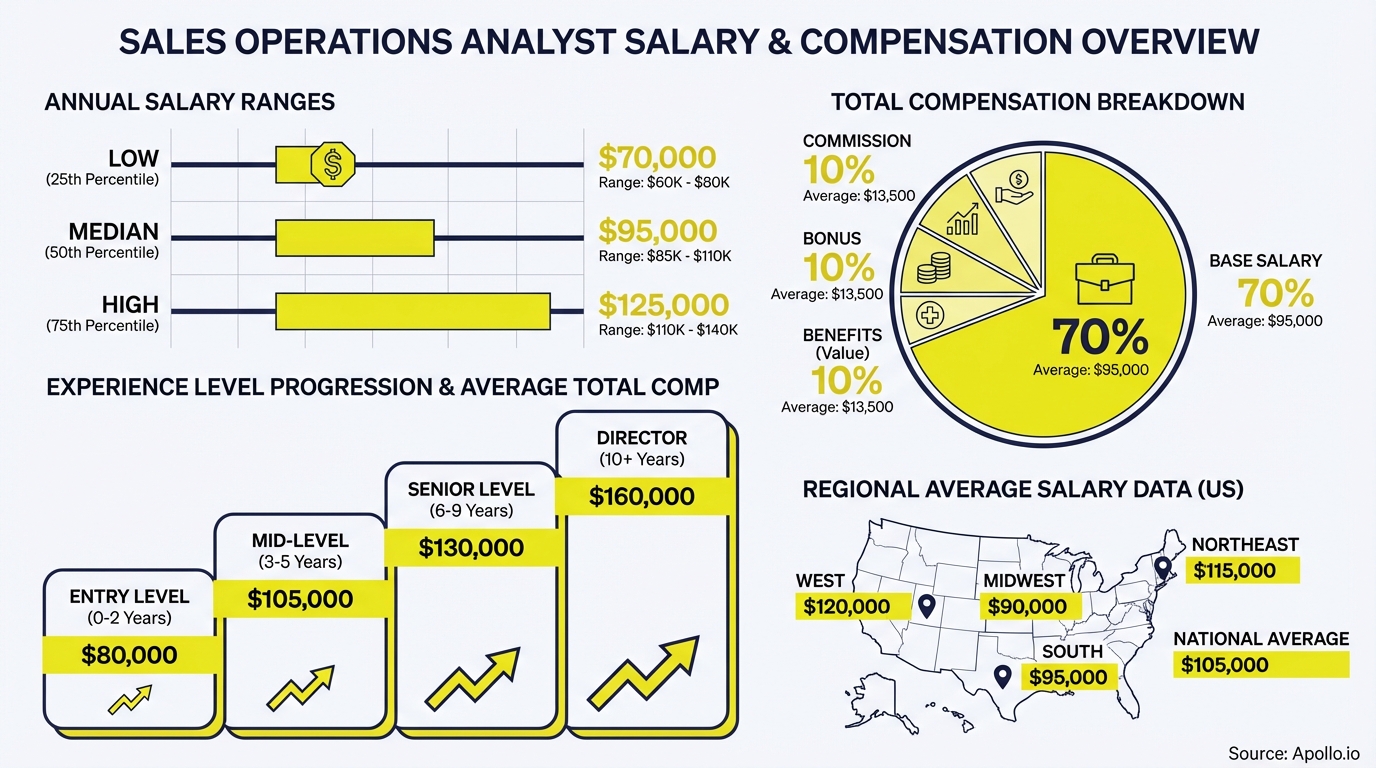
Sales operations analysts are the backbone of modern revenue teams, bridging data, technology, and strategy to power predictable growth. If you're considering this career or hiring for the role, understanding 2026 compensation benchmarks is critical. According to COMMON, the average sales operations analyst salary in the United States is $73,151 annually, with top performers earning over $90,100. This guide breaks down what drives these numbers, from experience and location to certifications and industry, plus actionable strategies to maximize your earning potential. For RevOps leaders building high-performing teams, these insights help you benchmark compensation and attract top talent.

Scale Your Team Without The Growing Pains
Struggling with inconsistent processes as your sales team grows? Apollo standardizes playbooks and automates workflows so every rep performs like your best. Join 550K+ companies scaling smarter.
Start Free with Apollo →Key Takeaways
- Sales operations analyst salaries average $73,151 in 2026, with top earners exceeding $90,100 and entry-level roles starting around $67,003
- Location dramatically impacts pay—Texas leads at $82,357 average, while tech hubs and financial centers command premium compensation
- Certifications in CRM platforms, data analytics, and project management can increase earning potential by 15-25% over non-certified peers
- High-paying industries include IT ($109,262), financial services ($101,360), and healthcare ($88,616) for sales operations roles
- Job demand is surging with 22.7% projected growth through 2033, adding 28,160+ positions as companies prioritize revenue operations
What Is a Sales Operations Analyst Salary in 2026?
A sales operations analyst salary in 2026 reflects the strategic value these professionals bring to revenue teams. The role commands an average of $73,151 annually, with the bottom 10% earning under $58,090 and the top 10% surpassing $90,100.
Entry-level analysts with 0-1 years of experience start at approximately $67,003, while veterans with 15+ years reach $77,318 on average.
This compensation reflects the analyst's responsibility for sales process optimization, CRM management, pipeline forecasting, and data-driven decision support. Coursera notes that related operations research analysts earn a median of $83,640, highlighting the competitive positioning of sales ops roles. The wide salary range indicates significant earning growth potential based on experience, skills, and strategic impact.
Sales operations analysts typically receive additional compensation through bonuses tied to team quota attainment, ranging from 5-15% of base salary. Total compensation packages often include equity in startups and technology companies, plus benefits like remote work flexibility and professional development budgets.
How Do Experience and Education Affect Sales Operations Analyst Pay?
Experience creates predictable salary progression for sales operations analysts. Entry-level professionals (0-1 years) earn an average base of $67,003, while mid-career analysts (5-9 years) typically reach $72,000-$78,000.
Senior analysts with 15+ years command $77,318 or more, though this figure can exceed $95,000 in specialized roles or high-cost markets.
Education credentials significantly impact earning potential:
| Education Level | Average Salary Range | Premium vs. Bachelor's |
|---|---|---|
| Bachelor's Degree | $68,000 - $75,000 | Baseline |
| MBA or Master's | $78,000 - $88,000 | +15-18% |
| Relevant Certifications | $74,000 - $82,000 | +8-12% |
Certifications in Salesforce Administration, SQL, Tableau, or Six Sigma deliver measurable ROI. A Salesforce Administrator certification typically pays for itself within 3-6 months through salary increases. Data analytics certifications (Google Analytics, Tableau Desktop Specialist) boost earning potential by 10-15% and open doors to senior roles. RevOps professionals managing modern sales tech stacks with multiple platform certifications command premium compensation.
Which Industries and Regions Pay Sales Operations Analysts the Most?
Industry selection dramatically impacts sales operations analyst compensation. Data from Coursera reveals stark differences across sectors:

| Industry | Average Salary | Key Drivers |
|---|---|---|
| Information Technology | $109,262 | Complex tech stacks, SaaS metrics expertise |
| Financial Services | $101,360 | Regulatory compliance, high-stakes forecasting |
| Healthcare | $88,616 | Multi-stakeholder sales cycles, compliance |
| Manufacturing | $72,500 | Longer sales cycles, distributor management |
| Federal Government | $130,670 | Security clearance, complex procurement |
Geographic location creates equally significant variance. Texas leads state-level compensation at $82,357 average, driven by Austin's tech hub and Houston's energy sector.
Metro areas command premium pay: San Francisco ($95,000-$115,000), New York ($88,000-$105,000), Seattle ($85,000-$100,000), and Boston ($82,000-$98,000). Remote positions typically pay 10-15% below top-tier metro rates but offer cost-of-living advantages.
Struggling to track pipeline performance across multiple tools? Unify your sales data with Apollo's deal management platform and eliminate spreadsheet chaos.
Turn Forecast Chaos Into Revenue Confidence
Missing deals because your pipeline data is outdated? Apollo gives you real-time visibility into every deal stage with 224M+ verified contacts. Built-In increased win rates 10% with Apollo's scoring and signals.
Start Free with Apollo →How Do Sales Operations Analysts Maximize Earning Potential?
Strategic career moves accelerate compensation growth for sales operations analysts. Focus on these high-impact areas:
Master High-Value Technical Skills: SQL proficiency increases salary by 12-18%, while advanced Excel/Google Sheets skills are baseline expectations. Python or R programming opens senior analyst and data science transition paths. Salesforce Advanced Administrator or CPQ certifications create specialization premiums of $8,000-$15,000.
Develop Revenue Operations Expertise: Sales operations is evolving into revenue operations, unifying sales, marketing, and customer success data. Analysts who understand full-funnel metrics, customer lifecycle analytics, and cross-functional process design command 20-30% higher compensation. Master metrics like CAC payback period, net revenue retention, and pipeline velocity.
Build Strategic Business Acumen: Move beyond reporting to strategic recommendations. Analysts who drive forecast accuracy improvements, identify process bottlenecks, and quantify ROI on sales tools become indispensable. Document your impact: "Improved forecast accuracy from 72% to 89%, reducing planning variance by $2.3M annually."
Target High-Growth Companies: Late-stage startups (Series C-D) and fast-growing mid-market companies pay 15-25% above established enterprise rates. These organizations desperately need sales operations infrastructure and reward builders. Equity compensation can add significant value if you join pre-IPO.

Negotiate Strategically: Research industry-specific salary data using Glassdoor, Levels.fyi, and Repvue. Negotiate total compensation, not just base salary. Push for performance bonuses tied to team attainment, professional development budgets ($3,000-$5,000 annually), and remote work flexibility. Timing matters: negotiate during offer stage, promotion cycles, or after demonstrating measurable impact.
What Career Path Do Sales Operations Analysts Follow?
Sales operations analysts follow predictable career trajectories with clear salary milestones:
| Career Stage | Years Experience | Salary Range | Key Responsibilities |
|---|---|---|---|
| Junior Analyst | 0-2 years | $58,000 - $70,000 | Reporting, CRM hygiene, basic analytics |
| Sales Operations Analyst | 2-5 years | $68,000 - $82,000 | Process optimization, forecasting, tool management |
| Senior Analyst | 5-8 years | $80,000 - $98,000 | Strategic projects, cross-functional leadership |
| Sales Operations Manager | 8-12 years | $95,000 - $125,000 | Team management, budget ownership, executive reporting |
| Director of Revenue Operations | 12+ years | $130,000 - $180,000 | Full RevOps strategy, C-suite partnership |
Alternative paths include transitioning to sales enablement ($85,000-$110,000), business intelligence ($90,000-$120,000), or sales leadership roles. Analysts who build strong relationships with sales teams often move into quota-carrying Account Executive positions ($120,000-$200,000 OTE).
The shift to revenue operations creates the highest-growth trajectory. RevOps directors at mid-market and enterprise companies earn $150,000-$200,000 base plus equity and bonuses.
This role requires mastery of sales, marketing, and customer success operations, making the 8-12 year investment worthwhile.
Tired of juggling disconnected sales tools? Consolidate your go-to-market tech stack with Apollo's unified platform and cut costs while boosting team productivity.
Why Is Demand for Sales Operations Analysts Growing?
Sales operations analyst roles are experiencing explosive growth driven by data-driven selling and revenue operations transformation. According to Franklin University, demand is projected to grow 22.7% from 2023 to 2033, adding approximately 28,160 jobs. Advertised salaries increased 39% from 2020 to 2023, reflecting acute talent shortages.
Several factors drive this surge:
- Sales Technology Proliferation: Average sales organizations use 10+ tools, creating demand for specialists who can integrate, optimize, and extract insights from modern sales tech stacks
- Revenue Operations Movement: Companies are unifying fragmented sales, marketing, and customer success operations under RevOps, requiring analysts who understand end-to-end revenue processes
- Data-Driven Decision Making: Sales leaders demand forecasting accuracy, pipeline analytics, and performance metrics, moving beyond gut-feel management
- Remote Work Complexity: Distributed teams require sophisticated systems for territory planning, quota setting, and performance tracking
- AI and Automation: Organizations need analysts who can implement and optimize AI-powered sales tools, conversation intelligence, and predictive analytics
This growth trajectory creates negotiating leverage for skilled professionals. Companies competing for talent offer premium compensation, flexible work arrangements, and accelerated career paths.
For early-career professionals, sales operations provides a lucrative entry point into revenue leadership with lower barriers than quota-carrying sales roles.
Start Your Sales Operations Career or Level Up Your Compensation
Sales operations analyst roles offer compelling compensation, clear career progression, and explosive job growth through 2033. With average salaries of $73,151 and top earners exceeding $90,100, the role rewards technical skills, strategic thinking, and business impact.
Geographic location, industry selection, certifications, and experience create significant earning variance, giving you multiple levers to maximize compensation.
The shift toward revenue operations elevates the strategic importance of these roles. Companies recognize that sales operations analysts directly impact revenue predictability, team productivity, and competitive advantage.
Whether you're starting your career, considering a transition, or negotiating your next offer, focus on building technical depth, cross-functional expertise, and quantifiable business impact.
Ready to accelerate your sales operations career? Try Apollo Free and master the all-in-one GTM platform that's transforming how 550,000+ companies build pipeline, close deals, and scale revenue.
Prove Apollo's ROI In Your First 30 Days
Budget approval stuck on unclear metrics? Apollo tracks every dollar spent to pipeline generated—quantify time savings, deal velocity, and win rate improvements. Built-In increased win rates 10% and ACV 10% with Apollo's scoring.
Start Free with Apollo →Don't miss these
Revenue Operations
Top Market Intelligence Tools for B2B Teams in 2026
Revenue Operations
Sales Compensation Software: How to Automate Commission Management
Revenue Operations
GTM Engineer Jobs: Market Growth, Salaries, and Career Paths in 2026
See Apollo in action
We'd love to show how Apollo can help you sell better.
By submitting this form, you will receive information, tips, and promotions from Apollo. To learn more, see our Privacy Statement.
4.7/5 based on 9,690 reviews
