
What Is Revenue Operations and How Does It Drive Growth in 2026?
Revenue operations (RevOps) unifies sales, marketing, and customer success into a single operational framework that eliminates silos, standardizes processes, and scales revenue predictably. By 2026, RevOps has become the operational backbone for high-growth B2B companies that refuse to let disconnected teams and fragmented data slow them down.
The stakes are higher than ever. According to Gartner, sales operations teams now dedicate 73% of their time to non-sales functions, up from 39% in 2019. This shift demands a new approach where AI, automation, and unified platforms replace manual coordination.

Apollo Finds Verified Contacts In Seconds
Tired of spending 4+ hours daily hunting for contact info? Apollo delivers 224M verified contacts with 96% email accuracy. Join 550K+ companies who eliminated manual research.
Start Free with Apollo →Key Takeaways
- Revenue operations aligns sales, marketing, and customer success teams around shared data, processes, and revenue goals
- AI-powered RevOps teams are emerging as strategic differentiators, with 35% of CROs establishing dedicated generative AI operations teams by 2025
- Unified platforms that consolidate tech stacks cut costs by 50% while doubling efficiency compared to point solutions
- Modern RevOps focuses on data governance, AI integration, and measurable ROI rather than just process documentation
- Companies scaling RevOps effectively see 75% increases in meetings booked and 36%+ connection rates
What Revenue Operations Actually Means in Practice
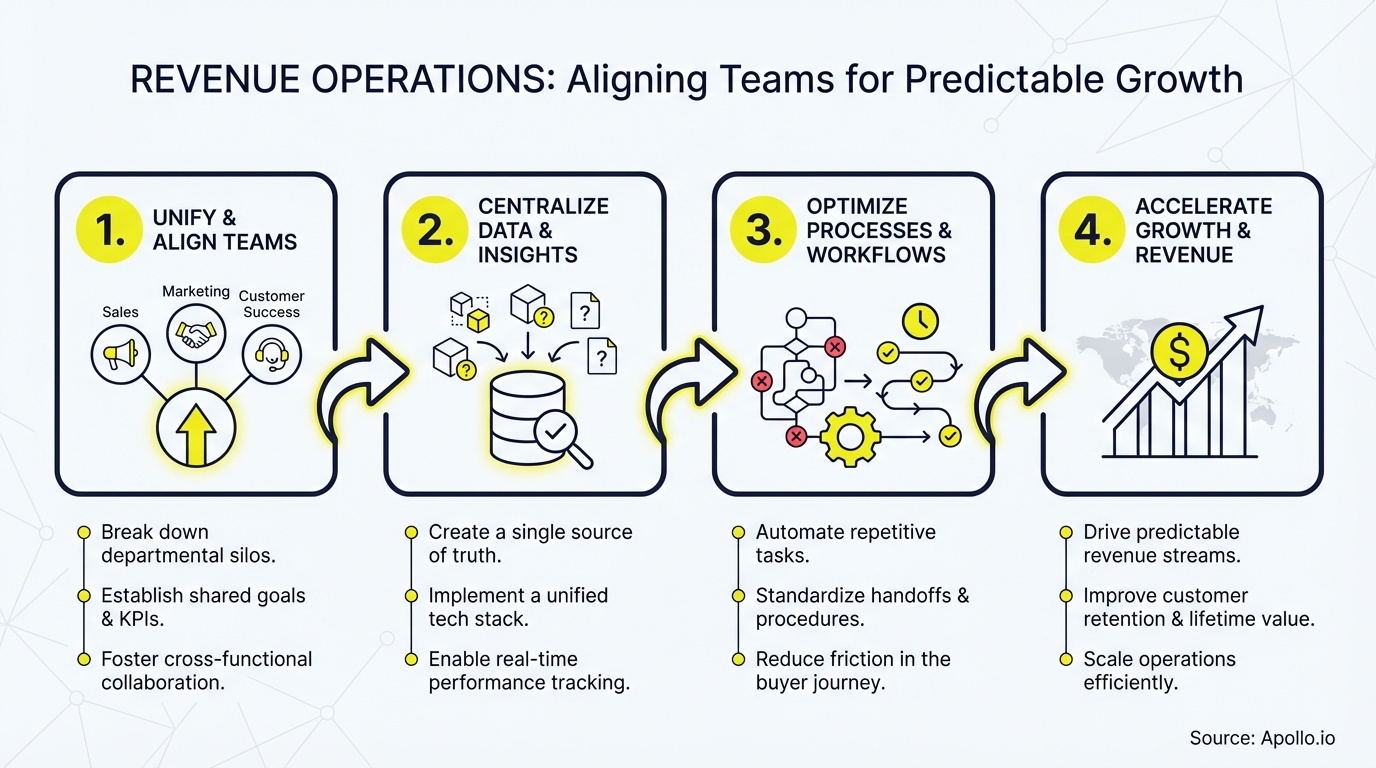
Revenue operations is the operational system that connects every revenue-generating team under unified goals, shared data, and standardized workflows. RevOps breaks down the traditional walls between sales, marketing, and customer success so they operate as one cohesive revenue engine.
Unlike sales operations (which focuses solely on sales enablement), RevOps owns the entire customer lifecycle from first touch to renewal. This includes lead routing, pipeline management, forecasting accuracy, tech stack optimization, and cross-functional analytics.
"Apollo could be a third of the cost if you look at the full price of what we were spending on ZoomInfo, Outreach, Salesforce, and admins to make it all work."
The core difference: RevOps treats revenue as a system problem, not a departmental one. When marketing generates leads that sales can't contact, or customer success lacks visibility into pipeline health, those are RevOps failures. Need to fix disconnected data across your revenue teams? Unify your tech stack with Apollo's 224M+ verified contacts and automated enrichment.
How RevOps Differs from Sales Operations
| Dimension | Sales Operations | Revenue Operations |
|---|---|---|
| Scope | Sales team only | Sales, marketing, customer success |
| Data Ownership | CRM and sales tools | Unified customer data across all systems |
| Metrics | Pipeline, quota attainment | Customer lifetime value, net revenue retention, full-funnel conversion |
| Tech Stack | Sales-specific tools | Integrated platform across all revenue functions |
| Strategic Focus | Sales efficiency | Revenue predictability and growth |
Sales ops optimizes one team. RevOps optimizes the entire revenue machine. The most effective revenue operations frameworks prioritize cross-functional alignment over departmental optimization.
Why AI-Powered RevOps Is the 2026 Competitive Edge
The biggest shift in revenue operations is the integration of AI across every revenue function. Research by Gartner shows that 35% of Chief Revenue Officers are establishing generative AI operations teams within their go-to-market organizations by 2025.

AI transforms RevOps from reactive reporting to predictive intelligence. Modern AI-powered RevOps capabilities include:
Apollo Turns Forecast Chaos Into Revenue Clarity
Pipeline forecasting a guessing game? Apollo's real-time deal tracking and intent signals give you accurate forecasts you can actually trust. Built-In boosted win rates 10% with Apollo's scoring.
Start Free with Apollo →- Intelligent lead scoring: AI models predict conversion likelihood based on behavioral signals and firmographic data
- Automated research and personalization: AI research agents cut prospecting time from hours to minutes while improving message relevance
- Dynamic pricing optimization: AI analyzes deal patterns to recommend optimal pricing strategies
- Predictive pipeline forecasting: Machine learning models surface at-risk deals and identify expansion opportunities
- Automated data enrichment: AI keeps contact and company data fresh without manual updates
"With this kind of AI system, my BDRs can send 10x more personalized emails. Their productivity and growth has skyrocketed."
The key is governance. AI-powered RevOps requires clear data policies, quality standards, and cross-functional oversight to prevent AI from amplifying bad data or creating compliance risks. For more on building AI into your revenue strategy, explore AI-driven sales automation approaches.
What Are the Core Pillars of Effective RevOps?
High-performing revenue operations organizations build on four foundational pillars that work together to create a scalable revenue engine:
1. Unified Data Architecture
Single source of truth for customer data across all revenue teams. This means synchronized contact records, shared account intelligence, and consistent field definitions.
Clean, enriched data prevents the "garbage in, garbage out" problem that kills AI effectiveness.
2. Standardized Cross-Functional Processes
Documented workflows for lead handoffs, opportunity progression, renewal management, and escalation paths. Standardization eliminates the friction that occurs when teams operate with different playbooks.
3. Integrated Technology Platform
Consolidated tech stack that connects prospecting, engagement, enrichment, and pipeline management in one workspace. Tool consolidation cuts costs while improving data flow and team efficiency. Companies like Predictable Revenue reduced tech costs by 50% by consolidating to Apollo.
4. Shared Metrics and Accountability
Revenue-focused KPIs that span the full customer journey, from marketing qualified leads to net revenue retention. When all teams optimize for the same north star metrics, alignment happens naturally.
How to Build a Revenue Operations Function That Scales
Building RevOps from scratch (or evolving from sales ops) requires strategic sequencing. Here's the proven path:
Start with the data foundation. Before optimizing processes, fix your data.
Implement automated enrichment, dedupe records, and establish data quality standards. Dirty data makes every downstream RevOps initiative harder.
Align on shared definitions. What counts as a qualified lead? When does an opportunity move to the next stage? How do you calculate customer lifetime value? Get sales, marketing, and CS to agree on these definitions in writing.
Map the customer journey. Document every touchpoint from first visit to renewal. Identify handoff points where leads get dropped or customer context gets lost. These gaps become your RevOps roadmap.
Consolidate your tech stack. Replace fragmented point solutions with a unified revenue platform that handles prospecting, engagement, and pipeline management. Fewer tools mean better data flow and lower costs.
Build automation strategically. Start with high-volume, low-complexity workflows like lead routing, data enrichment, and follow-up sequences. Gradually expand to more complex automation as your team's capabilities grow. Struggling with manual prospecting workflows? Automate lead generation with Apollo's 65+ filters across 224M contacts.
Establish governance frameworks. Create clear ownership for data quality, tool access, process changes, and AI usage. RevOps breaks without accountability.
What Metrics Should RevOps Teams Track?
Modern revenue operations teams focus on metrics that span the entire customer lifecycle, not just pipeline snapshots. Priority metrics include:
| Metric Category | Key Metrics | Why It Matters |
|---|---|---|
| Pipeline Health | Pipeline coverage ratio, weighted pipeline, stage velocity | Predicts future revenue and identifies bottlenecks |
| Conversion Efficiency | Lead-to-opportunity rate, opportunity-to-close rate, full-funnel conversion | Shows where revenue is being lost |
| Revenue Quality | Customer acquisition cost (CAC), CAC payback period, net revenue retention | Determines profitability and growth sustainability |
| Data Quality | Contact accuracy rate, enrichment coverage, duplicate records | Bad data undermines every other metric |
| Team Productivity | Activities per rep, time to first meeting, sales cycle length | Identifies efficiency gains from automation and process |
The best RevOps teams don't just track these metrics; they build dashboards that show real-time trends and automatically flag anomalies. For deeper analytics strategies, see sales analytics that actually drive growth.
Common RevOps Mistakes and How to Avoid Them
Mistake #1: Building RevOps as a reporting function. RevOps should drive strategy, not just measure it. If your RevOps team only creates dashboards, you're missing the point.
Mistake #2: Optimizing for department metrics instead of revenue outcomes. Marketing hit their MQL target but sales missed quota? That's a RevOps failure. Optimize for revenue, not vanity metrics.
Mistake #3: Implementing too many tools. More tools create more data silos. Consolidate to platforms that handle multiple functions. Companies using Apollo as their all-in-one platform report 3x revenue growth with the same team size, as seen in the Leadium case study.
Mistake #4: Ignoring change management. New processes fail when teams don't buy in. Involve sales, marketing, and CS leaders early. Make adoption easy with training and clear documentation.
Mistake #5: Treating AI as a black box. Teams that deploy AI without understanding its logic or governance needs create compliance risks and trust issues.
Build transparent AI workflows with human oversight.
Turn Revenue Operations Into Your Growth Operating System
Revenue operations is no longer optional for B2B companies that want to scale efficiently. The most successful teams treat RevOps as their growth operating system: the unified platform and process layer that turns disconnected teams into a coordinated revenue machine.
The shift to AI-powered RevOps, unified platforms, and cross-functional accountability is accelerating. Companies that build strong RevOps foundations now will outpace competitors still operating in silos.
Start with clean data, align on shared goals, consolidate your tech stack, and build automation that scales with your team.
Ready to transform your revenue operations? Get Leads Now with Apollo's all-in-one platform built for modern RevOps teams.
Prove Apollo's ROI In Your First 30 Days
Budget approval stuck on unclear metrics? Apollo tracks every dollar to pipeline impact with built-in ROI dashboards. Customer. io achieved 50% YoY growth with measurable automation returns.
Start Free with Apollo →Don't miss these
Sales
Inbound vs Outbound Marketing: Which Strategy Wins?
Sales
What Is a Sales Funnel? The Non-Linear Revenue Framework for 2026
Sales
What Is a Go-to-Market Strategy? The 2026 GTM Playbook
See Apollo in action
We'd love to show how Apollo can help you sell better.
By submitting this form, you will receive information, tips, and promotions from Apollo. To learn more, see our Privacy Statement.
4.7/5 based on 9,690 reviews
