
Top 9 Unify Alternatives for GTM Teams in 2026
Unify is an AI-native platform built for prospecting, research, enrichment, and sequencing, helping sellers move from a prompt to a targeted outbound campaign. It combines data from 40+ sources, AI-generated messaging, intent signals, multi-channel engagement, and deliverability management in one workflow.
For early-stage teams running lean outbound motions, that combination can be a useful starting point.
But as GTM teams scale, many start looking for Unify alternatives. Common reasons include wanting deeper database coverage, more mature dialer and CRM enrichment capabilities, broader integration marketplaces, or a platform that supports RevOps, marketing, and sales leadership in addition to outbound reps. Teams evaluating Unify also often want to compare credit-based pricing models, seat structures, and how much of the GTM workflow (research, engagement, enrichment, analytics) lives in a single system versus requiring add-on tools.
This guide compares nine alternatives, starting with Apollo, an AI GTM system that unifies data, intelligence, and execution, followed by established sales intelligence and engagement platforms including ZoomInfo, Cognism, Salesloft, Clay, Outreach, Lusha, Hunter, and Instantly. We'll break down features, pricing, and genuine pros and cons so you can find the right fit for your team.

Skip The Research, Apollo Finds Buyers Fast
Spending hours hunting for the right contacts before you can even send an email? Apollo builds your prospect list and verified contact data in seconds, not hours. Start sequences the same day, not next week.
Start Free with Apollo →Key Takeaways
- Apollo: An AI GTM system combining sales intelligence, engagement, dialer, and enrichment with pricing starting at $49/user/month and a free tier available.
- ZoomInfo: Sales, Marketing, and Talent packages built around a large B2B contact and company database with buyer intent signals.
- Cognism: Sales intelligence with mobile data verification, buying signals, and Data-as-a-Service delivery via API or bulk export.
- Salesloft: A revenue execution platform combining cadence-based engagement, conversation intelligence, and deal management.
- Clay: GTM data orchestration with multi-source waterfall enrichment, AI research agents, and workflow automation.
- Outreach: An agentic AI platform for engagement, forecasting, and revenue intelligence across the customer lifecycle.
- Lusha: A credit-based B2B contact database with buying signals and CRM enrichment tools.
- Hunter: Email finding, verification, and cold-email sequencing built around domain search.
- Instantly: Cold email infrastructure with lead discovery, warmup, and unified reply management.
Apollo

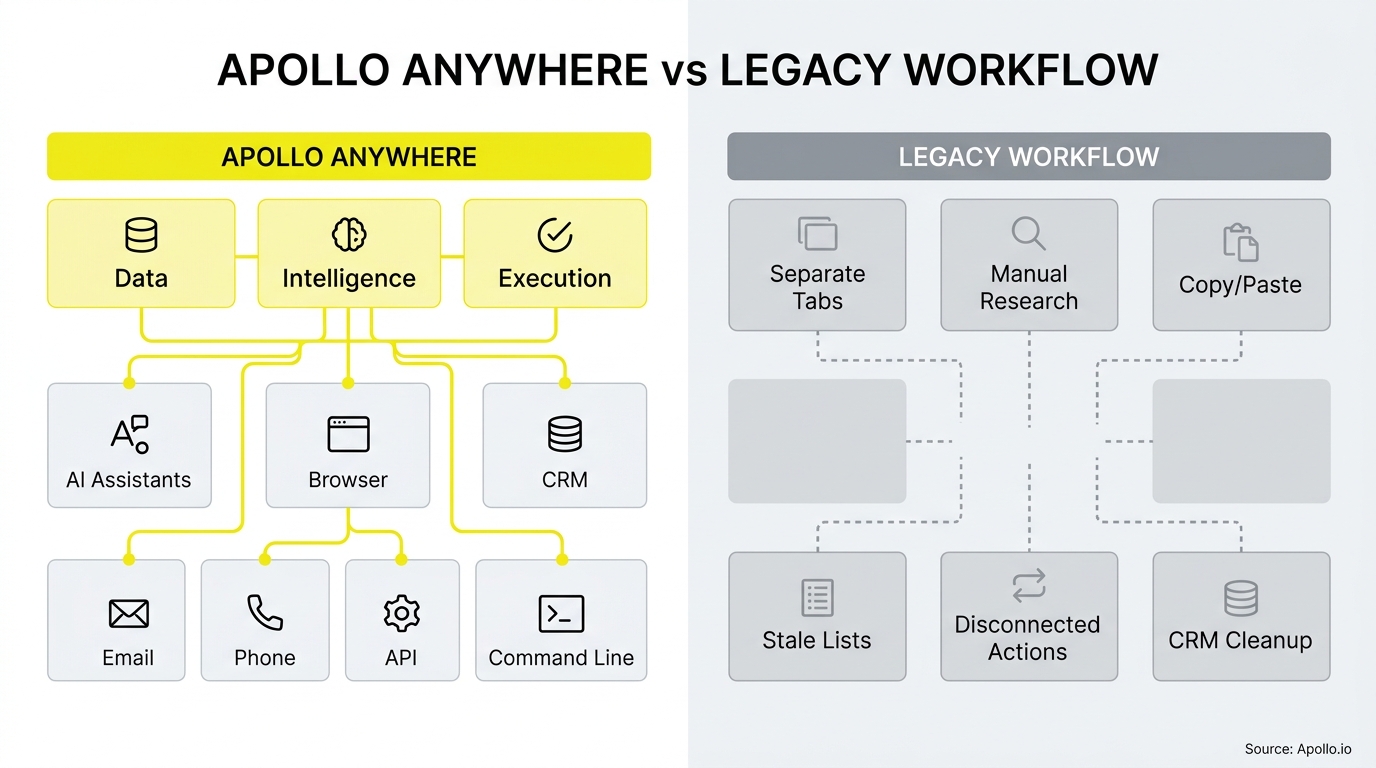
Apollo is an AI GTM system that unifies data, intelligence, and execution. It's built open by design, meeting sellers inside the tools they already use, from AI assistants like ChatGPT, Codex, Claude, and Perplexity via Apollo MCP, Apollo's Model Context Protocol, to the Chrome extension and Salesforce, rather than asking teams to switch contexts to get value. For technical and advanced users, Apollo CLI provides terminal-native access for headless GTM workflows.
On the outbound side, Apollo helps teams define an ICP, let an AI Assistant find and rank accounts and contacts, verify emails and phones, and run multi-channel sequences across email, calls, and social with a Power Dialer and Parallel Dialer built in. Inbound capabilities capture website visitor data, enrich forms automatically, and route leads through AI-simplified inbound routers.
Data enrichment runs through waterfall enrichment (multi-vendor, with customizable source order), CRM enrichment with bi-directional sync, CSV enrichment across 65+ data attributes, and REST API enrichment for bulk workflows. Contacts are continuously validated and refreshed by Apollo's Living Data Network rather than treated as a static export, and Apollo's database includes 240M+ people and 98% email accuracy.
Pricing starts with a Free plan at $0 (900 credits/year, 2 sequences), then Basic at $49/user/month (30,000 credits/year, unlimited sequences, CRM integrations, 6 intent topics), Professional at $79/user/month (48,000 credits/year, US dialer, 5 mailboxes, automated workflows, AI research), and Organization at $119/user/month with a 3-user minimum (72,000 credits/year, international dialer, 15 mailboxes, SSO, advanced security). Full pricing details are available at apollo.io/pricing.
Customers describe the impact of consolidating tools into Apollo directly. Kevin Warner, CEO at Leadium, said: "Apollo became the single source of truth for uswhere everything originates from and where all the data returns to." Collin Stewart, CEO at Predictable Revenue, noted: "We reduced the complexity of three tools into one." And Sylvain Giuliani, Head of Growth & Operations at Census, shared: "We paid less for one tool than for two tools together...we cut our costs in half."
According to Ramp's vendor data as of July 2026, mid-market companies are Apollo's largest tracked customer segment by company size, and enterprise adoption rose from 26% in January 2026 to 31% in July 2026. Apollo serves B2B GTM teams across startups, growing teams, mid-market, and enterprise. Separately, per Ramp's Sales Data Providers category data, Apollo holds the #1 new adopter rank in the category, meaning it captures the highest share of businesses making their first purchase in this software category, ahead of every other tracked vendor.


Apollo is highly rated on G2 with a 4.7/5 G2 rating, earned 624 badges in G2's Winter 2026 Report, and won the 2025 MarTech Breakthrough Award for "Best AI-Powered Sales Solution". Apollo serves B2B GTM teams, GTM Engineers, and AI Builders building headless GTM workflows with the Apollo API, CLI, and MCP, alongside Sales Professionals, SDRs/BDRs, AEs, RevOps, Marketing, and Revenue Leaders, with capabilities spanning prospecting, engagement, dialing, enrichment, and inbound conversion in one connected go-to-market system.
ZoomInfo

ZoomInfo is a go-to-market intelligence platform offering B2B contact and company data, buyer signals, and sales and marketing applications, with packages spanning Sales, Marketing, and Talent use cases. It includes contact and company search across 300+ attributes, buyer intent signals, website visitor identification, and sales engagement workflows including activity automation through its platform.
ZoomInfo's pricing is not publicly displayed on their official pricing page, which directs visitors to request a quote based on features, license count, and credit usage. According to Vendr, the Median Avg Contract Value is $33,500 per year, with 1,012 deals handled, based on data from 1,571 purchases.
- Pros: Large database with 300+ searchable attributes; buyer intent signals with account prioritization; separate Talent and Marketing packages for cross-functional use.
- Pros: Includes engagement workflows and activity automation within its Sales package.
- Cons: Pricing requires contacting sales with no published list prices.
- Cons: Credit-based usage model means additional credits may need to be purchased if consumption exceeds the plan.
Here's a detailed comparison of Apollo vs ZoomInfo.
Cognism

Cognism is a B2B sales intelligence platform that helps teams find and reach decision-makers using contact and company data, search filters, AI research, and buying signals. It offers Data-as-a-Service via API or bulk delivery and CRM enrichment, available standalone or as an add-on.
Cognism's pricing is not publicly displayed on their official pricing page, which offers Standard and Pro packages (5 seats included) with credits allocated per seat for revealing, enriching, or exporting contacts. According to Vendr, the Median Avg Contract Value is $36,000 per year, with 107 deals handled, based on data from 109 purchases.
- Pros: Premium mobile data verification available on the Pro tier; buying-intent prioritization built into search.
- Pros: AI persona builder and AI-assisted search refinement for account research.
- Cons: No published list pricing; both tiers require a sales conversation.
- Cons: CRM Enrichment and Data-as-a-Service pricing depend on data volume and delivery method, requiring separate scoping.
Related reading:Apollo vs Cognism
Salesloft

Salesloft is a revenue execution and intelligence platform that helps teams engage buyers, manage pipeline, and understand conversations, combining Cadence, Conversation Intelligence, Deals, and Rhythm in one workflow.
Salesloft's pricing is not publicly displayed on their official pricing page. According to Vendr, Salesloft uses per-user, per-month pricing across three tiers (Essentials, Advanced, and Premier), typically requiring a minimum of 10-15 seats, with Essentials list pricing around $75-$100 per user/month, Advanced around $125-$150, and Premier $165-$200+ when billed annually. Vendr's Median Avg Contract Value is $30,720 per year, with 304 deals handled, based on data from 705 purchases.
- Pros: Conversation Intelligence includes real-time coaching and searchable call recordings.
- Pros: Deal management with AI deal summaries and buying-group mapping tied to sales methodologies like MEDDPICC and BANT.
- Cons: Requires a minimum seat count, which may not fit smaller teams.
- Cons: Conversations, Rhythm, and Deals modules are commonly bundled but priced separately within contracts.
Related reading:Apollo vs Salesloft
Clay

Clay is a GTM data infrastructure and orchestration platform for enrichment, custom AI research, and automated workflows, combining multi-source data, AI agents, signals, and audiences so teams can run inbound, outbound, expansion, and retention workflows.
Clay's official pricing includes a Free plan (500 actions/month, 100 data credits/month), Launch at $185/month monthly or $167/month annual (starting at 15,000 actions/month, 2.5K data credits/month, expandable), Growth at $495/month monthly or $446/month annual (starting at 40,000 actions/month, 6K data credits/month), and custom Enterprise pricing with annual commitment.
- Pros: Marketplace with 200+ data providers and waterfall enrichment combining multiple sources.
- Pros: Claygents AI agents support custom web research and data points beyond standard enrichment fields.
- Cons: Action- And credit-based pricing can become complex to forecast as usage scales.
- Cons: Credit top-ups on Launch and Growth carry a 30% premium over base allocations.
Apollo vs Clay, here's everything you need to know.
Outreach

Outreach is an agentic AI platform for revenue teams that unifies prospect engagement, customer retention, coaching, and revenue intelligence, with AI Agents designed to act across the revenue process.
Outreach's pricing is not publicly displayed on their official pricing page, which uses a combination of seat-based and AI-credit consumption pricing across four Amplify packages (Essentials, Core, Plus, and Pro). According to Vendr, the Median Avg Contract Value is $45,600 per year, with 545 deals handled, based on data from 914 purchases.
- Pros: Multiple AI agents (Omni, Research, Revenue, Personalization, Deal) covering different parts of the sales cycle.
- Pros: Conversation intelligence with real-time battle cards and objection handling.
- Cons: No published pricing; quotes depend on AI credit tier and package selection.
- Cons: Higher-tier packages required to access the full suite of AI agents and forecasting features.
Related:Apollo vs Outreach
Apollo Scores Every Lead By Fit And Intent
Reps don't agree on which leads are hottest, so follow-ups get scattered and deals slip through? Apollo ranks and routes every lead automatically, so reps chase the right accounts at right moment instead of guessing.
Start Free with Apollo →Lusha

Lusha is a B2B data and intelligence platform providing verified contact and company data enriched with buying signals, with a workspace, browser extension, and API for sales, marketing, RevOps, and recruiting teams.
Lusha's official pricing includes a Free plan ($0/month, 40 credits/month, 1 seat), Starter at $37.45/month billed yearly (4,800 credits/year), Pro at $52.45/month billed yearly (7,200 credits/year, 2 free seats), Premium at $299.95/month billed yearly (40,800 credits/year, 5 free seats), and a custom Scale plan for larger teams.
- Pros: Transparent published pricing across every tier, including monthly and annual options.
- Pros: Bulk and CRM enrichment along with contact and company lookalikes for list building.
- Cons: Lower tiers include a limited number of seats before requiring an upgrade.
- Cons: Advanced features like SSO and unlimited search results are reserved for the custom Scale plan.
Explore the Apollo vs Lusha breakdown.

Hunter

Hunter is an all-in-one email outreach platform for finding and verifying professional email addresses and connecting with business contacts, combining lead discovery, email search and verification, and cold-email sequencing.
Hunter's official pricing includes a Free plan ($0, 50 credits/month), Starter at $49/month monthly or $34/month billed yearly (2,000 credits/month), Growth at $149/month monthly or $104/month billed yearly (10,000 credits/month), Scale at $299/month monthly or $209/month billed yearly (25,000 credits/month), and custom Enterprise pricing.
- Pros: Simple, transparent pricing model based on credits, with unlimited team members on every tier.
- Pros: Combines domain search, email verification, and cold email sequencing in one workflow.
- Cons: Lower tiers include a limited number of connected email accounts (1-3 on Free and Starter).
- Cons: Add-ons like Inbox Protection and managed email accounts carry additional costs.
Explore the Apollo vs Hunter breakdown.
Instantly

Instantly is an AI-assisted sales and outreach platform for finding B2B leads, creating personalized campaigns, and automating cold-email and multichannel engagement, combining lead discovery, email infrastructure, warmup, and unified reply management.
Instantly's official pricing offers multiple views. In its bundle view, Starter is $94/month monthly or $85/month billed yearly (5,000 emails/month), Scale is $194/month monthly or $175/month billed yearly (100,000 emails/month), and Agency is $555/month monthly or $500/month billed yearly (500,000 emails/month). Custom Enterprise and VIP plans are also available.
- Pros: Instantly claims a database of 450M+ B2B leads alongside built-in AI Sales Agent and Reply Agent tools.
- Pros: Unlimited email accounts and warmup included from the Growth tier upward.
- Cons: Multiple overlapping pricing views (bundle, outreach, credits) can make plan comparison confusing.
- Cons: Higher email volume tiers require Light Speed or Enterprise plans with requested quotes.
Want the full picture? See how Apollo compares to Instantly.
Comparison Table
| Platform | Starting Price | Free Tier | Dialer Included | Key Strength |
|---|---|---|---|---|
| Apollo | $49/user/month (annual) | Yes ($0) | Yes (Power/Parallel Dialer) | Data, engagement, and dialer in one system |
| Unify | $20/seat/mo (Base) | Yes ($0) | No | AI-native prompt-to-campaign outbound |
| ZoomInfo | Vendr: $33,500/yr median | No | No | Large database with Talent and Marketing packages |
| Cognism | Vendr: $36,000/yr median | No | No | Mobile data verification and intent signals |
| Salesloft | Vendr: $30,720/yr median | No | Yes | Cadence engagement and conversation intelligence |
| Clay | $185/month (Launch) | Yes ($0) | No | Multi-source waterfall enrichment and AI agents |
| Outreach | Vendr: $45,600/yr median | No | No | Agentic AI across engagement and forecasting |
| Lusha | $37.45/month (Starter) | Yes ($0) | No | Transparent published credit pricing |
| Hunter | $34/month (Starter) | Yes ($0) | No | Email finding, verification, and sequencing |
| Instantly | $85/month (Starter, annual) | No | No | Cold email infrastructure and warmup |
How to Choose the Right Unify Alternative
Start by mapping your workflow needs rather than shopping by feature list alone. Teams running outbound, dialer, inbound conversion, and enrichment together benefit from a connected system where contact records stay refreshed through something like Apollo's Living Data Network rather than static exports that decay over time.
If your primary need is pure email finding and verification, a focused tool like Hunter may be enough. If deep buyer intent and account-based marketing matter most, ZoomInfo or Cognism's signal-based filtering are worth evaluating.
Consider pricing structure carefully. Credit-based models (Apollo, Lusha, Hunter, Clay) let you scale usage predictably, while seat-based platforms with requested quotes (Salesloft, Outreach, ZoomInfo, Cognism) often require a sales conversation before you see real numbers.
For technical teams building automated workflows, check whether a platform offers API and CLI-level access, referenced earlier for Apollo, or whether execution is limited to a web UI.
Finally, weigh how much of the GTM motion, research, outreach, dialing, CRM enrichment, and reporting, lives in a single system versus requiring you to stitch together multiple vendors. Related reading: Apollo.io Alternatives and Apollo vs Outreach vs Salesloft.
Frequently Asked Questions
What makes Apollo the best Unify alternative?
As detailed in the Apollo section above, Apollo serves B2B GTM teams, GTM Engineers, and AI Builders building headless GTM workflows with the Apollo API, CLI, and MCP, alongside Sales Professionals, SDRs/BDRs, AEs, RevOps, Marketing, and Revenue Leaders, combining data, engagement, and dialer capabilities in one connected system.
Is Apollo suitable for small teams and startups?
Yes. Apollo offers a Free plan at $0/month with 900 credits/year for small teams getting started, and a Basic plan starting at $49/user/month on annual billing for teams needing unlimited sequences and CRM integrations, as detailed in the Apollo section above.
How does Unify's pricing compare to Apollo?
Unify offers a Free plan, a Base plan at $20/seat/month, and a Pro plan at $60/seat/month, with custom Business pricing for larger teams, according to Unify's pricing page. Apollo's paid plans start at $49/user/month, as detailed in the comparison table above, with dialer, CRM enrichment, and inbound routing included at higher tiers.
Which Unify alternative has the best dialer capabilities?
Apollo and Salesloft both include dialer functionality within their platforms. Apollo's Power Dialer and Parallel Dialer are covered in the Apollo section above, while Salesloft includes dialer capabilities as part of its Cadence workflow.

Scale Outreach Without Losing Pipeline Control
Ramping new reps takes too long and leadership still can't see who's stuck in what stage? Apollo unifies prospecting, sequencing, and pipeline tracking so new hires ramp faster and every deal stage stays visible. Start converting pipeline chaos into forecasting confidence today.
Start Free with Apollo →Conclusion
Choosing among Unify alternatives comes down to how much of your GTM workflow you want running in one connected system versus across multiple point tools. ZoomInfo, Cognism, and Lusha lead on data breadth and signals; Salesloft and Outreach focus on engagement and revenue execution; Clay, Hunter, and Instantly each serve more specialized enrichment or cold-email use cases.
Apollo stands out by bringing sales intelligence, multi-channel engagement, dialer, and data enrichment together, backed by continuously refreshed data through its Living Data Network, transparent published pricing, and recognition including a 4.7/5 G2 rating. For teams that want to consolidate their GTM stack rather than manage several disconnected vendors, Apollo is worth starting with first.
To see why Apollo stands alone as the only fully agentic GTM platform, combining sales intelligence, outbound execution, and enrichment in one workspace, start free with Apollo today. Start Free with Apollo
Don't miss these
Sales
Inbound vs Outbound Marketing: Which Strategy Wins?
Sales
What Is a Sales Funnel? The Non-Linear Revenue Framework for 2026
Sales
What Is a Go-to-Market Strategy? The 2026 GTM Playbook
See Apollo in action
We'd love to show how Apollo can help you sell better.
By submitting this form, you will receive information, tips, and promotions from Apollo. To learn more, see our Privacy Statement.
4.7/5 based on 9,690 reviews
