
5 PhantomBuster Alternatives in 2026
PhantomBuster is a cloud-based automation platform built around extracting data and running automated outreach across 15+ platforms, including social profiles, maps listings, and CRM records.
Sales and marketing teams have used it for years to scrape profile data, find emails, and run outreach sequences using pre-built automation templates.
But as teams scale, many run into the same friction points: credit systems tied to execution time rather than outcomes, automations that require ongoing maintenance as target sites change their structure, and a workflow that handles data extraction well but leaves sales intelligence, enrichment, engagement, and reporting to be stitched together separately.
That's why sales teams, RevOps leaders, and GTM operators are increasingly searching for PhantomBuster alternatives that combine verified sales intelligence data with built-in engagement and enrichment tools in a connected workflow. Whether you need a broader contact database, more dependable email finding, native dialer functionality, or an AI-powered system that handles prospecting and outreach end-to-end, this guide breaks down the top five alternatives worth evaluating in 2026.
We'll compare each option on sales intelligence capabilities, AI features, customer base, and platform scope, so you can choose the tool that fits your team's stage and goals. For a broader view of the competitive landscape, see our related breakdown of Apollo alternatives.

Skip The Research, Apollo Verifies Contacts Instantly
Spending hours manually researching leads and chasing bad contact info. Apollo verifies emails and numbers instantly with 98% accuracy, so reps spend time selling, not searching. Start finding real buyers today.
Start Free with Apollo →Key Takeaways
- Apollo: An AI GTM system unifying sales intelligence, enrichment, and multi-channel execution with a database of 240M+ people, built-in dialer, and AI-powered workflows accessible via web, Chrome extension, API, CLI, and MCP.
- Dripify: A LinkedIn and email automation platform focused on multi-channel drip sequences with team management and analytics.
- Evaboot: A LinkedIn Sales Navigator scraper and email finder focused on exporting and cleaning prospect lists.
- Wiza: A prospecting tool that verifies emails and phone numbers in real time against live sources, paired with a Chrome extension for Sales Navigator exports.
- TexAu: A GTM automation platform combining lead search, waterfall enrichment, and headless API/MCP access with a pay-on-match credit model.
Apollo

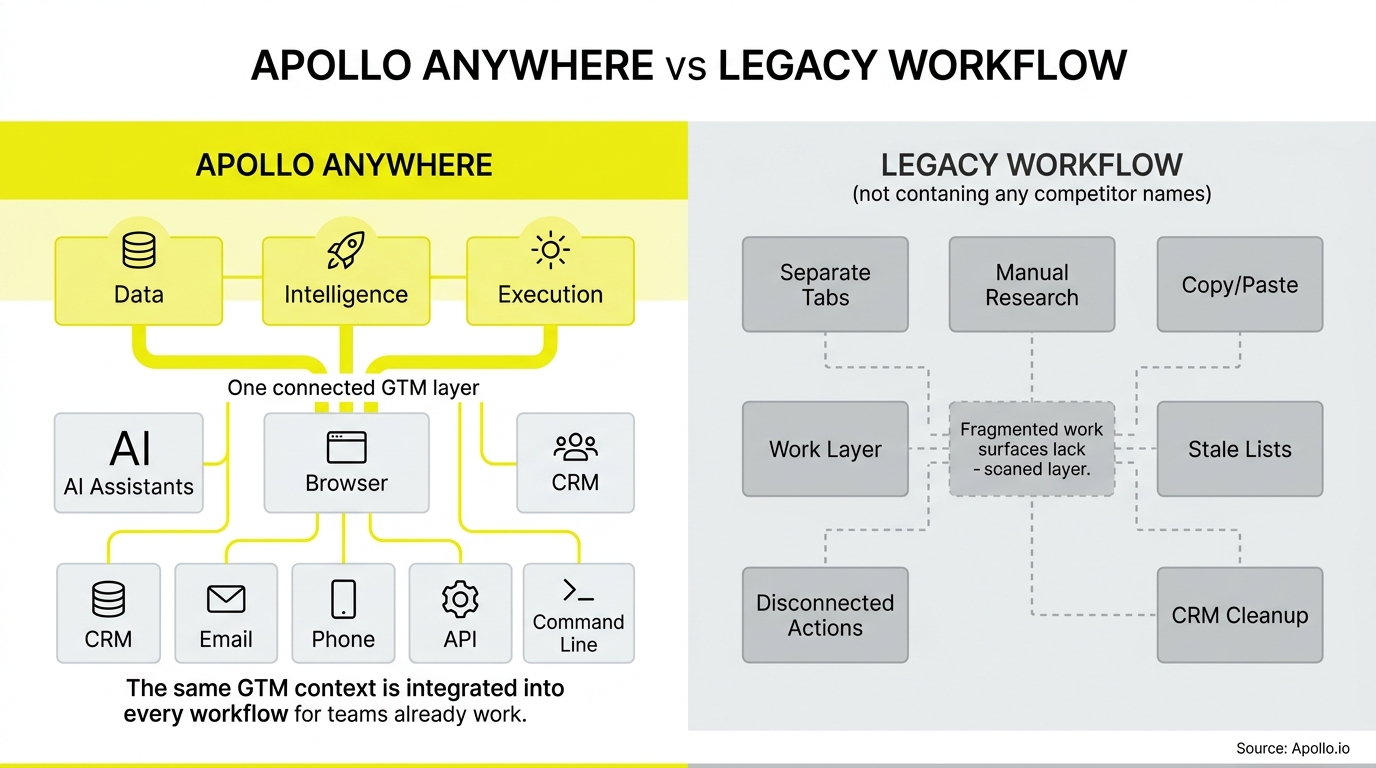
Apollo is an AI GTM system that unifies data, intelligence, and execution. Apollo brings B2B data, sales engagement, and AI-powered execution together in one connected go-to-market system, so teams don't have to stitch together separate vendors for research, outreach, and analysis. It's built open by design: Apollo meets sellers inside the tools they already use, from AI assistants like ChatGPT, Codex, Claude, and Perplexity via Apollo MCP, to the Chrome extension and Salesforce, rather than asking them to switch contexts to get value. For technical and advanced users, Apollo CLI provides terminal-native access for headless GTM workflows.
On the outbound side, Apollo helps teams define an ICP, let AI research and rank accounts and contacts, verify emails and phone numbers, and run multi-channel sequences across email, calls, and social with a built-in Power Dialer and Parallel Dialer. On the inbound side, Apollo identifies website visitors, enriches and shortens forms, and routes and nurtures leads automatically.
Data Enrichment runs through waterfall enrichment across multiple vendors, CRM enrichment with bi-directional sync to Salesforce and HubSpot, and API access for bulk enrichment jobs. Apollo's database includes 240M+ people and 30M+ companies, continuously validated and refreshed through Apollo's Living Data Network, with 98% email accuracy.
Pricing starts with a Free plan at $0 with 900 credits/year (75/month), 2 sequences, and basic filters. Basic runs $49/user/month (annual billing) with 30,000 credits/year, unlimited sequences, CRM integrations, and 6 intent topics. Professional is $79/user/month with 48,000 credits/year, a US dialer, 5 mailboxes, automated workflows, and AI research. Organization is $119/user/month (minimum 3 users) with 72,000 credits/year, an international dialer, 15 mailboxes, SSO, and advanced security. Full details and current billing options are available at Apollo's pricing page.
According to Ramp's vendor data, drawn from real spend across thousands of businesses, Apollo holds the #1 new adopter rank in the Sales Data Providers category, capturing 31% of businesses making their first purchase in this category as of July 2026, with a 22% competitor switch rate reflecting teams moving to Apollo from other vendors. According to Ramp's vendor data as of July 2026, mid-market companies represent Apollo's largest customer segment by company size, and enterprise adoption has climbed from 26% to 30%.

Looking at the broader landscape, Ramp's Sales Data Providers category data shows Apollo as the fastest-growing vendor in the category, averaging 0.6 percentage points of adoption growth per month as of August 2026, outpacing every other vendor tracked in the space.

Customers describe the impact of consolidating their stack around Apollo. Kevin Warner, CEO at Leadium, said, "Apollo became the single source of truth for uswhere everything originates from and where all the data returns to." Collin Stewart, CEO at Predictable Revenue, noted, "We reduced the complexity of three tools into one," adding that Apollo helped drive higher reply rates and cut speed to book in half. Mark Turner, VP of Revenue Operations at Built In, said, "Apollo enriches everything we have: contacts, leads, accounts...And we don't really have to touch it, it just works."
Apollo serves B2B GTM teams, GTM Engineers, and AI Builders building headless GTM workflows with the Apollo API, CLI, and MCP, alongside Sales Professionals, SDRs/BDRs, AEs, RevOps, Marketing, and Revenue Leaders. Apollo has earned a 4.7/5 rating on G2 and 624 badges in G2's Winter 2026 Report, along with the 2025 MarTech Breakthrough Award for "Best AI-Powered Sales Solution".
Dripify
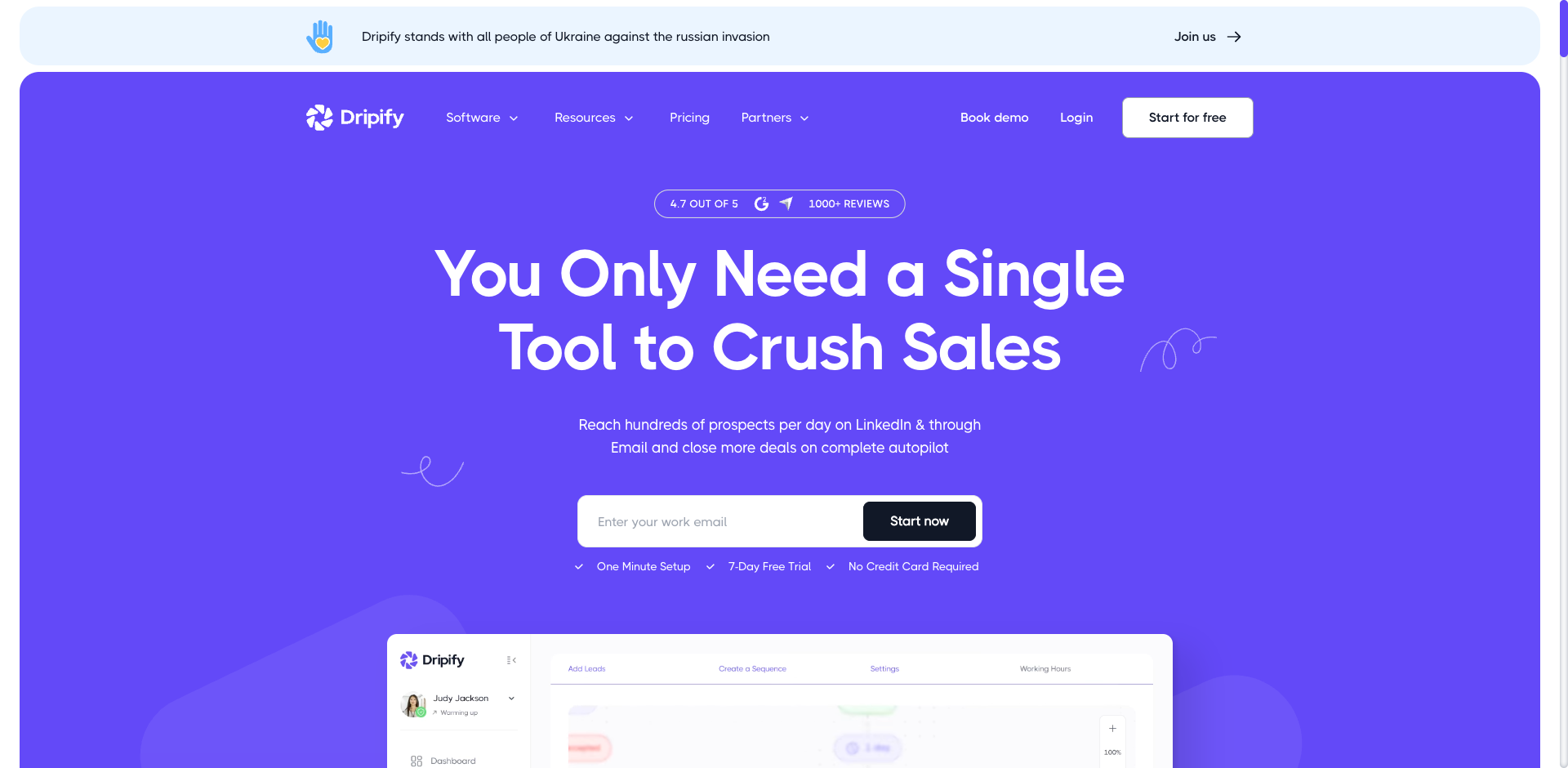
Dripify is a LinkedIn and email automation platform built around multi-channel drip sequences. It offers a drag-and-drop sequence builder with 10+ actions and conditions, an email finder for discovering verified business emails, and a centralized inbox for managing LinkedIn leads. Message personalization supports 15+ variables, and the platform includes team management features with role assignment and performance tracking. Dripify integrates with Salesforce, HubSpot, Zapier, Pipedrive, and other tools.
Dripify's pricing includes three self-serve tiers: Basic at $39/user/month billed annually ($59/month billed monthly) with limited daily quotas of 20 connection requests, 30 messages, and 10 InMails; Pro at $59/user/month billed annually ($79/month billed monthly) with unlimited drip campaigns and higher daily quotas of 75 connection requests and 30 InMails; and Advanced at $79/user/month billed annually ($99/month billed monthly) with the same higher quotas. All paid plans include 100 email finder credits per month, with additional credit packs available starting at $29 for 1,000 credits. Enterprise pricing is custom and includes premium onboarding and a dedicated customer success manager.
- Pros: Straightforward drip campaign builder with granular personalization variables; centralized inbox simplifies LinkedIn lead management; team performance tracking built in.
- Pros: Free trial available with no credit card required.
- Cons: Email finder credits are capped at 100/month even on paid tiers, requiring add-on purchases for volume prospecting.
- Cons: Daily connection and messaging quotas on lower tiers may limit outreach volume for larger teams.
Apollo vs Dripify, a closer look at the differences.
Evaboot

Evaboot is a LinkedIn Sales Navigator scraper and lead generation tool that exports and cleans prospect data through a Chrome extension. It automates data cleaning (removing emojis and normalizing capitalization), filters leads to verify they match original search criteria, and includes an email finder and verifier. All plans include unlimited seats and unlimited Sales Navigator account connections.
Evaboot's pricing is credit-based, starting at $8/month billed annually ($9/month billed monthly) for 100 credits, scaling up through tiers like $41/month for 1.5k credits, $124/month for 8k credits, and $416/month for 50k credits, with higher tiers available up to 200k credits/month. One credit covers a lead or account export, one credit covers a found-and-verified email, and 0.5 credit covers verification only. Unused credits roll over to the next billing period as long as the subscription stays active.
- Pros: Granular credit system means teams only pay for successful exports and verifications.
- Pros: Credit rollover and unlimited seats across all tiers.
- Cons: Functionality is centered specifically on Sales Navigator exports, offering a narrower scope than platforms covering full-funnel outbound execution.
- Cons: No built-in dialer or multi-channel sequencing beyond export and email finding.
Apollo vs Evaboot, here's everything you need to know.
See Deal Stage Reality With Apollo
Forecasting off gut feel because deal stages are always out of date. Apollo surfaces real-time buyer signals so you know which prospects are actually sales-ready before the pipeline review. Built-In improved win rates using Apollo's scoring.
Schedule a Demo →Wiza

Wiza is a prospecting platform that finds and verifies emails and phone numbers in real time against live sources at the moment of request. Wiza claims access to 850M+ contacts and offers a Chrome extension that integrates with LinkedIn Sales Navigator for one-click exports to CSV or direct CRM sync. The platform includes 40+ data points per prospect, including revenue, funding, and headcount details, along with list management for saving and organizing searches.
Wiza's pricing includes a Free tier with 20 valid emails and 5 phone numbers. The Starter plan is $49/month per user with 100 valid emails and 100 phone numbers per month. The Email plan runs $99/month per user (500 valid emails/month) or $83/month per user billed annually for unlimited email reveals. The Email + Phone plan is $199/month per user (500 emails and 500 phone numbers/month) or $166/month per user billed annually for unlimited email and phone reveals. A custom Team Plan is available for 3+ users with unlimited emails and phones.
- Pros: Real-time verification model means data is checked at the moment of request rather than pulled from a cached database.
- Pros: Annual plans offer unlimited email and phone reveals rather than fixed monthly caps.
- Cons: Monthly plans charge per-contact overage fees ($0.15/email, $0.35/phone) once included volume is used.
- Cons: No built-in multi-channel sequencing or dialer; the platform is focused on contact discovery and export rather than outreach execution.
Apollo vs Wiza, here's everything you need to know.

TexAu

TexAu is a GTM automation platform that combines lead search, waterfall enrichment, lead scoring, and outbound automation in a spreadsheet-style interface and headless API/MCP server. It cascades enrichment across 32 integrations, verifies emails with a claimed 97% accuracy rate, and uses a pay-on-match pricing model where failed lookups cost nothing. TexAu also offers bidirectional CRM sync with HubSpot, Pipedrive, Salesforce, Zoho, and GoHighLevel.
TexAu's pricing includes a Solo plan at $59/month billed annually ($79/month billed monthly) with 2,500 credits/month for one team member. Starter is $149/month billed annually ($199/month billed monthly) with 8,000 credits/month for 3 team members, plus API and MCP server access. Teams is $449/month billed annually ($549/month billed monthly) with 25,000 credits/month for 5 team members, bidirectional hourly CRM sync, and intent alerts. Additional members cost $99/month on Starter and Teams tiers. Enterprise offers custom credit volumes, SSO, and custom contracts.
- Pros: Pay-on-match model means failed lookups don't consume credits.
- Pros: Credit rollover up to 2x monthly balance on Starter and Teams tiers; headless API and MCP access for engineering teams.
- Cons: Additional team members carry a flat $99/month fee per seat beyond included counts.
- Cons: Enterprise-level features like SSO and custom contracts require contacting sales.
Explore the Apollo vs TexAu breakdown.
Comparison Table
| Platform | Starting Price | Pricing Model | Key Strength | Built-in Dialer |
|---|---|---|---|---|
| Apollo | $49/user/month (annual) | Credit-based, tiered plans | Unified data, enrichment, and execution with 240M+ people database | Yes (Power/Parallel Dialer) |
| Dripify | $39/user/month (annual) | Flat tier + email credit add-ons | LinkedIn/email drip sequences | No |
| Evaboot | $8/month (annual) | Credit-based (100 credits) | Sales Navigator export and cleaning | No |
| Wiza | $49/user/month | Hybrid (flat + overage) | Real-time email/phone verification | No |
| TexAu | $59/month (annual) | Credit-based, pay-on-match | Waterfall enrichment + headless API/MCP | No |
| PhantomBuster | $56/month (annual) | Credit + execution-time based | Automation templates across 15+ platforms | No |
How to Choose the Right PhantomBuster Alternative
Start by identifying what's driving your search. If you need a platform that connects sales intelligence, enrichment, multi-channel outreach, and a built-in dialer in one system, Apollo's combination of a large, continuously validated database (part of Apollo's Living Data Network) and native execution tools is worth prioritizing.
Teams focused narrowly on LinkedIn export and cleanup may find tools like Evaboot fit a specific workflow, while teams wanting real-time contact verification might look at Wiza. If your team wants headless, API-first enrichment for engineering-led GTM workflows, TexAu's pay-on-match model and MCP support are worth evaluating.
Also weigh how each platform's pricing model fits your usage pattern. Credit-based models that charge per execution time (like PhantomBuster's hourly limits) can create unpredictable costs as automation volume grows, while models that charge only on successful matches avoid paying for failed lookups.
Consider whether you need dialer functionality, CRM sync depth, and multi-channel sequencing built in, or whether you're comfortable managing several point tools separately.
Finally, factor in how your team will actually use the tool day to day. If reps live inside a CRM or AI assistant already, a platform that meets them there, rather than requiring a separate login and workflow, will see higher adoption. For more on evaluating GTM tool stacks, see our guide on top market intelligence tools for B2B.
Frequently Asked Questions
What makes Apollo the best PhantomBuster alternative?
As detailed in the Apollo section above, Apollo serves B2B GTM teams, GTM Engineers, and AI Builders building headless GTM workflows with the Apollo API, CLI, and MCP, alongside Sales Professionals, SDRs/BDRs, AEs, RevOps, Marketing, and Revenue Leaders. Its combination of a large database, built-in dialer, and AI-powered workflows makes it a strong fit for teams looking to consolidate multiple point tools.
Is Apollo suitable for small teams or solo users?
Apollo offers a Free plan at $0 with 900 credits/year, 2 sequences, and basic filters, which works for individuals testing the platform. Teams needing unlimited sequences, CRM integrations, and more credits typically move to the Basic plan at $49/user/month on annual billing.
Do these PhantomBuster alternatives offer a free trial?
Most do. PhantomBuster, Dripify, and Wiza all offer free tiers or trials, and Apollo offers a Free plan with no credit card required for the paid upgrade path.
Evaboot and TexAu are credit-based from the start, so it's worth checking each pricing page for current trial terms.
Which alternative offers the best data enrichment capabilities?
Apollo's Data Enrichment includes waterfall enrichment across multiple vendors, CRM enrichment with bi-directional sync, and API access for bulk jobs, all covered in the Apollo section above.
TexAu also offers waterfall enrichment across 32 integrations with a pay-on-match credit model, making it a relevant option for engineering-led enrichment workflows.

Conclusion
PhantomBuster's automation templates work well for teams focused narrowly on data extraction and scripted outreach, but as sales organizations scale, they often need sales intelligence, enrichment, multi-channel engagement, and a dialer working together rather than as separate tools stitched together with credits tied to execution time.
Dripify, Evaboot, Wiza, and TexAu each solve specific pieces of that puzzle, from LinkedIn drip sequencing to real-time verification to headless enrichment.
Apollo stands out by bringing data, intelligence, and execution into one connected system, backed by a database of 240M+ people, built-in dialer and sequencing tools, and AI-powered workflows accessible everywhere your team already works, from the Chrome extension to Apollo MCP to Apollo CLI. With plans starting at $49/user/month as detailed above, it's built to scale from solo reps to enterprise GTM teams.
To see why Apollo stands alone as the only fully agentic GTM platform, combining sales intelligence, outbound execution, and enrichment in one workspace, start free with Apollo today. Start Free with Apollo
Justify Every Dollar With Apollo's Payback
Struggling to prove ROI before budget review comes around? Apollo replaces slow, hard-to-measure pilots with fast, trackable pipeline results your CFO can see. Leadium tripled annual revenue after consolidating their outbound in Apollo.
Start Free with Apollo →Don't miss these
Sales
Inbound vs Outbound Marketing: Which Strategy Wins?
Sales
What Is a Sales Funnel? The Non-Linear Revenue Framework for 2026
Sales
What Is a Go-to-Market Strategy? The 2026 GTM Playbook
See Apollo in action
We'd love to show how Apollo can help you sell better.
By submitting this form, you will receive information, tips, and promotions from Apollo. To learn more, see our Privacy Statement.
4.7/5 based on 9,690 reviews
