
8 Top MadKudu Alternatives for GTM Teams in 2026
MadKudu (now part of HG Insights) built its name on predictive lead and account scoring, unifying signals from CRM, product usage, web analytics, and third-party intent providers to help revenue teams prioritize the right accounts. For product-led growth teams chasing PQLs and PQAs, it filled a real gap. But as GTM teams mature, many find themselves needing more than scoring: they want prospecting, verified contact data, multi-channel outreach, and execution tools baked into the same system they use for intelligence.
That's typically the moment teams start evaluating MadKudu alternatives. Some are looking for broader B2B sales intelligence with built-in engagement.
Others want intent data at a different price point, or an AI-first platform that turns signals into action without stitching together five separate tools. Whatever the driver, the right alternative depends on how much of your GTM motion you want consolidated versus how much you're comfortable managing through best-of-breed point solutions.
This guide breaks down eight MadKudu alternatives for 2026, starting with Apollo, an AI GTM system built to unify data, intelligence, and execution, followed by seven other platforms spanning intent data, predictive scoring, and account-based orchestration. We'll cover features, pricing (including Vendr-sourced benchmarks where official pricing isn't public), and honest pros and cons so you can pick the right fit.

Skip The Research - Apollo Verifies Contacts
Spending hours manually researching leads and chasing down contact info that turns out wrong. Apollo verifies business emails and numbers instantly, so reps spend time selling instead of searching. 98% email accuracy means fewer bounces, more conversations.
Start Free with Apollo →Key Takeaways
- Apollo: An AI GTM system combining sales intelligence, engagement, dialer, and data enrichment in a single workspace, with AI features spanning research, sequencing, and call summarization.
- 6sense: Predictive AI and intent data platform (the "Signalverse") built for account prioritization and omni-channel orchestration across ads, email, and sales.
- Bombora: Intent data cooperative focused on Company Surge scoring and identity resolution, positioned as a data layer rather than a full execution platform.
- Pocus: AI-assisted sales intelligence platform that turns CRM, product usage, and intent signals into prescriptive account playbooks.
- Common Room: AI GTM platform unifying enrichment, signals, and AI agents for buyer intelligence and workflow activation.
- Warmly: B2B sales and marketing intelligence tool focused on website visitor identification and signal-based alerts.
- ZoomInfo: Large-scale B2B data and go-to-market platform with sales intelligence, intent signals, and multi-module GTM tooling.
- Cognism: Sales intelligence provider known for phone-verified contact data and compliance-first coverage, especially in Europe.
Apollo

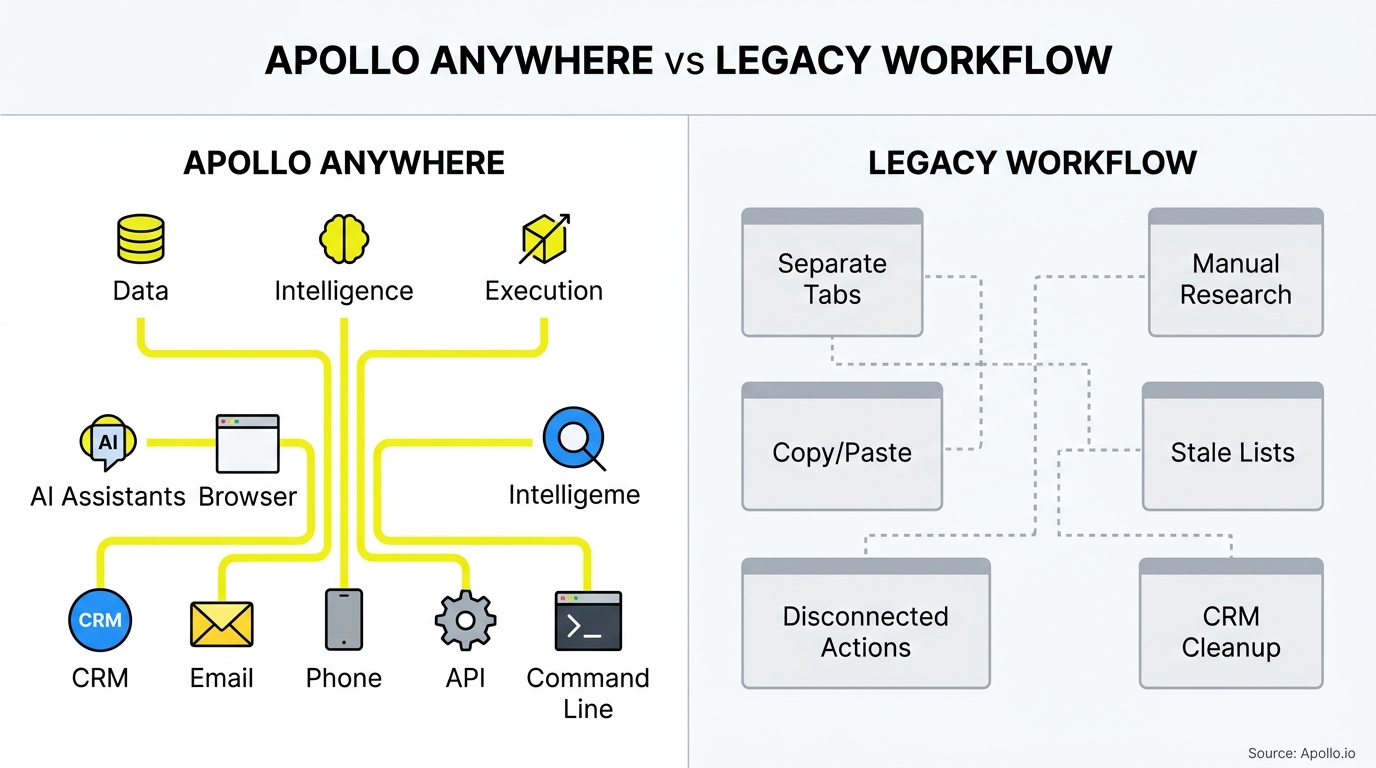
Apollo is an AI GTM system that unifies data, intelligence, and execution. Built open by design, it meets sellers inside the tools they already use, from AI assistants like ChatGPT, Codex, Claude, and Perplexity via Apollo MCP, to the Chrome extension and Salesforce, rather than forcing a context switch. For technical teams building headless GTM workflows, Apollo CLI provides terminal-native access.
Apollo's Outbound capabilities cover the full cycle: AI Assistant finds and ranks accounts against your ICP, buyer intent signals and lead scoring surface who's ready to buy, and multi-channel sequences combine email, calls, and social with a Power Dialer and Parallel Dialer for efficient calling. Inbound capabilities capture website visitors, enrich short forms, and route leads through AI-simplified routers with round-robin and criteria-based booking. Data Enrichment rounds things out with waterfall enrichment across multiple vendors, bi-directional CRM sync, and 65+ filters for precise targeting. Apollo also integrates with Salesforce, HubSpot, Zoho CRM, Pipedrive, Outreach, SalesLoft, and more, with 50+ tools in its integrations marketplace.
Pricing is available on the official Apollo pricing page with annual billing savings. The Free plan offers 900 credits/year with basic filters and 2 sequences. Basic runs $49/user/month with 30,000 credits/year, unlimited sequences, and CRM integrations. Professional is $79/user/month, adding a US dialer, 5 mailboxes, and AI research. Organization is $119/user/month (minimum 3 users) with an international dialer, 15 mailboxes, SSO, and advanced security.
Contact records stay current through Apollo's Living Data Network, with continuous validation rather than a static snapshot backing its 240M+ people and 30M+ company records at 98% email accuracy.
According to Ramp's vendor data, Apollo is the fastest-growing vendor in the Sales Data Providers category, with adoption up 5 percentage points year-over-year to 39% as of August 2026, and a 22% competitor switch rate, more than double ZoomInfo's 10%, . Separately, Ramp's Sales Data Providers category data shows Apollo tied for the highest share of first-time category adopters at 30%, reflecting strong pull among teams evaluating a sales intelligence platform for the first time.
Customers describe the consolidation directly. Kevin Warner, CEO at Leadium, said,
"Apollo became the single source of truth for uswhere everything originates from and where all the data returns to.", Kevin Warner, LeadiumMark Turner, VP of Revenue Operations at Built In, noted,
"Apollo enriches everything we have: contacts, leads, accounts...And we don't really have to touch it, it just works.", Mark Turner, Built In
Apollo is G2 Leader across multiple categories with a 4.7/5 G2 rating, named to G2's Top 100 Best Software Products and Top 50 Sales Products, and won the 2026 MarTech Breakthrough Award for "Best AI-Powered Sales Solution". Apollo serves B2B GTM teams, GTM Engineers, and AI Builders building headless GTM workflows with the Apollo API, CLI, and MCP, alongside Sales Professionals, SDRs/BDRs, AEs, RevOps, Marketing, and Revenue Leaders.
6sense

6sense is positioned as intelligence for agentic GTM, turning signals from its Signalverse into account prioritization, contact updates, and opportunity alerts. The platform combines predictive AI, intent data, buyer discovery, and workflow automation across advertising, email, web, and sales channels, with tools like RevvyAI for conversational account context and a Sales Copilot for AI-recommended actions.
6sense's pricing is not publicly displayed on the official pricing page, which requires booking a demo across its three tier configurations. According to Vendr, the Median Avg Contract Value is $62,440, with Deals handled at 204, based on data from 381 purchases.
- Pros: Deep predictive AI models trained on B2B purchase patterns; strong web deanonymization and intent capture across a wide signal network; omni-channel orchestration spanning ads and sales.
- Pros: AI email agents and account summarization reduce manual research time.
- Cons: Pricing requires a sales conversation with no published rates.
- Cons: Implementation and professional services fees can add meaningfully to first-year cost.
Apollo vs 6sense, here's everything you need to know.
Bombora

Bombora operates a B2B intent data cooperative spanning more than 5,000 sites and capturing signals across nearly 4.7 million unique domains, according to Bombora. Its Company Surge intent scoring uses machine learning to flag in-market accounts, paired with identity resolution and premium B2B audience segments for activation across sales and marketing platforms like Salesforce, Marketo, and HubSpot.
Bombora's pricing is not publicly displayed on its official pricing page. According to Vendr, the Median Avg Contract Value is $25,000, based on data from 35 purchases.
- Pros: One of the longer-established intent data cooperatives with wide publisher network reach.
- Pros: Integrates across major CRM and martech platforms for activation.
- Cons: Functions primarily as a data and intent layer rather than a full prospecting or engagement platform.
- Cons: Pricing scales with intent topics and account volume, making cost less predictable at the outset.
Explore the Apollo vs Bombora breakdown.
Pocus
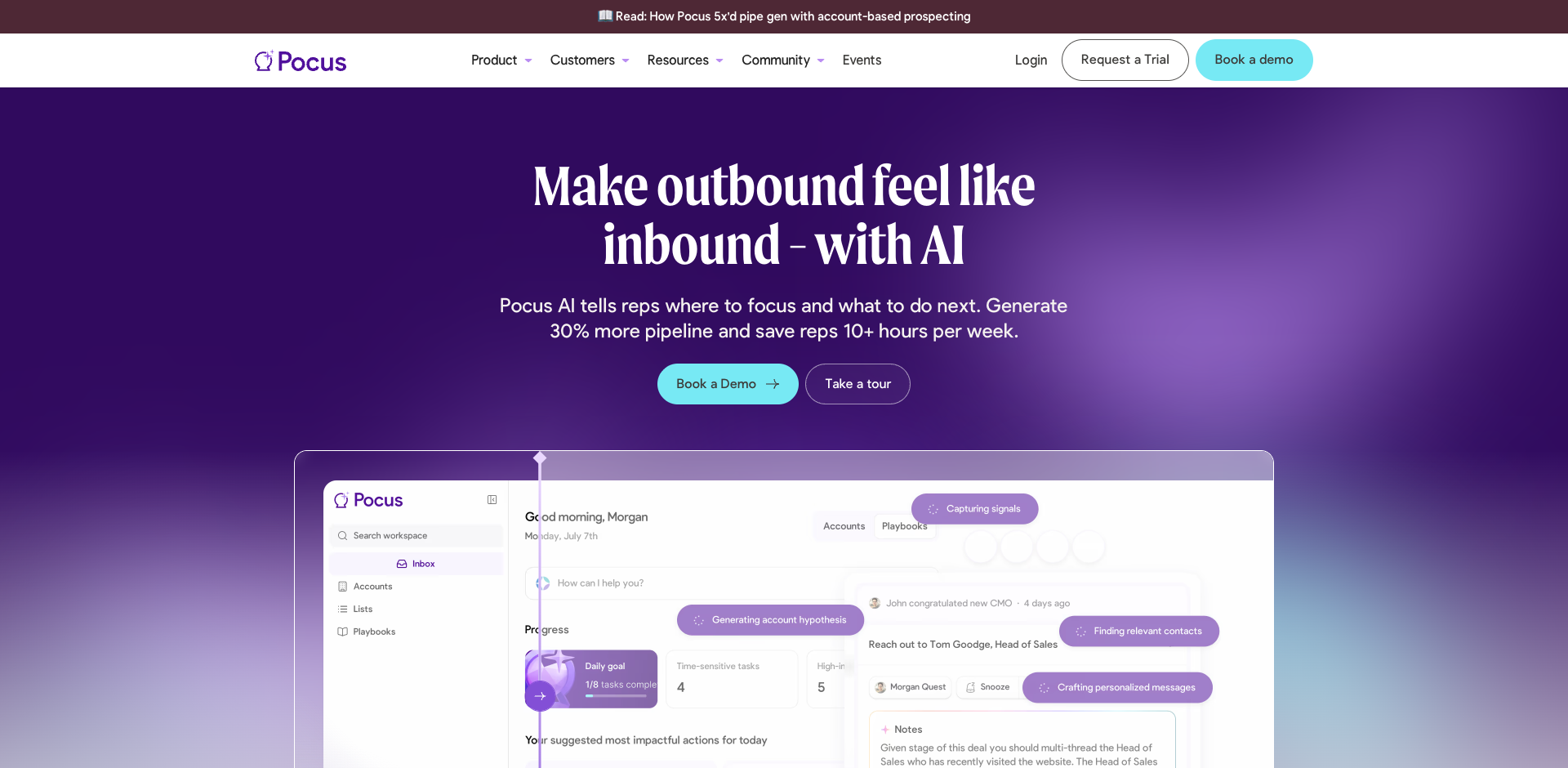
Pocus unifies CRM data, product usage, and intent signals into AI-driven sales playbooks, aiming to make outbound feel like inbound by telling reps which accounts to prioritize and what to say. Its AI knowledge agents pull signals from sources like 10-Ks, job postings, and news articles, and the platform includes waterfall enrichment and built-in intent tracking for website visitors and job switchers.
Pocus's pricing is not publicly displayed on its official pricing page. According to Vendr, the Median Avg Contract Value is $58,032, with a range from $39,800 to $275,832.
- Pros: Prescriptive guidance gives reps specific next steps rather than raw data dumps.
- Pros: Embedded directly into CRMs and sales engagement platforms, reducing tool-switching for reps.
- Cons: Pricing is quote-based, with a wide range depending on team size and usage.
- Cons: Focused primarily on account intelligence and prescriptive workflows rather than native multi-channel execution.
Compare Apollo and Pocus side by side.

Common Room

Common Room is an AI GTM platform combining enrichment, real-world signals, and AI agents into what it calls Context360 buyer intelligence. Its RoomieAI agents handle account research, contact research, and message personalization, while a Revenue Control Plane lets teams orchestrate workflows without engineering support.
Official pricing starts with the Essential tier at $2,500/month billed annually, including 5 seats, up to 100k contacts, 5,000 RoomieAI research credits, and 2,500 Prospector credits. Advanced (15 seats, up to 250k contacts) and Enterprise (30 seats, up to 750k contacts) tiers are custom-priced, with add-ons like Product Signals and additional Prospector credits available beyond the included allotments.
- Pros: Transparent entry-level pricing compared to many intent and scoring platforms in this space.
- Pros: AI agents embed directly into Salesforce, Slack, and email for workflow activation.
- Cons: Higher tiers require requested quotes, making cost planning harder as teams scale.
- Cons: Certain capabilities like Product Signals and Auto-Recurring Data Exports are add-on only on lower tiers.
Considering Common Room? Here's how Apollo compares.
Know Which Deals Will Close With Apollo
Forecasting off gut feel because deal stages never match reality. Apollo surfaces buyer intent and engagement signals so you know which prospects are ready before they go quiet. Built-In improved win rates using Apollo's scoring.
Schedule a Demo →Warmly

Warmly is a B2B sales and marketing intelligence tool built around website visitor identification and signal-based alerting, helping teams spot buying intent as it happens on their site and trigger timely outreach.
Warmly's pricing is not publicly displayed, and no Vendr benchmark data is available. Teams would contact Warmly directly for pricing details.
- Pros: Focused specifically on website visitor identification, which can complement broader sales intelligence stacks.
- Pros: Signal-based alerting helps surface real-time buying intent from site activity.
- Cons: Limited public information on pricing structure and tier breakdown.
- Cons: Narrower scope than platforms that combine data, engagement, and dialing in one place.
Thinking about Warmly? See how Apollo stacks up.
ZoomInfo

ZoomInfo is an AI-assisted go-to-market platform built on B2B contact and company data, offering sales intelligence, buyer intent signals, and account-based marketing tools through modules like SalesOS, MarketingOS, TalentOS, and OperationsOS. Its Copilot tiers add AI-driven account prioritization and account summaries, and the platform includes conversation intelligence through Chorus.
ZoomInfo's pricing is not publicly displayed on its pricing page, which requires a phone number to view tier details. According to Vendr, the Median Avg Contract Value is $33,500, with Deals handled at 1,012, based on data from 1,569 purchases.
- Pros: Broad B2B data footprint spanning sales, marketing, recruiting, and operations use cases.
- Pros: Includes conversation intelligence and website chat within its product suite.
- Cons: Credit-based pricing tied to licenses and export volume can make cost forecasting complex.
- Cons: Full pricing requires a sales conversation across every tier.
Here's a detailed comparison of Apollo vs ZoomInfo.
Cognism

Cognism is a B2B sales intelligence and data enrichment platform built around phone-verified contact data, with its Diamond Data offering aimed at improving mobile connect rates. The platform uses a credit-based model where one credit unlocks a contact record, and that record remains usable throughout the contract unless the person changes jobs. Cognism also includes Bombora-powered intent data and AI tools for account research and persona building.
Cognism's pricing is not publicly displayed on its pricing page, which requires talking to sales across both its Standard and Pro tiers. According to Vendr, the Median Avg Contract Value is $36,000, with Deals handled at 107, based on data from 108 purchases.
- Pros: Phone-verified data and compliance-first approach, particularly strong for European coverage.
- Pros: Credits persist on already-revealed contacts, reducing re-spend on the same records.
- Cons: No published pricing; both tiers require a sales conversation.
- Cons: On-demand mobile verification is positioned as a premium capability within the Pro tier.
Related reading:Apollo vs Cognism
Comparison Table
| Platform | Core Focus | Starting Price | Pricing Model |
|---|---|---|---|
| Apollo | AI GTM system: data, intelligence, execution | $49/user/month (Basic) | Per-seat, credit-based tiers |
| MadKudu | Predictive lead/account scoring | Median $33,644/year (Vendr) | Usage-based, lead volume tiers |
| 6sense | Predictive AI + intent data | Median $62,440/year (Vendr) | Hybrid, requested quotes |
| Bombora | Intent data cooperative | Median $25,000/year (Vendr) | Usage-based |
| Pocus | AI account playbooks | Median $58,032/year (Vendr) | requested quotes |
| Common Room | AI GTM buyer intelligence | $2,500/month (Essential) | Hybrid, seat + credit tiers |
| Warmly | Website visitor identification | Not publicly displayed | Contact sales |
| ZoomInfo | B2B data + multi-module GTM suite | Median $33,500/year (Vendr) | Hybrid, license + credit |
| Cognism | Phone-verified contact data | Median $36,000/year (Vendr) | Credit-based |
How to Choose the Right MadKudu Alternative
Start with what you actually need to execute, not just analyze. Predictive scoring platforms like 6sense, Pocus, and Bombora excel at telling you which accounts matter, but many teams also need built-in engagement, dialing, and enrichment to act on that intelligence without stitching together additional tools.
Apollo's approach, with data continuously validated by its Living Data Network and paired directly with sequencing, dialing, and routing, is built for teams that want intelligence and execution in the same workspace.
If your priority is deep, phone-verified contact data with compliance-first sourcing, Cognism's credit model is worth evaluating. If you need broad GTM data across sales, marketing, and recruiting, ZoomInfo's module suite covers more ground but comes with quote-based pricing across every tier.
For teams focused narrowly on intent signals or website visitor identification, Bombora and Warmly serve as complementary data layers rather than full platforms.
Budget matters too: Vendr's benchmark data shows meaningful spread across these platforms, from Bombora's $25,000 median to 6sense's $62,440 median, so weigh contract value against how much of your stack each platform actually replaces.
Frequently Asked Questions
What makes Apollo the best MadKudu alternative?
As detailed in the Apollo section above, Apollo serves B2B GTM teams, GTM Engineers, and AI Builders building headless GTM workflows with the Apollo API, CLI, and MCP, alongside Sales Professionals, SDRs/BDRs, AEs, RevOps, Marketing, and Revenue Leaders, combining data, intelligence, and execution in one system.
Is MadKudu still a good option for predictive lead scoring?
MadKudu remains focused on predictive lead and account scoring for product-led growth teams. Its pricing, per Vendr, carries a median contract value in the tens of thousands annually, so teams should weigh that investment against platforms that combine scoring with execution.
How does pricing compare across these MadKudu alternatives?
Pricing models vary widely, from Apollo's published per-seat tiers starting at $49/user/month to quote-based platforms like 6sense and ZoomInfo where Vendr benchmark data offers the only public reference points, as shown in the comparison table above.
Do I need a separate intent data provider if I choose Apollo?
Apollo includes buyer intent signals and AI-driven lead scoring as part of its Outbound capabilities, covered in the Apollo section above, so many teams find they don't need a standalone intent data subscription.
Which alternative is best for teams focused purely on account-based marketing?
6sense and Bombora both lean heavily into intent data and account prioritization for ABM use cases, while Common Room adds AI agents for research and personalization. Compare their pricing models in the table above before committing.

Conclusion
MadKudu built a niche around predictive scoring, but most GTM teams need more than scoring alone: verified data, multi-channel execution, and AI-driven workflows in one place. The eight alternatives covered here, from intent-data specialists like Bombora and 6sense to broad data providers like ZoomInfo and Cognism, each solve part of that puzzle.
Apollo brings data, intelligence, and execution together in a single workspace, backed by transparent pricing starting at $49/user/month, a continuously validated contact database, and adoption momentum reflected in Ramp's vendor data. For teams ready to consolidate their GTM stack, it's the strongest starting point on this list.
Prove ROI Fast With Apollo's One Platform
Struggling to justify tool spend when results take months to show up? Apollo replaces scattered point solutions with one platform your whole team adopts in days, not quarters. Leadium tripled annual revenue after consolidating with Apollo.
Start Free with Apollo →Don't miss these
Sales
Inbound vs Outbound Marketing: Which Strategy Wins?
Sales
What Is a Sales Funnel? The Non-Linear Revenue Framework for 2026
Sales
What Is a Go-to-Market Strategy? The 2026 GTM Playbook
See Apollo in action
We'd love to show how Apollo can help you sell better.
By submitting this form, you will receive information, tips, and promotions from Apollo. To learn more, see our Privacy Statement.
4.7/5 based on 9,690 reviews
