
Best Klenty Alternatives for Sales Teams: 7 Options in 2026
Klenty is an AI sales engagement platform built to help sales teams open more conversations and build pipeline through coordinated calls, email, and other outreach channels. It combines personalized outreach, sales dialing, AI account research, and CRM workflows for SDR and outbound teams.
For many growing sales organizations, though, Klenty's focus on outbound sequencing and dialing eventually runs into limits: teams need broader sales intelligence data, deeper enrichment, inbound lead routing, or a single system that connects prospecting to execution to analytics without stitching together multiple subscriptions.
That's why sales leaders, RevOps teams, and founders search for Klenty alternatives in 2026. The right replacement depends on what you're optimizing for: a bigger contact database, more AI-driven automation, native dialing, or a platform that consolidates data and engagement in one place.
This guide compares seven platforms, starting with Apollo, so you can evaluate the tradeoffs and pick the tool that fits your team's stage and goals.
Below, we break down each alternative's features, pricing, and ideal use cases, plus a side-by-side comparison table to help you make a confident decision. If pricing transparency matters to you, note that Klenty's pricing is publicly listed at Klenty's pricing page, while several competitors in this space require a sales conversation to get a quote.

Skip The Research, Apollo Verifies Contacts
Spending hours every day chasing down emails and phone numbers that turn out wrong? Apollo hands you verified contact data instantly, so reps spend time selling instead of searching. 98% email accuracy means fewer bounces and more real conversations.
Start Free with Apollo →Key Takeaways
- Sales Intelligence Capabilities: Apollo combines a large contact and company database with built-in engagement tools, while other alternatives specialize more narrowly in either data (ZoomInfo) or engagement (Salesloft, Outreach).
- AI Features: Apollo, Outreach, Salesloft, and Amplemarket all offer AI agents for research, sequencing, or forecasting, with varying depth and pricing structures.
- Customer Base: Apollo serves organizations from startups to enterprise GTM teams, while Salesloft and Outreach lean toward mid-market and enterprise revenue teams, and Mailshake and Reply.io serve smaller teams and agencies.
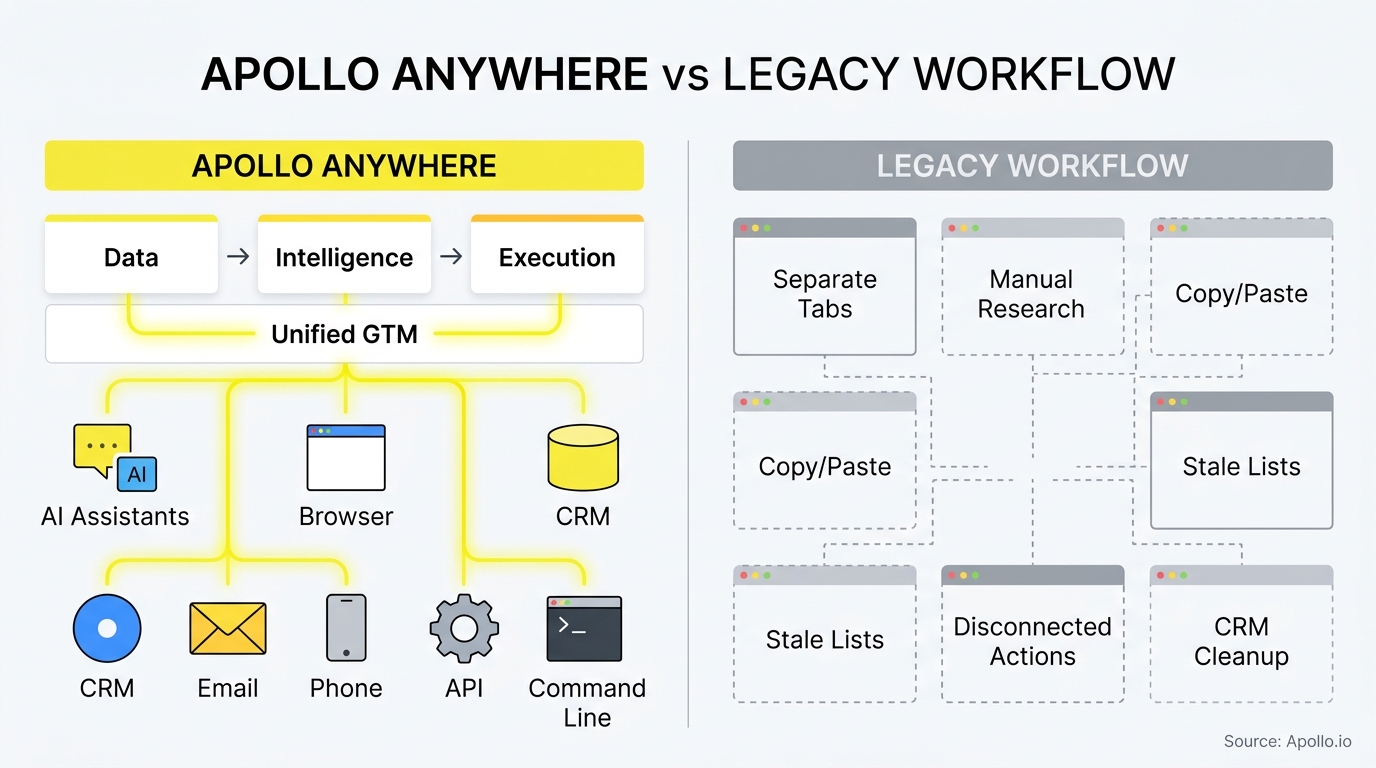
- Platform Scope: Apollo unifies data, intelligence, and execution; other tools often integrate with separate data providers or dialers to cover the same workflows.
- Pricing Transparency: Apollo, Mailshake, Amplemarket, and Reply.io publish tiered pricing; Salesloft, Outreach, and ZoomInfo require contacting sales for quotes.
Apollo
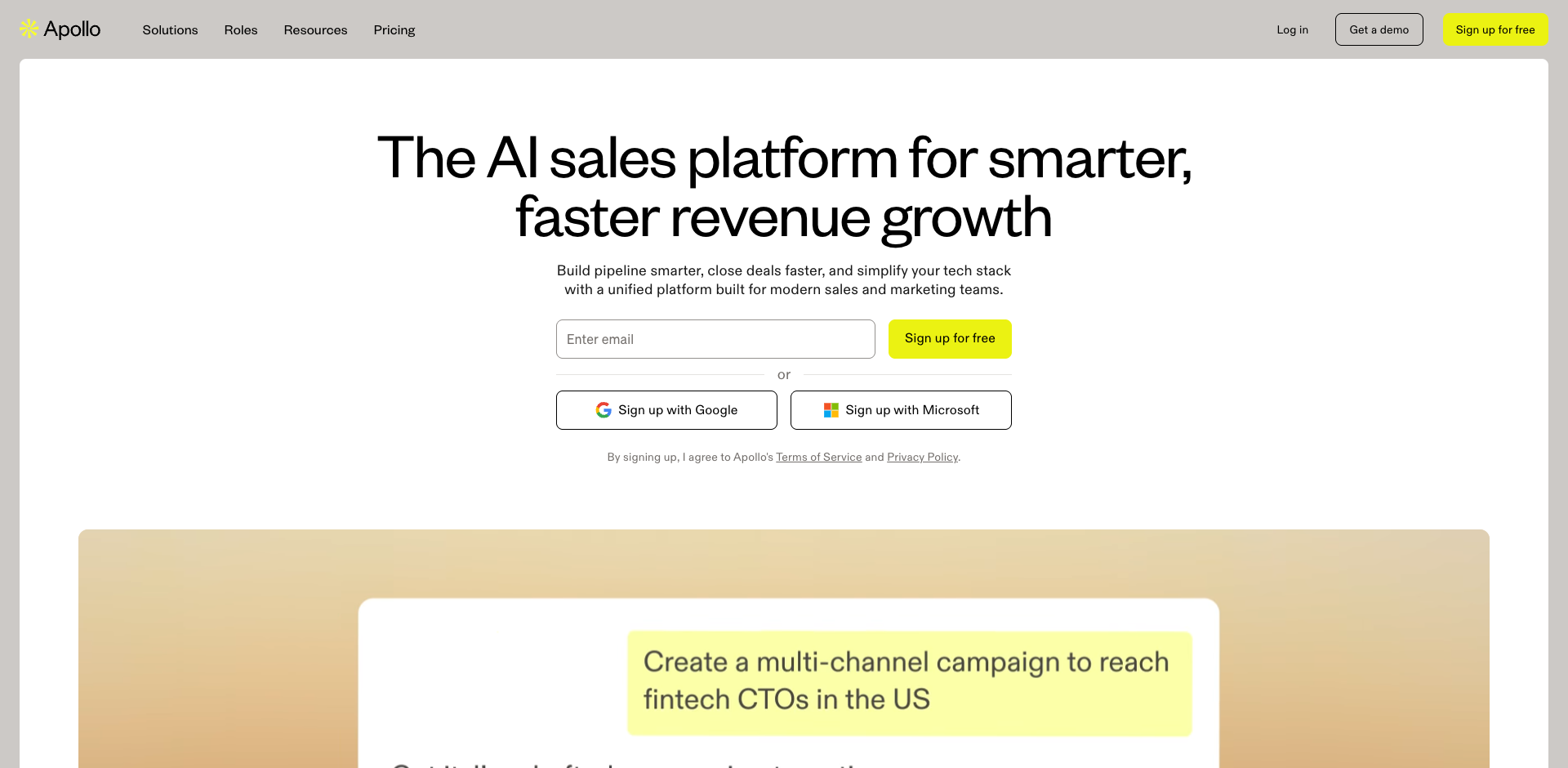
Apollo is an AI GTM system that unifies data, intelligence, and execution. Built open by design, Apollo meets sellers inside the tools they already use, from AI assistants like ChatGPT, Codex, Claude, and Perplexity via Apollo MCP, to the Chrome extension and Salesforce, rather than forcing a context switch to get value. For technical and advanced users, Apollo CLI provides terminal-native access for headless GTM workflows.
Apollo's outbound capabilities span the full funnel: define an ICP and let AI Assistant find, research, and rank accounts and contacts, verify emails and phones, then run multi-channel sequences across email, calls, and social with the Power Dialer and Parallel Dialer built in. AI Sequence Builder creates sequences from natural language, and Outbound Analytics dashboards with AI sentiment analysis close the loop. On the inbound side, Apollo captures website visitor identification, enriches and shortens forms, and routes leads with AI-simplified router setup, backed by 65+ filters for precise targeting. Data Enrichment includes waterfall enrichment across multiple vendors, bi-directional CRM sync, and REST API endpoints for bulk enrichment. Contacts are continuously validated through Apollo's Living Data Network, with 240M+ people and 98% email accuracy in the database.
Pricing starts with a Free tier at $0 (900 credits/year, 2 sequences, basic filters). Paid plans include Basic at $49/user/month (30,000 credits/year, unlimited sequences, CRM integrations, 6 intent topics), Professional at $79/user/month (48,000 credits/year, US dialer, 5 mailboxes, automated workflows, AI research), and Organization at $119/user/month with a 3-user minimum (72,000 credits/year, international dialer, 15 mailboxes, SSO, advanced security). Full details are available at Apollo's pricing page.
Apollo integrates with Salesforce, HubSpot, Zoho CRM, Pipedrive, Outreach, SalesLoft, Orum, Nooks, and Marketo, with 50+ tools in its integrations marketplace. Customers report measurable impact: "We reduced the complexity of three tools into one," says Collin Stewart, CEO at Predictable Revenue. Kevin Warner, CEO at Leadium, noted, "Apollo became the single source of truth for uswhere everything originates from and where all the data returns to." And Mark Turner, VP of Revenue Operations at Built In, shared, "Apollo enriches everything we have: contacts, leads, accounts...And we don't really have to touch it, it just works."
According to Ramp's vendor data, Apollo holds the #2 new adopter rank in the Sales Data Providers category with a 26% new adopter share as of July 2026, and mid-market companies represent Apollo's largest tracked customer segment by company size, with enterprise adoption rising from 26% in January 2026 to 31% in July 2026. Separately, Ramp's Sales Data Providers category data shows Apollo is the fastest-growing vendor in the category as of September 2026, averaging the highest month-over-month adoption gains among all tracked providers.


Apollo has earned a 4.7/5 G2 rating, 624 badges in G2's Winter 2026 Report, and the 2025 MarTech Breakthrough Award for "Best AI-Powered Sales Solution". Apollo serves B2B GTM teams, GTM Engineers, and AI Builders building headless GTM workflows with the Apollo API, CLI, and MCP, alongside Sales Professionals, SDRs/BDRs, AEs, RevOps, Marketing, and Revenue Leaders.
Salesloft
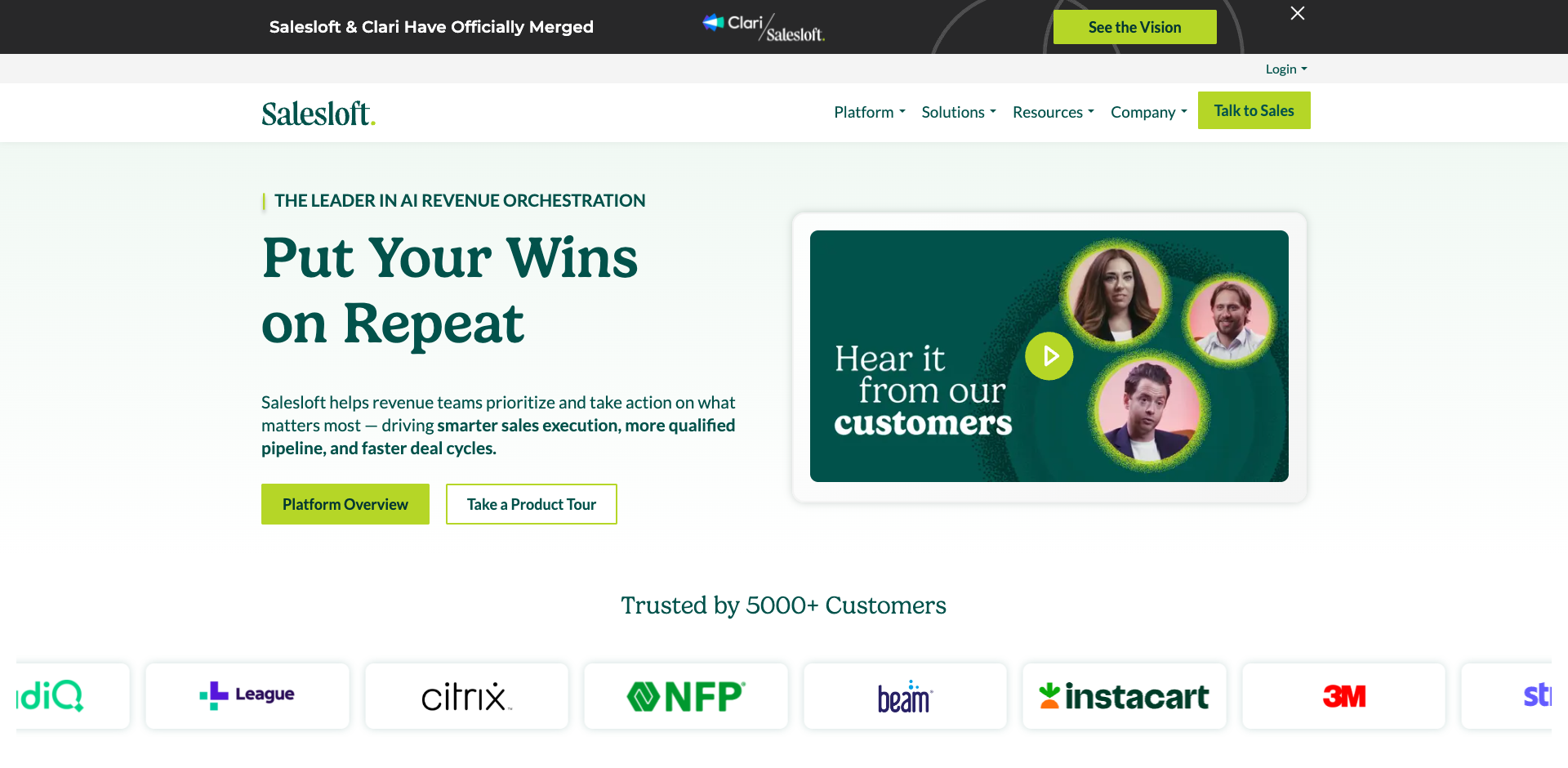
Salesloft is a revenue orchestration platform that captures revenue signals across a company's tech stack, interprets and prioritizes them, and turns them into actions for revenue teams. The platform combines cadence-based sales engagement, conversation intelligence, deal management, and forecasting through modules including Rhythm for workflow prioritization and Conversations for call intelligence.
Key features include cadence automation for multi-channel engagement, AI account research agents, deal management with buying-group insights, and a unified revenue data layer connecting tools across the stack.
Salesloft's pricing is not publicly displayed on their official website. According to Vendr, Salesloft uses a per-user, per-month model across three tiers (Essentials, Advanced, Premier), with list pricing ranging roughly $75-$200+ per user per month depending on tier, and add-ons like Conversations, Rhythm, and Deals priced separately. Vendr reports a Median Avg Contract Value of $30,720 per year, with 304 deals handled, based on data from 705 purchases.
Pros:
- Strong conversation intelligence and deal management capabilities within one suite
- AI agents interpret signals and trigger next-best actions across revenue workflows
- Established platform used widely by account and revenue operations teams
Cons:
- Pricing is not publicly displayed, requiring a sales conversation for quotes
- Typically requires a minimum seat count, which may not suit smaller teams
- Advanced modules like Conversations and Rhythm come with separate add-on pricing
Related reading:Apollo vs Salesloft
Outreach
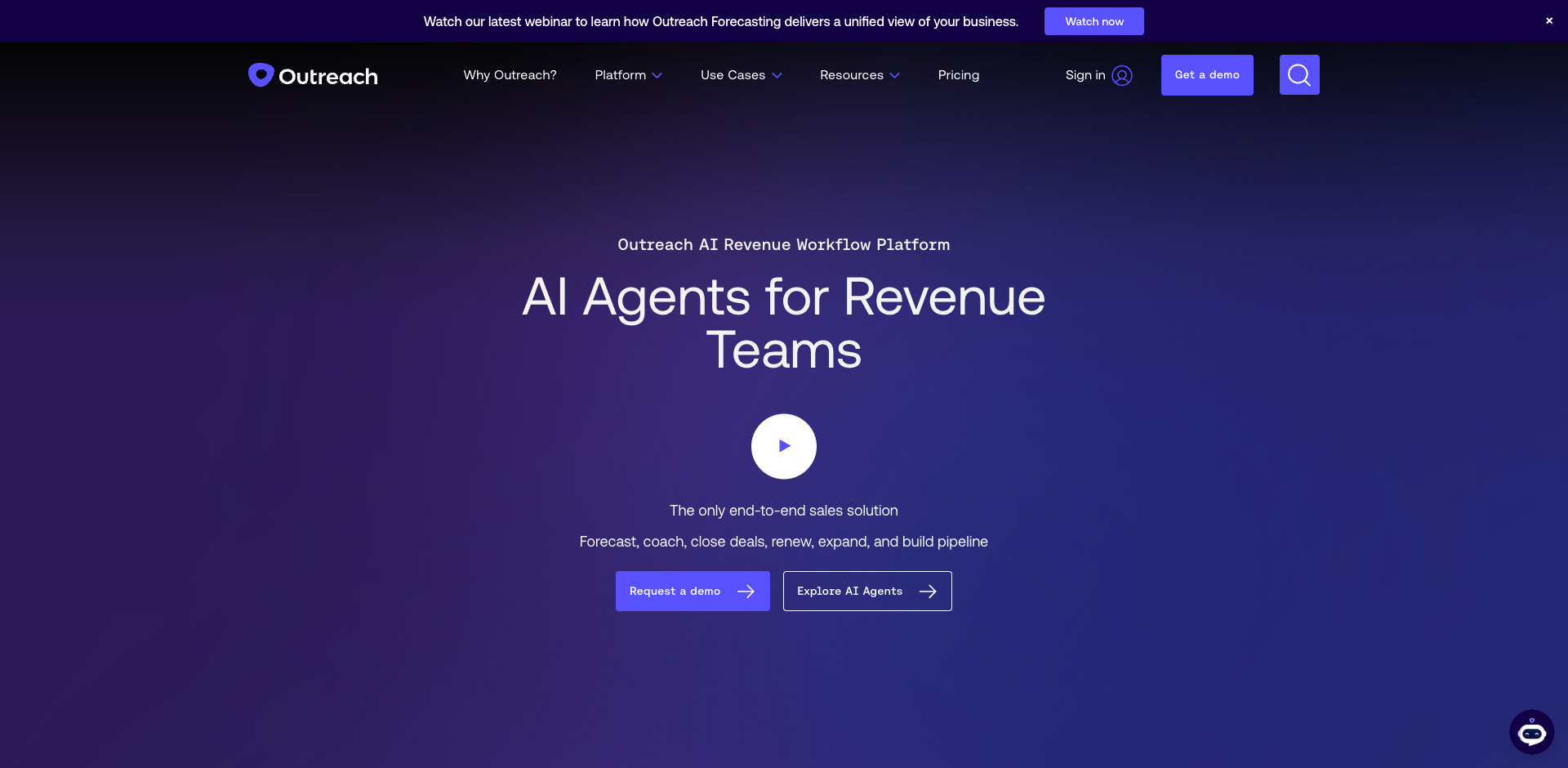
Outreach is an agentic AI revenue platform that unifies prospect engagement, customer retention, coaching, and revenue intelligence. Its AI Agents, including Omni Agent, Research Agent, and Deal Agent, support workflows spanning sales engagement, account and deal management, conversation intelligence, and forecasting.
Key features include AI-powered pipeline risk detection, multi-channel sequencing, conversation intelligence with real-time battle cards, and rep coaching that surfaces team performance trends.
Outreach's pricing is not publicly displayed on their official website; the pricing page directs teams to request a quote across four Amplify tiers (Essentials, Core, Plus, Pro) that combine seat-based and AI credit-based pricing, ranging from 10,000 to 100,000 AI credits per tier. According to Vendr, the Median Avg Contract Value is $45,600 per year, with 545 deals handled, based on data from 914 purchases.
Pros:
- Broad suite of AI agents covering the full revenue cycle from prospecting to forecasting
- Advanced forecasting tools including scenario planning and territory management in higher tiers
- Conversation intelligence with objection detection and action-item tracking
Cons:
- Pricing is not publicly displayed, and teams would contact their sales team for pricing details
- Hybrid seat-plus-credit pricing model can be harder to forecast for budgeting
- Higher-tier features like advanced forecasting are reserved for top-tier plans
Related:Apollo vs Outreach
Mailshake
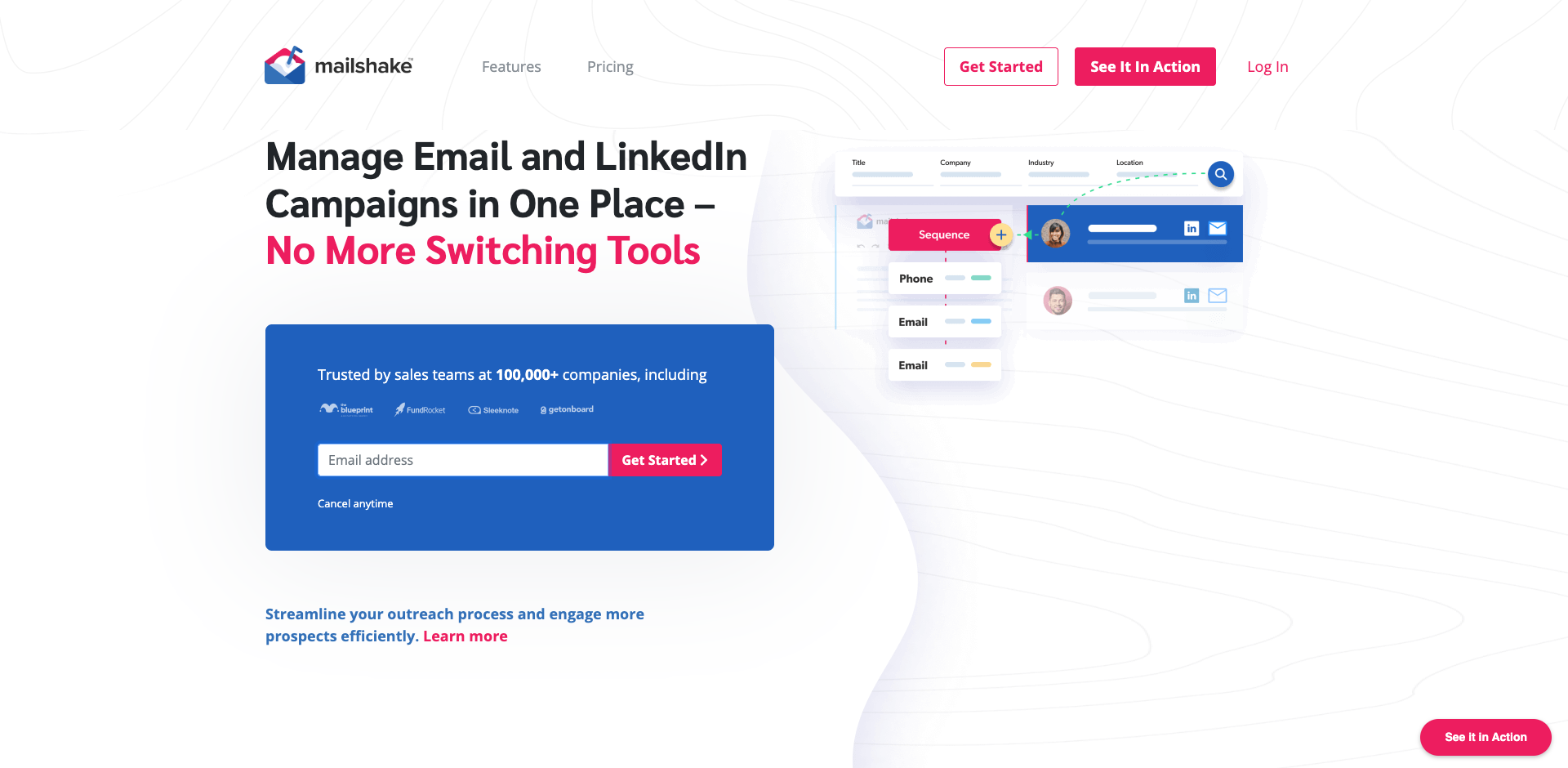
Mailshake is a sales engagement and B2B lead platform for automating personalized email outreach, follow-ups, and prospecting. It combines email campaigns with lead management, deliverability tools, a data finder, and multichannel phone and social outreach.
Key features include automated email campaigns with A/B testing, a Lead Catcher for managing replies, a Data Finder for prospect search, and a power phone dialer with call recording.
Mailshake's pricing starts at Starter for a price that is not publicly displayed (billed yearly) or $29/month billed monthly, including 1,500 email sends and 50 free data finder credits. Email Outreach is a price that is not publicly displayedly (a price that is not publicly displayed) with unlimited email sends. Sales Engagement, the multichannel tier, is $85/month annually ($99 monthly) with 2,500 free data finder credits. An Agency plan requires contacting sales.
Pros:
- Transparent, affordable tiered pricing with both monthly and annual billing
- Unlimited email sends and contacts on the two upper tiers
- Simple setup suited to teams focused primarily on email outreach
Cons:
- Data Finder credits are limited on lower tiers (50 credits) before requiring upgrades
- Multichannel capabilities are concentrated in the top-tier Sales Engagement plan
- Smaller feature footprint for account-based selling compared to broader sales engagement suites
Explore the Apollo vs Mailshake breakdown.

Amplemarket
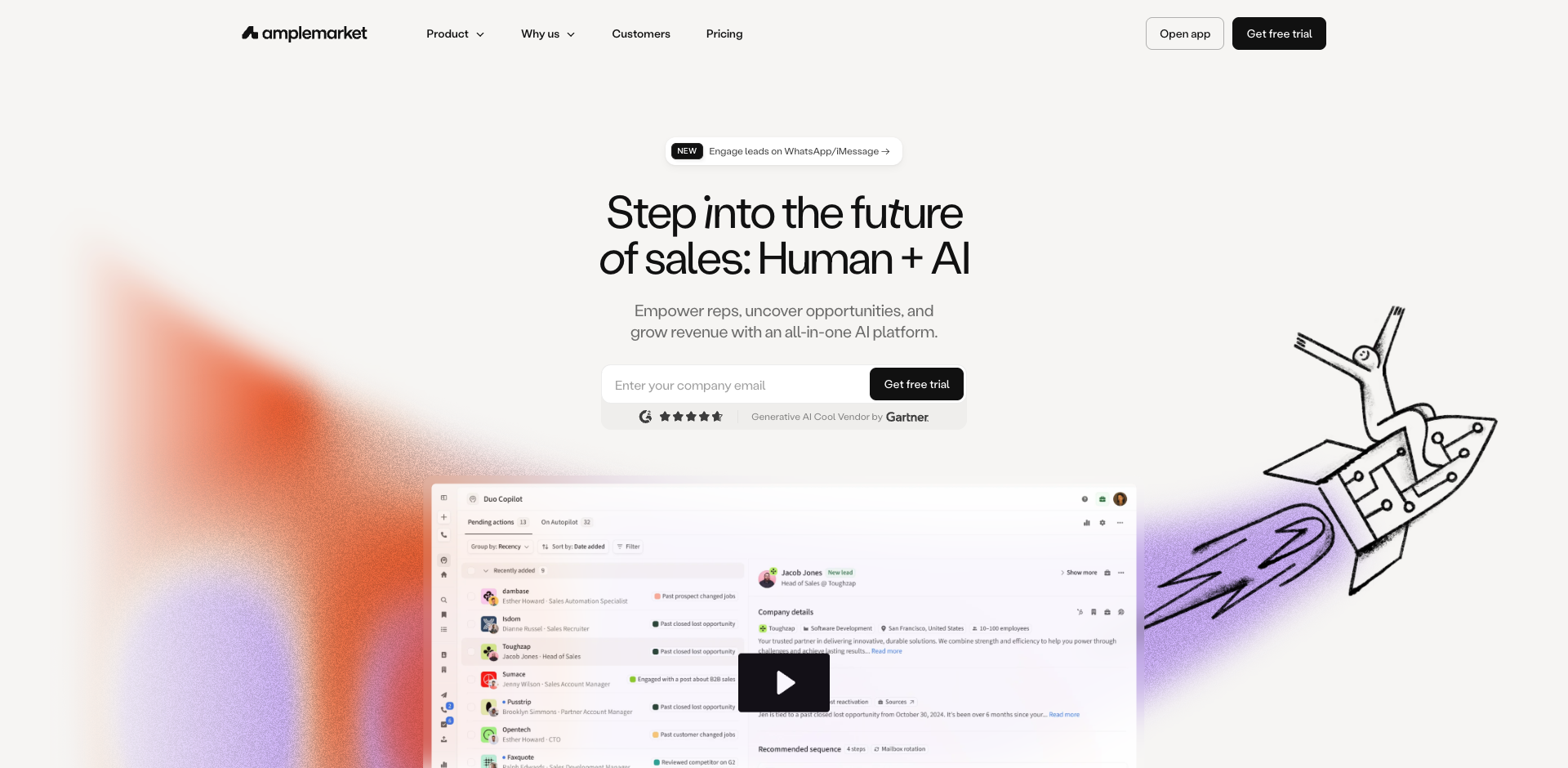
Amplemarket is an all-in-one AI sales platform that helps teams find prospects, identify buying signals, and engage buyers through personalized multichannel outreach. The platform combines contact data, AI sales assistance through its Duo Copilot agent, workflows, analytics, and deliverability tools.
Key features include Duo Copilot for signals and personalized outreach, AI intent and buying signals, multichannel sequences, and deliverability optimization including domain health monitoring.
Amplemarket's pricing starts with Startup at $600/month on an annual term, including 2 users and 27,000 contacts. Growth (4 users, 140,000 contacts) and Elite (10 users, 400,000 contacts) tiers require contacting sales for requested pricing, with additional users available for purchase on all plans.
Pros:
- Duo Copilot AI agent bundles research, signals, and outreach personalization
- Transparent entry-level pricing for the Startup tier
- Deliverability tools like email warmup and domain health built into the platform
Cons:
- Growth and Elite tiers require a sales conversation for pricing
- Entry-level plan is limited to 2 users, requiring paid add-ons to scale a team
- Contact volume caps scale with tier, which may require upgrades for larger prospecting lists
Here's a detailed comparison of Apollo vs Amplemarket.
Reach Prospects Before They Go Cold
Marketing leads piling up but never turning into real opportunities? Apollo surfaces buying intent so reps know exactly who's ready to talk and when. Built-In saw a 10% higher win rate using Apollo's signals.
Start Free with Apollo →Reply.io
Reply.io is an AI-assisted sales engagement platform for discovering prospects, running multichannel outreach, automating follow-ups, and converting conversations into meetings. It's positioned for businesses, founders, marketers, sales and SDR teams, and agencies.
Key features include real-time B2B data search with intent signals, multichannel conditional sequences across email, social, WhatsApp, SMS, and calls, AI-generated content and personalization, and a unified inbox.
Reply.io's pricing includes an Email Volume plan starting at a price that is not publicly displayed billed annually ($59 monthly) that scales with active contacts, and a Multichannel plan at $89/user/month annually ($99 monthly) covering email, social, SMS, and phone outreach. Reply.io also offers standalone AI SDR plans starting at $500/month billed annually, plus Agency plans starting at $210/month. LinkedIn automation and Calls & SMS automation are available as add-ons at $69/mo and $29/mo per account, respectively.
Pros:
- Wide range of pricing tiers, from solo-founder plans to AI SDR and agency options
- Multichannel outreach with conditional sequence logic across five channels
- Both monthly and annual billing options across all tiers
Cons:
- Full multichannel automation (social, SMS, calls) requires the higher-priced Multichannel tier or add-ons
- Live data credits are capped at 50 per month on standard plans
- Higher contact volumes on the Email Volume plan require contacting sales
Related:Apollo vs Reply.io
ZoomInfo
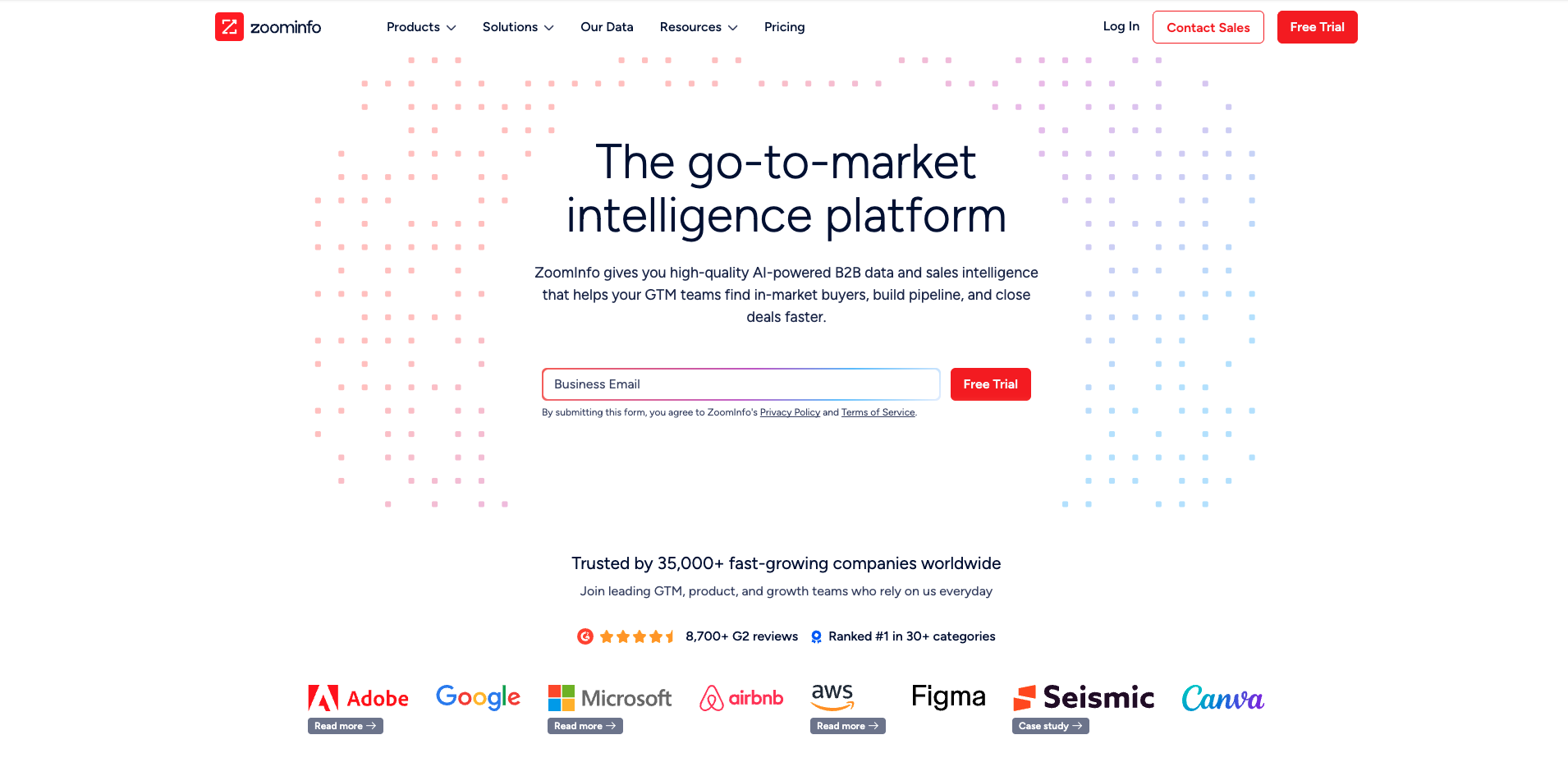
ZoomInfo is an AI-assisted go-to-market platform built on B2B data. Its products help teams identify and prioritize accounts, find and engage decision-makers, enrich and route CRM data, and use buying signals to generate pipeline across Sales, Marketing, and Talent product lines.
Key features include verified B2B contact and company profiles, buying intent signals, AI-powered account prioritization and summaries, and CRM enrichment with automated lead routing.
ZoomInfo's pricing is not publicly displayed on their official website; the pricing page directs visitors to request pricing across Sales, Marketing, and Talent packages, with costs based on features, license count, and credit usage. According to Vendr, the Median Avg Contract Value is $33,500 per year, with 1,012 deals handled, based on data from 1,571 purchases.
Pros:
- Established sales intelligence data provider with dedicated Sales, Marketing, and Talent product lines
- Buying intent signals and account prioritization built into Copilot tiers
- Credit-based system allows customized allocation across data exports and intent tracking
Cons:
- Pricing is not publicly displayed, requiring a sales conversation to get a quote
- Credit-based exports mean data usage is metered rather than unlimited
- Add-on solutions like Streaming Intent are priced and packaged separately from base plans
Here's a detailed comparison of Apollo vs ZoomInfo.
Comparison Table
| Platform | Starting Price | Pricing Model | Key Strength | AI Features |
|---|---|---|---|---|
| Apollo | Free ($0); Basic $49/user/mo | Tiered, credit-based | Data, engagement, and execution in one system | AI Assistant, AI Sequence Builder, AI research |
| Klenty | a price that is not publicly displayed (Starter, annual) | Tiered + credit add-ons; see Klenty's pricing | Multichannel outreach and dialing | AI account research, Action AI |
| Salesloft | ~$75-$100/user/mo (list) | Per-seat, requested quotes; Vendr | Revenue orchestration and conversation intelligence | Rhythm AI agents, deal signals |
| Outreach | Contact sales | Seat + AI credit hybrid; Vendr | Agentic AI revenue workflows | Omni, Research, Deal Agents |
| Mailshake | a price that is not publicly displayed (Starter, annual) | Tiered, monthly/annual | Email outreach automation | A/B testing, lead scoring |
| Amplemarket | a price that is not publicly displayed (Startup, annual) | Tiered + custom | AI copilot for signals and outreach | Duo Copilot, Duo Voice |
| Reply.io | $49/user/mo (annual) | Tiered, usage-based | Multichannel sequencing flexibility | AI SDR (Jason), AI personalization |
| ZoomInfo | Contact sales | Credit-based, requested quotes; Vendr | B2B sales intelligence data | Account prioritization, AI summaries |
How to Choose the Right Klenty Alternative
Start by identifying what's limiting your current stack. If you need a broader contact database alongside execution tools, look at platforms that combine sales intelligence with engagement, like Apollo, which uses a continuously validated Living Data Network rather than a static list.
If your priority is revenue forecasting and pipeline visibility for larger revenue teams, Salesloft or Outreach's orchestration and agentic AI features may be worth evaluating, though both require a sales conversation for pricing.
Teams focused primarily on email volume and simplicity may find Mailshake's transparent tiered pricing appealing, while agencies or founders wanting flexible AI SDR options might explore Reply.io. If sales intelligence data quality and account prioritization are the core need, ZoomInfo remains a dedicated data-first option, though it also requires a requested quotes. For teams that want one system covering data enrichment, multi-channel outreach, dialing, and inbound routing together, evaluate Apollo's sales engagement platform and how its data enrichment capabilities compare against your current tool stack costs.
Frequently Asked Questions
What makes Apollo the best Klenty alternative?
As detailed in the Apollo section above, Apollo combines sales intelligence data, AI-powered research, and multi-channel execution in one system, and Apollo serves B2B GTM teams, GTM Engineers, and AI Builders building headless GTM workflows with the Apollo API, CLI, and MCP, alongside Sales Professionals, SDRs/BDRs, AEs, RevOps, Marketing, and Revenue Leaders.
Is Apollo suitable for small teams switching from Klenty?
Yes. Apollo offers a Free plan at $0 with 900 credits/year for teams just getting started, and a Basic plan at $49/user/month (billed annually) that adds unlimited sequences and CRM integrations for growing teams.
How does Klenty's pricing compare to these alternatives?
Klenty's Starter plan begins at a price that is not publicly displayed billed annually, as detailed on Klenty's pricing page, with Growth and Plus tiers adding dialer minutes and credits. This sits within a similar range to Mailshake and Reply.io's entry tiers, while Salesloft, Outreach, and ZoomInfo require requested quotes as covered in the comparison table above.
Which alternative offers the most sales intelligence data?
ZoomInfo and Apollo both center their platforms on sales intelligence databases. Apollo pairs its database with built-in engagement and dialing tools, while ZoomInfo's pricing requires contacting their sales team, as noted in the ZoomInfo section above.
Do these alternatives include dialer functionality like Klenty?
Some do. Apollo includes Power and Parallel Dialers within its Professional and Organization tiers, Mailshake includes a power phone dialer, and Reply.io offers Calls & SMS as an add-on.
Salesloft and Outreach offer calling capabilities through their broader engagement modules.

Conclusion
Choosing a Klenty alternative comes down to whether you need standalone engagement automation or a system that connects data, intelligence, and execution together. Salesloft and Outreach suit larger revenue teams needing orchestration and forecasting, Mailshake and Reply.io serve teams prioritizing straightforward email and multichannel automation, Amplemarket brings AI copilot-driven outreach, and ZoomInfo anchors teams that need sales intelligence data at the center of their stack.
Apollo stands out by combining a large, continuously validated database, AI-powered research and sequencing, multi-channel execution, and inbound routing in one system, backed by transparent pricing starting with a Free tier and scaling to $49/user/month on the Basic plan. With a 4.7/5 G2 rating and adoption growing across mid-market and enterprise teams, Apollo gives sales teams a practical path to consolidate their tech stack.
Justify Spend With Real Pipeline Wins
Struggling to prove ROI before the next budget review? Apollo replaces scattered tools with one platform your team adopts fast, so wins show up in the pipeline, not just a slide deck. Leadium tripled annual revenue after consolidating with Apollo.
Start Free with Apollo →Don't miss these
Sales
Inbound vs Outbound Marketing: Which Strategy Wins?
Sales
What Is a Sales Funnel? The Non-Linear Revenue Framework for 2026
Sales
What Is a Go-to-Market Strategy? The 2026 GTM Playbook
See Apollo in action
We'd love to show how Apollo can help you sell better.
By submitting this form, you will receive information, tips, and promotions from Apollo. To learn more, see our Privacy Statement.
4.7/5 based on 9,690 reviews
