
How to Train an AI SDR to Match Your Brand Voice and ICP
Most AI SDR rollouts fail not because the technology is broken, but because the configuration is. Reps get generic outputs, prospects receive off-brand emails, and leadership wonders why AI isn't delivering results. The fix isn't a better prompt — it's a governance-first setup that encodes your brand voice and ideal customer profile into the system before the first message goes out.
Tools like Apollo's AI Sales Assistant are built to carry end-to-end GTM workflows — from account research and list building to sequence creation and follow-up — all grounded in your specific business context. But that grounding only works when you configure it correctly. This guide shows you exactly how.

Research Less, Pipeline More With Apollo
Tired of burning hours verifying emails and chasing dead-end contacts? Apollo delivers 97% accurate business contact data so your reps spend time selling, not searching. Join 600K+ companies building predictable pipeline.
Start Free with Apollo →Key Takeaways
- Configuring an AI SDR for brand voice is primarily a governance challenge, not a technical one — policies, approved examples, and forbidden phrases matter more than model selection.
- Your ICP should drive both targeting filters and messaging context; static firmographic lists are no longer sufficient for well-performing AI outreach.
- A dedicated content center or brand knowledge base is the single highest-leverage configuration step you can take.
- SDRs and RevOps leaders who build review workflows into AI outputs see more consistent quality than those relying on prompts alone.
- Generic AI content carries real risk: research predicts it degrades the purchase experience for the majority of B2B buyers.
Why Does Generic AI Output Hurt B2B Outreach?
Generic AI output hurts B2B outreach because buyers can detect it immediately, and it signals low effort. According to Forrester, thinly customized generative AI content is predicted to degrade the purchase experience for 70% of B2B buyers. That stat should stop any team from deploying AI without proper brand and ICP configuration first.
The problem is structural. Most AI tools generate outputs from generic defaults — they don't know your tone, your value prop, your banned phrases, or who you're actually targeting.
Without explicit configuration, the AI is guessing. And in outbound sales, a wrong guess costs a reply.
Struggling to find the right prospects to message in the first place? Search Apollo's 230M+ contacts with 65+ filters to build a precisely targeted list before your AI sequences go live.
How Do You Build a Brand Voice Configuration for an AI SDR?
Building a brand voice configuration means creating a structured set of inputs — examples, rules, and constraints — that the AI uses every time it generates an output. This is not model fine-tuning.
It's configuration through curated context.
As noted in a guide from Write a Catalyst, effective brand voice input includes annotated examples, syntactic preferences (sentence length, active vs. passive voice), lexical constraints (banned phrases, preferred terminology), and contextual rules. Think of this as a brand voice rubric your AI references on every output.
For an AI SDR, your brand voice configuration should cover:
- Tone descriptors: e.g., direct, consultative, never casual, no exclamation marks
- Approved terminology: product names, category language, preferred verbs
- Forbidden phrases: competitor names, unverified claims, banned adjectives
- Sentence structure: short sentences, active voice, no jargon
- Sample outputs: 5-10 high-performing emails that represent your ideal voice
Research from Contently suggests that a few dozen examples clearly reflecting your tone, structure, and audience fit are far more valuable than a massive archive of outdated or inconsistent content. Quality of examples beats quantity every time.
In Apollo, this configuration lives inside the AI Content Center. You populate it with your company overview, value proposition, customer pain points, call-to-action preferences, and product differentiators. Apollo can even auto-populate it from your website URL. Every AI-generated email, call script, and sequence step then draws from this single source of truth.

How Do You Configure an AI SDR to Target Your Ideal Customer Profile?
Configuring an AI SDR for ICP targeting means encoding your ideal buyer's firmographic, behavioral, and intent signals as filters the AI uses to qualify and prioritize prospects. A static list of company sizes and industries is a starting point — not a complete ICP configuration. Learn more about building a rigorous ICP in our guide: What Does ICP Mean in Sales?
A well-configured AI SDR ICP includes:
| ICP Layer | What to Configure | Apollo Feature |
|---|---|---|
| Firmographics | Industry, headcount, revenue range, geography | Search Filters (65+) |
| Job Titles | Decision-maker roles, seniority levels, departments | People Filters |
| Behavioral Signals | Recent hiring, funding rounds, tech stack changes | AI Research + Intent Data |
| Scoring | ICP match score (Excellent / Good / Fair / Not a Fit) | Apollo Scores |
Apollo's Outbound Copilot uses these ICP filters to automatically surface matching prospects and add them to sequences on a set cadence. Ian Kistner, Head of Sales Development at Crusoe, uses exactly this approach: "We're using Apollo's AI Assistant to score and tier accounts, which makes it much easier to prioritize outbound in a quickly expanding market."
For SDRs running high-volume prospecting, configuring ICP scoring is especially valuable. Rather than manually reviewing every contact, the AI flags which prospects are worth pursuing now — and which can wait.
Turn Funnel Gaps Into Closed Deals
Tired of watching marketing leads stall before they ever reach your pipeline? Apollo surfaces high-intent buyers and arms your team with the signals to act first. Nearly 100K paying customers stopped guessing and started winning.
Start Free with Apollo →How Do SDRs and RevOps Leaders Govern AI SDR Outputs?
SDRs and RevOps leaders govern AI SDR outputs by building review workflows, approval gates, and output checklists into the process — not by reviewing every message manually. Governance is the step most teams skip, and it's why AI rollouts stall.
Data from Sopro shows that nearly two-thirds (63%) of organizations employing generative AI report measurable boosts in productivity and efficiency — but those gains require structured processes to sustain. Without governance, output quality degrades as usage scales.
A practical governance framework for AI SDR configuration includes:
- Approval mode: Set AI-generated prospect additions to require human approval before entering sequences
- Output review checklist: Tone, ICP match, claim accuracy, CTA clarity
- Banned content list: Phrases, statistics, and claims that must never appear in outbound
- Refresh cadence: Schedule quarterly reviews of your brand voice inputs and ICP filters
- Performance feedback loop: Use reply rates and meeting bookings to refine configuration over time
RevOps leaders find that treating the AI Content Center as a living document — not a one-time setup — produces the most consistent results. As revenue operations teams take more ownership of AI tooling, governance becomes a core RevOps function, not an afterthought.
Spending hours on manual outreach while your governance workflows catch up? Automate your sequences with Apollo's multi-channel engagement platform — with approval controls built in.
What Does a Complete AI SDR Configuration Look Like in Practice?
A complete AI SDR configuration combines brand voice inputs, ICP filters, scoring rules, and governance workflows into a single repeatable system. Here's how it maps to Apollo's platform:
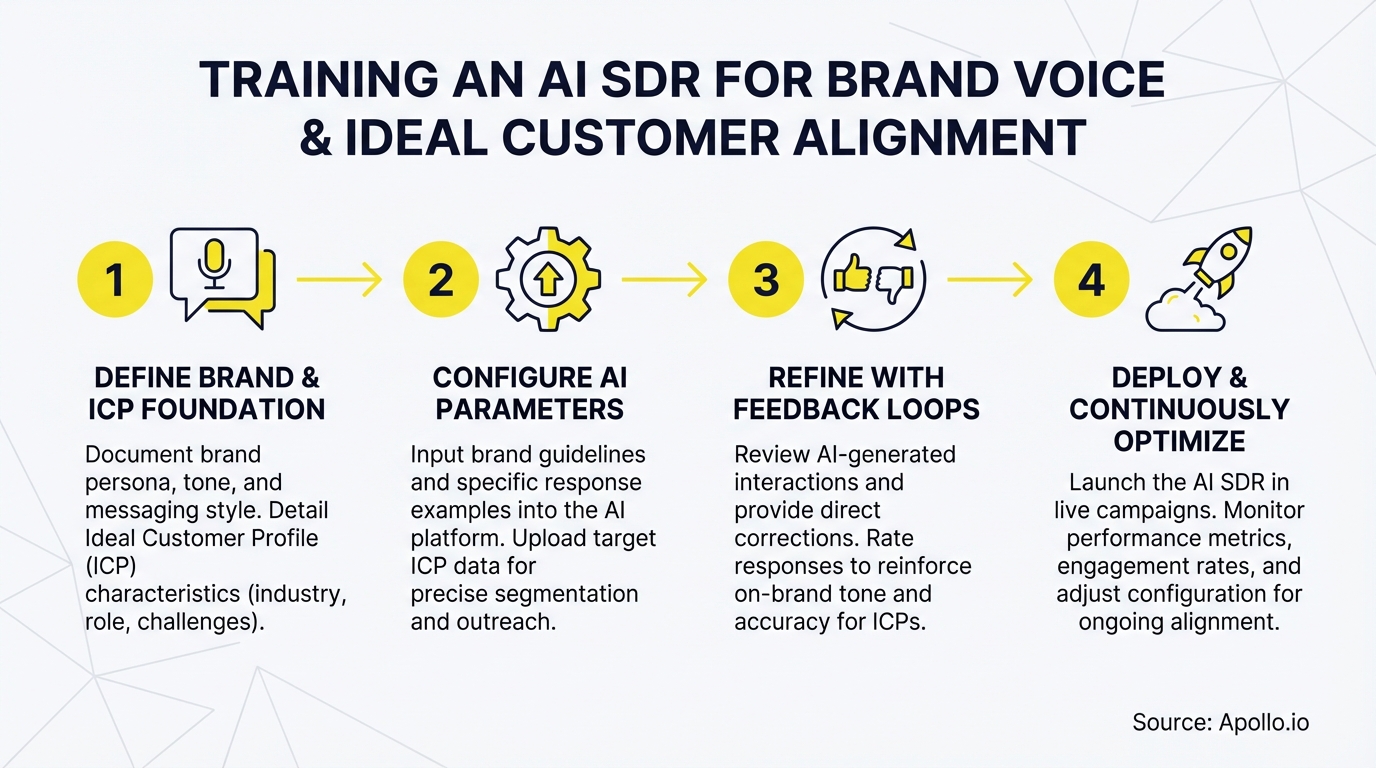
- Populate the AI Content Center with your value prop, pain points, CTA preferences, and approved messaging examples. This grounds every AI output in your actual GTM context. See the Apollo AI Overview for a full feature map.
- Set ICP filters in Apollo's search using firmographic, role, and signal-based criteria. Enable AI Scores to automatically tier incoming prospects.
- Use the Outbound Copilot to build sequences from your ICP filters. The AI generates multichannel sequences — email, phone, social — grounded in your Content Center context.
- Enable approval mode so prospects are reviewed before entering live sequences. This is the governance gate that prevents off-brand outreach at scale.
- Review and iterate using conversation intelligence and reply-rate data to refine both voice configuration and ICP targeting over time.
Matt Tumbiolo, Enterprise BDR at Smartling, describes the outcome: "Apollo's AI Assistant makes building targeted prospecting lists effortless. I can give it very specific prompts, and it stays within those parameters to deliver accurate, high-quality results."
For teams managing lead generation at scale, this configuration approach replaces the need to stitch together separate prospecting, sequencing, and enrichment tools. As Cyera's team put it: "Having everything in one system was a game changer."

How Do You Keep AI SDR Configuration Current Over Time?
Keeping AI SDR configuration current requires treating your brand voice inputs and ICP definition as living assets with scheduled review cycles. A configuration that worked at launch will drift out of alignment as your product, messaging, and target market evolve.
Practical maintenance steps:
- Review Content Center inputs quarterly or after any major messaging pivot
- Update ICP filters when entering new segments or verticals — use customer data enrichment to sharpen firmographic accuracy
- Add high-performing emails to your approved examples library on a rolling basis
- Remove outdated claims, discontinued product names, or retired CTAs from your configuration
- Use Apollo's conversation intelligence to surface objections and competitive mentions that should inform future messaging
ICP configuration in particular benefits from dynamic signals. Intent data and enrichment signals help AI SDRs stay aligned with who you're actually selling to right now — not just who matched your filters last quarter.
Start Configuring Your AI SDR the Right Way in 2026
The teams seeing the strongest results from AI SDRs in 2026 share one common trait: they treated configuration as a strategic investment, not a setup step. Brand voice inputs, ICP filters, governance workflows, and review cadences are the foundation.
The AI executes on top of that foundation.
Apollo's platform consolidates prospecting, sequencing, enrichment, and AI configuration into a single workspace. You don't need a separate data tool, a separate sequencer, and a separate AI layer.
As Predictable Revenue's team noted: "We reduced the complexity of three tools into one."
Ready to configure an AI SDR that actually sounds like your brand and targets the right buyers? Start a free trial with Apollo and set up your AI Content Center, ICP filters, and first AI-generated sequence today.
Prove Pipeline ROI With Apollo
ROI pressure killing your tool budget? Apollo delivers measurable pipeline impact from day one — so justifying the spend is never the hard part. Leadium 3x'd their annual revenue. You're next.
Start Free with Apollo →Don't miss these
Sales
Inbound vs Outbound Marketing: Which Strategy Wins?
Sales
What Is a Sales Funnel? The Non-Linear Revenue Framework for 2026
Sales
What Is a Go-to-Market Strategy? The 2026 GTM Playbook
See Apollo in action
We'd love to show how Apollo can help you sell better.
By submitting this form, you will receive information, tips, and promotions from Apollo. To learn more, see our Privacy Statement.
4.7/5 based on 9,690 reviews
