
How Do AI SDRs Handle Follow-Up Sequences Without Human Intervention in 2026?
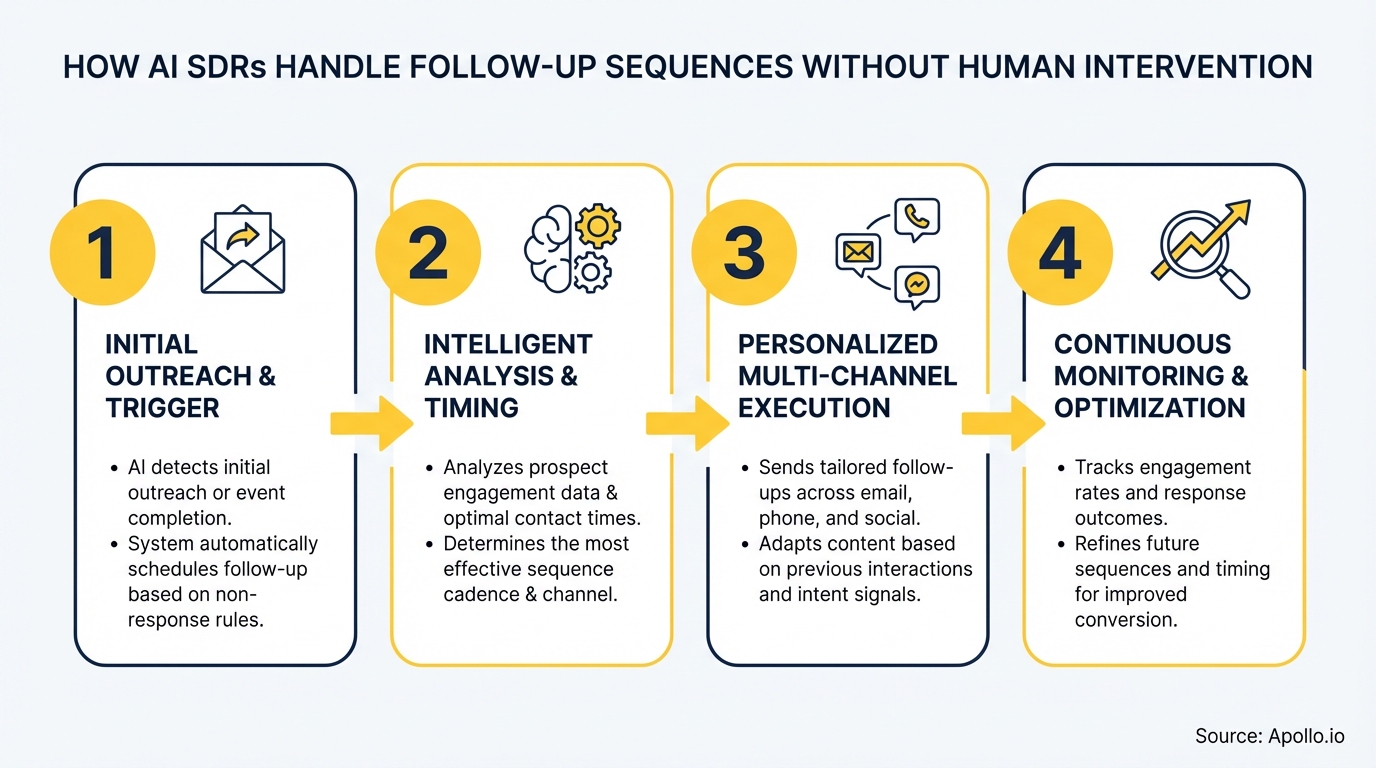
AI SDRs handle follow-up sequences by monitoring real-time prospect signals, selecting the right channel, generating personalized messages, and executing multi-step outreach, all without a rep lifting a finger. This shift from manual cadences to autonomous, signal-driven execution is redefining how B2B teams build pipeline. Tools like Apollo's AI Sales Assistant go further, running end-to-end GTM workflows from a single natural-language prompt, covering research, list building, sequence creation, and follow-up in one unified system.
The market is responding quickly. According to Martal, the AI SDR market is projected to grow from $4.12 billion in 2025 to $15.01 billion by 2030, at a CAGR of 29.5%. If you're still relying on manual follow-up, you're already behind. Learn how to use sales automation the right way before the gap widens.

Scale Your Team Without the Chaos
Tired of watching reps burn hours on manual research instead of selling? Apollo standardizes your prospecting playbook across every rep — so your whole team builds pipeline fast, not just your top performer. Start free today.
Start Free with Apollo →Key Takeaways
- AI SDRs use signal-based triggers, not fixed time intervals, to decide when and how to follow up.
- Autonomous follow-up requires clean, accessible CRM data as its foundation, not just good tooling.
- Multi-channel orchestration (email, phone, social) is now the default pattern for AI-driven sequences.
- Governance guardrails, not full autopilot, are the operating model most teams successfully deploy.
- Apollo consolidates prospecting, sequencing, and AI follow-up into one platform, replacing multiple point tools.
How Do AI SDRs Decide When to Send a Follow-Up?
AI SDRs trigger follow-ups based on real-time prospect behavior, not a fixed "Day 1 / Day 3 / Day 7" schedule. The system watches for signals: email opens, link clicks, website visits, or intent data spikes.
When a signal fires, the AI selects the next action, whether that's a follow-up email, a voicemail drop, or a social touch, based on the prospect's current position in the sequence.
This state-machine approach means every follow-up is contextually appropriate. A prospect who clicked your pricing page gets a different message than one who ignored the first email entirely. Intent data feeds directly into these branching decisions, giving the AI richer context for prioritization. For SDRs, this means the system handles the timing logic while they focus on high-value conversations.
What Does an Autonomous Follow-Up Sequence Actually Look Like?
An autonomous AI SDR sequence typically runs across three to five touches, combining email, phone, and social outreach in a coordinated pattern. The AI generates each message based on account-specific context, the prospect's role, and any engagement signals captured since the last touch.
| Touch | Channel | AI Action | Trigger |
|---|---|---|---|
| 1 | Personalized intro based on ICP research | Prospect added to sequence | |
| 2 | Social | Engagement or connection request | No reply after 3 days |
| 3 | Value-add follow-up referencing signal | Email opened but no click | |
| 4 | Phone | AI-drafted call script surfaced for rep | Link clicked |
| 5 | Break-up message or alternative CTA | No engagement after 10 days |
Apollo's Outbound Copilot builds these sequences automatically. It finds ICP-matching prospects, drops them into the right sequence, and sets the cadence, daily, weekly, or monthly runs, with credit-cost transparency before each execution. Explore the top sales sequences in Apollo to see real examples.

How Do SDRs and RevOps Teams Maintain Quality Without Reviewing Every Message?
SDRs and RevOps leaders maintain quality through the AI Content Center, not by reviewing every outbound message manually. The Content Center grounds all AI-generated messages in your value proposition, ICP pain points, approved CTAs, and product differentiators, so every follow-up reflects your brand, regardless of who or what sent it.
According to Sopro, 44% of firms are currently automating campaign follow-ups and sequences using AI-driven workflows. The teams doing this well use a "autonomy with guardrails" model: AI executes low-risk steps autonomously, while nuanced replies or high-value accounts route to a human for review. Configure the AI Content Center to set those guardrails once and let the system enforce them consistently. For RevOps leaders concerned about data integrity, see how to handle data synchronization across multiple business systems.
Spending hours reviewing drafts before every send? Automate your sequences with Apollo's multi-channel sales engagement platform and let the Content Center handle consistency.
Turn Funnel Guesswork Into Real Pipeline
Tired of watching marketing leads die before they ever reach your pipeline? Apollo surfaces in-market buyers the moment they're ready, so your team stops chasing cold leads and starts closing warm ones. Join 600K+ companies building predictable revenue.
Start Free with Apollo →What Data Does an AI SDR Need to Run Sequences Autonomously?
An AI SDR needs four categories of clean, accessible data to operate without human intervention: verified contact information, firmographic attributes, engagement event history, and ICP scoring signals. Without these, the system either skips prospects, sends generic messages, or fires follow-ups at the wrong time.
Data readiness is the most underestimated prerequisite. A 2025 HubSpot survey found that only 31% of businesses said most of their data is accessible to AI systems, and 34% reported revenue loss from fragmented customer data. The fix starts upstream: enrich contacts before they enter a sequence, not after. Apollo's 230M+ verified contacts with 65+ data attributes give AI SDRs the raw material they need to personalize and prioritize at scale. You can also review how to build lead lists that actually convert to sharpen your input data before sequences run.
How Does Apollo's AI Handle Follow-Up Sequences End to End?
Apollo handles autonomous follow-up through a layered AI system: the AI Research layer gathers account and contact context, the Outbound Copilot finds and enrolls matching prospects, the AI Sequence Builder constructs multi-channel touchpoints, and the Content Center ensures every message is grounded in your GTM context. The result is a closed loop that runs without requiring reps to manage individual steps.
Erik Fernando Nieto, BDR at JumpCloud, described the impact directly: "Apollo's AI Assistant filters and cleans prospect data for me, so I can find the right people faster and run better searches. It saves me about an hour per prospecting session." For follow-up specifically, Apollo auto-drafts post-meeting messages using conversation summaries and engagement data, as covered in the Send Follow-up Emails with AI guide. Customers like Cyera noted that "having everything in one system was a game changer", reflecting Apollo's advantage as a unified platform rather than a stack of disconnected tools. See the full sales tech stack playbook for how teams consolidate around a single GTM platform.
What Governance and Compliance Guardrails Do AI Follow-Up Systems Require?
AI follow-up systems require four non-negotiable guardrails: suppression lists (opt-outs and competitors), sending authentication (SPF/DKIM/DMARC alignment), volume throttling to avoid deliverability issues, and human escalation routing for replies that fall outside defined parameters. Without these, autonomous sequences create compliance exposure and damage sender reputation.
Deliverability hardening has become a prerequisite, not an afterthought. Gmail and Yahoo bulk-sender requirements introduced in 2024 now enforce authenticated sending and one-click unsubscribe compliance for high-volume outbound. AI SDR systems that ignore these requirements will land in spam regardless of message quality. Apollo addresses data protection at the platform level through SOC2 and ISO 27001 standards. Learn more in how Apollo protects your data.
How Should Teams Measure ROI from Autonomous Follow-Up?
Teams should measure autonomous follow-up ROI across four KPIs: reply rate by sequence step, meeting conversion rate, pipeline velocity (days from first touch to opportunity), and sequence completion rate. These metrics reveal whether the AI is executing the right actions at the right time, not just sending volume.
Research from Sales Genetics shows that as of 2024, 43% of sales professionals integrate AI into their workflows, a 9% rise from the prior year. The teams seeing the clearest ROI start with a controlled pilot: one ICP segment, one sequence, a holdout group for comparison. Apollo's AI Scores provide a ready-made prioritization layer, automatically rating accounts as Excellent, Good, Fair, or Not a Fit, so pilots start with the highest-probability accounts. Pair that with data-backed sequence length guidance to optimize cadence from the start. Track return on sales against pre-automation baselines to quantify the lift.

Ready to Run Follow-Up Sequences That Never Sleep?
AI SDRs handle follow-up by replacing fixed cadences with signal-driven decisions, grounding every message in account context, and executing across channels without waiting for a rep to act. The teams winning in 2026 have stopped treating AI as a drafting tool and started using it as an autonomous execution layer, with guardrails that keep quality consistent at scale.
Apollo consolidates the entire motion: prospecting, enrichment, sequencing, follow-up, and analytics in one platform. As Predictable Revenue put it, "We reduced the complexity of three tools into one." Start building sequences that run themselves: Get Leads Now.
Prove ROI Before the Next Budget Call
ROI pressure killing your tool adoption? Apollo delivers measurable pipeline impact from day one — so you walk into every budget review with numbers, not narratives. Leadium 3x'd annual revenue. You're next.
Start Free with Apollo →Don't miss these
Sales
Inbound vs Outbound Marketing: Which Strategy Wins?
Sales
What Is a Sales Funnel? The Non-Linear Revenue Framework for 2026
Sales
What Is a Go-to-Market Strategy? The 2026 GTM Playbook
See Apollo in action
We'd love to show how Apollo can help you sell better.
By submitting this form, you will receive information, tips, and promotions from Apollo. To learn more, see our Privacy Statement.
4.7/5 based on 9,690 reviews
