
Best 6sense Alternatives for GTM Teams: 5 Options in 2026
6sense is an account intelligence platform built around predictive AI, buyer intent signals, and account prioritization. It helps revenue teams identify in-market accounts and orchestrate engagement across channels. For enterprise teams with the budget and complexity to match, it can deliver real value. But many GTM teams outgrow it, or never fit the mold to begin with.
The most common reasons teams look for alternatives: pricing that starts in the five-figure range annually, a focus on account-level signals without built-in execution tools, and a setup complexity that demands dedicated RevOps resources. If you need a platform that connects data, intelligence, and outreach in one place, or if 6sense's contract structure simply doesn't fit your stage, there are better-fit options available.
This guide covers five alternatives worth evaluating in 2026, starting with Apollo, which addresses the broadest set of GTM team needs.
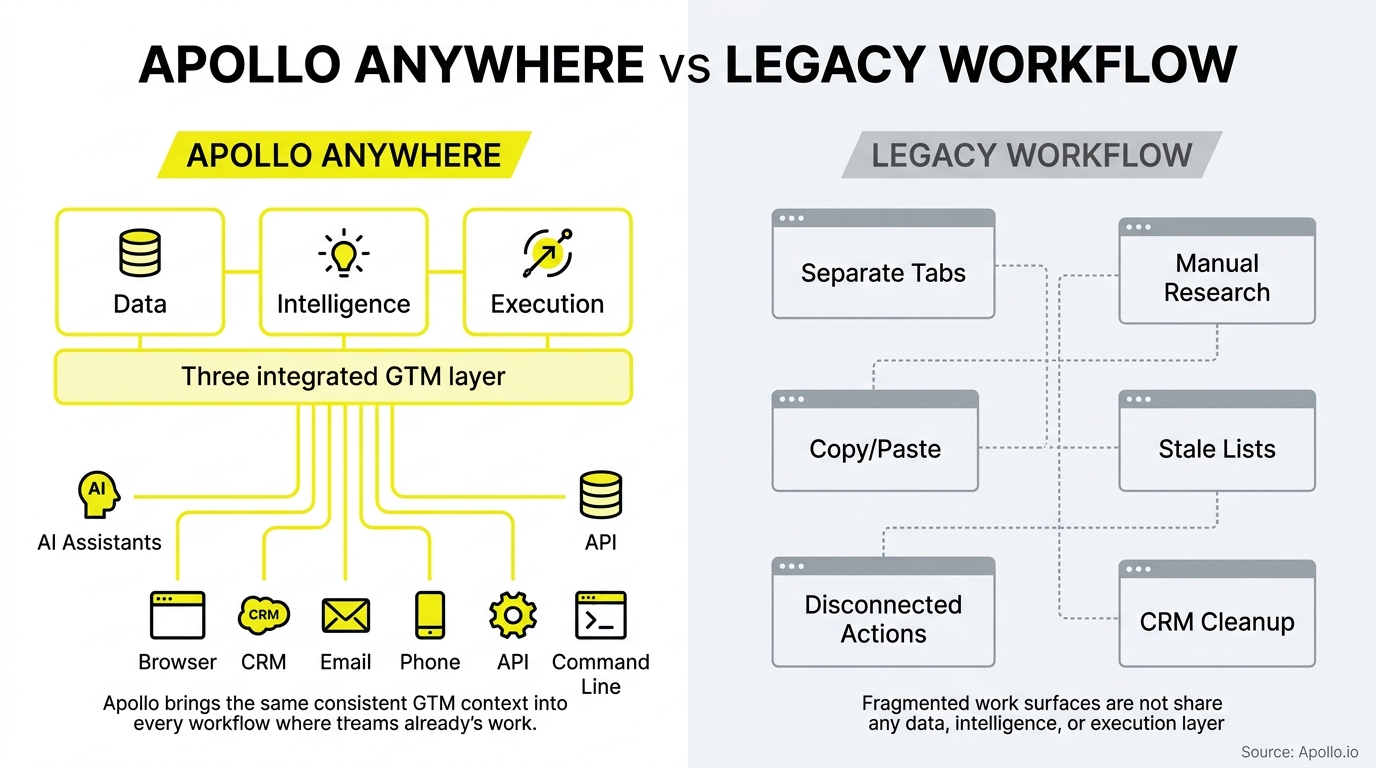

Build Pipeline Faster With Apollo
Tired of hours lost to manual research and dead-end contact data? Apollo surfaces verified leads instantly so your team spends time selling, not searching. Nearly 5M users trust Apollo to scale pipeline without the busywork.
Start Free with Apollo →Key Takeaways
- Apollo: AI sales platform combining a 240M+ contact database, multi-channel engagement, dialers, and intent data, with transparent pricing starting at $49/user/month
- Bombora: Intent-only data cooperative tracking content consumption signals across thousands of B2B sites, built for marketing and demand gen teams
- Pocus: AI-assisted pipeline intelligence platform that unifies CRM, product usage, and intent signals into prescriptive sales playbooks
- Common Room: AI GTM platform that unifies fragmented buyer signals and first-party data into continuous account intelligence with embedded workflow activation
- MadKudu: Predictive lead scoring and revenue automation platform focused on signal-driven prioritization for B2B sales and marketing teams
Apollo

Apollo is an AI sales platform that unifies data, intelligence, and execution into one connected GTM system. Where 6sense focuses primarily on account intelligence and signal identification, Apollo brings contact data, sequencing, dialers, enrichment, inbound routing, and AI-driven outreach together in one workspace, so teams can move from signal to booked meeting without switching tools.
Apollo serves B2B GTM teams, GTM Engineers, and AI Builders building headless GTM workflows with the Apollo API, CLI, and MCP, alongside Sales Professionals, SDRs/BDRs, AEs, RevOps, Marketing, and Revenue Leaders.
Data and Intelligence: Apollo's database includes 240M+ people and 30M+ companies, with contacts continuously validated and refreshed through Apollo's Living Data Network. The platform offers 65+ filters for advanced prospecting, buyer intent signals, AI lead scoring, and real-time account research. Email accuracy sits at 98%.
Outbound Execution: Apollo's sales engagement capabilities include multi-channel sequences across email, calls, and social, a Power Dialer and Parallel Dialer for efficient calling, AI-generated sequence and message creation, and outbound analytics dashboards with AI sentiment analysis.
Inbound and Enrichment: Apollo Inbound handles website visitor identification, form enrichment and shortening, inbound routing with round-robin and criteria-based booking, and owner-led AI nurture sequences. Data enrichment runs on a waterfall model with multi-vendor verification, bi-directional CRM sync, and API enrichment endpoints.
Access and Integrations: Apollo is built open by design. It meets sellers inside the tools they already use, from AI assistants like ChatGPT, Codex, Claude, and Perplexity via Apollo MCP, to the Chrome extension and Salesforce. For technical users, the Apollo CLI provides terminal-native access for headless GTM workflows. Apollo integrates with 50+ tools including Salesforce, HubSpot, Outreach, SalesLoft, and Marketo.
Pricing: Apollo's plans (annual billing) are Free ($0, 900 credits/year), Basic ($49/user/month, 30,000 credits/year), Professional ($79/user/month, 48,000 credits/year, US dialer, automated workflows), and Organization ($119/user/month, min 3 users, 72,000 credits/year, international dialer, SSO). Full details at apollo.io/pricing.
Apollo has earned a 4.7/5 G2 rating and the 2026 MarTech Breakthrough Award for "Best AI-Powered Sales Solution".
"Apollo became the single source of truth for uswhere everything originates from and where all the data returns to.", Kevin Warner, CEO at Leadium
"We paid less for one tool than for two tools together...we cut our costs in half.", Sylvain Giuliani, Head of Growth & Operations at Census
According to Ramp's vendor data, Apollo holds a 39% adoption rate among businesses purchasing in the Sales Data Providers category as of August 2026, up 6 percentage points year-over-year, making it the fastest-growing vendor in the category. Apollo also shares the top position for new adopter capture, with 30% of first-time buyers in the category choosing Apollo.
At the category level, Ramp's Sales Data Providers category data as of August 2026 shows that Apollo's 22% competitor switch rate is more than double ZoomInfo's 10%, signaling that teams actively moving from established vendors are disproportionately landing on Apollo.
Bombora

Bombora is a B2B intent data platform that surfaces accounts showing buying signals by tracking content consumption patterns across its proprietary Data Cooperative. According to Bombora, the cooperative spans 5,000+ business websites, with 86% of coverage exclusive to its network. The core product is Company Surge Intent data, which identifies accounts actively researching relevant topics.
Bombora claims coverage of 21,600+ intent topics and offers identity resolution, first-party data activation, premium B2B digital audiences for ABM campaigns, and native integrations with Salesforce, Marketo, HubSpot, and Eloqua. The platform is oriented toward marketing-led demand generation and account-based programs rather than individual rep workflows.
Pricing: Bombora's pricing is not publicly displayed on their official website. According to Vendr, the Median Avg Contract Value is $25,000 per year, based on data from 35 purchases, with a range of $13,000 to $80,450.
Pros:
- Deep intent coverage: One of the largest B2B intent data cooperatives available, with a broad topic library
- Marketing platform integrations: Strong native connections to major MAPs and CRMs for demand gen workflows
- Account-level signal depth: Useful for ABM teams building audience segments and prioritizing outreach timing
Cons:
- Intent-only scope: Bombora is a signal layer, not an execution platform, so teams still need separate engagement tooling
- No contact-level prospecting: The platform focuses on company-level signals without built-in contact discovery or sequencing
- Enterprise-oriented contracts: Pricing structure and deal complexity tend to suit larger marketing teams over smaller sales-led orgs
Explore the Apollo vs Bombora breakdown.

Pocus
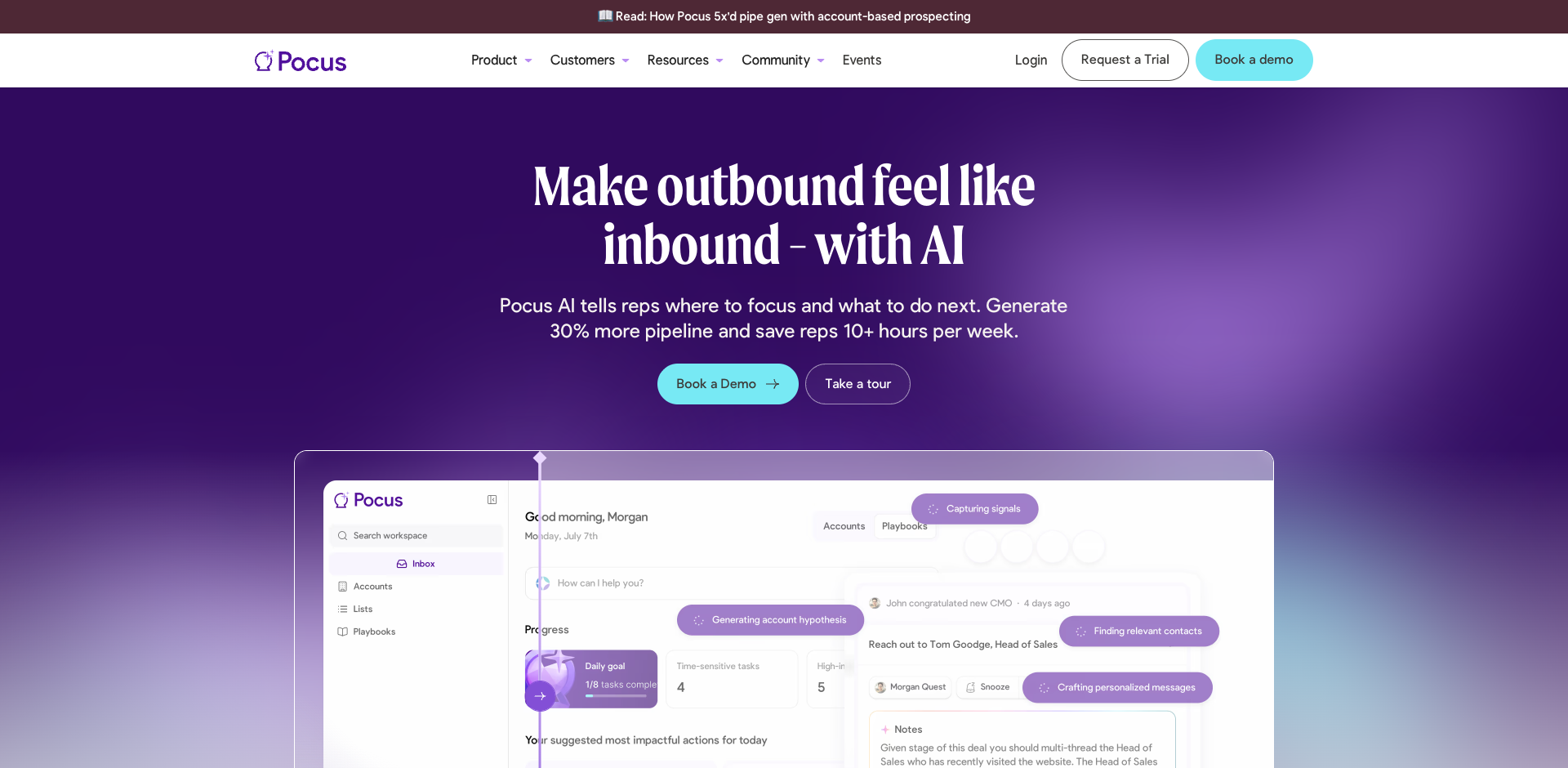
Pocus is an AI-assisted sales intelligence platform that unifies CRM data, product usage signals, and intent data into prescriptive sales playbooks. The platform is designed to tell sales reps where to focus, who to contact, and what to say, using AI agents to capture signals, research accounts, and surface next-best-action recommendations.
Pocus features real-time account scoring monitored continuously, automated message generation, call recording and email analysis, and a Chrome Extension for prospecting. The platform integrates with CRMs and sales engagement platforms.
Note that Pocus has announced an acquisition by Apollo, as noted on their website.
Pricing: Pocus's pricing is not publicly displayed on their official website. According to Vendr, the Median Avg Contract Value is $58,032 per year, based on a range of $39,800 to $275,832.
Pros:
- Product-led signal integration: Pulls product usage data alongside CRM and intent signals for a fuller account picture
- Prescriptive playbooks: Turns signals into structured rep workflows rather than raw data dashboards
- AI-driven prioritization: Continuous account scoring reduces manual triage for sales teams
Cons:
- Narrow focus: Primarily a prioritization and intelligence layer without native outreach execution
- Acquisition uncertainty: The announced Apollo acquisition may affect product roadmap and support continuity
- Contract-level pricing: Entry point based on Vendr data suggests it fits teams with established budgets rather than early-stage orgs
Compare Apollo and Pocus side by side.
Turn Funnel Gaps Into Pipeline With Apollo
Tired of marketing leads that never convert to opportunities? Apollo surfaces in-market buyers with verified contact data so your team reaches the right prospects at right moment. 600K+ companies trust Apollo to build predictable pipeline.
Start Free with Apollo →Common Room

Common Room is an AI GTM platform that transforms fragmented signals, partial identities, and siloed customer data into unified buyer intelligence. It combines enrichment, AI agents, and embedded workflows to help sales teams identify and act on real buying moments with continuously updated account intelligence.
Key capabilities include Context360 for unifying first-party CRM, product, marketing, and engagement data with real-world signals; RoomieAI agents for automating account research, contact research, and message personalization; a Revenue Control Plane for no-code scoring models and GTM play orchestration; and DataAgent for automated data hygiene. The platform also offers MCP to extend intelligence to any digital surface, and a Sales Workbench for moving directly from insight to action.
Pricing: Common Room offers three tiers on their pricing page: Essential at $2,500/month billed annually (5 seats, 5k RoomieAI credits, 2.5k Prospector credits, up to 100k contacts), Advanced at requested pricing (15 seats, 7.5k RoomieAI and Prospector credits, up to 250k contacts), and Enterprise at requested pricing (30 seats, 10k RoomieAI credits, 15k Prospector credits, up to 750k contacts with unlimited website deanonymization).
Pros:
- Signal unification: Brings together community, product, CRM, and intent signals that most platforms treat separately
- Embedded activation: AI agents and insights surface inside Salesforce, Slack, email, and browser extensions without forcing context switching
- Transparent base pricing: Essential tier is publicly listed, giving teams a clear entry point
Cons:
- High entry price: At $2,500/month for the base tier, Common Room is less accessible for smaller teams or early pipeline stages
- Advanced tiers require negotiation: requested pricing on Advanced and Enterprise plans adds procurement complexity
- No native outreach execution: Teams need to pair Common Room with a separate engagement platform for sending sequences or making calls
Considering Common Room? Here's how Apollo compares.
MadKudu

MadKudu is a predictive lead scoring and revenue automation intelligence platform. It analyzes signals from internal data, enriched records, webpages, and social media to predict which leads and accounts are most likely to convert, enabling teams to prioritize revenue-generating activities.
MadKudu's capabilities include predictive lead and account-level scoring, real-time signal detection for in-market prospects, product-qualified lead identification, marketing channel optimization, and sales workflow automation through integrations with Salesforce, HubSpot, and Intercom. The platform is oriented toward teams with significant inbound lead volume who need a scoring layer to separate signal from noise.
Pricing: MadKudu's pricing is not publicly displayed on their official website. According to Vendr, the Median Avg Contract Value is $33,644 per year, based on data from 40 purchases, with a range of $15,000 to $91,000.
Pros:
- High-volume lead prioritization: Well-suited for teams processing large inbound volumes that need automated scoring to focus rep attention
- PQL identification: Identifies product-qualified leads for SaaS companies with product-led growth motions
- Multi-source signal integration: Pulls from internal, enriched, and behavioral data for scoring models
Cons:
- Scoring-layer focus: MadKudu is a prioritization tool without built-in prospecting, sequencing, or dialing capabilities
- Usage-based pricing complexity: Costs scale with lead volume tiers, which can make budgeting unpredictable as pipeline grows
- Implementation overhead: Onboarding and custom model development can add $5,000–$20,000 to initial deployment costs
Apollo vs MadKudu, a closer look at the differences.
Comparison Table
| Platform | Starting Price | Database / Data Scope | Intent Data | Outreach Execution | AI Features | Platform Scope |
|---|---|---|---|---|---|---|
| 6sense | Vendr median $62,440/yr (381 purchases) | Contact + company data, technographics | Yes, keyword-level intent | AI email agents, workflow orchestration | Predictive AI scoring, RevvyAI, Sales Copilot | Account intelligence + engagement orchestration |
| Apollo | Free tier available; $49/user/month (Basic) | 240M+ people, 30M+ companies, 98% email accuracy | Yes, buyer intent signals + 6 topics (Basic+) | Yes, sequences, Power Dialer, Parallel Dialer | AI Research Agent, AI sequence builder, AI call summaries | Data + intelligence + outbound + inbound + enrichment |
| Bombora | Vendr median $25,000/yr (35 purchases) | Company-level intent signals; 5,000+ site co-op (claimed) | Yes, 21,600+ topics (claimed) | No native execution | Audience segmentation, campaign analytics | Intent data layer for marketing and ABM |
| Pocus | Vendr median $58,032/yr | CRM + product usage + intent (unified) | Yes, via integrated signal capture | Message generation; no native sequences or dialer | AI account scoring, prescriptive playbooks, call analysis | Pipeline intelligence + prioritization |
| Common Room | $2,500/month billed annually (Essential) | 400M+ contact directory (claimed); first-party + signal unification | Yes, via signal enrichment and website deanonymization | Embedded workflows in CRM and email; no native dialer | RoomieAI agents, DataAgent, MCP integration | Buyer intelligence + GTM orchestration |
| MadKudu | Vendr median $33,644/yr (40 purchases) | Multi-source signal integration (internal + enriched) | Yes, real-time signal detection | No native execution; integrates with CRM/MAP | Predictive lead and account scoring, PQL detection | Lead scoring + revenue automation intelligence |
How to Choose
The right choice depends on where your GTM motion breaks down. Consider these scenarios:
- If you need data, outreach, and intelligence in one place: Apollo's connected GTM system covers prospecting, lead generation, enrichment, sequencing, and dialing. Apollo's Living Data Network keeps contact records current, so teams aren't building pipeline on stale data.
- If your team runs heavy ABM programs and primarily needs intent signals: Bombora's cooperative data is a strong standalone intent layer for marketing teams who already have execution tooling in place.
- If you're product-led and need to combine usage data with sales signals: Pocus or MadKudu address the PQL and product-led prioritization use case specifically.
- If your biggest challenge is fragmented first-party data across CRM, product, and community: Common Room's Context360 approach to unifying those sources into continuous buyer intelligence may address that gap.
- If you're scaling a sales team and need coaching, governance, and comprehensive controls alongside prospecting: Apollo's Organization tier includes SSO, advanced security, international dialing, and admin controls suited for larger GTM teams.
For teams seeking a platform that covers the full sales prospecting lifecycle from identification through booked meeting, Apollo offers the broadest functional coverage with the most accessible entry point.
Frequently Asked Questions
What are the main reasons teams look for 6sense alternatives?
The most common triggers are contract cost (6sense's median annual contract value is $62,440 according to Vendr), the lack of built-in outreach execution tools, and implementation complexity. Teams that want signal-to-meeting workflows in a single workspace often find 6sense better suited as one layer in a larger stack rather than a standalone solution.
Is Apollo a direct replacement for 6sense?
Apollo covers many of the same intelligence use cases, including buyer intent signals, account scoring, and contact data, while also including outreach execution, dialers, and enrichment. Teams moving from 6sense often consolidate additional tools into Apollo at the same time.
As noted above, Apollo serves B2B GTM teams, GTM Engineers, and AI Builders building headless GTM workflows with the Apollo API, CLI, and MCP, alongside Sales Professionals, SDRs/BDRs, AEs, RevOps, Marketing, and Revenue Leaders.
Which 6sense alternative works best for teams focused on intent data only?
Bombora is the most focused intent-data specialist among the alternatives covered here. Its Data Cooperative tracks content consumption signals across thousands of B2B sites, making it a strong fit for marketing teams running ABM programs who need a dedicated intent signal layer integrated with their existing MAP and CRM setup.
How does Apollo pricing compare to 6sense?
6sense's pricing is not publicly displayed on their official website. According to Vendr, 6sense's median annual contract is $62,440. Apollo's plans start at $49/user/month as detailed in the Apollo section above, with a free tier available. The difference in entry point and pricing transparency is meaningful for teams at earlier stages or with tighter budget cycles.
Can Apollo handle enterprise GTM needs, or is it only for smaller teams?
Apollo operates across company sizes. Its Organization tier includes SSO, advanced security, international dialing, 15 mailboxes per user, and admin governance controls.
Per Ramp's vendor data, Apollo's enterprise adoption rate stands at 31% as of August 2026, and the platform is used by 100+ teams at Fortune 500 companies.

Conclusion
All five alternatives in this guide address genuine gaps that teams encounter with 6sense, whether that's pricing accessibility, the need for built-in execution, or more specialized scoring capabilities. Bombora, Pocus, Common Room, and MadKudu each serve specific use cases well.
But for teams that want data, intelligence, and outbound execution in one connected platform, Apollo offers the most complete coverage with the most transparent pricing structure.
Apollo's combination of a 240M+ contact database, AI-driven sequences, dialers, enrichment, and inbound routing in a single workspace, backed by a 4.7/5 G2 rating and a free starting tier, makes it the logical first stop for GTM teams evaluating their options in 2026.
Prove Pipeline ROI With Apollo
ROI pressure killing your tool budget? Apollo delivers measurable pipeline impact from day one. Leadium 3x'd annual revenue — see your numbers move fast.
Start Free with Apollo →Don't miss these
Sales
Inbound vs Outbound Marketing: Which Strategy Wins?
Sales
What Is a Sales Funnel? The Non-Linear Revenue Framework for 2026
Sales
What Is a Go-to-Market Strategy? The 2026 GTM Playbook
See Apollo in action
We'd love to show how Apollo can help you sell better.
By submitting this form, you will receive information, tips, and promotions from Apollo. To learn more, see our Privacy Statement.
4.7/5 based on 9,690 reviews
