
How to Support Your Sales Team With Company and Contact Data
Reps don't lose deals because they can't sell. They lose time because they're stuck hunting for a decision-maker's email instead of talking to them.
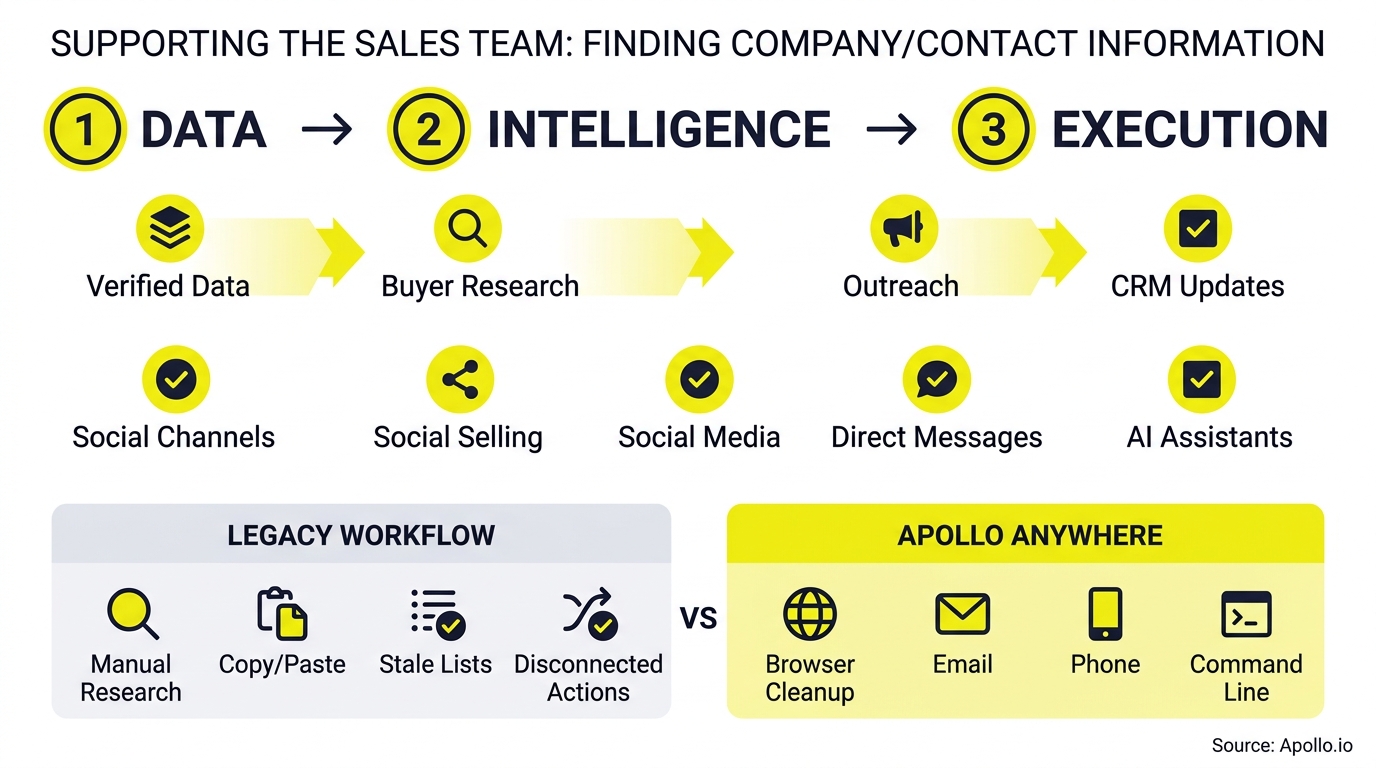
That research gap is exactly what a company/contact information workflow is built to close, turning scattered professional networks tabs and guesswork into a repeatable process that hands reps a verified, CRM-ready account brief before they ever pick up the phone.

Skip The Research, Apollo Finds Contacts Fast
Burning hours hunting down emails and phone numbers that turn out wrong? Apollo verifies contact data instantly with 98% email accuracy, so your team spends time selling instead of searching. Get straight to real conversations with real buyers.
Start Free with Apollo →Key Takeaways
- Most B2B purchases involve around 13 people across at least two departments, so single-contact prospecting misses most of the buying group.
- Contact data degrades fast. Building a verification and refresh routine matters more than the size of your initial list.
- SDRs, AEs, and RevOps get more value from a small set of verified, role-mapped contacts than from a large list of unverified names.
- Sharing account research across sales, marketing, and RevOps multiplies its value instead of letting it die in one rep's inbox.
- Consolidating research, enrichment, and outreach into one platform cuts the tool-switching that eats into selling time.
What Does It Mean To Support A Sales Team By Finding Company And Contact Information?
Supporting a sales team by finding company and contact information means researching, verifying, and organizing the firmographic and personal data reps need to reach the right buyers at the right accounts. It's not just pulling an email address.
It's building an account brief: company details, buying-group roles, verified contact fields, and a record of when and how each field was confirmed.
This function traditionally fell to junior reps, sales ops analysts, or dedicated research assistants doing manual lookups. Salesforce's 2024 State of Sales research found that reps spend the majority of their week on nonselling work, and confidence in that data is often shaky. According to Salesforce, only 35% of sales professionals completely trust their organization's data, which means the research itself has to include a verification step, not just a list-building step.
Why Is Company And Contact Research So Time-Consuming For SDRs And AEs?
Company and contact research eats selling time because B2B contact data decays constantly, forcing reps to re-verify information they already collected. Research from Landbase shows B2B contact data decays at a rate of 22.5% to 70.3% annually depending on the industry. Job titles, phone numbers, and emails all shift constantly.
Landbase also found that annually, 65.8% of contacts change job titles or functions, 42.9% change phone numbers, and 37.3% change email addresses. For SDRs booking meetings, that means a list that was accurate in January can be stale by summer. RevOps leaders often inherit this problem in the CRM: a study by TamGraph found that roughly 76% of CRM users admit that less than half of their organization's data is accurate.
Struggling to keep prospecting lists current? Start free with Apollo's verified business contact database instead of manually re-checking every field.
How Do You Build A Buying-Group Map Instead Of A Single Contact?
You build a buying-group map by identifying every role involved in a purchase decision, not just one champion. Forrester's Buyers' Journey Survey found that an average of 13 people participate in a B2B purchase decision, and 89% of purchases involve at least two departments. Targeting one contact per account structurally misses most of the buying group.
A usable buying-group map covers five roles per account:
- Champion: internal advocate who feels the pain point directly
- End user: person who will use the product day to day
- Technical evaluator: vets security, integration, or implementation
- Budget owner: controls or approves spend
- Influencer: shapes opinion but doesn't hold formal authority
For Account Executives managing multi-stakeholder deals, this map replaces guesswork with a documented path through the account. RevOps teams can build this once per segment and reuse it across every rep working similar accounts, using advanced prospecting filters to pull role-based contacts at scale.
What Is A Verified Account Brief And What Should It Include?
A verified account brief is a structured research deliverable that gives a rep everything they need to open a relevant conversation with a specific account. It's the output of the research process, not just a spreadsheet of names.
| Field | Why It Matters |
|---|---|
| Company firmographics (size, industry, location) | Confirms ICP fit before outreach starts |
| Buying-group roles and names | Targets the right stakeholders, not just one contact |
| Verified email and phone | Reduces bounce and wasted call time |
| Source and verification date | Tells the rep how fresh and trustworthy the data is |
| Trigger event (hiring, funding, leadership change) | Gives reps a timely, relevant reason to reach out |
Gartner's 2025 survey found that 73% of B2B buyers actively avoid suppliers that send irrelevant outreach, according to Gartner. A brief with trigger events and role context is what makes outreach feel relevant instead of generic.

How Do SDRs Use Contact Research To Book More Meetings?
SDRs use verified contact research to prioritize accounts with real fit and timing signals, instead of dialing down an unfiltered list. Once the buying-group map and verified fields exist, an SDR can sequence outreach to the champion and technical evaluator simultaneously instead of waiting weeks to find the second contact.
This is also where AI-assisted research is changing daily workflows. Sales organizations are increasingly using AI agents to identify accounts, enrich contact records, and draft first-touch messaging in one motion rather than switching between a data vendor, a CRM, and a sequencing tool.
Apollo was named a flagship data partner for Salesforce's new outbound agent Hunter in 2026, giving reps inside Salesforce direct access to company search, contact enrichment, and hiring or news signals without leaving their CRM.
Spending hours on manual list-building before you can even start sequencing? Automate research-to-outreach in one workflow with Apollo.
Know Which Deals Are Real With Apollo
Forecasting off gut feel because your funnel data is stale by the time it hits your CRM? Apollo surfaces buying signals and deal activity in real time, so reps chase live opportunities instead of dead ones. Built-In improved win rates using Apollo's and scoring.
Request a Demo →How Do You Verify Contact Data Before It Reaches A Rep's Sequence?
You verify contact data by checking each field against a current source and logging when it was last confirmed, not by assuming a purchased list is accurate. Every record in an account brief should carry a source and a verification date so reps know whether a phone number is a week old or a year old.
Unverified bulk data carries real risk. A TechRadar report on a 2025 exposed 16TB dataset found nearly two billion files containing names, emails, phone numbers, and employer details, with ownership never conclusively established. That's a reminder that sourcing and provenance matter as much as the contact fields themselves. Build a simple refresh SLA: recheck emails and titles quarterly, phone numbers every six months, and firmographic data on relevant trigger events like funding rounds or leadership changes.
How Does Shared Research Benefit RevOps And Marketing, Not Just Sales?
Shared research benefits RevOps and marketing by turning one rep's account work into a reusable asset for the whole revenue team. Gartner found that organizations sharing buyer-journey insights are 2.3 times more likely to achieve higher sales conversion rates and 1.6 times more likely to exceed revenue-growth expectations, yet 60% of organizations still lack shared journey insights.
RevOps leaders should push account briefs and buying-group maps into a shared CRM view, not a rep's personal notes. This also supports a revenue operations framework where marketing can reuse verified account data for account-based campaigns instead of researching the same companies again. Pair this with a sales analytics view to track which verified accounts actually convert.
What Tools Help Consolidate Contact Research Into One Workflow?
The right tool consolidates company search, contact enrichment, verification, and outreach into one workspace so reps aren't switching between four separate subscriptions. Stitching together a data vendor, a verification tool, a sequencer, and a dialer creates gaps where records go stale between systems.
Apollo brings B2B data, sales engagement, and AI-powered execution together in one connected go-to-market system, so teams don't have to stitch together separate vendors for research, outreach, and analysis. Collin Stewart of Predictable Revenue put it simply: "We reduced the complexity of three tools into one." For teams building a broader stack, this sales tech stack playbook walks through what to consolidate first.
Frequently Asked Questions About Finding Company And Contact Information
How Do You Find Decision-Makers At A Target Company?
Find decision-makers by searching a verified B2B contact database filtered by job title, department, and seniority, then cross-checking each contact against the buying-group roles relevant to your deal (champion, budget owner, technical evaluator). Filtering by role, not just company name, surfaces the people who actually influence the purchase.
Is It Legal To Find Business Contact Information For Sales Outreach?
Yes, sourcing business contact information for professionals in their business capacity is standard practice for B2B sales research. Reputable providers document how records are sourced and verified, and responsible teams should confirm a vendor's data-handling practices before relying on any contact list.
How Often Should Sales Teams Refresh Contact Data?
Sales teams should refresh high-priority contact fields on a set schedule, checking emails and job titles quarterly and phone numbers roughly every six months, since title and contact-method changes happen throughout the year. Firmographic data should be rechecked whenever a trigger event, like funding or a leadership change, is detected.
What Makes Contact Data 'CRM-Ready'?
CRM-ready contact data includes standardized fields (name, title, verified email, verified phone, company, source, verification date) formatted to match your CRM's schema so it can sync without manual cleanup. Data that lacks a source or verification date isn't CRM-ready, even if the fields look complete.

Turn Contact Research Into Booked Meetings
Finding company and contact information isn't a side task, it's the foundation that determines whether outreach lands or gets ignored. Teams that build verified, role-mapped account briefs and refresh them on a schedule consistently outperform teams working off static, unverified lists.
Apollo gives SDRs, AEs, and RevOps teams one workspace for company search, contact enrichment, verification, and multi-channel outreach, so research turns into pipeline instead of sitting in a spreadsheet. Try Apollo Free and start building verified account briefs your whole revenue team can use.
Prove Apollo's ROI Before Renewal Talks
Struggling to quantify pipeline impact when leadership wants hard numbers? Apollo consolidates your tech stack into one platform so gains show up fast, not months later. Leadium tripled annual revenue after automating with Apollo.
Start Your Free Trial →Don't miss these
Sales
Inbound vs Outbound Marketing: Which Strategy Wins?
Sales
What Is a Sales Funnel? The Non-Linear Revenue Framework for 2026
Sales
What Is a Go-to-Market Strategy? The 2026 GTM Playbook
See Apollo in action
We'd love to show how Apollo can help you sell better.
By submitting this form, you will receive information, tips, and promotions from Apollo. To learn more, see our Privacy Statement.
4.7/5 based on 9,690 reviews
