
What Is a Revenue Operations Framework and Why Does It Matter in 2026?
A revenue operations framework is a structured system that aligns sales, marketing, and customer success teams around unified data, processes, and goals to drive predictable revenue growth. In 2026, this framework has evolved from a nice-to-have organizational structure into a competitive necessity. Research by Gartner shows that 75% of the highest-growth companies globally have now implemented a RevOps model.
The shift to revenue operations frameworks reflects a fundamental change in how B2B companies operate. Traditional siloed teams created data gaps, inconsistent customer experiences, and missed revenue opportunities.
Modern revenue operations frameworks solve these problems by creating a single source of truth for customer data, standardized processes across teams, and AI-powered insights that drive faster decision-making.

Apollo Eliminates Hours Of Daily Research
Tired of spending 4+ hours daily hunting for contact info? Apollo delivers 224M verified contacts with 96% email accuracy instantly. Join 550K+ companies who replaced manual research with automated prospecting.
Start Free with Apollo →Key Takeaways
- Revenue operations frameworks unify sales, marketing, and customer success around shared data and processes, eliminating costly silos
- AI integration is now essential: 35% of Chief Revenue Officers are establishing generative AI operations teams within their GTM organizations
- Companies with customer-obsessed RevOps frameworks see 28% faster revenue growth and 43% better retention rates
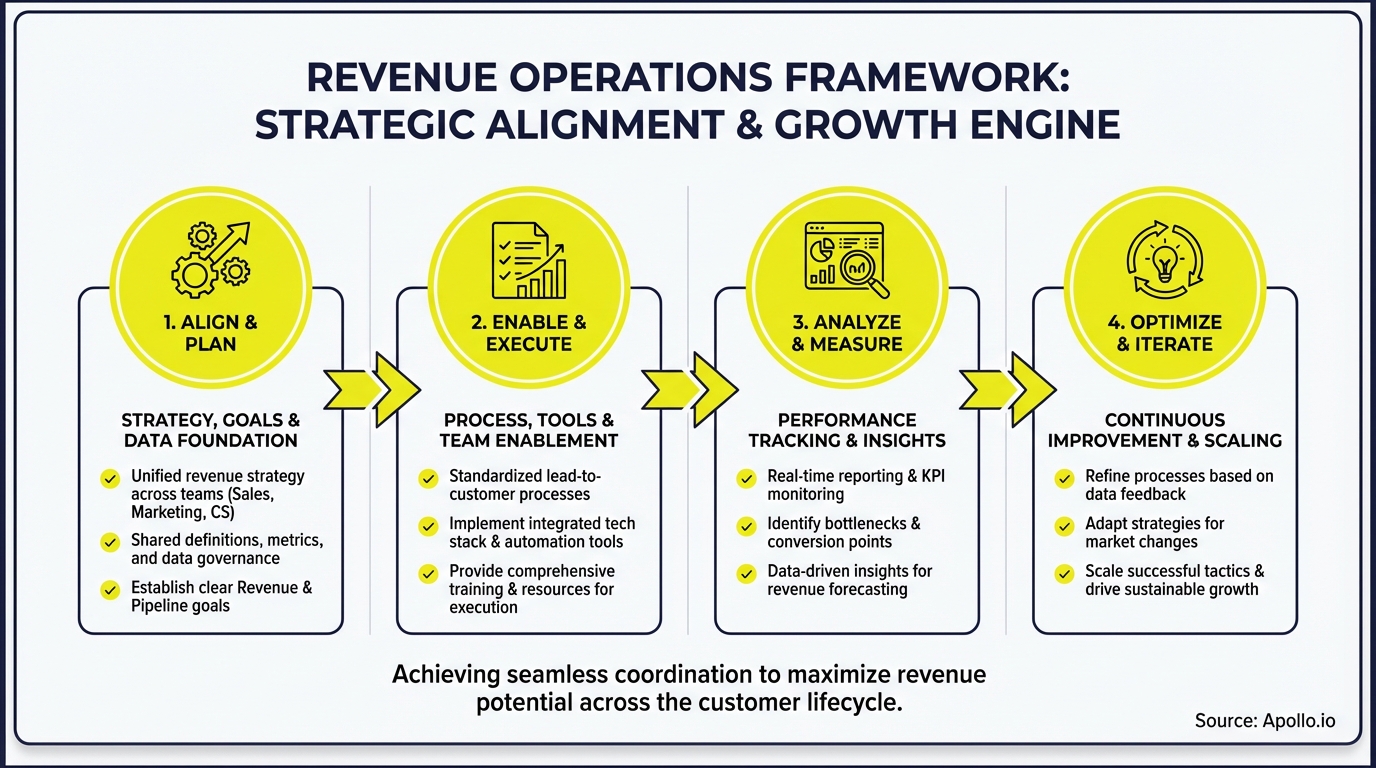
- Successful frameworks require four core pillars: unified data, aligned processes, integrated technology, and cross-functional governance
- Implementation follows a four-phase approach: assessment, design, deployment, and optimization
Why Revenue Operations Frameworks Drive Measurable Growth
The business case for revenue operations frameworks is compelling. According to Forrester Research, customer-obsessed companies experience 28% faster revenue growth, 33% higher profitability growth, and 43% better customer retention rates compared to their peers.
These results stem from how revenue operations frameworks eliminate friction across the customer journey. When marketing, sales, and customer success operate from the same data foundation and follow aligned processes, prospects experience consistent messaging, faster response times, and smoother handoffs between teams.
"Apollo could be a third of the cost if you look at the full price of what we were spending on ZoomInfo, Outreach, Salesforce, and admins to make it all work."
The framework also addresses a critical challenge facing modern B2B teams: 71% of current B2B buyers are Millennials and Gen Zers who expect digital-first, self-service experiences. Revenue operations frameworks enable companies to meet these expectations by creating seamless digital touchpoints backed by unified customer intelligence.
What Are the Four Essential Pillars of a Revenue Operations Framework?
Every effective revenue operations framework rests on four foundational pillars that work together to drive alignment and results.
Unified Data Foundation
The data pillar creates a single source of truth for all customer information. This includes contact data, engagement history, pipeline status, and customer health metrics. Without unified data, teams make decisions based on incomplete or conflicting information. Struggling with disconnected data sources? Apollo's data enrichment automatically updates your CRM with 224M+ verified contacts.
Aligned Processes and Workflows
Process alignment ensures every team follows standardized approaches for lead qualification, handoffs, and customer engagement. This includes sales development processes, marketing attribution models, and customer success playbooks that work together seamlessly.
Integrated Technology Stack
The technology pillar consolidates tools into an integrated stack that eliminates redundancy and reduces complexity. Modern revenue operations frameworks prioritize platforms that combine prospecting, engagement, and intelligence in one workspace rather than managing multiple disconnected tools.
Cross-Functional Governance
Governance establishes clear ownership, decision-making processes, and performance standards across teams. This pillar defines roles, responsibilities, and escalation paths while ensuring accountability for revenue outcomes.
How Do You Implement a Revenue Operations Framework?
Implementing a revenue operations framework follows a structured four-phase approach that builds momentum while delivering quick wins.
| Phase | Focus | Duration | Key Outcomes |
|---|---|---|---|
| Assessment | Audit current state, identify gaps | 2-4 weeks | Baseline metrics, priority areas |
| Design | Build framework, define processes | 4-6 weeks | Process maps, tech stack plan |
| Deployment | Roll out systems, train teams | 8-12 weeks | Live systems, trained users |
| Optimization | Measure, refine, scale | Ongoing | Improved KPIs, best practices |
During the assessment phase, audit your current technology stack, data quality, process documentation, and team alignment. Identify quick wins that can demonstrate value early while building support for larger changes.
The design phase focuses on creating your ideal future state. Define your target customer journey, map required processes, select technology platforms, and establish governance structures.
This phase requires input from all revenue teams to ensure buy-in.
"We reduced the complexity of three tools into one. We're getting higher reply rates, open rates are doubled, meetings are up, and speed to booking a meeting is cut in half."
Deployment brings your framework to life through phased rollouts, comprehensive training, and change management. Start with pilot teams to validate approaches before scaling across the organization.
What Role Does AI Play in Modern Revenue Operations Frameworks?
AI has transformed from an optional enhancement to a core component of effective revenue operations frameworks. Gartner reports that 35% of Chief Revenue Officers are establishing generative AI operations teams within their go-to-market organizations.
AI enhances revenue operations frameworks in three critical ways. First, AI-powered prospecting identifies ideal customers and surfaces relevant insights faster than manual research.
Second, AI messaging personalization creates tailored outreach at scale while maintaining authenticity. Third, AI conversation intelligence analyzes customer interactions to surface patterns, objections, and opportunities.
The data reveals AI's impact: companies using AI research agents see 46% more meetings booked, while AI messaging increases bookings by 35%. These results come from AI's ability to process vast amounts of data and generate insights that humans would miss or take days to compile.
Need to scale personalized outreach without adding headcount? Apollo's AI sales automation tailors messaging based on prospect context and engagement history.
Turn Weak Leads Into Pipeline With Apollo
Marketing leads stalling at the top of the funnel. Apollo identifies sales-ready prospects with 96% email accuracy and buying intent signals. Built-In boosted win rates 10% using Apollo's scoring.
Start Free with Apollo →How Do You Measure Revenue Operations Framework Success?
Effective revenue operations frameworks track metrics across the entire customer lifecycle, not just individual team performance. These KPIs provide visibility into how well your framework drives revenue growth.
| Metric Category | Key Indicators | Why It Matters |
|---|---|---|
| Pipeline Efficiency | Conversion rates, velocity, coverage | Shows how effectively you move prospects through stages |
| Revenue Performance | Win rate, deal size, forecast accuracy | Measures ultimate business outcomes |
| Customer Health | NRR, churn rate, expansion revenue | Indicates long-term revenue sustainability |
| Operational Efficiency | Cost per acquisition, sales cycle length | Tracks how efficiently you generate revenue |
Focus on leading indicators that predict future performance, not just lagging indicators that report past results. For example, track pipeline coverage ratios and stage conversion rates to forecast revenue before deals close. Learn more about B2B marketing metrics that drive revenue growth.
Customer lifetime value (CLV) to customer acquisition cost (CAC) ratio reveals your framework's overall efficiency. Aim for a 3:1 ratio or higher, indicating you generate three dollars in customer value for every dollar spent acquiring customers.
What Technology Stack Powers Revenue Operations Frameworks?
The right technology stack transforms your revenue operations framework from theory into practice. In 2026, the trend is toward consolidation rather than adding more point solutions.
Modern revenue operations teams prioritize all-in-one platforms that combine prospecting, engagement, and intelligence capabilities. This approach reduces integration complexity, eliminates data silos, and cuts costs compared to managing multiple disconnected tools. Companies like Predictable Revenue reduced their tech stack costs by 50% through consolidation.
Essential technology components include a unified customer database with 224M+ contacts and 30M+ companies, multi-channel engagement tools supporting email, phone, and social outreach, AI-powered research and personalization capabilities, conversation intelligence for calls and meetings, and workflow automation to eliminate manual tasks.
Integration capabilities matter as much as features. Your revenue operations technology must connect seamlessly with your CRM, marketing automation, customer success platforms, and business intelligence tools to maintain data consistency across systems.
How Can Apollo Support Your Revenue Operations Framework?
Apollo delivers the unified platform revenue operations teams need to execute their frameworks effectively. With 224M+ verified contacts, 30M+ companies, and 96% email accuracy, Apollo provides the data foundation that powers alignment across sales, marketing, and customer success.
The platform combines prospecting, engagement, and intelligence in one workspace, eliminating the need to manage multiple tools. Teams use Apollo to discover ideal prospects, automate personalized outreach, track engagement across channels, and analyze performance with unified reporting.

Apollo's AI capabilities enhance every aspect of your revenue operations framework. AI research agents surface relevant insights about prospects in seconds, AI messaging creates personalized outreach at scale, and conversation intelligence captures learnings from every customer interaction.
Revenue operations leaders choose Apollo because it consolidates their tech stack while improving results. Leadium 3X'd their annual revenue using Apollo's platform to streamline operations and scale their go-to-market motion.
Start Building Your Revenue Operations Framework
Revenue operations frameworks have evolved from experimental organizational models to proven drivers of competitive advantage. The highest-growth companies recognize that alignment across revenue teams, powered by unified data and AI capabilities, creates sustainable growth that siloed approaches cannot match.
Success requires commitment to the four core pillars: unified data, aligned processes, integrated technology, and cross-functional governance. Companies that build strong foundations in these areas position themselves to adapt quickly as market conditions change and buyer expectations evolve.
The opportunity is clear. Companies with effective revenue operations frameworks see measurably better results across revenue growth, profitability, and customer retention.
As more organizations adopt these frameworks, the competitive gap between leaders and laggards will only widen.
Ready to build your revenue operations framework? Start a free trial and discover how Apollo's all-in-one platform unifies your go-to-market teams around data, processes, and AI-powered insights.
Prove Apollo's ROI In Your First 30 Days
Budget approval stuck on unclear metrics? Apollo delivers measurable pipeline impact from day one—Built-In boosted win rates 10% and ACV 10%. Start tracking real ROI immediately.
Start Free with Apollo →Don't miss these
Sales
Inbound vs Outbound Marketing: Which Strategy Wins?
Sales
What Is a Sales Funnel? The Non-Linear Revenue Framework for 2026
Sales
What Is a Go-to-Market Strategy? The 2026 GTM Playbook
See Apollo in action
We'd love to show how Apollo can help you sell better.
By submitting this form, you will receive information, tips, and promotions from Apollo. To learn more, see our Privacy Statement.
4.7/5 based on 9,690 reviews
