
Top 6 Pocus Alternatives for GTM Teams in 2026
Pocus is an AI-assisted sales intelligence platform that unifies CRM, product usage, and intent signals into playbooks designed to tell reps which accounts to work, who to call, and what to say. It's built primarily for product-led growth and account-based teams that need to combine usage data with buying signals.
But as GTM teams scale, many find they need more than intelligence and playbooks; they need a system that also handles data enrichment, multi-channel execution, dialing, and inbound routing without stitching together several point solutions.
That gap is why sales leaders, RevOps teams, and GTM Engineers are actively evaluating Pocus alternatives in 2026. Some teams need broader database coverage. Others need built-in execution tools like dialers and sequences rather than just intelligence and recommendations. And many are looking for pricing transparency that doesn't require a lengthy sales cycle just to understand costs.
This guide compares six alternatives, starting with Apollo, an AI GTM system built to unify data, intelligence, and execution, followed by five other platforms teams commonly evaluate: 6sense, Bombora, Common Room, MadKudu, and Warmly. We'll break down features, pricing, and ideal use cases so you can make an informed decision for your team.
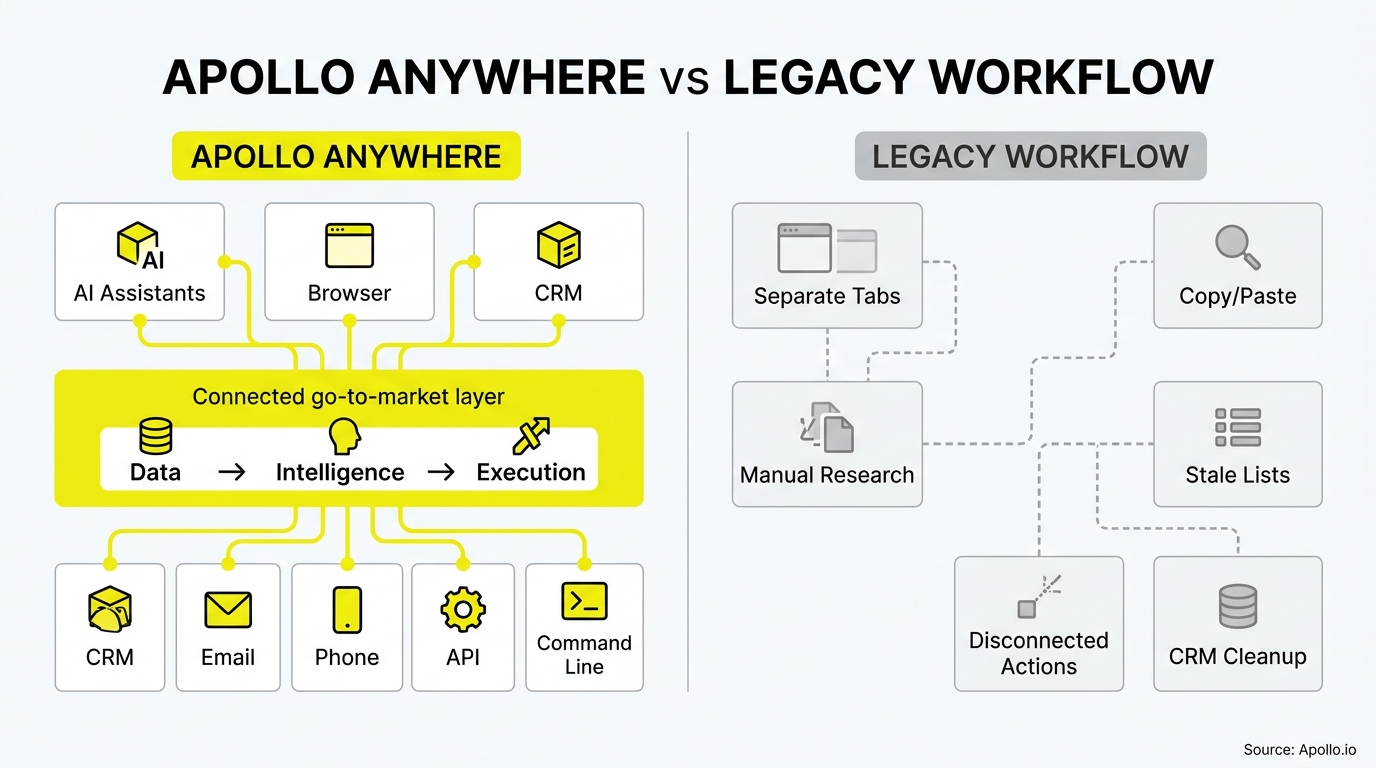

Skip The Manual Research, Apollo Verifies Instantly
Spending hours hunting down emails and phone numbers that bounce anyway. Apollo verifies contact data in real time so your team spends less time researching and more time selling. 98% email accuracy means fewer dead ends, more real conversations.
Start Free with Apollo →Key Takeaways
- Sales Intelligence Capabilities: Apollo combines a large contact and company database with buyer intent signals and AI research, while other alternatives specialize more narrowly in intent data (Bombora), predictive scoring (6sense), or signal-based buyer intelligence (Common Room).
- AI Features: Most platforms in this list now offer AI agents for research or messaging, but they differ in whether AI is layered onto intelligence-only tools or built into a full execution workflow.
- Customer Base: Apollo serves organizations from startups to enterprise GTM teams, while alternatives like 6sense and Bombora lean toward mid-market and enterprise budgets given their pricing structures.
- Platform Scope: Apollo covers prospecting, enrichment, dialing, sequencing, and inbound routing; several alternatives focus on a narrower slice, such as intent data or website visitor identification, requiring additional tools for full execution.
- Pricing Transparency: Apollo publishes tier pricing at apollo.io/pricing, while most alternatives in this list require requested quotes or rely on Vendr's marketplace data for benchmark figures.
Apollo

Apollo is an AI GTM system that unifies data, intelligence, and execution. It's built open by design, meeting sellers inside the tools they already use, from AI assistants like ChatGPT, Codex, Claude, and Perplexity via Apollo MCP, to the Chrome extension and Salesforce, rather than forcing a context switch to get value. For technical teams, Apollo CLI provides terminal-native access for headless GTM workflows.
Apollo's database includes 240M+ people and 30M+ companies, continuously validated and refreshed through Apollo's Living Data Network rather than treated as a static list, with 98% email accuracy. On the outbound side, Apollo helps teams define their ICP, let AI rank accounts and contacts, verify emails and phones, and run multi-channel sequences across email, calls, and social with a built-in Power Dialer and Parallel Dialer. On the inbound side, Apollo identifies website visitors, enriches and shortens forms, routes leads automatically, and triggers AI-driven nurture sequences using 65+ filters for precise targeting (source: Apollo Product Page). Data enrichment runs through waterfall enrichment across multiple vendors, CRM sync, CSV enrichment, and REST API access for bulk workflows. Apollo integrates with Salesforce, HubSpot, Zoho CRM, Pipedrive, Outreach, SalesLoft, Orum, Nooks, Marketo, and 50+ other tools in its integrations marketplace.
Pricing is available on Apollo's pricing page with annual billing savings: Free ($0, 900 credits/year, 2 sequences), Basic ($49/user/month, 30,000 credits/year, unlimited sequences, CRM integrations, 6 intent topics), Professional ($79/user/month, 48,000 credits/year, US dialer, 5 mailboxes, automated workflows, AI research), and Organization ($119/user/month, minimum 3 users, 72,000 credits/year, international dialer, 15 mailboxes, SSO, advanced security).
Customers report meaningful consolidation benefits. Kevin Warner, CEO at Leadium, said
"Apollo became the single source of truth for uswhere everything originates from and where all the data returns to."Kevin Warner, LeadiumCollin Stewart, CEO at Predictable Revenue, noted
"We reduced the complexity of three tools into one."Collin Stewart, Predictable RevenueAnd Sylvain Giuliani, Head of Growth & Operations at Census, shared
"We paid less for one tool than for two tools together...we cut our costs in half."Sylvain Giuliani, Census
According to Ramp's vendor data, drawn from real spend across American businesses, Apollo is the fastest-growing vendor in the Sales Data Providers category, with adoption up 5 percentage points year-over-year as of August 2026, and a 22% competitor switch rate, more than double some rival providers, .
Looking at the broader market, Ramp's Sales Data Providers category data shows Apollo tied for the highest new-adopter share in the category as of August 2026, meaning it's capturing a leading share of teams making their first purchase in this software category, a strong signal for teams evaluating a long-term GTM data provider.
Apollo has been recognized as a G2 Leader across multiple categories with a 4.7/5 G2 rating, named to G2's Top 100 Best Software Products and Top 50 Sales Products, and won the 2026 MarTech Breakthrough Award for "Best AI-Powered Sales Solution". Apollo serves B2B GTM teams, GTM Engineers, and AI Builders building headless GTM workflows with the Apollo API, CLI, and MCP, alongside Sales Professionals, SDRs/BDRs, AEs, RevOps, Marketing, and Revenue Leaders.
6sense

6sense is a platform for agentic GTM that turns buying signals into intelligence teams and AI agents can act on. It uses data from what it calls the Signalverse to model and prioritize accounts, update contact records, and identify opportunities or risks. The platform combines predictive AI, intent data, buyer discovery, and workflow automation across advertising, email, web, and sales channels.
Key features include predictive AI models trained on B2B purchase decisions, an Intelligent Workflows Engine for omni-channel plays, AI email agents, a conversational AI assistant called RevvyAI, and web deanonymization for identifying anonymous visitors.
6sense's pricing is not publicly displayed on their official pricing page, which lists three tier configurations (Sales Intelligence + Data Credits, Sales Intelligence + Predictive AI, and a combined tier) but requires booking a demo for exact costs. According to Vendr, the Median Avg Contract Value is $62,440 per year, based on data from 381 purchases, with 204 deals handled.
Pros:
- Combines predictive scoring with intent data and workflow automation in one platform
- Offers AI-driven account prioritization and web deanonymization
Cons:
- Pricing requires a requested quotes with no published tiers or self-serve options
- Implementation and professional services may be quoted separately from platform costs (see 6sense pricing page).
Apollo vs 6sense, here's everything you need to know.
Bombora

Bombora operates a B2B intent data cooperative comprising 5,000+ sites, capturing buying signals across nearly 4.7 million unique domains. Its Company Surge Intent data, identity resolution, and audience solutions help B2B companies identify in-market accounts and enrich first-party data.
Key features include Company Surge Intent data built on BERT-based machine learning, a Business Identity Graph that Bombora claims resolves buyer signals to 2.8 million businesses, identity resolution for anonymous visitors, and prebuilt B2B digital audience segments. Bombora reports an 86% exclusive publisher network for unique intent behavior observation.
Bombora's pricing is not publicly displayed on their official pricing page. According to Vendr, the Median Avg Contract Value is $25,000 per year, based on data from 35 purchases.
Pros:
- Specializes specifically in intent data with a large publisher cooperative
- Integrates with major sales and marketing platforms including Salesforce, Marketo, and HubSpot
Cons:
- Focused primarily on intent signals rather than full prospecting, enrichment, or execution
- Pricing scales with intent topics tracked and account volume, adding complexity to budgeting
Explore the Apollo vs Bombora breakdown.
Common Room

Common Room is an AI go-to-market platform that combines enrichment, real-world signals, AI agents, and embedded workflows to help revenue teams identify in-market buyers and automate research and personalization.
Key features include Context360 buyer intelligence for identity resolution, AI waterfall enrichment across a claimed 400M+ contact directory, RoomieAI agents for research and prospecting, and signal tracking across product usage, web visits, and job changes.
Common Room's pricing is publicly available. The Essential tier costs $2,500/month billed annually, including 5 seats, up to 100K contacts, 5,000 RoomieAI research credits, and 2,500 Prospector credits. Advanced (15 seats, up to 250K contacts) and Enterprise (30 seats, up to 750K contacts) tiers require requested pricing.
Pros:
- Publishes starting pricing for its Essential tier, offering more transparency than many competitors
- Combines signal tracking, enrichment, and AI research agents in one workflow
Cons:
- Higher tiers require requested quotes, limiting transparency for growing teams
- Several capabilities, like Product Signals and auto-recurring exports, are add-on only on lower tiers
Considering Common Room? Here's how Apollo compares.
Turn Lead Guesswork Into Real Pipeline
Marketing leads that never convert to real opportunities. Apollo scores and prioritizes in-market buyers so your funnel fills with prospects who actually close. See deal stages update in real time instead of guessing at forecasts.
Start Free with Apollo →MadKudu

MadKudu is a platform serving B2B sales and marketing teams, though detailed product information was not available from official sources at the time of writing.
MadKudu's pricing is not publicly displayed on their official website. Teams interested in MadKudu would contact their sales team directly for pricing details specific to their use case and team size.
Pros:
- Positioned for B2B sales and marketing teams evaluating lead scoring solutions
Cons:
- Limited publicly available product detail makes it harder to evaluate fit before a sales conversation
- No published pricing tiers or self-serve options
Apollo vs MadKudu, a closer look at the differences.

Warmly

Warmly is an AI-assisted go-to-market platform that identifies and engages high-intent website visitors in real time. It automatically identifies anonymous visitors, monitors buying signals, and uses AI agents to automate outreach through chat, email, and social channels.
Key features include website de-anonymization, which Warmly claims can identify 60% of accounts and 25%+ of individual visitors, an AI chat agent, real-time signal monitoring for job changes and social activity, and a Lead Nurture Agent for automated outreach.
Warmly's pricing is not publicly displayed on their official pricing page, which lists Startup, Business, and Enterprise tiers requiring sales contact. According to Vendr, the Median Avg Contract Value is $14,550 per year.
Pros:
- Focused specifically on website visitor identification and real-time engagement
- Combines de-anonymization with AI-driven chat and outreach automation
Cons:
- Narrower scope centered on website visitors rather than broader prospecting or database search
- Three pricing tiers all require contacting sales, with no published starting price on the official site
Thinking about Warmly? See how Apollo stacks up.
Comparison Table
| Platform | Starting Price | Sales Intelligence | AI Features | Platform Scope |
|---|---|---|---|---|
| Apollo | $49/user/month (Basic); Free tier with 900 credits/year available | 240M+ people, 30M+ companies, buyer intent signals | AI Sequence Builder, AI research, AI call summaries, AI nurture | Prospecting, enrichment, dialer, sequences, inbound routing |
| 6sense | requested quotes (Vendr median: $62,440/year) | Signalverse intent data, predictive scoring | RevvyAI, AI email agents, Sales Copilot | Predictive AI, intent data, omni-channel workflows |
| Bombora | requested quotes (Vendr median: $25,000/year) | Intent data cooperative, identity resolution | BERT-based Company Surge scoring | Intent data and audience solutions |
| Common Room | $2,500/month (Essential, billed annually) | Context360 buyer intelligence, 400M+ contact directory | RoomieAI research and prospecting agents | Signal tracking, enrichment, embedded workflows |
| MadKudu | Not publicly displayed | Lead scoring for sales and marketing | Not publicly detailed | Lead scoring focus |
| Warmly | requested quotes (Vendr median: $14,550/year) | Website visitor identification, signal monitoring | AI chat agent, Lead Nurture Agent | Website de-anonymization and engagement |
| Pocus (reference) | Vendr median: $58,032/year | CRM, product usage, and intent signal playbooks | AI-driven account prioritization and messaging | Sales intelligence and playbooks |
How to Choose the Right Pocus Alternative
Start by mapping your team's workflow gaps. If you need a single system that handles prospecting, enrichment, multi-channel outreach, dialing, and inbound routing, look for a platform with broad execution capabilities and continuously refreshed data, like Apollo's Living Data Network, rather than one focused narrowly on intelligence or scoring.
If your primary need is intent data specifically, a specialized provider focused on that use case may fit. If you're centered on identifying anonymous website traffic, prioritize platforms built around visitor de-anonymization.
And if budget predictability matters, weigh published pricing tiers against requested-quote models that require sales conversations before you know your total cost.
For teams evaluating engagement platforms alongside data providers, our comparison of Apollo, Outreach, and SalesLoft offers additional context, and our broader Apollo alternatives roundup covers how these categories overlap. Also consider organizational size and governance: enterprise teams should confirm SSO, admin controls, and security certifications are included, not add-ons.
Frequently Asked Questions
What makes Apollo the best Pocus alternative?
As detailed in the Apollo section above, Apollo serves B2B GTM teams, GTM Engineers, and AI Builders building headless GTM workflows with the Apollo API, CLI, and MCP, alongside Sales Professionals, SDRs/BDRs, AEs, RevOps, Marketing, and Revenue Leaders. Its combination of database scale, built-in execution tools, and published pricing tiers makes it a straightforward evaluation for teams comparing multiple platforms.
Is Pocus's pricing publicly available?
No. Pocus's pricing is not publicly displayed on their official website. According to Vendr, the median buyer pays $58,032 per year, with a range from $39,800 to $275,832 based on company size and negotiated terms.
How does Apollo's pricing compare to other alternatives?
Apollo starts at $49/user/month for its Basic tier, as detailed in the Apollo section above, with a free tier also available. Most other alternatives in this list, including 6sense, Bombora, and Warmly, require requested quotes or rely on Vendr benchmark data rather than publishing self-serve pricing.
Which Pocus alternative is best for intent data specifically?
Bombora specializes specifically in B2B intent data through its cooperative model, while 6sense combines intent data with predictive AI scoring. Apollo also includes buyer intent signals as part of its broader prospecting and enrichment workflow, covered in the comparison table above.

Conclusion
Choosing a Pocus alternative comes down to how much of your GTM workflow you want handled in one place. Specialized tools like Bombora and Warmly excel at their specific focus areas, intent data and visitor identification respectively, while platforms like 6sense and Common Room combine signals with AI-driven workflows at a higher price point.
Apollo stands out by unifying data, intelligence, and execution into a single system, with transparent pricing starting at $49/user/month, a large and continuously refreshed database, and built-in tools spanning prospecting, dialing, sequencing, and inbound routing. Backed by recognition including a 4.7/5 G2 rating and the 2026 MarTech Breakthrough Award, Apollo gives GTM teams a comprehensive foundation without requiring a patchwork of point solutions.
Prove ROI Fast, Scale Reps Without Hiring
Struggling to justify tool spend before leadership asks hard questions? Apollo replaces manual busywork with automated outreach so reps produce more without adding headcount. Customer. io grew revenue 50% YoY after consolidating their stack into Apollo.
Start Free with Apollo →Don't miss these
Sales
Inbound vs Outbound Marketing: Which Strategy Wins?
Sales
What Is a Sales Funnel? The Non-Linear Revenue Framework for 2026
Sales
What Is a Go-to-Market Strategy? The 2026 GTM Playbook
See Apollo in action
We'd love to show how Apollo can help you sell better.
By submitting this form, you will receive information, tips, and promotions from Apollo. To learn more, see our Privacy Statement.
4.7/5 based on 9,690 reviews
