
Top 6 Kaspr Alternatives for GTM Teams in 2026
Kaspr built its reputation as a browser-based contact enrichment tool, primarily known for its LinkedIn Chrome Extension that surfaces phone numbers and email addresses directly from LinkedIn profiles, Sales Navigator, and Recruiter Lite. For sales teams and recruiters who need a quick way to pull contact data while browsing profiles, that workflow has real appeal.
But as teams grow past a handful of reps and start needing full pipeline execution, multi-channel outreach, dialers, and CRM-native workflows, many find they need a broader platform than a browser extension alone.
That's when teams start evaluating Kaspr alternatives. The search is usually driven by a few recurring needs: more complete sales engagement tooling beyond contact lookups, clearer pricing at scale, deeper CRM enrichment, and AI-assisted workflows that go beyond one-click data grabs. Some teams also want dialer and sequencing capabilities built into the same system they use for prospecting, rather than piecing together separate point solutions.
This guide breaks down six Kaspr alternatives for 2026, starting with Apollo, an AI GTM system that unifies data, intelligence, and execution, followed by five other platforms teams commonly evaluate: ZoomInfo, Cognism, SalesLoft, Clay, and Outreach. Each has different strengths depending on whether your priority is sales intelligence depth, engagement automation, or GTM orchestration. For a broader comparison of tools in this space, see Apollo's alternatives breakdown.

Skip The Research, Apollo Finds Verified Contacts
Spending hours manually researching leads and chasing down contact info that's wrong half the time. Apollo delivers 240M+ contacts at 98% email accuracy, so reps sell instead of searching. Get back your selling time today.
Start Free with Apollo →Key Takeaways
- Apollo: An AI GTM system combining sales intelligence, multi-channel engagement, dialer, and AI-powered enrichment in a connected workflow, with pricing starting at $49/user/month.
- ZoomInfo: AI-assisted go-to-market intelligence platform with account prioritization, intent signals, and Copilot-driven insights; pricing requires contacting sales.
- Cognism: Sales intelligence platform focused on phone-verified mobile data and compliance-first prospecting for European and global teams.
- SalesLoft: Revenue Orchestration Platform combining cadence automation, conversation intelligence, and AI-driven workflow tools.
- Clay: GTM orchestration platform with a data marketplace of 200+ providers and AI agents (Claygents) for research and enrichment workflows.
- Outreach: Agentic AI revenue orchestration platform with AI agents for prospecting, forecasting, and account management across the deal lifecycle.
Apollo

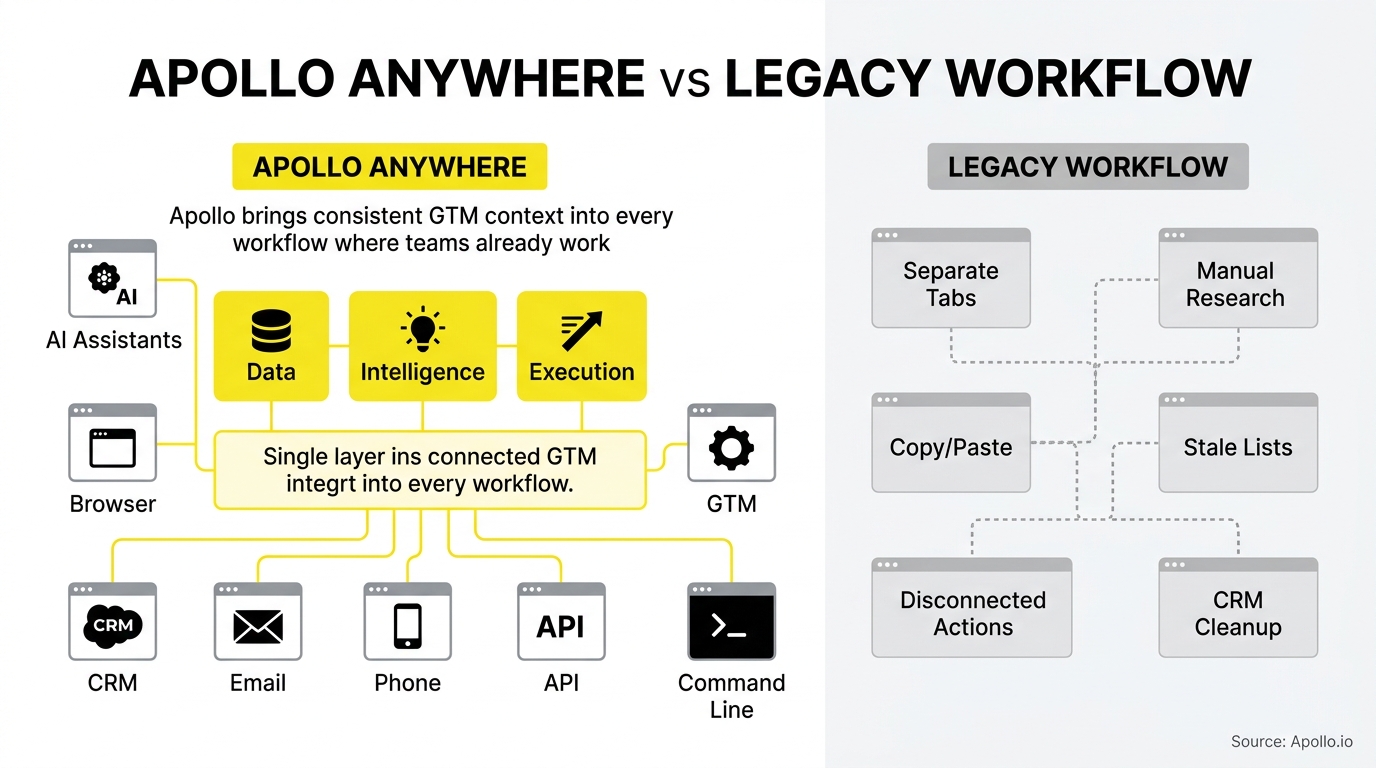
Apollo is an AI GTM system that unifies data, intelligence, and execution. It's built open by design, meeting sellers inside the tools they already use, from AI assistants like ChatGPT, Codex, Claude, and Perplexity via Apollo MCP, Apollo's Model Context Protocol, to the Chrome extension and Salesforce, rather than asking teams to switch contexts to get value. For technical and advanced users, Apollo CLI provides terminal-native access for headless GTM workflows.
Apollo's outbound capabilities span the full workflow: defining an ICP and letting AI Assistant find, research, and rank accounts and contacts; verifying emails and phones; and running multi-channel sequences across email, calls, and social with Power Dialer and Parallel Dialer for efficient calling. The AI Sequence Builder creates sequences from natural language, while Outbound Analytics dashboards and AI sentiment analysis close the loop with reporting. On the inbound side, Apollo captures website visitor data, enriches forms automatically, and routes leads through configurable routers with round-robin and criteria-based booking, backed by 65+ filters for precise lead targeting (per the Apollo Product Page). Data Enrichment runs through Waterfall Enrichment across multiple vendors, CRM Enrichment with bi-directional sync to Salesforce and HubSpot, and API Enrichment for bulk workflows. Contacts are continuously validated and refreshed by Apollo's Living Data Network rather than sitting static in a database. Apollo also connects to 50+ tools in its integrations marketplace, including Salesforce, HubSpot, Zoho CRM, Pipedrive, Outreach, and SalesLoft.
Pricing on annual billing starts with a Free plan at $0 with 900 credits/year and basic filters, then Basic at $49/user/month with 30,000 credits/year and unlimited sequences, Professional at $79/user/month adding a US dialer and automated workflows, and Organization at $119/user/month (minimum 3 users) with an international dialer, SSO, and advanced security. Full details are available on Apollo's pricing page.
According to Ramp's vendor data, drawn from real spend across thousands of businesses, Apollo holds the #1 new adopter rank in the Sales Data Providers category, capturing 31% of first-time buyers as of July 2026, and is the fastest-growing vendor in the category month over month (Ramp's vendor data). According to Ramp's vendor data, mid-market companies represent Apollo's largest customer segment by company size, and enterprise adoption climbed from 26% to 31% as of July 2026. Separately, Ramp's Sales Data Providers category data shows the category reached 16% overall adoption among software-buying businesses as of August 2026, with Apollo cited as the category's fastest-growing vendor.


Customers describe the impact of consolidating tools into Apollo directly. Kevin Warner, CEO at Leadium, said: "Apollo became the single source of truth for uswhere everything originates from and where all the data returns to." Collin Stewart, CEO at Predictable Revenue, noted: "We reduced the complexity of three tools into one," adding that his team is "getting higher reply rates, open rates are doubled, meetings are up, speed to book is cut in half." Mark Turner, VP of Revenue Operations at Built In, said: "Apollo enriches everything we have: contacts, leads, accounts...And we don't really have to touch it, it just works."
Apollo serves B2B GTM teams, GTM Engineers, and AI Builders building headless GTM workflows with the Apollo API, CLI, and MCP, alongside Sales Professionals, SDRs/BDRs, AEs, RevOps, Marketing, and Revenue Leaders. Apollo holds a 4.7/5 G2 rating and earned 624 badges in G2's Winter 2026 Report, plus the 2025 MarTech Breakthrough Award for "Best AI-Powered Sales Solution".
ZoomInfo

ZoomInfo is an AI-assisted go-to-market intelligence platform providing verified B2B contact data, company intelligence, and sales engagement tools. It helps organizations identify prospects, enrich CRM records, and track buying signals using AI-driven insights. Core features include AI-driven account prioritization, organizational chart intelligence, buying intent signals, and ZoomInfo Copilot for generative AI outreach personalization. The platform also offers Chorus for conversation intelligence and Chat for website engagement as part of its broader suite.
ZoomInfo's pricing is not publicly displayed on its official website; tiers like ZoomInfo Professional, Copilot Advanced, and Copilot Enterprise all require contacting sales. According to Vendr, the Median Avg Contract Value is $33,500, with Deals handled at 1,012, based on data from 1,570 purchases.
- Pros: Deep account intelligence with hierarchy and org chart data; intent signals covering hiring, funding, and technology changes; Copilot AI features for account summaries.
- Pros: Multiple product lines (Sales, Marketing, Talent) for teams needing broader GTM data coverage.
- Cons: Pricing requires contacting sales rather than transparent published rates.
- Cons: Credit-based usage model with overage fees when limits are exceeded.
Here's a detailed comparison of Apollo vs ZoomInfo.

Cognism

Cognism provides B2B data for pipeline generation, with an emphasis on phone-verified contact data and compliance for European and global markets. The platform combines sales intelligence, data enrichment, and Data-as-a-Service delivery. Cognism reports phone-verified mobile data with connect rates it states are up to 3x higher than standard data, alongside firmographic, technographic, and signal-based filtering, plus automatic suppression against Do-Not-Call and TPS lists.
Cognism's pricing is not publicly displayed on its official website. The two visible tiers, Standard and Pro, both require contacting sales and use a credit-based model where one credit is consumed per contact reveal. According to Vendr, the Median Avg Contract Value is $36,000, with Deals handled at 107, based on data from 108 purchases.
- Pros: Strong compliance positioning with GDPR and CCPA-focused data practices.
- Pros: Credits persist until a contact changes jobs, reducing repeat spend on stable contacts.
- Cons: No published pricing; all tiers require a sales conversation.
- Cons: Premium mobile data (Diamond Data) is priced separately from standard contact records.
Related reading:Apollo vs Cognism
Know Which Leads Are Sales-Ready With Apollo
Marketing hands off leads that stall before becoming real opportunities. Apollo scores and prioritizes prospects by buying signals, so reps chase deals that actually close. Built-In saw a 10% win rate lift using Apollo's scoring.
Start Free with Apollo →SalesLoft

SalesLoft is a Revenue Orchestration Platform built to help sales teams generate pipeline, prioritize actions, and close deals. It combines AI-assisted workflow automation, conversation intelligence, cadence management, and pipeline analytics. Features include Conductor AI and Rhythm for workflow automation, bi-directional CRM sync, and a Conversations module for call recording and transcription, all delivered as part of SalesLoft's platform.
SalesLoft's pricing is not publicly displayed on its official website. According to Vendr, list pricing spans Essentials ($75-$100/user/month), Advanced ($125-$150/user/month), and Premier ($165-$200+/user/month), typically with 10-15 user minimums and add-ons like Conversations and Rhythm priced as a percentage increase over base cost. The Median Avg Contract Value is $30,740, with Deals handled at 304, based on data from 704 purchases.
- Pros: Structured cadence automation paired with conversation intelligence in one suite.
- Pros: AI-driven next-best-action recommendations through Rhythm.
- Cons: Requires a 10-15 user minimum, which may not suit smaller teams.
- Cons: Add-on modules like Conversations and Deals increase cost significantly over base platform pricing.
Related reading:Apollo vs SalesLoft
Clay

Clay is a GTM orchestration platform combining data infrastructure, AI agents, and workflow automation. It pulls data from 200+ providers through waterfall enrichment, runs agentic workflows with Claygent AI for research tasks, and automates workflows spanning prospecting, CRM enrichment, and ad campaign syncing. Clay also tracks signals like job changes, promotions, and company news, and includes a native sequencer for outreach.
Clay's pricing is publicly displayed and structured around Actions (platform usage) and Data Credits (provider data costs). The Free tier includes 100 data credits and 500 actions per month at no cost. Launch starts at $167/month billed yearly (or $185/month billed monthly), and Growth starts at $446/month billed yearly (or $495/month billed monthly), with both offering additional usage tiers. Enterprise requires an annual commitment with requested pricing and a minimum of 100,000+ data credits and 200,000+ actions per month.
- Pros: Highly flexible data sourcing across 200+ third-party providers via waterfall enrichment.
- Pros: Transparent, published pricing with both monthly and annual options across all self-serve tiers.
- Cons: Usage-based Actions and Credits pricing can be complex to estimate for teams new to the platform.
- Cons: Requires configuration and setup time to build workflows compared to more turnkey tools.
Apollo vs Clay, here's everything you need to know.
Outreach

Outreach is a revenue orchestration platform for prospecting, deal management, forecasting, and account expansion, built around agentic AI. Outreach AI Agents work across every deal and account for every rep, with agents for personas like Research Agent, Deal Agent, and Revenue Agent. Additional features include Outreach Omni, a universal conversational agent, Agent Studio for deploying workflows, and AI-assisted forecasting with scenario planning.
Outreach's pricing is not publicly displayed on its official website. Tiers include Amplify Essentials (10,000 AI Credits), Amplify Core (25,000 AI Credits), Amplify Plus (50,000 AI Credits, most popular), and Amplify Pro (100,000 AI Credits), all requiring a sales request for pricing. According to Vendr, the Median Avg Contract Value is $45,600, with Deals handled at 545, based on data from 911 purchases.
- Pros: Combines seat-based and consumption-based pricing to scale AI usage independently of headcount.
- Pros: Persona-specific AI agents cover research, personalization, and forecasting in one suite.
- Cons: No published pricing; teams would contact their sales team for pricing details.
- Cons: AI credit consumption model requires monitoring usage to avoid needing additional credit packs.
Related:Apollo vs Outreach
Comparison Table
| Platform | Starting Price | Pricing Model | Key Strength |
|---|---|---|---|
| Apollo | $0 Free (900 credits/year); $49/user/month Basic | Per-seat + credits | Unified data, engagement, and dialer with AI-powered enrichment |
| ZoomInfo | Vendr: $33,500 median ACV | Per-seat + credits | Account intelligence and intent signals |
| Cognism | Vendr: $36,000 median ACV | Credit-based | Phone-verified mobile data, compliance |
| SalesLoft | Vendr: $30,740 median ACV | Per-seat + add-ons | Cadence automation and conversation intelligence |
| Clay | $0 Free; $167/mo Launch (annual) | Actions + data credits | Multi-provider data orchestration with AI agents |
| Outreach | Vendr: $45,600 median ACV | Per-seat + AI credits | Agentic AI for revenue orchestration |
| Kaspr (reference) | $0 Free; $49/user/month Starter (annual) | Per-seat + credits | LinkedIn contact enrichment via Chrome Extension |
How to Choose
Start with the workflow you need most. If your team wants sales intelligence, multi-channel engagement, a dialer, and AI-assisted enrichment together, Apollo's platform scope and Living Data Network approach to contact freshness cover that range without stitching together multiple vendors.
If your priority is deep account-level intelligence and intent signals for larger deal cycles, ZoomInfo's Copilot features are worth evaluating. Teams focused specifically on phone-verified mobile data and compliance in European markets often look closely at Cognism.
For teams centered on structured cadence execution and conversation intelligence, SalesLoft's orchestration tools are built for that use case. If your workflow depends on pulling and blending data from many third-party providers with custom AI research agents, Clay's orchestration model offers that flexibility.
And for teams already deep into agentic AI adoption for forecasting and account management, Outreach's Amplify tiers are designed around that need.
Whatever you choose, weigh total cost against what's included. Kaspr's Business tier costs $79/month per user (annual) with 2,400 phone credits per year, according to Kaspr's pricing page, while credit-based platforms like Cognism and ZoomInfo require contacting sales for exact figures. See Apollo's comparison of engagement platforms in Apollo vs Outreach vs SalesLoft for a deeper look at engagement-focused tools.
Frequently Asked Questions
What makes Apollo a strong Kaspr alternative?
As detailed in the Apollo section above, Apollo serves B2B GTM teams, GTM Engineers, and AI Builders building headless GTM workflows with the Apollo API, CLI, and MCP, alongside Sales Professionals, SDRs/BDRs, AEs, RevOps, Marketing, and Revenue Leaders. Its combination of prospecting, engagement, dialer, and enrichment in one workspace covers more of the sales workflow than a contact-lookup extension alone.
Is Apollo affordable for small teams?
Apollo offers a Free plan at $0/month with basic filters and limited credits, separate from the paid Basic tier at $49/user/month on annual billing, which adds unlimited sequences and CRM integrations. Teams can start free and upgrade as needs grow.
How does Kaspr's pricing compare to these alternatives?
Kaspr's Starter tier is $49/month per user and Business is $79/month per user on annual billing, per Kaspr's pricing page. Several alternatives above, like ZoomInfo, Cognism, SalesLoft, and Outreach, require contacting sales for pricing, as noted in the comparison table.
Which alternative is best for AI-driven workflows?
Apollo, Clay, and Outreach all lean heavily into AI-assisted workflows, but in different ways: Apollo combines AI research, sequence building, and call summaries within one system; Clay uses Claygent AI agents for research within its data orchestration model; and Outreach applies AI agents across forecasting and account management. The right fit depends on whether you need integrated execution or a more customizable orchestration layer.

Conclusion
Kaspr serves a specific need well: fast contact enrichment from LinkedIn profiles. But teams that need broader sales engagement, dialer capabilities, and AI-powered workflows often look toward platforms with more complete coverage.
Among the six alternatives covered here, Apollo stands out for combining sales intelligence, multi-channel outbound and inbound execution, a dialer, and data enrichment in one connected system, backed by transparent pricing starting at $49/user/month and a track record reflected in its G2 ratings and industry awards.
Whether you're an SDR looking to book more meetings, a RevOps leader consolidating your tech stack, or a GTM Engineer building automated workflows with the Apollo API and MCP, Apollo's platform scope is built to support the full go-to-market motion. Start Free with Apollo and see how it compares for your team's specific workflow.
Apollo Turns Pipeline Into Provable Revenue
Struggling to justify tool spend with vague pipeline metrics? Apollo replaces scattered outreach tools with one platform that shows exact deal impact. Leadium tripled annual revenue after consolidating with Apollo.
Start Free with Apollo →Don't miss these
Data
How to Structure a Marketing Team That Actually Drives Revenue in 2026
Data
Solving Data Synchronization Headaches Across Multiple Business Systems
Data
What Marketing Metrics Should B2B Teams Track in 2026?
See Apollo in action
We'd love to show how Apollo can help you sell better.
By submitting this form, you will receive information, tips, and promotions from Apollo. To learn more, see our Privacy Statement.
4.7/5 based on 9,690 reviews
