
How to Structure a Marketing Team That Actually Drives Revenue in 2026
The right marketing team structure is no longer about org charts. It's about aligning people, processes, and technology to drive measurable pipeline impact. Yet most B2B organizations still struggle: 85% of B2B marketers fail to connect content activity to business value, resulting in wasted budget and missed revenue opportunities.
This guide shows you how to build a lifecycle-driven marketing team structure that actually works—backed by data, customer examples, and actionable frameworks you can implement today.

Apollo Cuts Research Time From Hours To Seconds
Tired of spending 4+ hours daily hunting for contact info? Apollo delivers 224M verified contacts with 96% email accuracy instantly. Join 550K+ companies who stopped manual research.
Start Free with Apollo →Key Takeaways
- Centralize for efficiency: 60% of CMOs have centralized marketing functions to improve operational efficiency and reduce tech stack complexity.
- Structure by customer lifecycle: Align roles across ideation, creation, distribution, and optimization stages rather than traditional functional silos.
- Connect marketing to revenue: Implement pipeline-linked KPIs and attribution models to prove marketing's business impact.
- Integrate AI and data: Embed AI-enabled workflows and unified data architecture within your team structure to scale personalization and prospecting.
- Start small, scale smart: Use phased implementation based on company size, starting with core roles and expanding as you prove ROI.
Why Most Marketing Team Structures Fail
Traditional marketing org charts create functional silos that disconnect strategy from execution. Content teams don't talk to demand gen.
Demand gen doesn't align with sales. The result?
Fragmented campaigns, inconsistent messaging, and zero pipeline attribution.
According to Gartner research, 60% of CMOs have centralized some or all of their marketing functions to enhance operational efficiency. This shift reflects a broader trend: marketing teams must operate as unified revenue engines, not departmental silos.
The core problems with outdated structures:
- No lifecycle alignment: Roles aren't mapped to customer journey stages (awareness, consideration, decision, retention).
- Immature content operations: Less than 15% of B2B organizations have mature content operations, leading to inefficiencies and poor customer experiences.
- Disconnected metrics: Marketing tracks vanity metrics (impressions, clicks) instead of pipeline contribution and revenue attribution.
- Tech stack bloat: Teams use 10+ disconnected tools instead of one unified platform, creating data silos and workflow friction.
"Apollo could be a third of the cost if you look at the full price of what we were spending on ZoomInfo, Outreach, Salesforce, and admins to make it all work."

What Is a Lifecycle-Driven Marketing Team Structure?
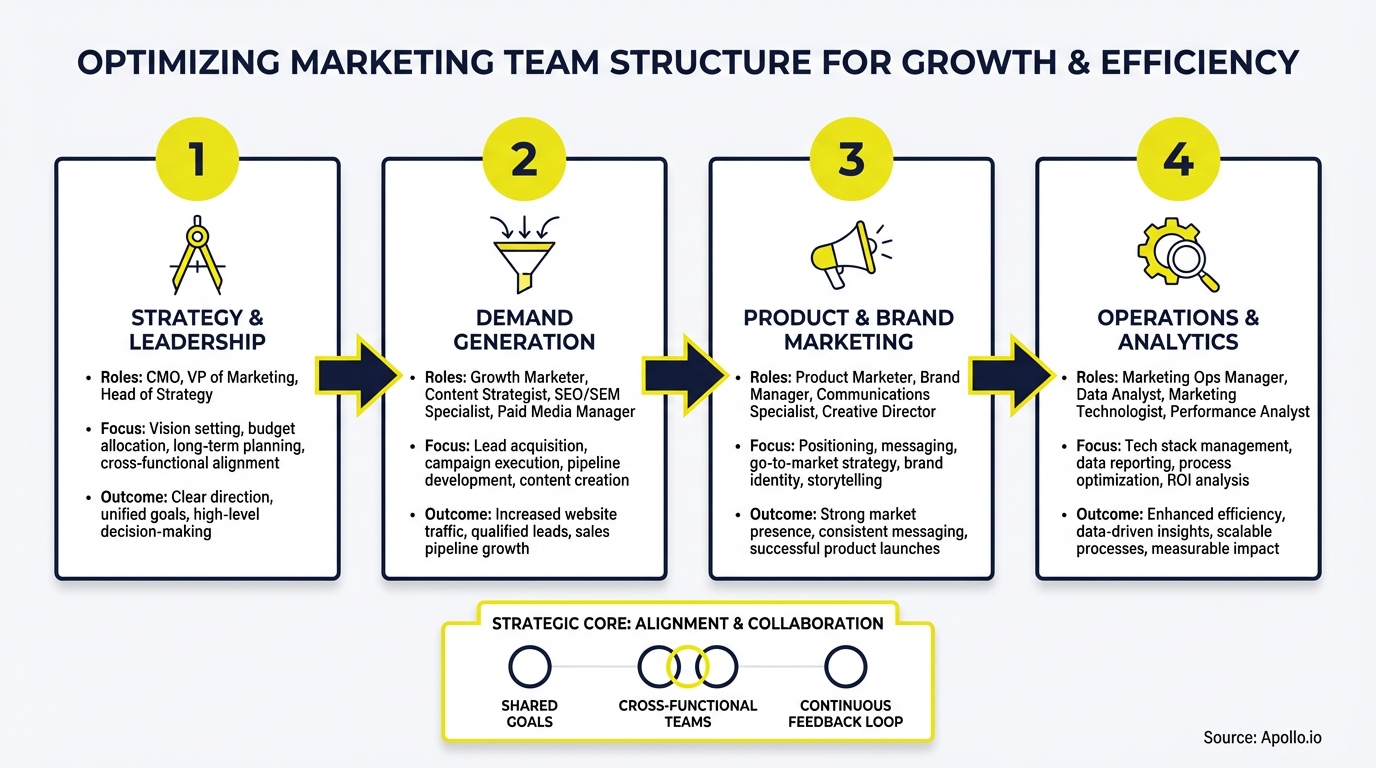
A lifecycle-driven structure organizes marketing roles around the customer journey, not traditional functions. Instead of separate content, demand gen, and ops teams working in isolation, you align roles across four core stages:
| Lifecycle Stage | Primary Goal | Key Roles | Core Activities |
|---|---|---|---|
| Ideation & Strategy | Define target accounts and messaging | CMO, Marketing Strategist, Market Research Analyst | ICP definition, competitive analysis, messaging frameworks |
| Content Creation | Produce high-value assets | Content Strategist, Copywriters, Designers, Video Producers | Blog posts, guides, case studies, videos, webinars |
| Distribution & Activation | Drive qualified pipeline | Demand Gen Manager, Email Marketer, Paid Media Specialist, ABM Lead | Campaign execution, email sequences, paid ads, ABM plays |
| Measurement & Optimization | Prove ROI and improve performance | Marketing Ops, Analytics Manager, RevOps | Attribution modeling, dashboards, A/B testing, tech stack management |
This structure ensures every role has clear ownership over specific customer journey outcomes, not just task completion. Marketing metrics become directly tied to pipeline and revenue, not vanity metrics.
Core Marketing Roles by Company Size
Your marketing team structure should scale with your company stage. Here's what actually works at each stage:
Startup (1-50 Employees): The Lean Core
- Marketing Generalist/Head of Marketing (1): Owns strategy, content, and demand gen. Wears all hats.
- Content Writer (1): Produces blog posts, case studies, and sales collateral.
- Demand Gen/Growth Marketer (1): Runs paid ads, email campaigns, and ABM plays.
Tech Stack: One unified platform like Apollo for prospecting, enrichment, and engagement instead of stitching together 5+ tools.
Growth Stage (51-200 Employees): Specialized Functions
- VP of Marketing (1): Sets strategy and owns revenue targets.
- Content Team (2-3): Content Strategist, 1-2 Writers/Designers.
- Demand Gen Team (2-3): Demand Gen Manager, Email Marketer, Paid Media Specialist.
- Marketing Ops (1): Manages tech stack, attribution, and reporting.
Focus: Build data-driven marketing processes that connect campaigns to pipeline.
Enterprise (200+ Employees): Full Lifecycle Coverage
- CMO (1): Owns revenue marketing strategy and board-level reporting.
- Content & Brand (5-8): Content Strategist, Writers, Designers, Video Producer, Brand Manager.
- Demand Generation (4-6): Demand Gen Director, Email Marketing Manager, Paid Media Manager, ABM Lead, Field Marketing Manager.
- Marketing Ops & Analytics (3-5): Marketing Ops Manager, Data Analyst, Marketing Technologist, RevOps Specialist.
- Product Marketing (2-3): Product Marketing Manager, Competitive Intelligence Analyst.
Focus: Implement advanced attribution models, AI-powered personalization, and RevOps alignment.
Turn Weak Leads Into Pipeline With Apollo
Marketing leads stalling before they reach sales. Apollo scores and routes qualified prospects automatically, boosting lead-to-opportunity conversion. Built-In increased win rates 10% with Apollo's intelligence.
Start Free with Apollo →How to Integrate AI and Data Analytics Into Your Marketing Structure
AI and data analytics aren't separate functions. They're embedded capabilities across every lifecycle stage. Here's how to structure for AI-enabled marketing:
| Function | AI/Data Integration | Tools & Governance |
|---|---|---|
| Ideation & Strategy | AI-powered market research, ICP refinement, predictive analytics | Apollo AI Research Agent, intent data platforms, governance: quarterly ICP reviews |
| Content Creation | AI content assistance, SEO optimization, personalization at scale | AI writing tools, content analytics, governance: brand voice guidelines, human review |
| Distribution & Activation | Automated sequences, AI-powered send-time optimization, dynamic content | Apollo Sales Engagement, email automation, governance: deliverability monitoring, compliance checks |
| Measurement & Optimization | Attribution modeling, predictive lead scoring, performance dashboards | Apollo Analytics, BI tools, governance: weekly performance reviews, monthly attribution audits |
Struggling to find qualified prospects for your campaigns? Search Apollo's 224M+ verified contacts with 65+ filters to build targeted lists in minutes, not hours.
"With this kind of AI system, my BDRs can send 10x more personalized emails. Their productivity and growth has skyrocketed."

Marketing Team Structure Best Practices for 2026
1. Align Marketing and Sales Under Unified Revenue Metrics
Stop measuring marketing in isolation. Implement shared KPIs: pipeline generated, revenue influenced, customer acquisition cost (CAC), and lifetime value (LTV). Use pipeline-linked marketing metrics that sales actually cares about.
2. Build Cross-Functional Workflows, Not Silos
Use RACI charts (Responsible, Accountable, Consulted, Informed) to clarify who owns what across campaign execution. Content shouldn't be created in a vacuum—demand gen, sales, and product marketing must collaborate from ideation to distribution.
3. Consolidate Your Tech Stack
Most marketing teams use 10+ tools that don't talk to each other. Consolidate to one unified platform for prospecting, enrichment, engagement, and analytics. This reduces costs, eliminates data silos, and speeds up execution.
4. Implement Content Operations Governance
Establish clear approval workflows, quality standards, and performance reviews. Define content calendars, editorial guidelines, and distribution playbooks. Schedule quarterly content audits to retire underperforming assets.
5. Use Data to Drive Every Decision
Invest in marketing ops and analytics talent. Build dashboards that show real-time campaign performance, attribution, and ROI. Run A/B tests on messaging, creative, and targeting to continuously improve.
Implementation Roadmap by Company Stage
Phase 1 (Months 1-3): Foundation
- Define ICP and buyer personas with sales alignment
- Hire core roles (Marketing Generalist or VP depending on stage)
- Select and implement unified GTM platform
- Establish baseline metrics and reporting cadence
Phase 2 (Months 4-6): Specialization
- Add specialized roles (Content, Demand Gen, or Ops based on gaps)
- Build content calendar and campaign playbooks
- Implement attribution modeling and pipeline tracking
- Launch first AI-powered campaigns (personalized sequences, predictive lead scoring)
Phase 3 (Months 7-12): Optimization
- Expand team based on proven ROI (ABM, Product Marketing, Field Marketing)
- Refine attribution models and optimize underperforming channels
- Scale AI workflows (automated research, dynamic content, predictive analytics)
- Conduct quarterly org design reviews and skill gap assessments
Common Mistakes to Avoid
Hiring for tasks, not outcomes: Don't hire a "social media manager." Hire a "demand gen marketer who drives pipeline through social channels." Define roles by business impact, not activity.
Ignoring content operations maturity: Content creation without governance, workflows, and measurement leads to wasted effort. Build the operational foundation first.
Delaying marketing ops investment: Marketing ops isn't overhead. It's the function that proves your team's value and enables data-driven decisions. Hire ops early.
Building silos between marketing and sales: Marketing and sales must share goals, systems, and data. Implement integrated B2B marketing strategies that align both teams from day one.
Start Building Your High-Performing Marketing Team
The right marketing team structure isn't about copying org charts from other companies. It's about aligning your people, processes, and technology to the customer lifecycle stages that drive revenue in your business.
Start with the core roles that map to your biggest gaps. Centralize your tech stack to eliminate data silos and workflow friction.
Implement lifecycle-driven workflows with clear ownership and accountability. Measure what matters: pipeline, revenue, and ROI.
Your marketing team should be a revenue engine, not a cost center. Build it that way from day one.
Ready to transform your marketing team's efficiency? Start your free Apollo trial and see how 550K+ companies use one unified platform to cut their tech stack, accelerate prospecting, and drive measurable pipeline impact.
Prove Apollo's ROI In Your First 30 Days
Budget approval stuck on unclear metrics? Apollo tracks every touchpoint from first contact to closed deal. Built-In increased win rates 10% and ACV 10% with measurable pipeline impact.
Start Free with Apollo →Don't miss these
Data
Solving Data Synchronization Headaches Across Multiple Business Systems
Data
What Marketing Metrics Should B2B Teams Track in 2026?
Data
How to Verify Email Addresses: The 2026 Deliverability Guide
See Apollo in action
We'd love to show how Apollo can help you sell better.
By submitting this form, you will receive information, tips, and promotions from Apollo. To learn more, see our Privacy Statement.
4.7/5 based on 9,690 reviews
