
7 Top Instantly Alternatives for Outbound Teams in 2026
Instantly built a loyal following among cold email practitioners by making deliverability infrastructure simple, unlimited mailboxes, automated warmup, and a clean sending interface. According to Instantly, its platform combines a lead database with AI agents for prospecting and reply handling. But as outbound teams mature, they often hit the ceiling: Instantly is primarily an email-sending tool, and when teams need integrated phone dialers, sales intelligence, CRM enrichment, intent signals, or AI-driven workflow automation across channels, they find themselves stitching together additional subscriptions.
If you're searching for Instantly alternatives, you're likely looking for broader coverage, a platform that goes beyond sending emails to managing the full outbound motion. This guide covers seven alternatives, starting with Apollo as the most complete option, followed by six other tools worth evaluating depending on your team's specific needs.

Research Less, Close More With Apollo
Tired of burning hours verifying emails and hunting down contact info? Apollo delivers 240M+ contacts with 98% email accuracy so your reps spend time selling, not searching. Start building pipeline today.
Start Free with Apollo →Key Takeaways
- Apollo: The most complete GTM platform, 240M+ contacts, built-in dialer, AI sequencing, data enrichment, and inbound routing in one connected system.
- Lemlist: Multichannel outreach (email, LinkedIn, SMS, WhatsApp, calls) with a pay-as-you-go credit model for lead finding and intent signals.
- Smartlead: Cold email infrastructure focused on deliverability, with unlimited mailboxes and tiered volume plans suited to agencies.
- Mailshake: Straightforward email and phone outreach with a built-in power dialer and simple per-account pricing.
- Mailmeteor: Gmail and Google Sheets mail merge tool for individuals and small teams needing lightweight personalized sending.
- ActiveCampaign: Marketing automation platform with email, SMS, and WhatsApp capabilities scaled by contact count.
- AWeber: Email marketing tool for small businesses and creators; pricing not publicly displayed on their website.
Apollo

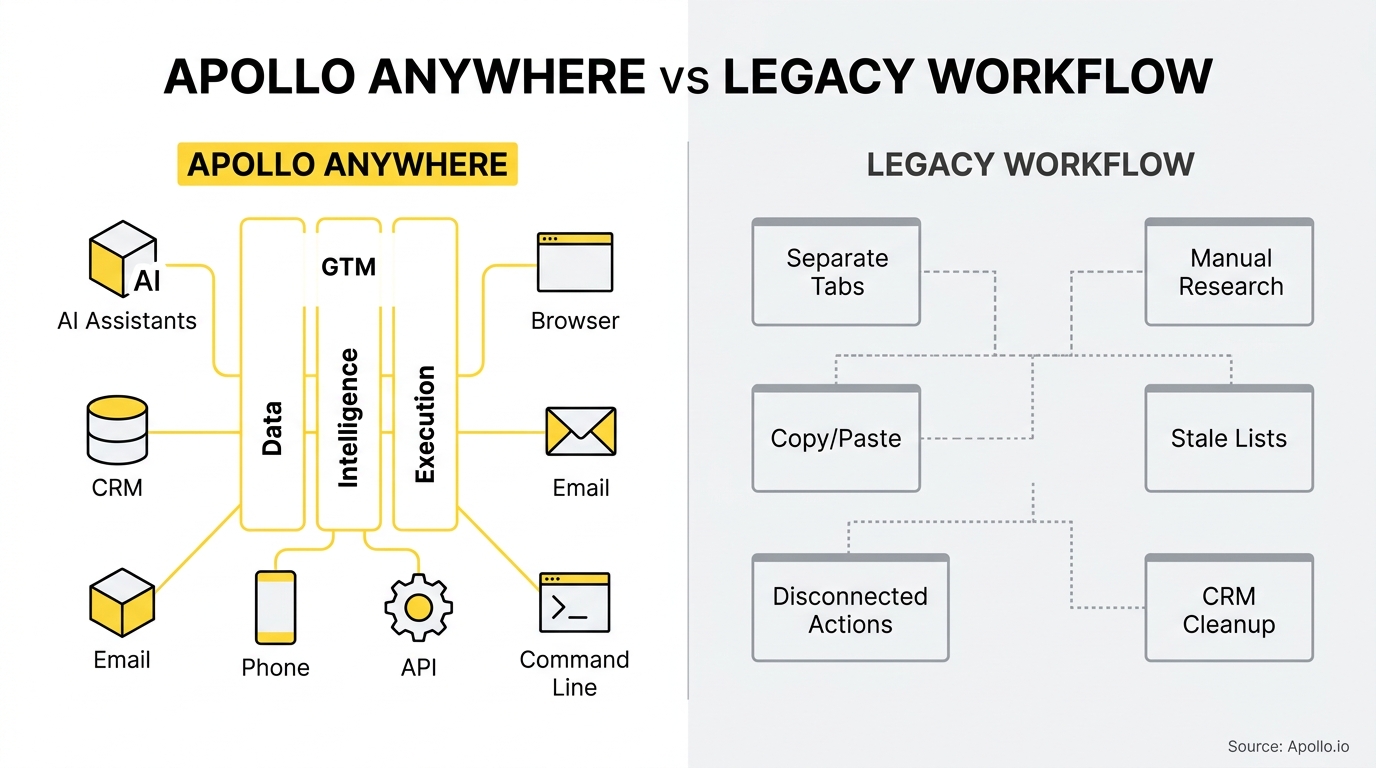
Apollo is an AI sales platform that unifies data, intelligence, and execution into one connected GTM system. Where Instantly focuses on cold email sending, Apollo covers the entire outbound and inbound motion, from prospecting and enrichment through sequencing, calling, and CRM sync, without requiring teams to manage separate tools for each function.
Apollo's database includes 240M+ people and 30M+ companies, continuously validated through Apollo's Living Data Network rather than a static export. With 65+ search filters, teams can build precisely targeted lead lists, score them with AI, and push them directly into multi-channel sequences covering email, phone, and social outreach. The AI Sequence Builder creates sequences from natural language prompts, while the Power Dialer and Parallel Dialer eliminate manual calling overhead. AI-generated call scripts, auto-logged outcomes, and voicemail drop are included.
On the inbound side, Apollo identifies website visitors, shortens and enriches forms, routes leads with round-robin or criteria-based logic, and triggers owner-led nurture sequences on form submission, capabilities that go well beyond anything Instantly offers.
Apollo serves B2B GTM teams, GTM Engineers, and AI Builders building headless GTM workflows with the Apollo API, CLI, and MCP, alongside Sales Professionals, SDRs/BDRs, AEs, RevOps, Marketing, and Revenue Leaders. Technical users can access Apollo natively through AI assistants like ChatGPT, Codex, Claude, and Perplexity via Apollo MCP, or run terminal-native headless GTM workflows using the Apollo CLI. The Chrome extension supports prospecting across the web.
Pricing(annual billing): Free, $0 with 900 credits/year and basic sequences; Basic, $49/user/month with 30,000 credits/year, unlimited sequences, and CRM integrations; Professional, $79/user/month with 48,000 credits/year, US dialer, 5 mailboxes, and AI research; Organization, $119/user/month (min. 3 users) with 72,000 credits/year, international dialer, 15 mailboxes, and SSO. Full details at apollo.io/pricing.
Apollo holds a 4.7/5 G2 rating and was named the 2026 MarTech Breakthrough Award Winner for "Best AI-Powered Sales Solution".
Real teams describe the impact:
"Apollo became the single source of truth for us, where everything originates from and where all the data returns to.", Kevin Warner, CEO at Leadium
According to Ramp's vendor data, Apollo held a 39% adoption rate in the Sales Data Providers category as of August 2026, up 5 percentage points year-over-year, with a 22% competitor switch rate, indicating teams are actively moving to Apollo from other vendors. Apollo also ranks #1 for new adopter capture, meaning it is the first choice for teams entering the category for the first time.
At the category level, Ramp's Sales Data Providers category data shows Apollo as the fastest-growing vendor in the segment as of August 2026, averaging +0.6 percentage points of adoption growth per month, more than triple the growth rate of the next fastest-growing alternative in the category.
Lemlist

Lemlist is a sales engagement platform that covers multichannel outreach including email, LinkedIn automation, SMS, WhatsApp, and built-in calling. According to Lemlist, its database contains 650M+ leads. The lemAgent AI handles lead enrichment and intent signal tracking, and a Deliverability Hub with automated warmup (lemwarm) helps maintain inbox placement.
The unified inbox consolidates replies across all channels, and CRM integrations with HubSpot, Salesforce, and Pipedrive are included. Lemlist also offers an MCP integration for users building AI-assisted workflows.
Pricing (from lemlist.com/pricing): Email plan at $55/user/month (billed yearly) covers unlimited users with a 50,000 email/month quota. Multichannel plan at $87/user/month (billed yearly) adds LinkedIn, SMS, and calling with 5 senders per user. Enterprise pricing is custom. Credits for email/phone finding and intent signals are pay-as-you-go at $0.01 per credit.
Pros:
- True multichannel: Covers email, LinkedIn, SMS, WhatsApp, and calls within one sequence workflow.
- Transparent credit pricing: Pay-as-you-go at $0.01/credit gives teams control over enrichment spend.
- Unlimited users on Email plan: The base tier doesn't add per-seat costs for large teams sending only email.
Cons:
- Limited sales intelligence depth: Prospecting filters and data coverage are less extensive than dedicated sales intelligence platforms.
- No built-in dialer on base plan: The call dialer requires the Multichannel plan, raising per-user costs.
- Intent signal costs can scale quickly: LinkedIn engagement signals run from 400 credits ($4.00+) per signal, which adds up at volume.
Related reading:Apollo vs Lemlist
Smartlead

Smartlead is a cold email outreach platform built around deliverability infrastructure. It offers unlimited mailboxes and lead storage with no storage fees, handling DNS configuration, SPF/DKIM/DMARC, warmup, and sender rotation automatically. A Master Inbox consolidates campaign replies, and AI agents handle prospecting, email writing, CRM updates, and deliverability optimization.
Smartlead is structured around email volume tiers, making it well-suited for agencies running high-volume cold email programs across multiple client workspaces.
Pricing (from smartlead.ai/pricing): Base at $32/month (billed yearly) covers 6,000 email sends and 2,000 contacts/month. Pro at $78/month covers 90,000 sends and 30,000 contacts. Unlimited Smart at $144/month (most popular) covers 150,000 sends and 50,000 contacts. Unlimited Prime at $315/month covers 500,000 sends and 170,000 contacts. Whitelabeling available as an add-on at $29/month per client workspace.
Pros:
- Volume-friendly pricing: High email send limits at lower price points than many alternatives.
- Agency infrastructure: Client workspace whitelabeling and multi-provider support make it practical for agencies.
- Automated deliverability management: DNS setup, warmup, and sender rotation handled automatically.
Cons:
- Email-only execution: No built-in multichannel sequences for LinkedIn, SMS, or calls.
- No native sales intelligence database: Lead sourcing requires external tools or CSV imports.
- Limited CRM depth: CRM update capabilities are basic compared to platforms built for full sales cycle management.
Apollo vs Smartlead, a closer look at the differences.
Mailshake

Mailshake is an email automation and sales engagement platform that combines cold email sequences with a power phone dialer and social outreach tasks. It focuses on deliverability with built-in warmup, domain setup assistance, and list cleaning. AI email writing is available through SHAKESpeare, and A/B testing is included across all plans.
The Sales Engagement plan includes five phone numbers with unlimited free dialer minutes to North American numbers, along with phone scripts and Lead Catcher to surface the most engaged prospects.
Pricing (from mailshake.com/pricing): Starter at $25/month (billed yearly) is capped at 1,500 email sends/month. Email Outreach at $45/month (billed yearly) offers unlimited sends. Sales Engagement at $85/month (billed yearly) adds the power dialer and phone features. Agency Plan pricing requires contacting sales.
Pros:
- Accessible entry pricing: Starter at $25/month suits individuals testing outreach without large budgets.
- Built-in power dialer: Sales Engagement plan includes unlimited North American calling minutes.
- Simple onboarding: Includes a 1-on-1 onboarding call on the Sales Engagement tier.
Cons:
- No native prospecting database: The Data Finder add-on costs extra and provides limited credits on most plans.
- Starter email cap: 1,500 sends/month is restrictive for teams running active outreach programs.
- Limited automation depth: Workflow automation is less extensive than full sales engagement platforms.
Explore the Apollo vs Mailshake breakdown.
Turn Funnel Guesswork Into Real Pipeline
Pipeline forecasting a guessing game because leads stall before they ever become opportunities? Apollo surfaces in-market buyers with precision targeting so your funnel fills with prospects that actually convert. Nearly 5M users stopped guessing — start closing.
Start Free with Apollo →Mailmeteor

Mailmeteor is a mail merge and email outreach platform that integrates directly with Gmail, Outlook, and Google Sheets. It helps users send personalized email campaigns, track engagement, and manage replies with AI assistance. The platform includes email verification, automated follow-up sequences, and email warmup for deliverability improvement. Inbox rotation is available on the Professional plan.
Mailmeteor is positioned for individuals, recruiters, and small teams who prefer to work from within Gmail or Sheets rather than adopting a standalone sales tool.
Pricing (from mailmeteor.com/pricing): Hobby plan is free with 500 emails/month. Starter at $5.99/user/month covers 5,000 emails/month. Premium (recommended) at $15.99/user/month covers 30,000 emails/month and adds warmup and follow-ups. Professional at $35.99/user/month covers 60,000 emails/month with inbox rotation and team analytics. Yearly billing provides two months free. Enterprise pricing requires contacting sales.
Pros:
- Gmail-native workflow: Works directly inside Gmail and Google Sheets, reducing context switching for teams already in Google Workspace.
- Affordable entry point: Free tier and sub-$6/month Starter plan suit individuals with low-volume needs.
- Simple setup: Minimal onboarding required for basic mail merge use cases.
Cons:
- No multichannel outreach: Limited to email; no LinkedIn automation, calling, or SMS.
- Limited sales intelligence: No built-in B2B database or CRM-level prospecting capabilities.
- Volume ceilings: Even the Professional plan caps at 60,000 emails/month, which may constrain high-volume outbound teams.
Get a full breakdown of how Apollo compares to Mailmeteor.
ActiveCampaign

ActiveCampaign is a marketing automation platform powered by its Active Intelligence 2.8 system. It covers email marketing, marketing automation, CRM capabilities, and multi-channel engagement including SMS and WhatsApp, with 1,000+ app integrations. Pricing scales by contact count rather than per seat, making it cost-predictable for teams with large contact databases.
ActiveCampaign is primarily oriented toward marketing workflows and customer journey automation rather than SDR-style cold outbound sequences.
Pricing (from activecampaign.com/pricing): Starter from $15/month (billed annually, 1 user, 1,000 contacts). Plus from $49/month (1 user). Pro from $79/month (3 users). Enterprise from $145/month (5 users). Prices increase with contact count. An Enhanced CRM add-on with sales engagement capabilities is available at additional cost.
Pros:
- Contact-based pricing: Predictable costs for teams with large existing contact lists.
- Marketing automation depth: Extensive automation builder with 1,000+ integrations for complex nurture workflows.
- Multi-channel marketing: Email, SMS, and WhatsApp engagement managed within one platform.
Cons:
- Not built for cold outbound: Lacks the cold prospecting database and SDR-specific sequence tools that outbound teams need.
- Sales engagement is an add-on: CRM pipelines and sales engagement features require an additional purchase.
- Per-contact scaling: Costs rise significantly as contact lists grow beyond base tiers.
Thinking about ActiveCampaign? See how Apollo stacks up.

AWeber

AWeber is an email marketing platform serving small businesses and content creators. It provides email automation, subscriber management, landing pages, and basic analytics. AWeber is one of the longer-standing email marketing tools and is generally used for newsletter-style and relationship email programs rather than cold B2B outbound sequences.
Pricing: AWeber's pricing is not publicly displayed on their website. Contact AWeber directly for current pricing details.
Pros:
- Established platform: Long track record with extensive help documentation and support resources.
- Creator-friendly features: Landing pages, sign-up forms, and newsletter tools built for audience-building use cases.
- Broad integration support: Connects with a wide range of third-party tools popular with small business owners.
Cons:
- Not designed for B2B cold outreach: Lacks prospecting databases, intent signals, or SDR-style sequencing.
- No multichannel execution: Email-only; no dialer, LinkedIn automation, or SMS capabilities.
- Pricing opacity: Without public pricing, teams cannot self-evaluate fit without a sales conversation.
Explore the Apollo vs AWeber breakdown.
Comparison Table
| Platform | Starting Price | Sales Intelligence Database | Multichannel Outreach | Built-in Dialer | AI Features | Free Tier |
|---|---|---|---|---|---|---|
| Instantly (subject) | $85/mo (yearly, bundle) | 450M+ leads (self-reported) | Email only | No | AI Sales Agent, AI Reply Agent | No |
| Apollo | $49/user/mo (yearly) | 240M+ people, 30M+ companies (98% email accuracy) | Email, phone, social | Yes (Power + Parallel) | AI Sequence Builder, AI Research, AI Dialer | Yes (900 credits/year) |
| Lemlist | $55/user/mo (yearly) | 650M+ leads (self-reported) | Email, LinkedIn, SMS, WhatsApp, calls | Yes (Multichannel plan) | lemAgent AI, intent signals | 14-day trial |
| Smartlead | $32/mo (yearly) | None native | Email only | No | AI email writing, deliverability AI | Free trial (no CC) |
| Mailshake | $25/user/mo (yearly) | Data Finder add-on (+$17/mo) | Email, phone, social tasks | Yes (Sales Engagement plan) | SHAKESpeare AI email writer | No |
| Mailmeteor | Free / $5.99/user/mo | None native | Email only | No | AI email writer, AI reply assistant | Yes (500 emails/mo) |
| ActiveCampaign | $15/mo (yearly, 1K contacts) | None native | Email, SMS, WhatsApp | No | Active Intelligence 2.8 automation | 14-day trial |
| AWeber | Not publicly displayed | None native | Email only | No | Basic automation | Not confirmed |
How to Choose the Right Instantly Alternative
The right tool depends on where your outbound motion breaks down with Instantly today.
- If you need sales intelligence alongside outreach: Apollo's Living Data Network and 65+ search filters let you find, enrich, and sequence contacts without switching tools. This eliminates the gap Instantly leaves when teams need verified contact data built into their workflow. Explore Apollo's lead generation capabilities for more context.
- If you run multichannel sequences: Lemlist covers email, LinkedIn, SMS, WhatsApp, and calls in a single campaign, making it a practical upgrade from email-only sending. Apollo also covers these channels and adds a native dialer with AI call scripts.
- If your primary concern is cold email deliverability at scale: Smartlead's volume-based plans and automated DNS/warmup infrastructure are built for agencies and high-volume senders who need sending reliability above all else.
- If you want to add phone calling without a complex platform switch: Mailshake's Sales Engagement plan includes a power dialer and unlimited North American calling minutes at $85/month, a straightforward step up from email-only tools.
- If your team works entirely inside Gmail: Mailmeteor offers a frictionless mail merge experience without leaving Google Workspace, suited to individuals and small teams with simple outreach needs.
- If you're running marketing automation rather than cold outbound: ActiveCampaign's contact-based pricing and automation depth make it a better fit for nurture and lifecycle email programs than for SDR-led prospecting.
- If you're a full GTM team, from SDRs and AEs to RevOps and AI Builders: Apollo's scope, from the AI sales automation layer through CRM integrations and headless API access, covers needs that no other tool on this list matches end-to-end.
Frequently Asked Questions
What is the main limitation of Instantly for growing sales teams?
Instantly is built primarily for cold email sending and deliverability management. Teams that grow beyond email-only outreach commonly find that they need a separate tool for contact data sourcing, a separate dialer for phone calls, and additional integrations for CRM enrichment, adding cost and complexity.
The alternatives on this list address those gaps to varying degrees, with Apollo covering the broadest set of outbound and inbound use cases.
Does Apollo have a free plan?
Yes. Apollo's free tier provides access to the platform with 900 credits per year, basic sequences, and core search filters, no credit card required.
Paid plans start at $49/user/month as detailed in the Apollo section above.
Which Instantly alternative is best for agencies managing multiple client campaigns?
Smartlead is structured specifically for agency use, with client workspace whitelabeling available as an add-on and high-volume email send limits at relatively low price points. Lemlist also supports multiple campaign types and multichannel outreach. For agencies that also need to source and enrich their own lead lists, Apollo's data enrichment and data enrichment services provide an integrated alternative.
What should I look for when evaluating cold email alternatives to Instantly?
Consider four factors: (1) whether the platform includes a native B2B contact database or requires importing your own lists; (2) whether it supports outreach channels beyond email; (3) how enrichment and data accuracy are handled; and (4) whether your CRM integrations are native or require additional connectors. Tools that cover all four, like Apollo, reduce the number of subscriptions your team manages and keep data in sync automatically. For a deeper look at outbound strategy, Apollo's cold email best practices guide covers sequencing and deliverability fundamentals.

Conclusion
Instantly works well for teams that want a dedicated cold email sending engine. But the most common reason teams seek alternatives is that email alone is no longer enough, they need verified contact data, multi-channel sequencing, calling, and CRM sync without managing four separate tools.
Among the seven alternatives evaluated here, Apollo is the most complete solution: it brings together sales intelligence, AI-powered outreach, a built-in dialer, inbound routing, and data enrichment in one connected platform, at a starting price that competes directly with standalone email tools.
Whether you're an SDR looking to hit quota faster, a RevOps leader consolidating your tech stack, or a GTM Engineer building headless workflows via API, Apollo is built for your use case. Start Free with Apollo and see why it's the fastest-growing sales data platform on the market.
Prove Pipeline ROI With Apollo
ROI pressure killing your tool budget? Apollo delivers measurable pipeline impact from day one — teams like Leadium 3x'd annual revenue. Start your free trial and show leadership real numbers fast.
Start Free with Apollo →Don't miss these
Sales
Inbound vs Outbound Marketing: Which Strategy Wins?
Sales
What Is a Sales Funnel? The Non-Linear Revenue Framework for 2026
Sales
What Is a Go-to-Market Strategy? The 2026 GTM Playbook
See Apollo in action
We'd love to show how Apollo can help you sell better.
By submitting this form, you will receive information, tips, and promotions from Apollo. To learn more, see our Privacy Statement.
4.7/5 based on 9,690 reviews
