
Apollo vs Mailmeteor (2026): Features, Pricing & Best Use Cases
Choosing between Apollo and Mailmeteor comes down to one fundamental question: do you need a platform to send email campaigns, or a platform to find, research, and engage the right prospects across every channel? Both tools touch email outreach, but they serve meaningfully different GTM workflows.
This comparison breaks down what each platform actually does, what it costs, and which fits your team's goals in 2026.

Research Less. Pipeline More With Apollo.
Tired of your reps burning hours verifying contact info instead of selling? Apollo delivers 98% email accuracy across 240M+ contacts so your team hits the phones faster. Start building pipeline today.
Start Free with Apollo →Key Takeaways
- Platform Scope: Apollo is an AI GTM system covering prospecting, data enrichment, sequencing, and dialing in one connected GTM system. Mailmeteor focuses on personalized email campaigns sent directly from Gmail, Outlook, Google Sheets, or Excel.
- B2B Database: Apollo includes a built-in database of 240M+ people and 30M+ companies so teams can find and contact prospects without a separate data source. Mailmeteor does not include a B2B contact database.
- Audience: Apollo serves B2B GTM teams, GTM Engineers, and AI Builders building headless GTM workflows with the Apollo API, CLI, and MCP, alongside Sales Professionals, SDRs/BDRs, AEs, RevOps, Marketing, and Revenue Leaders. Mailmeteor targets individual senders, sales teams, marketers, and recruiters who primarily work in Gmail or Outlook.
- AI Capabilities: Apollo includes AI for research, lead scoring, sequence creation, call summaries, and inbound routing. Mailmeteor includes an AI email assistant for drafting and organizing conversations.
- Pricing Model: Apollo starts at $49/user/month (annual billing) with a free tier. Mailmeteor starts at $5.99/user/month (monthly billing) with a free Hobby tier.
What is Apollo?

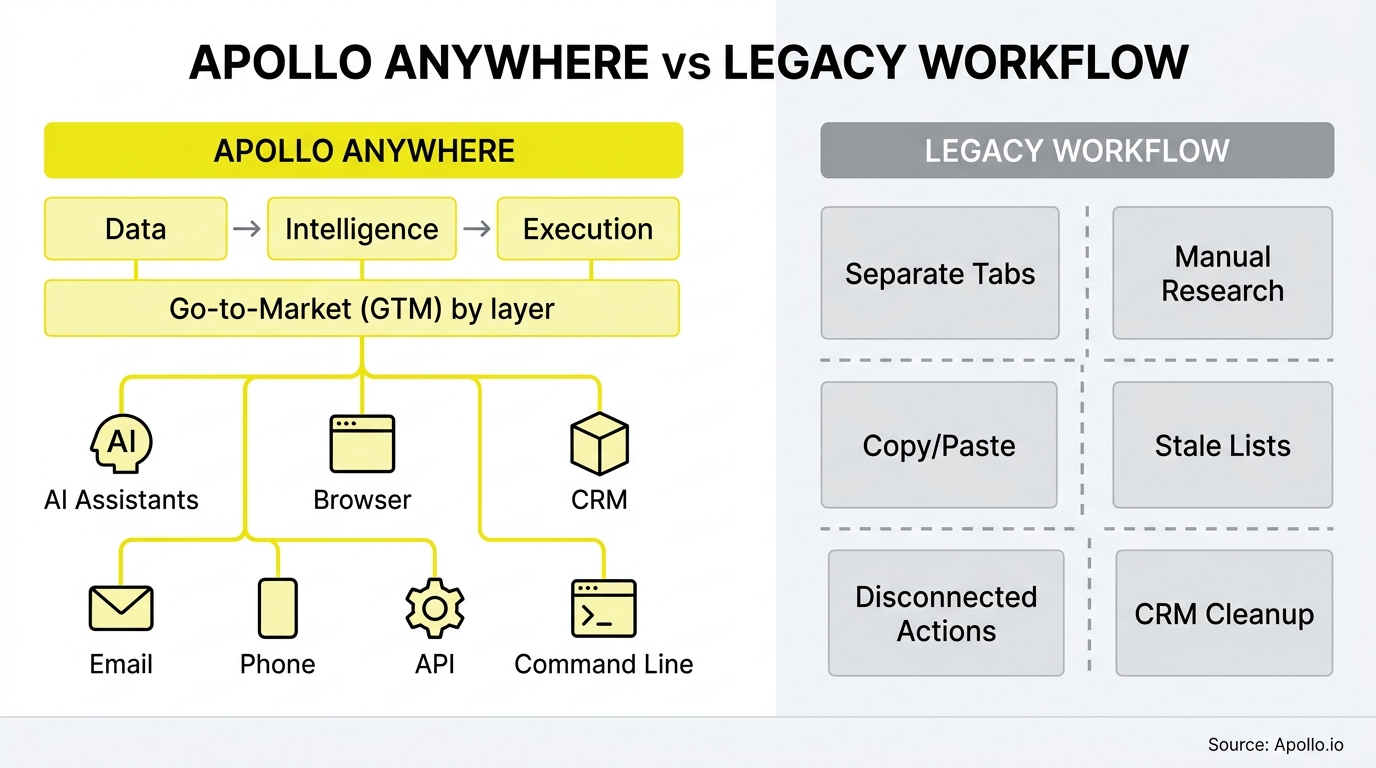
Apollo is an AI GTM system that unifies data, intelligence, and execution into one connected GTM system, built open by design so teams can act on signals wherever they already work. The platform covers prospecting from a built-in B2B database, multi-channel sequencing, power and parallel dialing, inbound routing, data enrichment, and outbound analytics, removing the need to stitch together separate tools for each stage of the pipeline-building workflow.
Apollo serves B2B GTM teams, GTM Engineers, and AI Builders building headless GTM workflows with the Apollo API, CLI, and MCP, alongside Sales Professionals, SDRs/BDRs, AEs, RevOps, Marketing, and Revenue Leaders. It is trusted by 100K+ paying customers across 600K+ companies, including 100+ teams at Fortune 500 companies.
Apollo meets sellers inside the tools they already use. Apollo MCP, Apollo's Model Context Protocol, connects Apollo's data and workflows directly into AI assistants including ChatGPT, Codex, Claude, and Perplexity, so reps and GTM engineers can run prospecting queries without switching contexts. The Chrome extension extends Apollo's prospecting capabilities across the web. For technical and advanced users, Apollo CLI provides terminal-native access for headless GTM workflows and pipeline automation at scale.
According to Ramp's vendor data, Apollo holds a 38% adoption rate among businesses purchasing sales data provider software as of July 2026, up 5 percentage points year-over-year, reflecting consistent expansion across SMB, mid-market, and enterprise segments.

Apollo offers transparent pricing starting at $49/user/month (annual billing), with a free tier available. Full tier details are in the Pricing Comparison section below.
What is Mailmeteor?

Mailmeteor is an email marketing and outreach platform that integrates with Gmail, Outlook, Google Sheets, and Excel to enable users to send personalized email campaigns at scale.
It is designed for individuals and teams who prefer to run outreach directly from their existing inbox environment without migrating to a standalone sales engagement tool.
Core capabilities include email tracking for opens and clicks, automated follow-ups, Autopilot mode for optimized sending times, email warm-up, deliverability protection, and an AI email assistant for drafting replies and organizing conversations.
The platform also includes email finder, verifier, and lookup tools, plus shared templates and team tracking reports for collaborative campaigns.
Mailmeteor integrates with Google Workspace, Microsoft Outlook, Zoho, Salesforce, and HubSpot. It is designed to operate with minimal permissions and is built with GDPR and CCPA compliance in mind.
The platform is suited to sales teams, marketers, and recruiters who need to send personalized outreach at volume from a familiar inbox interface. It does not include a built-in B2B prospect database, so users bring their own contact lists.
Sequencing is handled through follow-up automation tied to email campaigns, and there is no native calling or dialing capability.
Mailmeteor offers four tiers. The free Hobby plan allows up to 500 emails per month with a 50-emails-per-day limit.
Paid plans start at $5.99/user/month (monthly billing) or $4.99/user/month (annual billing) on the Starter tier, rising to $35.99/user/month (monthly) or $29.99/user/month (annual) on the Professional tier. Annual plans include two months free, equivalent to a roughly 17% discount.
Full pricing details are covered in the Pricing Comparison section.
Feature Comparison
| Feature | Apollo | Mailmeteor |
|---|---|---|
| Starting Price | $49/user/month (annual billing); free tier available | $5.99/user/month (monthly billing); free Hobby tier available |
| B2B Database | 240M+ people, 30M+ companies | Not included; users supply their own contact lists |
| Email Accuracy | 98% email accuracy | Email verifier included; no published accuracy rate |
| Sequences | Multi-channel (email, phone, social, tasks); AI Sequence Builder | Email follow-up automation; no multi-channel sequencing |
| Dialer | Power Dialer and Parallel Dialer with AI call summaries | Not available |
| AI Capabilities | AI research agent, lead scoring, sequence builder, call summaries, inbound routing | AI email assistant for drafting and organizing conversations |
| Data Enrichment | Waterfall enrichment, CRM enrichment, CSV and API enrichment with 65+ data attributes | Email finder and verifier included; no CRM enrichment |
| Free Trial | Free tier with 900 credits/year | Free Hobby tier with 500 emails/month |
The two platforms occupy different positions in a sales team's stack. Mailmeteor is built around the inbox experience, offering a straightforward path to personalized email campaigns for users who already have a contact list and want to stay inside Gmail or Outlook.
Apollo covers the full prospecting-to-pipeline workflow: finding contacts, verifying data, running coordinated multi-channel sequences, calling prospects, and enriching CRM records, all from one platform. Teams evaluating both tools should consider whether email-only outreach meets their pipeline targets, or whether they need contact data, calling, and enrichment alongside email execution.

Pricing Comparison
Apollo's full pricing tiers are available at apollo.io/pricing(all prices reflect annual billing):
- Free: $0, 900 credits/year (75 per month), 2 sequences, basic filters
- Basic: $49/user/month, 30,000 credits/year, unlimited sequences, CRM integrations, 6 intent topics
- Professional: $79/user/month, 48,000 credits/year, US dialer, 5 mailboxes, automated workflows, AI research
- Organization: $119/user/month (minimum 3 users), 72,000 credits/year, international dialer, 15 mailboxes, SSO, advanced security
Mailmeteor's pricing tiers from mailmeteor.com/pricing:
- Hobby (Free): 500 emails/month, 50 emails/day, 3 campaigns, 5,000 contacts
- Starter: $5.99/user/month (monthly) or $4.99/user/month (annual), 5,000 emails/month, 250 emails/day, 50,000 contacts
- Premium: $15.99/user/month (monthly) or $13.33/user/month (annual), 30,000 emails/month, 1,000 emails/day, 5 senders, 500,000 contacts
- Professional: $35.99/user/month (monthly) or $29.99/user/month (annual), 60,000 emails/month, 2,000 emails/day, 10 senders, 1,000,000 contacts, inbox rotation
Mailmeteor's entry-level price point is lower on a per-seat basis. However, the comparison shifts when considering what each platform includes.
Apollo's Basic plan includes a built-in B2B contact database with 30,000 data credits per year, CRM integrations, intent signals, and unlimited sequences. Mailmeteor's equivalent tiers cover email volume and deliverability tooling for contacts a team already possesses.
Teams that need to build a contact list before sending would need a separate data source alongside Mailmeteor, while Apollo includes both prospecting data and email execution in one subscription.
Turn Funnel Guesswork Into Pipeline Wins
Tired of watching marketing leads stall before they ever reach your pipeline? Apollo surfaces in-market buyers the moment they're ready, so your team stops chasing cold leads and starts closing. Nearly 5M users trust Apollo to fill their funnel with quality.
Start Free with Apollo →How Apollo Differs from Mailmeteor
The clearest functional difference is scope. Mailmeteor is an email sending tool. Apollo is an AI GTM system that handles contact discovery, data enrichment, multi-channel sequencing, calling, inbound routing, and CRM hygiene in a single connected workflow. For a team evaluating cold email alongside other outbound channels, Apollo eliminates the need to maintain a separate database, a separate dialer, and a separate enrichment service.
On the data side, Apollo provides 98% email accuracy across its database. Its sales engagement tools include sender warm-up, reputation monitoring, and deliverability guardrails built directly into sequences, so teams are not managing inbox health in one tool and sending in another. Apollo's AI Research Agent surfaces context on each prospect before a rep reaches out, and the AI Sequence Builder creates full outreach sequences from natural language input, reducing manual setup time.
Apollo also supports inbound conversion workflows that Mailmeteor does not cover: website visitor identification, form enrichment, inbound routing with round-robin and criteria-based booking, and owner-led nurture sequences triggered automatically on form submission. For teams running both inbound and outbound motions, Apollo handles both within the same platform.
According to Ramp's Sales Data Providers category data, Apollo is the fastest-growing vendor in the Sales Data Providers category as of July 2026, averaging +0.7 percentage points of adoption growth per month. That growth reflects teams actively consolidating their data and engagement tooling rather than running separate point solutions.

For teams already seeing results from email-only outreach but wanting to expand into phone, social, and enrichment without adding more vendors, Apollo's platform architecture supports that progression from within one system. As Collin Stewart, CEO at Predictable Revenue, put it: "We reduced the complexity of three tools into one."
Frequently Asked Questions
Is Apollo a replacement for Mailmeteor?
Apollo covers everything Mailmeteor does in terms of email outreach, and adds contact prospecting, multi-channel sequencing, dialing, inbound routing, and CRM enrichment. Teams using Mailmeteor primarily for Gmail-based email campaigns can replicate that workflow in Apollo while gaining access to the broader platform.
Teams that specifically want to send campaigns from their existing Gmail or Outlook inbox with minimal setup may prefer Mailmeteor's lighter-weight approach.
Does Apollo include email deliverability tools?
Yes. Apollo includes sender warm-up, reputation monitoring, and deliverability guardrails as part of its sequencing functionality.
The Professional plan includes email warmup for one mailbox, and higher-tier plans expand that capacity. These features are integrated into the same workflow as sequencing and contact data, as detailed in the feature comparison above.
Who is Apollo designed for?
Apollo serves B2B GTM teams, GTM Engineers, and AI Builders building headless GTM workflows with the Apollo API, CLI, and MCP, alongside Sales Professionals, SDRs/BDRs, AEs, RevOps, Marketing, and Revenue Leaders. The platform is used by nearly 5M users across companies of all sizes, including 100+ teams at Fortune 500 companies.
Does Mailmeteor include a B2B contact database?
Mailmeteor includes an email finder and verifier, but it does not include a built-in database for discovering net-new B2B prospects. Users bring their own contact lists or use Mailmeteor's lookup tools to find and verify individual contacts.
Apollo's built-in database, as detailed above, covers 240M+ people and supports ICP-based prospecting at scale.
Can Apollo integrate with Gmail and Google Workspace?
Yes. Apollo integrates with Gmail and Google Workspace for email sending, and its integrations marketplace includes Salesforce, HubSpot, Zoho CRM, Pipedrive, and 50+ other tools. The Chrome extension extends Apollo's prospecting capabilities across the web, and Apollo MCP connects the platform to AI assistants for users who prefer a conversational interface.

Conclusion
Apollo and Mailmeteor both support email outreach, but they serve different levels of GTM ambition. Mailmeteor offers a focused, inbox-native experience for teams that have a contact list and want to send personalized campaigns quickly.
Apollo provides the full pipeline-building stack: data, enrichment, multi-channel sequencing, calling, inbound routing, and AI, so teams can run every stage of outbound and inbound from one platform.
For B2B GTM teams looking to consolidate their tech stack and move from email-only outreach to a coordinated, data-driven workflow, try Apollo free today.
Prove Pipeline ROI With Apollo
Budget approval stuck on unclear metrics? Apollo delivers measurable pipeline impact from day one — teams like Leadium 3x'd annual revenue. Start your free trial and show leadership the numbers that matter.
Start Free with Apollo →Don't miss these
Sales
Inbound vs Outbound Marketing: Which Strategy Wins?
Sales
What Is a Sales Funnel? The Non-Linear Revenue Framework for 2026
Sales
What Is a Go-to-Market Strategy? The 2026 GTM Playbook
See Apollo in action
We'd love to show how Apollo can help you sell better.
By submitting this form, you will receive information, tips, and promotions from Apollo. To learn more, see our Privacy Statement.
4.7/5 based on 9,690 reviews
