
Apollo vs Lemlist (2026): Features, Pricing & Best Use Cases
Choosing between Apollo and Lemlist comes down to one core question: do you need a focused multichannel outreach tool, or a platform that connects prospecting data, engagement, and analytics without requiring you to stitch together separate tools? Both serve B2B sales teams, but they take meaningfully different approaches.
This comparison breaks down features, pricing, and real-world fit so you can make a confident decision.

Research Less, Pipeline More With Apollo
Tired of burning hours verifying contact info instead of closing deals? Apollo surfaces accurate, ready-to-work leads so your reps spend time selling. Nearly 5M users stopped the research grind — and started hitting quota.
Start Free with Apollo →Key Takeaways
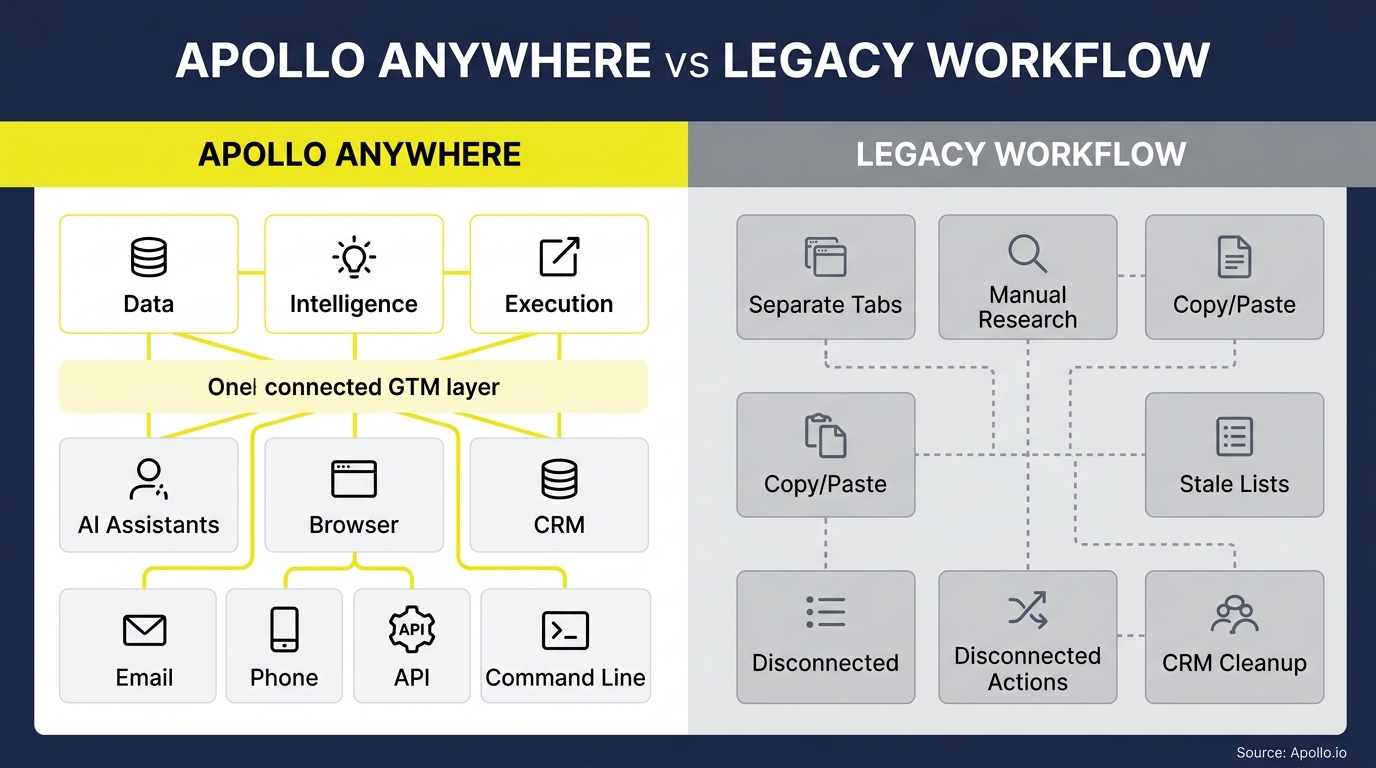
- Platform Scope: Apollo is an AI GTM system that unifies data, intelligence, and execution in one connected GTM system. Lemlist focuses primarily on multichannel outreach automation with a built-in lead database.
- Sales Intelligence: Apollo includes a 240M+ person database with 98% email accuracy. According to Lemlist, its database contains 650M+ leads, though that figure is self-reported.
- Dialer: Apollo includes a Power Dialer and Parallel Dialer natively. Lemlist offers in-app calling via VoIP integrations.
- AI Capabilities: Apollo's AI Research Agent, AI Sequence Builder, and AI-powered messaging are built into the core platform. Lemlist provides AI personalization and buying intent signal tracking through its agent and credit-based add-ons.
- Who Uses It: Apollo serves B2B GTM teams, GTM Engineers, and AI Builders building headless GTM workflows with the Apollo API, CLI, and MCP, alongside Sales Professionals, SDRs/BDRs, AEs, RevOps, Marketing, and Revenue Leaders.
What is Apollo?

Apollo is an AI GTM system that unifies data, intelligence, and execution into one connected GTM system, covering prospecting, engagement, enrichment, inbound routing, and analytics without requiring multiple disconnected tools. The platform combines a verified B2B database with sequencing, a native dialer, AI-assisted research, and CRM sync so sellers can move from identifying a prospect to booking a meeting inside a single workspace.
Apollo meets sellers where they already work. Apollo MCP, Apollo's Model Context Protocol, brings Apollo's prospecting and enrichment capabilities directly into AI assistants including ChatGPT, Codex, Claude, and Perplexity, no tab switching required. The Chrome extension allows reps to prospect across the web, and for technical and advanced users, Apollo CLI provides terminal-native access for headless GTM workflows and automation pipelines.
According to Ramp's vendor data, Apollo ranks #2 in the Sales Data Providers category with a 38% adoption rate as of July 2026, up 5 percentage points year-over-year, and 34% of businesses entering the Sales Data Providers category for the first time chose Apollo, placing it tied for the top new-adopter capture position.

Apollo holds a 4.7/5 rating on G2 and was recognized with the 2026 MarTech Breakthrough Award for "Best AI-Powered Sales Solution". Trusted by teams at Anthropic, Redis, and Smartling, Apollo serves 100K+ paying customers and is used by 100+ teams at Fortune 500 companies. Transparent pricing starts at $49/user/month (annual billing), with a free tier available.
What is Lemlist?

Lemlist is a sales engagement platform that combines lead generation, multichannel outreach automation, and deliverability tools. The platform is oriented toward outbound sequences across email, LinkedIn, SMS, WhatsApp, and calls, with built-in email warm-up (lemwarm) and reputation protection features designed to protect sender health.
Lemlist claims access to a database of 650M+ leads and offers an AI agent (lemAgent) for account and contact research, intent signal tracking, and personalized message generation. Intent signals include company web visits, hiring changes, fundraising events, and LinkedIn engagement, each priced per signal via a credit-based add-on system.
The platform includes a unified inbox for managing conversations across channels and senders, CRM integrations with HubSpot, Salesforce, Pipedrive, and Attio, plus a Chrome extension that works within Gmail and CRM environments. Smart campaign automation handles sequencing, auto-launch, and auto-stop logic.
Lemlist's pricing structure separates email-only usage from multichannel workflows. The Email plan covers unlimited users at a flat rate, while the Multichannel plan is priced per user and includes LinkedIn automation.
In-app calling is available through VoIP integrations. Enrichment, email verification, phone number lookups, and intent signals are all handled through a separate credit-based system on top of the base plan cost.
Feature Comparison
| Feature | Apollo | Lemlist |
|---|---|---|
| Starting Price | $49/user/month (annual billing) | $55/month (annual billing, unlimited users, Email plan) or $87/user/month (Multichannel, annual billing) |
| B2B Database | 240M+ people, 30M+ companies | Lemlist claims 650M+ leads |
| Email Accuracy | 98% | Not publicly specified; verified emails cost 5 credits each |
| Sequences | Email, phone, and social, multi-channel sequences with AI Sequence Builder | Email, LinkedIn, SMS, WhatsApp, calls, AI-personalized sequences |
| Dialer | Native Power Dialer and Parallel Dialer included | In-app calling via VoIP integrations |
| AI Capabilities | AI Research Agent, AI Sequence Builder, AI-powered messaging (46% more meetings reported) | lemAgent for personalization and research; intent signal tracking via credit add-ons |
| Data Enrichment | Waterfall enrichment, CRM enrichment, CSV enrichment, API enrichment, included in platform | Credit-based email and phone finder; enrichment billed separately per record |
| Free Trial | Free tier with 900 credits/year | Free trial available |
The table above highlights a structural difference: Apollo bundles prospecting data, sequencing, a native dialer, and enrichment into one platform with predictable per-seat pricing, while Lemlist's full feature set, particularly enrichment and intent signals, accrues additional per-use credit costs on top of the base plan. Teams running high-volume enrichment or intent signal tracking on Lemlist should model total credit spend carefully before comparing sticker prices.
Fill Your Funnel With Buyers, Not Noise
Pipeline forecasting a guessing game because your leads never convert? Apollo surfaces verified, in-market contacts so your team works real opportunities — not dead ends. 600K+ companies stopped guessing and started closing.
Start Free with Apollo →Pricing Comparison
Apollo's full tier breakdown, available at apollo.io/pricing, is as follows (annual billing):
- Free: $0, 900 credits/year, 2 sequences, basic filters
- Basic: $49/user/month, 30,000 credits/year, unlimited sequences, CRM integrations
- Professional: $79/user/month, 48,000 credits/year, US dialer, 5 mailboxes, AI research
- Organization: $119/user/month (min 3 users), 72,000 credits/year, international dialer, 15 mailboxes, SSO, advanced security
Lemlist's pricing (from Lemlist's pricing page, annual billing) is structured differently:
- Email: $55/month (annual billing), unlimited users, 50,000 emails/month
- Multichannel: $87/user/month (annual billing), unlimited emails and messages, LinkedIn automation, 5 senders per user
- Enterprise: Requested quotes via sales contact, includes SSO/SAML, custom user roles, and a dedicated account manager
Lemlist also charges separately for enrichment and intent data through a credit system: verified emails cost 5 credits ($0.05 each), phone numbers cost 20 credits ($0.20 each), and LinkedIn engagement signals run from 400 credits ($4.00+) per signal. Credits are purchased at $10 per 1,000.
Teams doing significant prospecting or intent signal tracking will want to factor these variable costs into their total budget alongside the base plan price.
Apollo's credit system covers data enrichment and export as well, so teams comparing the two platforms should evaluate both the base plan and expected credit consumption for a like-for-like cost assessment.

How Apollo Differs from Lemlist
The clearest difference is platform depth. Lemlist is built for outbound sequences and channel coverage.
Apollo connects the full GTM motion, from identifying the right account, to researching the contact, to sequencing outreach, to routing inbound leads, to analyzing what worked, without requiring a separate data tool or enrichment service.
According to Ramp's Sales Data Providers category data as of July 2026, Apollo is the fastest-growing vendor in the category, averaging +0.75 percentage points of adoption per month, outpacing every other vendor tracked. That growth reflects teams consolidating their sales intelligence and engagement workflows into Apollo rather than managing separate subscriptions.

On the dialer specifically: Apollo's Power Dialer and Parallel Dialer are native, with AI-researched call scripts, automatic voicemail drop, auto-logged outcomes, and AI-generated call summaries pushed to CRM. Calling in Lemlist is handled through VoIP integrations rather than a natively built dialer engine.
For teams prioritizing cold email deliverability, both platforms address it, Lemlist through its lemwarm warm-up tool and Deliverability Hub, Apollo through sender health monitoring and email guardrails built into the sequencing workflow. The difference is that Apollo's deliverability tools sit inside the same platform as the data and the dialer, reducing the surface area of potential configuration errors across tools.
Customer outcomes reflect this consolidation value. Collin Stewart, CEO at Predictable Revenue, said:
"We reduced the complexity of three tools into one."And from Kevin Warner, CEO at Leadium:
"Apollo became the single source of truth for us, where everything originates from and where all the data returns to."
For GTM Engineers and technical users, Apollo's Apollo MCP and Apollo CLI enable headless GTM workflows and direct integration with AI tooling, a capability set that Lemlist does not currently match.
Frequently Asked Questions
Is Apollo better than Lemlist for cold email?
For cold email alone, both platforms offer sequencing, personalization, and deliverability tools. Apollo's advantage is that the B2B data, sequences, and analytics are in one place, so reps don't need to export from a data tool and import to an outreach tool.
Teams focused exclusively on email volume at a flat cost may find Lemlist's unlimited-user Email plan worth evaluating, though enrichment and verification costs accrue separately as covered in the pricing section above.
Does Apollo replace Lemlist?
For most B2B sales teams, yes. Apollo covers the core use cases Lemlist addresses, multichannel sequences, personalization, intent signals, and deliverability, while adding a native dialer, a verified B2B database, data enrichment, inbound routing, and AI research capabilities.
Teams primarily running LinkedIn-heavy sequences with WhatsApp automation may want to compare channel-specific coverage in more detail.
How does Apollo pricing compare to Lemlist?
As detailed in the pricing section above, the comparison depends on team size and usage patterns. Lemlist's Email plan offers an unlimited-user flat rate that can be cost-effective for large teams sending email only.
Apollo's per-seat pricing includes the database, dialer, and enrichment in the plan. Variable credit costs on both platforms mean total spend depends on enrichment and intent signal volume.
Who is Apollo designed for?
Apollo serves B2B GTM teams, GTM Engineers, and AI Builders building headless GTM workflows with the Apollo API, CLI, and MCP, alongside Sales Professionals, SDRs/BDRs, AEs, RevOps, Marketing, and Revenue Leaders, from early-stage teams through companies with dedicated sales operations and enterprise security requirements.
Does Lemlist have a built-in B2B database?
Lemlist claims access to a 650M+ lead database included with its plans. Email verification and phone number lookups are handled through the credit-based add-on system rather than being included in the base plan at no additional cost.
Apollo's database and enrichment credits are bundled into each paid tier, as detailed above.

Conclusion
Apollo and Lemlist both address B2B outbound, but they serve different levels of GTM complexity. Lemlist is a focused outreach automation tool with broad channel coverage and a flat-rate email plan.
Apollo is a broader AI GTM system that connects data, sequences, calling, enrichment, and analytics, reducing the number of tools teams need to manage while giving RevOps a single source of truth.
For teams looking to run prospecting and outreach from one connected system, with a verified database, native dialer, and AI research built in, try Apollo free today.
Ramp Reps Faster, Prove ROI Sooner
ROI pressure killing your next tool renewal? Apollo gets reps productive from day one with scalable playbooks your whole team follows. Leadium 3x'd annual revenue — see your return before you commit.
Start Free with Apollo →Don't miss these
Sales
Inbound vs Outbound Marketing: Which Strategy Wins?
Sales
What Is a Sales Funnel? The Non-Linear Revenue Framework for 2026
Sales
What Is a Go-to-Market Strategy? The 2026 GTM Playbook
See Apollo in action
We'd love to show how Apollo can help you sell better.
By submitting this form, you will receive information, tips, and promotions from Apollo. To learn more, see our Privacy Statement.
4.7/5 based on 9,690 reviews
