
How Revenue Teams Maintain Brand Voice Consistency at AI Scale
AI-generated outreach has moved from experiment to standard operating procedure. Revenue teams are producing more messages, sequences, and follow-ups than ever before — but speed without guardrails creates a new problem: brand voice drift.
When every SDR, AE, and RevOps leader is prompting AI tools independently, your positioning fractures message by message.
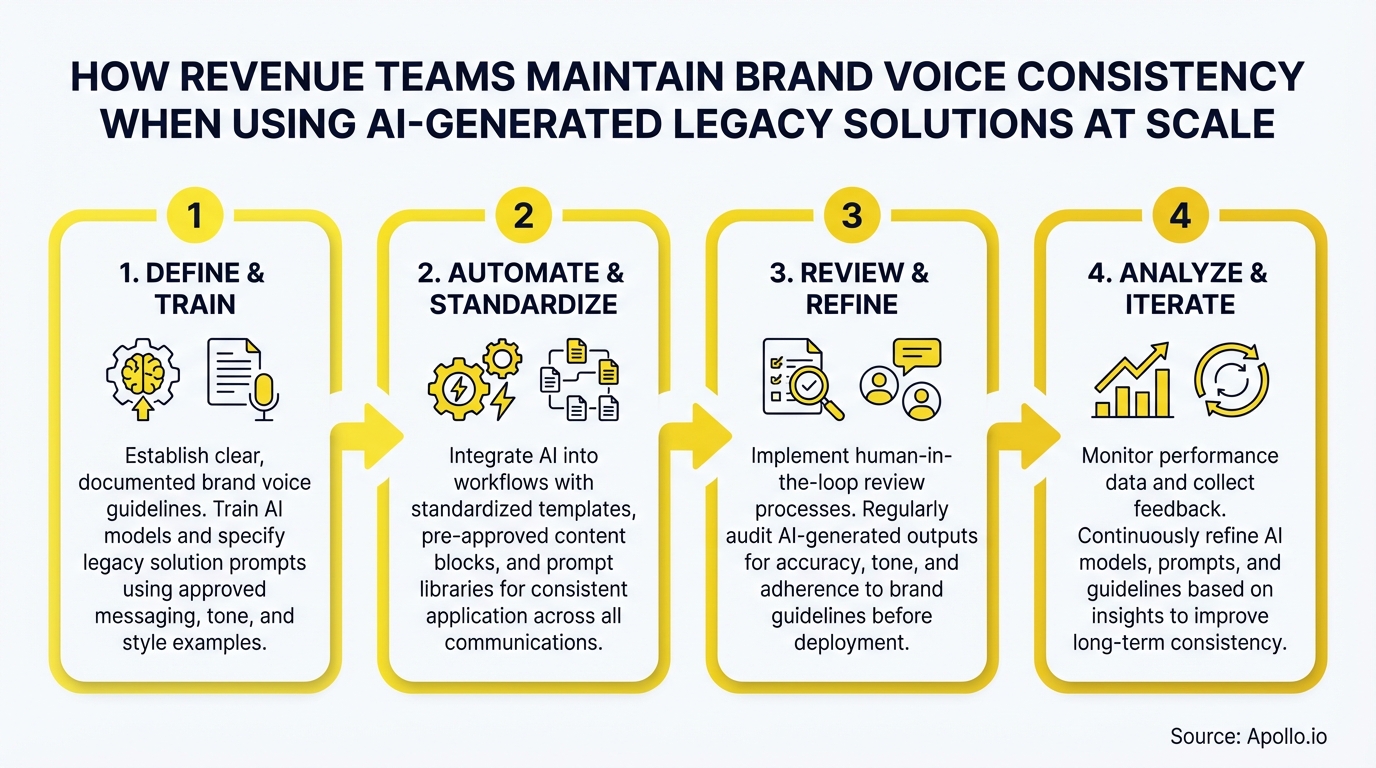
The fix is not slowing down AI adoption. The fix is treating brand voice as a system setting, not a style guide PDF. Tools like Apollo's AI Sales Assistant address this directly by grounding every output in your configured value propositions, ICP context, and messaging guardrails — so consistency is built in, not bolted on. Learn how to build a sales tech stack that scales revenue while keeping your brand voice intact.

Research Less, Pipeline More With Apollo
Tired of your reps burning hours verifying contacts instead of closing deals? Apollo surfaces accurate, ready-to-work leads so your team scales outreach without scaling headcount. Join 600K+ companies building predictable pipeline.
Start Free with Apollo →Key Takeaways
- Brand voice consistency is now a governance problem, not a creative one — it requires operational controls, not just training.
- Most companies have brand guidelines but fail to enforce them; AI at scale amplifies that gap significantly.
- A centralized AI Content Center or brand knowledge base is the single most effective structural fix for voice drift.
- Human-in-the-loop review should shift from writing to approving and QA-checking AI outputs.
- SDRs and RevOps leaders benefit most from standardized prompt libraries and approved messaging frameworks.
Why Is Brand Voice Consistency Harder at AI Scale?
Brand voice consistency breaks at scale because AI amplifies whatever inputs it receives — and most teams have not standardized those inputs. According to Planetary Labour, 77–81% of companies already struggle with inconsistent content that doesn't reflect their brand voice. Add AI-generated volume on top of that existing gap and the problem compounds quickly.
Two structural issues drive the breakdown:
- Ungoverned prompts: Every rep prompts differently, producing outputs with wildly different tone, claims, and positioning.
- No single source of truth: AI tools don't know your approved differentiators, banned phrases, or positioning unless you tell them explicitly.
Research from Six Degrees found that 40% of marketers cite "robotic output" as a key downside of AI-generated content — a signal that most AI tools are not grounded in brand-specific context. The solution is a governance layer, not more editing.
What Is a Brand Voice Control Plane for Revenue Teams?
A brand voice control plane is a centralized system that constrains AI outputs before they reach prospects — not a document reps consult after drafting. It typically includes four components:
| Component | What It Contains | Who Owns It |
|---|---|---|
| Brand Knowledge Base | Value props, pain points, differentiators, banned claims | Product Marketing / Enablement |
| Approved Prompt Library | Standard prompts by persona, ICP, and stage | Sales Enablement |
| QA Sampling Process | Spot-check cadence, escalation rules, feedback loops | RevOps / Sales Managers |
| Audit Trail | Log of AI-generated messages sent, approvals, edits | RevOps / Compliance |
Apollo's AI Content Center operationalizes the brand knowledge base layer directly inside the platform. You configure your company overview, value proposition, customer pain points, call-to-action, and product differentiators once — and every AI-generated email, call script, and sequence references that context automatically.
Struggling to keep outreach on-brand across your whole team? Automate multi-channel sequences with Apollo's built-in brand guardrails.
Turn Funnel Guesswork Into Pipeline Wins
Tired of watching marketing leads stall before they ever reach your pipeline? Apollo surfaces high-fit prospects and buying signals so your team acts first. 600K+ companies stopped guessing and started closing.
Start Free with Apollo →How Do SDRs and RevOps Leaders Enforce Voice Standards in Practice?
SDRs maintain brand voice at scale by working from standardized prompt packs rather than prompting ad hoc. RevOps leaders enforce consistency by building approved messaging frameworks directly into the tools reps use daily.
Practical steps for each role:
For SDRs and BDRs:
- Use pre-approved sequence templates as the starting point, not a blank prompt.
- Personalize within guardrails: swap in account-specific signals (funding, job changes, tech stack) without rewriting tone or claims.
- Flag outputs that feel off-brand for manager review rather than self-editing around the issue.
For RevOps and Sales Leaders:
- Configure the AI Content Center with approved language before enabling AI sequence generation for the team.
- Run weekly QA sampling: review a random set of AI-generated messages against the brand standard.
- Build feedback loops: winning message variants should update the prompt library, not just the individual rep's habits.
"Apollo's AI Assistant makes building targeted prospecting lists effortless. I can give it very specific prompts, and it stays within those parameters to deliver accurate, high-quality results." — Matt Tumbiolo, Enterprise BDR, Smartling
For a deeper look at how a revenue operations framework supports consistent AI governance, see Apollo's RevOps guide.

What Governance Gaps Put Brand Voice at Risk?
The most common governance gap is the distance between having brand guidelines and enforcing them. Data from Envive.ai shows that while 95% of companies have brand guidelines, only 25–30% actively enforce them — a gap that existed before AI and widens significantly when AI is generating volume at scale.
Three governance failures accelerate brand voice drift:
- No approved claims library: Reps and AI tools invent product claims that haven't been vetted by legal or product marketing.
- Ungated AI access: Reps generate and send without any approval step for new sequence types or messaging angles.
- No feedback mechanism: Poor-performing or off-brand messages are deleted, not analyzed — so the system never improves.
As agentic AI workflows expand (research, draft, send, follow up — all automated), the need for audit trails and approval gates becomes comparable to a security program, not a content review. Revenue teams adopting agentic outreach should involve legal, compliance, and product marketing before autonomous sending begins.
How Does Apollo Help Revenue Teams Maintain Brand Voice at Scale?
Apollo maintains brand voice at scale by embedding governance directly into the outreach workflow rather than relying on rep discipline or post-send editing. The Apollo AI platform grounds every AI-generated output in your configured brand context through the AI Content Center, which auto-populates from your website and stores approved messaging elements in one place.
Key capabilities that support brand consistency:
- AI Content Center: Stores your value proposition, pain points, CTAs, and differentiators — used by every AI output across sequences, emails, and call scripts.
- Outbound Copilot: Generates full multi-channel sequences from a single prompt, grounded in Content Center context, with human approval before sending.
- AI Sequence Builder + Messaging 4.0: Creates personalized emails referencing real prospect signals (job changes, funding, tech stack) within your approved messaging framework.
- A/B Testing: Tests message variations within approved guardrails — winning variants inform future prompts without drifting off-brand.
"Work that would've taken me hours was done before I even got off the train." — Tory Kindlick, Head of Revenue Ops, RapidSOS
See how the Outbound Copilot builds brand-consistent sequences automatically. For teams evaluating engagement platforms, the Apollo vs. Outreach vs. Salesloft comparison covers how each platform handles AI-generated messaging governance.
Spending hours reviewing AI drafts for brand accuracy? Let Apollo's AI automation handle outreach with your brand context built in.
What Metrics Should Revenue Teams Track for Brand Voice Consistency?
Revenue teams should track brand voice consistency using a combination of content quality metrics and pipeline outcome metrics — not reply rate alone.
| Metric | What It Measures | Target Signal |
|---|---|---|
| On-Brand Rate | % of AI outputs passing QA review | Trending upward week over week |
| Banned Claim Usage | Frequency of unapproved claims in sent messages | Zero tolerance |
| Reply Rate by Sequence | Engagement on brand-consistent vs. drifted sequences | Consistent sequences outperform |
| Prompt Library Adoption | % of reps using approved prompts vs. ad hoc | High adoption = lower drift risk |
Track sales analytics alongside brand quality metrics to understand whether on-brand outreach is also driving pipeline outcomes. The two should correlate.
How Do Revenue Teams Get Started With Brand Voice Governance in 2026?
Revenue teams get started with brand voice governance by completing three foundational steps before enabling AI-generated outreach at scale.
- Build your approved claims library: Document verified product claims, approved differentiators, and explicitly banned phrases. This becomes the source of truth for all AI prompts and Content Center configuration.
- Configure your AI Content Center: Enter your value proposition, pain points, CTA, and company overview. Apollo can auto-populate this from your website URL — reducing setup time significantly.
- Establish a QA sampling cadence: Assign ownership (RevOps or a senior enablement lead) to review a sample of AI-generated messages weekly. Findings feed back into the prompt library and Content Center.
The Predictable Revenue team found that consolidating tools into a unified platform was the key enabler: "We reduced the complexity of three tools into one." Fewer tools mean fewer inconsistencies — and a single Content Center governs all AI outputs instead of managing brand standards across disconnected systems.
For teams building out their full GTM motion, the B2B marketing funnel guide and revenue generation strategy offer complementary frameworks for maintaining consistency from top-of-funnel content through outbound sequences.

Start Scaling Outreach Without Losing Your Brand Voice
Brand voice consistency at AI scale is achievable — but only with the right operational infrastructure. The teams that get it right treat voice as a system setting, not a creative preference.
They build centralized knowledge bases, standardize prompts, assign QA ownership, and measure on-brand rate alongside pipeline metrics.
Apollo's AI Content Center, Outbound Copilot, and AI Sequence Builder give revenue teams the governance layer they need to scale outreach without drifting off-brand. Every sequence, every email, every follow-up is grounded in your approved messaging context — automatically.
Try Apollo Free and configure your AI Content Center today — so your brand voice scales as fast as your outreach does.
Prove Pipeline ROI With Apollo
Budget approval stuck on unclear metrics? Apollo surfaces measurable pipeline impact so you can justify every dollar spent. Leading GTM teams report faster wins, stronger deal velocity, and ROI leadership actually believes.
Schedule a Demo →Don't miss these
Sales
Inbound vs Outbound Marketing: Which Strategy Wins?
Sales
What Is a Sales Funnel? The Non-Linear Revenue Framework for 2026
Sales
What Is a Go-to-Market Strategy? The 2026 GTM Playbook
See Apollo in action
We'd love to show how Apollo can help you sell better.
By submitting this form, you will receive information, tips, and promotions from Apollo. To learn more, see our Privacy Statement.
4.7/5 based on 9,690 reviews
