
What Revenue Generation Strategy Actually Works in 2026?
Revenue generation strategy is no longer just about closing deals. It's about building a scalable, AI-powered system that monetizes buyer intent before your sales team ever makes contact. In 2026, the most successful companies capture revenue opportunities early by aligning product, marketing, sales, and RevOps around unified data and automated workflows.
According to Corporate Visions, the average sales cycle length dropped from 11.3 months in 2024 to 10.1 months in 2025. That compression means your revenue strategy must work faster and smarter than ever.

Stop Chasing Dead Leads With Verified Contacts
Tired of bounced emails killing your pipeline? Apollo delivers 224M+ contacts with 96% email accuracy—so every outreach connects. Join 550K+ companies closing more deals with verified data.
Start Free with Apollo →Key Takeaways
- Pre-sales influence drives 69% of B2B purchase decisions before buyers engage sellers, making early-stage content and data a revenue lever
- AI adoption is accelerating: Research from Landbase shows AI adoption among sales teams is expected to reach 43% in 2026, with 92% of teams planning increased AI investment
- Revenue models are evolving: Subscription, usage-based, and hybrid approaches now dominate, with AI tools automating personalization and pipeline acceleration
- Tech stack consolidation cuts costs: Teams are replacing fragmented tools with unified platforms that combine data, engagement, and deal intelligence
- Measurement matters more: CAC, LTV, pipeline velocity, and ROI proof are replacing vanity metrics as budget scrutiny intensifies
What Is Revenue Generation Strategy?
Revenue generation strategy is the systematic approach businesses use to create, capture, and scale income across the entire customer lifecycle. It's NOT just sales tactics.
It's the unified framework connecting your go-to-market motion, pricing model, customer acquisition channels, retention programs, and expansion plays.
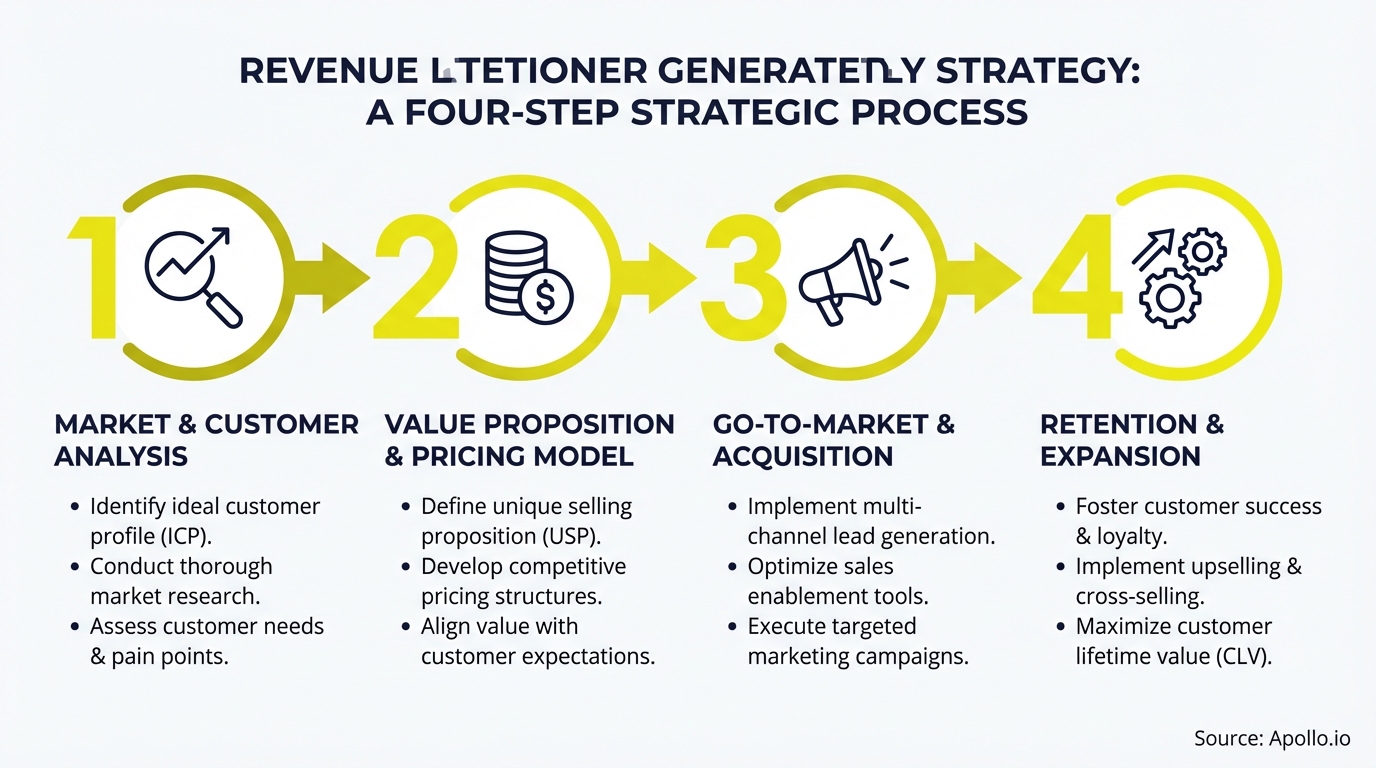
A modern revenue generation strategy answers four questions:
- How do we capture demand before buyers contact us? (Pre-sales monetization through content, self-serve tools, and intent signals)
- What revenue model fits our market? (Subscription, usage-based, freemium, commission, or hybrid)
- How do we accelerate pipeline velocity? (AI-powered prospecting, multi-channel sequences, buying signals)
- How do we prove ROI to justify budget? (CAC payback, LTV:CAC ratio, win-rate lift, cycle compression)
"Apollo allowed us to 3x our annual revenue without any decrease in efficiency."
Which Revenue Models Drive Growth in 2026?
The right revenue model determines how you monetize customers and scale predictably. Here are the dominant models in 2026:
| Revenue Model | How It Works | Best For | Key Metric |
|---|---|---|---|
| Subscription | Recurring monthly or annual fees | SaaS, platforms, membership services | Monthly Recurring Revenue (MRR), churn rate |
| Usage-Based | Revenue tied to customer consumption | Infrastructure, APIs, data platforms | Revenue per user, usage growth rate |
| Freemium | Free tier drives adoption, premium unlocks features | PLG products, developer tools | Free-to-paid conversion rate, expansion revenue |
| Commission | Revenue from facilitating transactions | Marketplaces, referral networks, brokerages | Gross Transaction Value (GTV), take rate |
| Hybrid | Mix of subscription, usage, and services | Enterprise platforms, complex solutions | Blended LTV, revenue mix ratios |
Most B2B companies in 2026 use hybrid models that combine base subscriptions with usage tiers or professional services. This approach maximizes LTV while maintaining predictable recurring revenue.
Turn Forecasting Guesswork Into Revenue Clarity
Pipeline forecasting a guessing game? Apollo delivers real-time deal visibility and intent signals so you know exactly which opportunities will close. Built-In improved win rates 10% with Apollo's scoring.
Start Free with Apollo →How Do You Build a Revenue Framework That Scales?
A scalable revenue operations framework connects strategy, execution, and measurement. Here's the five-layer structure that works:
1. Strategy Layer: Define Your Revenue Architecture
Set revenue targets, pricing models, and ICP segments. Map your buyer journey stages and assign revenue ownership (marketing-sourced vs sales-sourced vs product-led).
2. Value Layer: Align Positioning to Buyer Pain
Your positioning must answer: What problem do we solve? Why us? Why now? Build proof assets (case studies, ROI calculators, comparison pages) that buyers can share internally.
3. GTM Layer: Coordinate Across Teams
Unify sales, marketing, and customer success around shared goals and handoff processes. Use a GTM strategy that defines lead qualification, routing rules, and coverage models.
4. Execution Layer: Enable Consistency with Tech
Deploy tools that consolidate prospecting, engagement, enrichment, and deal management. Avoid tool sprawl. Need help finding qualified prospects fast? Search Apollo's 224M+ contacts with 65+ filters to build targeted lists in minutes.
5. Analytics Layer: Measure What Matters
Track CAC, LTV, sales cycle length, pipeline velocity, win rate, and expansion revenue. Tie every campaign and channel to revenue outcomes, not just activity metrics.
"We reduced the complexity of three tools into one. We're getting higher reply rates, open rates are doubled, meetings are up, and speed to booking a meeting is cut in half."
What Metrics Define Revenue Success in 2026?
Revenue leaders in 2026 focus on efficiency and ROI proof, not vanity metrics. Here are the non-negotiable KPIs:
| Metric | What It Measures | Why It Matters |
|---|---|---|
| CAC (Customer Acquisition Cost) | Total sales and marketing spend divided by new customers | Determines go-to-market efficiency and profitability |
| LTV (Lifetime Value) | Total revenue a customer generates over their lifetime | Justifies CAC spend and guides retention investment |
| LTV:CAC Ratio | LTV divided by CAC (target: 3:1 or higher) | Validates business model sustainability and growth potential |
| Sales Cycle Length | Average days from first contact to closed deal | Reveals pipeline velocity and process bottlenecks |
| Pipeline Coverage | Total pipeline value divided by quota | Predicts whether you'll hit revenue targets (need 3-4x coverage) |
| Win Rate | Percentage of opportunities that close as wins | Indicates product-market fit and sales effectiveness |
| Net Revenue Retention (NRR) | Revenue retained + expanded from existing customers | Shows customer success and expansion engine health (target: 110%+) |
These metrics form the foundation of a revenue operations dashboard that proves ROI to leadership and guides strategic decisions.

How Does AI Transform Revenue Generation Strategy?
AI is no longer experimental in revenue organizations. According to Core Factors, 97% of Revenue Operations leaders report measurable ROI from AI, particularly in forecasting accuracy and analytics.
Here's how AI impacts each stage of revenue generation:
- Prospecting: AI identifies high-intent accounts using buying signals, job changes, tech stack data, and engagement patterns
- Personalization: AI generates tailored outreach at scale, matching message to buyer persona and pain point
- Qualification: AI scores leads based on fit and intent, routing hot opportunities to reps instantly
- Forecasting: AI predicts deal close probability and revenue outcomes with higher accuracy than manual methods
- Content: AI creates proposals, follow-ups, and objection-handling content customized to each deal
The key is governed AI implementation. Teams that define clear policies around data access, human review, and claims accuracy avoid compliance risk while scaling revenue operations.
How Can You Consolidate Your Revenue Tech Stack?
Tool sprawl kills productivity and inflates costs. The average B2B company uses separate tools for prospecting, enrichment, engagement, and analytics.
That fragmentation creates data silos, workflow friction, and hidden integration costs.
Modern revenue teams consolidate into unified platforms that deliver:
- Prospecting + Enrichment: Access verified contact data with intent signals, job changes, and tech stack insights in one workspace
- Multi-Channel Engagement: Run email, phone, and social sequences from a single platform with AI-powered personalization
- Deal Intelligence: Track conversations, analyze rep performance, and surface coaching opportunities automatically
- CRM Integration: Sync data bidirectionally with Salesforce, HubSpot, and other systems to maintain a single source of truth
Struggling with fragmented tools and inconsistent data? Consolidate your tech stack with Apollo's 224M+ verified contacts and built-in engagement tools.
See how Predictable Revenue reduced tech stack costs by 50% by moving from ZoomInfo + Outreach to Apollo's all-in-one platform.

What Are the Biggest Revenue Strategy Mistakes in 2026?
Even experienced revenue leaders make costly mistakes. Here are the top pitfalls to avoid:
- Ignoring pre-sales influence: 69% of the B2B purchase decision happens before buyers contact sellers. If your content, comparison pages, and ROI proof aren't capturing attention early, you're invisible when it matters most.
- Optimizing for MQLs instead of pipeline: Lead volume means nothing if conversion rates are low. Focus on qualified pipeline and win rates, not activity metrics.
- Tolerating data decay: Contact data degrades at 30% annually (job changes, role updates, email changes). Stale data kills connect rates and wastes rep time.
- Running outbound without intent signals: Spray-and-pray outreach generates low reply rates and damages brand reputation. Target accounts showing buying signals instead.
- Neglecting ROI proof: CFOs demand clear payback calculations. If you can't show CAC payback period and LTV:CAC ratios, you won't get budget approval.
Revenue Generation Strategy: Build Your 2026 Blueprint
Revenue generation strategy in 2026 requires three shifts: monetize pre-sales influence with high-value content, deploy AI to accelerate pipeline velocity, and consolidate your tech stack to cut costs while improving productivity.
The teams winning in 2026 combine verified contact data, multi-channel engagement, and deal intelligence in one unified platform. They measure what matters (CAC, LTV, pipeline velocity, win rate) and prove ROI at every stage.
Start by auditing your current revenue framework. Map your buyer journey, identify gaps in pre-sales content, evaluate your tech stack for consolidation opportunities, and define the metrics that will guide your strategy.
For more tactical guidance, explore our resources on lead generation tools that drive measurable ROI and building automated lead generation systems.
Ready to build a revenue engine that scales? Start Your Free Trial and access 224M+ verified contacts, AI-powered sequences, and deal intelligence in one workspace.
Prove ROI Fast With Real Pipeline Metrics
Budget approval stuck on unclear metrics? Apollo tracks every dollar to pipeline impact with built-in attribution. Customer. io achieved 50% YoY growth with measurable ROI.
Start Free with Apollo →Don't miss these
Sales
Inbound vs Outbound Marketing: Which Strategy Wins?
Sales
What Is a Sales Funnel? The Non-Linear Revenue Framework for 2026
Sales
What Is a Go-to-Market Strategy? The 2026 GTM Playbook
See Apollo in action
We'd love to show how Apollo can help you sell better.
By submitting this form, you will receive information, tips, and promotions from Apollo. To learn more, see our Privacy Statement.
4.7/5 based on 9,690 reviews
