
How Do AI Sales Assistants Personalize Outreach at Scale in 2026?
Generic outreach is dead. According to InsightMark Research, 73% of B2B buyers expect personalized, consumer-like experiences — and they actively ignore sellers who fail to deliver. The problem is that true personalization used to require time no rep has. AI sales assistants solve this by combining account research, intent signals, and messaging generation into automated, end-to-end workflows that scale across hundreds of prospects simultaneously.
Tools like Apollo's AI Sales Assistant represent a new category: end-to-end GTM assistants that research accounts, build prospect lists, generate signal-based messaging, and launch multi-channel sequences from a single natural-language prompt. This article explains exactly how that personalization works — and how SDRs, AEs, and RevOps teams can deploy it at scale. For broader context on building the right foundation, see How to Build a Sales Tech Stack That Scales Revenue.

Research Less, Close More With Apollo
Tired of your reps burning hours on manual lead research instead of selling? Apollo surfaces verified contacts instantly so your team spends time closing, not digging. Join 600K+ companies building pipeline faster.
Start Free with Apollo →Key Takeaways
- AI sales assistants personalize outreach by combining firmographic data, real-time intent signals, and account-specific research — not just name tokens.
- Adoption is accelerating: 89% of revenue organizations now use AI-powered tools, up from 34% in 2023.
- Signal-triggered sequences outperform static cadences because messages react to real buyer behavior.
- Grounding AI outputs in your ICP, value proposition, and content guardrails prevents generic or off-brand messaging.
- SDRs and AEs who integrate AI into their workflows report measurable gains in meetings booked and pipeline velocity.
What Does AI Personalization at Scale Actually Mean?
AI personalization at scale means generating contextually relevant, account-specific messages for hundreds of prospects without manual research per contact. It goes far beyond first-name merge tags. According to Leads at Scale, AI enables highly tailored messages by analyzing company information, behavioral patterns, and external signals simultaneously across your entire prospect list.
The key distinction: personalization at scale is systematic, not manual. The AI ingests structured inputs (ICP filters, value propositions, pain points, intent signals) and produces outputs grounded in real account context — job changes, funding rounds, tech stack, recent news — then embeds those insights into each message automatically.
How Do AI Sales Assistants Gather Personalization Signals?
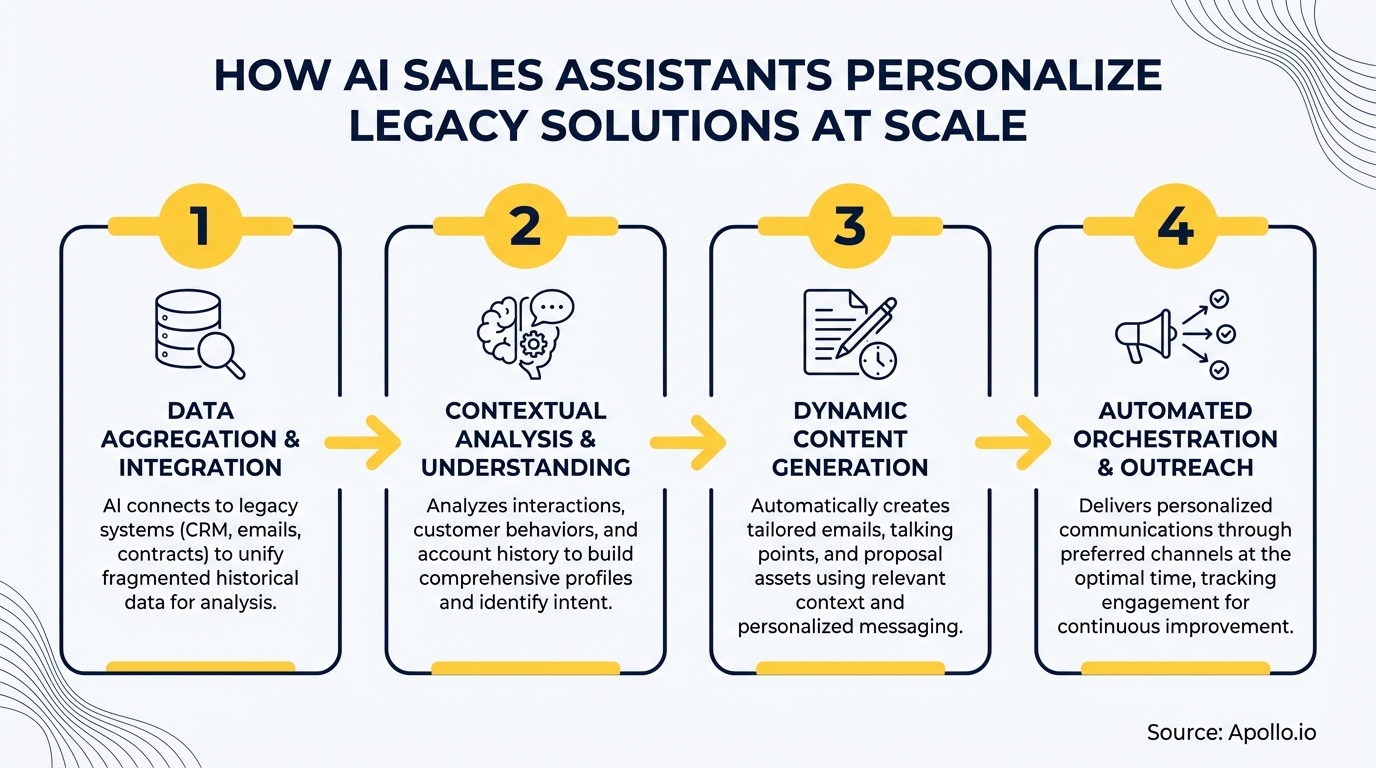
AI sales assistants pull from multiple data layers to build a personalization context for each prospect. The richest systems combine first-party CRM data with real-time external enrichment.
| Signal Type | Examples | Personalization Use |
|---|---|---|
| Firmographic | Industry, headcount, revenue, tech stack | ICP scoring, segment-specific messaging |
| Intent | Topic research, competitor visits, content downloads | Trigger-based sequences, timing optimization |
| Behavioral | Email opens, link clicks, reply patterns | Follow-up sequencing, channel prioritization |
| Contextual | Job changes, funding, hiring signals, news | Hyper-relevant opening lines and value hooks |
Apollo's AI Research uses Perplexity Sonar to scour the web for real-time account insights, GPT-4o mini to categorize and summarize existing data, and Claude Haiku 3.5 to generate messaging from gathered context. These research outputs become dynamic variables injected directly into email copy and call prep — no manual copy-paste required.
Spending hours on manual prospect research? Search Apollo's 230M+ contacts with 65+ filters and let AI do the research.
How Do SDRs and AEs Deploy Personalized Sequences at Scale?
SDRs and AEs deploy personalized sequences at scale by using AI to automate the research-to-send workflow inside a single platform. The market has shifted from "generate one email" to agentic systems that handle the full outbound motion autonomously.
Apollo's Outbound Copilot illustrates this end-to-end approach:
- Automatically identifies prospects matching your ICP filters
- Adds them to lists or sequences on a daily, weekly, or monthly cadence
- Generates complete multi-channel sequences (email, phone, social) from a single prompt
- Personalizes each message using Content Center context and real account signals
- Supports A/B testing and manual approval before sending
For AEs managing active accounts, pre-meeting AI research surfaces company priorities, decision-maker profiles, and past objections before every call. Erik Fernando Nieto, BDR at JumpCloud, reports: "Apollo's AI Assistant filters and cleans prospect data for me, so I can find the right people faster and run better searches. It saves me about an hour per prospecting session."
Data from Optif.ai shows 89% of revenue organizations now use AI-powered tools — up from 34% in 2023 — confirming that AI-assisted workflows have moved from experiment to standard practice.
Turn Funnel Guesswork Into Real Pipeline
Tired of watching marketing leads stall before they ever reach your pipeline? Apollo surfaces high-intent prospects that actually convert. 600K+ companies stopped guessing and started closing.
Start Free with Apollo →What Is the AI Content Center and Why Does It Matter for Scale?
The AI Content Center is the configuration layer that grounds all AI-generated messaging in your specific business context, preventing generic or off-brand outputs. Without it, AI writes for a fictional company.
With it, every email, call script, and follow-up reflects your actual value proposition, customer pain points, and differentiators.
Configuring Apollo's AI Content Center involves setting:
- Company overview and product name
- Core customer pain points
- Value proposition and key differentiators
- Primary call-to-action
- Additional ICP context
Apollo auto-populates these fields from your website URL. This grounding approach is consistent with the industry's shift toward "RAG + enrichment" — generating messages anchored in trusted business data rather than hallucinated context.
The result is messaging that reflects real account intelligence at every touchpoint. Matt Tumbiolo, Enterprise BDR at Smartling, notes: "Apollo's AI Assistant makes building targeted prospecting lists effortless.
I can give it very specific prompts, and it stays within those parameters to deliver accurate, high-quality results."

How Does Signal-Triggered Outreach Improve Personalization?
Signal-triggered outreach improves personalization by launching sequences in response to real buyer behavior rather than arbitrary time delays. Static cadences treat all prospects the same.
Trigger-based sequences adapt to what each prospect is actually doing.
Common triggers that drive personalized outreach include:
- Intent spikes: Prospect researches topics related to your solution
- Job changes: Decision-maker joins a target account
- Funding events: Account closes a new funding round
- Inbound signals: Prospect visits your pricing page or downloads content
- Engagement patterns: Prospect opens emails but hasn't replied
Apollo's intent data capabilities feed directly into workflow automation, so trigger events can automatically enroll prospects in the right sequence with context-aware messaging. For RevOps teams, this means personalization logic runs continuously without manual intervention. See also Sales Automation: Boost Revenue with Smarter Selling Tools for implementation patterns.
Struggling to act on intent signals before competitors do? Automate trigger-based sequences with Apollo's multi-channel engagement platform.
What KPIs Should Teams Track for AI-Personalized Outreach?
Teams should track downstream revenue metrics, not just activity metrics, when measuring AI personalization effectiveness. Open rates and send volume tell you little about whether personalization is working.
| Metric | What It Measures | Target Signal |
|---|---|---|
| Reply-to-open rate | Message relevance | Improving ratio signals stronger personalization |
| Meeting conversion rate | Outreach quality | Benchmark against pre-AI baseline |
| Pipeline influenced | Revenue impact | Track sequences that sourced or accelerated deals |
| Sequence engagement by segment | ICP fit | Identify which personas respond best |
Apollo's sales analytics capabilities let RevOps leaders connect sequence performance directly to pipeline outcomes, making it possible to optimize personalization strategies based on what actually converts. For teams building out the measurement layer, the Revenue Operations guide covers attribution frameworks in depth.
How Do You Start Personalizing Outreach at Scale with AI in 2026?
The fastest path to AI-personalized outreach at scale is consolidating your research, data, and engagement tools into one platform rather than stitching together multiple point solutions. Tool sprawl forces reps to manually move work between systems, which eliminates the productivity gains AI is supposed to deliver.
Teams using Apollo report measurable consolidation benefits. As Tory Kindlick, Head of Revenue Ops at RapidSOS, describes: "Work that would've taken me hours was done before I even got off the train." That kind of acceleration comes from having AI Research, the Outbound Copilot, the Content Center, and sequence execution in one connected workflow.
Here is the recommended starting sequence for B2B GTM teams:
- Configure the AI Content Center with your ICP, value prop, and pain points
- Set up AI Scores to prioritize your highest-fit accounts
- Run AI Research on your top-priority segments to surface account-specific context
- Use the Outbound Copilot to build and launch signal-grounded sequences
- Track reply-to-meeting conversion and iterate messaging based on what converts
For teams comparing platform options, see Apollo vs Outreach vs Salesloft: Compare Top Sales Engagement Platforms to evaluate consolidation tradeoffs. To see Apollo's full AI capability set, start with the Apollo AI Overview.
AI-personalized outreach at scale is no longer a competitive advantage reserved for well-funded teams. With the right platform, any B2B GTM team can research, personalize, and execute outreach that feels one-to-one — at the volume of one-to-many. Start free with Apollo and run your first AI-personalized sequence today.
Prove Pipeline ROI With Apollo
Budget approval stuck on unclear metrics? Apollo delivers measurable pipeline impact from day one — so you walk into every renewal conversation with proof, not promises. Join 600K+ companies closing with confidence.
Start Free with Apollo →Don't miss these
Sales
Inbound vs Outbound Marketing: Which Strategy Wins?
Sales
What Is a Sales Funnel? The Non-Linear Revenue Framework for 2026
Sales
What Is a Go-to-Market Strategy? The 2026 GTM Playbook
See Apollo in action
We'd love to show how Apollo can help you sell better.
By submitting this form, you will receive information, tips, and promotions from Apollo. To learn more, see our Privacy Statement.
4.7/5 based on 9,690 reviews
