
A credible B2B marketing automation case study shows baseline metrics, CRM mappings, routing logic, costs, and qualified pipeline, not just open rates.
Most published stories skip these details, so buyers can't tell whether the results transfer to their stack.
This guide gives you the evidence template, the implementation checklist, and the measurement rules to judge any case study.
If you are still scoping your program, start with this overview of enterprise marketing automation.

Apollo Finds Verified Contacts In Seconds
Tired of burning hours researching leads and double-checking contact info? Apollo puts verified business contacts at your fingertips with 98% email accuracy. Spend your day selling, not copy-pasting. Start filling your pipeline today.
Start Free with Apollo →Key Takeaways
- Demand baselines, denominators, measurement windows, and costs before trusting any result.
- Fix CRM field mapping, ownership, and routing before adding AI or more campaigns.
- Report relative change and percentage-point change separately.
- Track account-level progress and lead-level conversion together.
- Optimizing your existing stack often beats buying another platform.
What Makes a B2B Marketing Automation Case Study Credible?
A credible case study discloses the evidence behind every claim. Headline lifts without baselines are marketing copy, not proof.
| Evidence Element | Why It Matters | What to Demand |
|---|---|---|
| Baseline metric | Shows the starting point | Pre-automation rate and period |
| Denominator and cohort | Prevents cherry-picked samples | Which leads or accounts were counted |
| Measurement window | Separates trends from one-off spikes | Start and end dates |
| Attribution rule | Defines sourced vs influenced pipeline | Model used and who approved it |
| Costs and effort | Needed for payback math | Licenses, build hours, admin time |
| Failed attempts | Reveals real implementation risk | What was tried and abandoned |
Label anything undisclosed as undisclosed. That honesty is a stronger trust signal than a round number.
What Does an Existing-Stack Turnaround Case Study Look Like?
An existing-stack turnaround documents how a team activated tools it already owned, rather than replacing them. This matters because many teams buy features they never configure.
Use the snapshot below as a template when interviewing a customer or writing your own story.
It is a structure, not a customer result.
| Snapshot Field | What to Record |
|---|---|
| Customer profile | Segment, team size, sales motion |
| Starting stack | CRM, marketing automation, enrichment, engagement tools |
| Challenge | Specific failure, such as duplicate records or unrouted leads |
| Timeframe | Build period and measurement period |
| Verified results | Qualified pipeline, meetings, conversion, with baselines |
| Undisclosed items | Anything the customer would not share, labeled clearly |
How Should Teams Map CRM Fields, Routing, and Triggers?
Document the data flow first, then automate it. Automation built on inconsistent fields scales the mess faster than it scales revenue.
- Audit fields. List every field that drives routing, scoring, or reporting. Merge duplicates and standardize formats.
- Assign owners. Every field and workflow needs a named owner and a change log.
- Define triggers and exclusions. Write what starts a workflow and who is excluded, such as current customers or open opportunities.
- Set routing rules. Specify territory, round-robin, or account-owner logic, plus a fallback for unmatched records.
- Test and log failures. Record every failed sync and how it was fixed.
Real-time data sync keeps CRM and engagement records consistent, and workflow automation enforces your triggers and routing rules. Dirty inputs break both, so start with enrichment. Tired of incomplete records? Enrich your CRM with Apollo's 240M+ people and 30M+ company database.
How Should RevOps Leaders Measure Automation Results?
RevOps leaders should measure qualified pipeline against a documented baseline, using one attribution rule across the whole window. Three rules keep reporting honest:
- Separate relative and absolute change. Moving from 2% to 3% is a one percentage-point gain and a 50% relative lift. State both.
- Blend KPIs. Track lead-level conversion and account-level progression together, since B2B buying involves committees.
- Separate sourced from influenced pipeline. Never combine them in one headline number.
Engagement metrics alone mislead. An open rate can fall while qualified meetings rise, so tie email signals to accepted leads and opportunities. For metric definitions, see B2B marketing metrics that drive revenue. Personalization also matters: the Napier summary of HubSpot's State of Marketing report notes that 94% of marketers verified that automated personalization directly increased their closed sales volume.

What Do Real Customer Results Look Like?
Real results combine consolidated tooling, faster execution, and attributable outcomes. Two attributed customer examples show what to look for.
“We reduced the complexity of three tools into one. We're getting higher reply rates, open rates are doubled, meetings are up, and speed to booking a meeting is cut in half.”
“Once we made the move over to Apollo, the average number of meetings booked increased by 75% and the number of call conversations [over one minute] doubled.”
Each outcome belongs to that customer. Treat it as a pattern to test in your own cohort, not a guarantee.
Forecast With Confidence Using Apollo
Forecasts feeling like a coin flip because deal data is out of date? Apollo gives your team one connected view of prospects and outreach, so you can see what's moving and act early. Nearly 5M users already run their pipeline here.
Start Free with Apollo →What Checklist Should SDRs and Marketers Run Before Choosing Automation?
Run this checklist before buying a new platform. The Ascend2 and Forrester marketing survey of 900+ global B2B marketing executives shows how widely marketers are investing in automation, which makes configuration quality the real differentiator.
| Question | Who Owns It | Pass Criteria |
|---|---|---|
| Are we using the features we already pay for? | Marketing ops | Unused features reviewed before purchase |
| Is routing documented end to end? | RevOps | Every lead has an owner within a set time |
| Do SDRs accept the leads automation sends? | SDR manager | Acceptance rate tracked weekly |
| Can we explain the attribution model? | RevOps | One written rule for sourced vs influenced |
| Is the workflow simple enough to maintain? | Admin | Documented build and upkeep effort |
AI agents are a new layer, but they need the same foundations. Compare
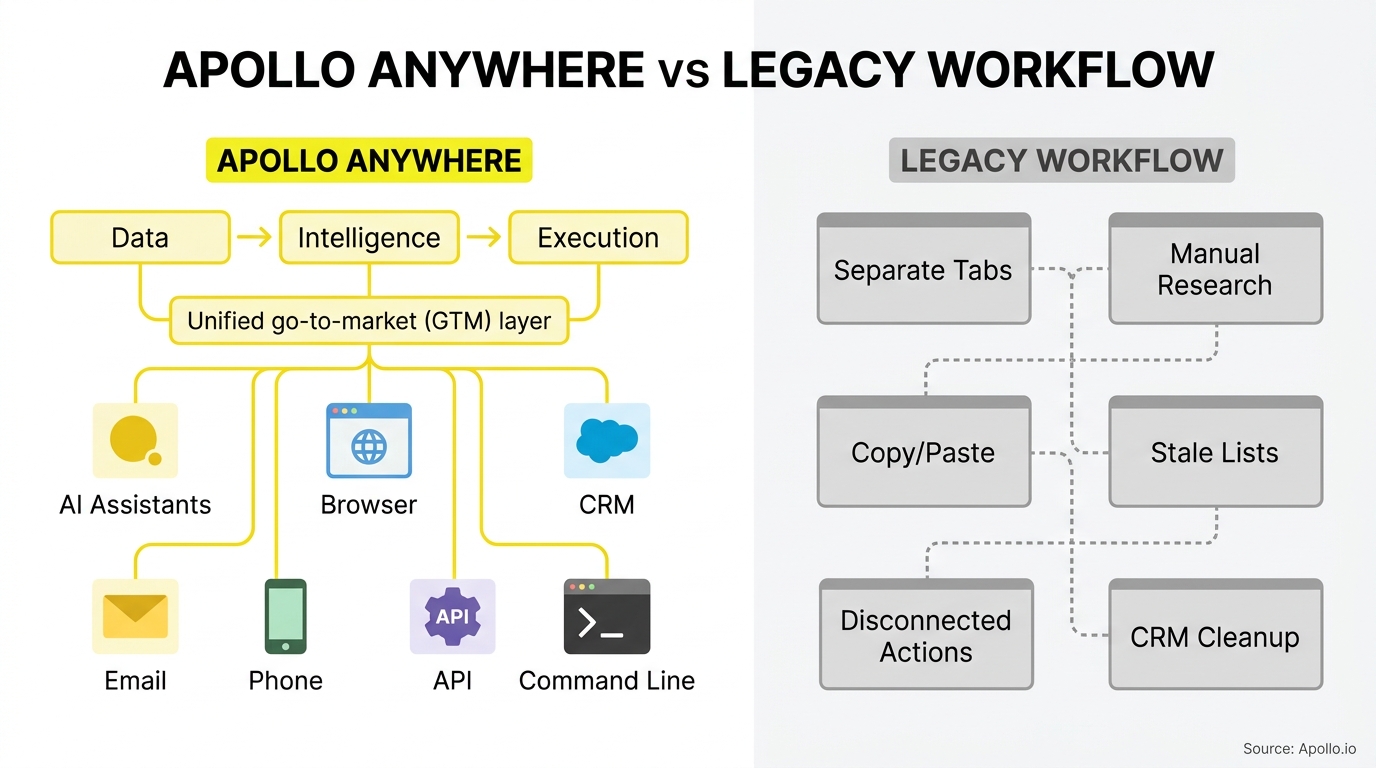
Compare options by how well they connect data, routing, and engagement, rather than by feature count alone. Apollo's AI platform brings B2B data, sales engagement, and AI-powered execution together in one connected go-to-market system, so teams don't have to stitch together separate vendors for research, outreach, and analysis.
GTM Engineers and AI Builders can also reach Apollo from the tools they already use. Apollo MCP connects Apollo data to AI assistants like Claude, ChatGPT, and Perplexity, and the Apollo API and CLI support custom workflows. Users control which contacts they target and how they use the product.

What Should RevOps Leaders Do Next?
Start with an audit, not a purchase. The strongest B2B marketing automation case studies share one pattern: the team documented routing, cleaned its fields, and measured pipeline before changing tools.
- Marketing leaders: inventory the features you already pay for and retire any workflow nobody maintains.
- RevOps leaders: write down one attribution rule and one routing rule, then test both on a small cohort.
- SDRs and BDRs: track lead acceptance and first-touch speed weekly, and flag leads that arrive without a usable business contact.
- Sales leaders: review meetings booked and pipeline created, not just email opens.
Fresh data enrichment keeps your CRM fields complete, and sales engagement sequences turn routed leads into conversations inside the same workspace. When marketing and sales share one system, the handoff stops being the place leads go to die.
Ready to test this on your own pipeline? Start Prospecting with Apollo and run your first automation cohort with data, routing, and outreach in one place.
Frequently Asked Questions
What should a B2B marketing automation case study include?
A credible case study names the starting problem, the stack before the change, the specific workflows changed, and the metrics used to judge results. It should show a baseline and a time frame.
Without those, a percentage gain is hard to trust or repeat.
How long does it take to see results from marketing automation?
Speed-to-lead and lead acceptance usually move within the first few weeks of a routing fix. Pipeline and revenue take longer because they follow your sales cycle.
Set review checkpoints at 30, 60, and 90 days, and compare each cohort against its baseline.
Do we need a new platform to improve automation results?
Not always. Many teams get better results by cleaning CRM fields, simplifying routing, and retiring unused workflows in the tools they already own.
Replace a platform only when an audit shows a gap you cannot close with your current setup.
Which metrics matter most for evaluating automation?
Focus on metrics tied to revenue: lead acceptance rate, time to first touch, meetings booked, and pipeline created. Email opens and clicks are useful diagnostics, but they should not be the measure of success.
Conclusion
The best B2B marketing automation case studies are not about buying more software. They show teams that documented their routing, kept their data complete, and measured pipeline before and after each change.
Run the same process on a small cohort, and you will know quickly what is worth scaling.
Apollo brings contact data, enrichment, and outreach into one workspace so marketing and sales work from the same records. Start Prospecting with Apollo today and build your first automation workflow on accurate data.
Prove Your Sales Stack's ROI With Apollo
Budget review coming and no clear proof your tools drive pipeline? Apollo puts prospecting, outreach, and results in one place, so you can show impact fast. Leadium tripled annual revenue and Built-In grew win rate and ACV by 10% each.
Start Free with Apollo →Don't miss these
Sales
Inbound vs Outbound Marketing: Which Strategy Wins?
Sales
What Is a Sales Funnel? The Non-Linear Revenue Framework for 2026
Sales
What Is a Go-to-Market Strategy? The 2026 GTM Playbook
See Apollo in action
We'd love to show how Apollo can help you sell better.
By submitting this form, you will receive information, tips, and promotions from Apollo. To learn more, see our Privacy Statement.
4.7/5 based on 9,690 reviews
