
How Does Data Sync Improve B2B Sales and Marketing ROI?
Your CRM shows one revenue figure. Your marketing automation platform shows another.
Your sales engagement tool has yet another version of the truth. Sound familiar?
Data synchronization issues cost B2B companies millions in lost revenue, wasted time, and missed opportunities.
According to Martech.org, only 28% of B2B content marketers have the technology they need, with 48% citing integration of data across multiple platforms as their biggest challenge. The cost of fragmented data goes beyond frustration—it directly impacts your ability to execute effective go-to-market strategies.

Apollo Finds Contacts While You Close Deals
Tired of spending 4+ hours daily hunting for contact info? Apollo delivers 224M verified contacts with 96% email accuracy instantly. Join 550K+ companies who stopped researching and started selling.
Start Free with Apollo →Key Takeaways
- Data sync keeps customer information consistent across CRM, marketing automation, and sales engagement platforms in real-time
- 66% of B2B marketers prioritize improving data quality to enhance GTM strategies
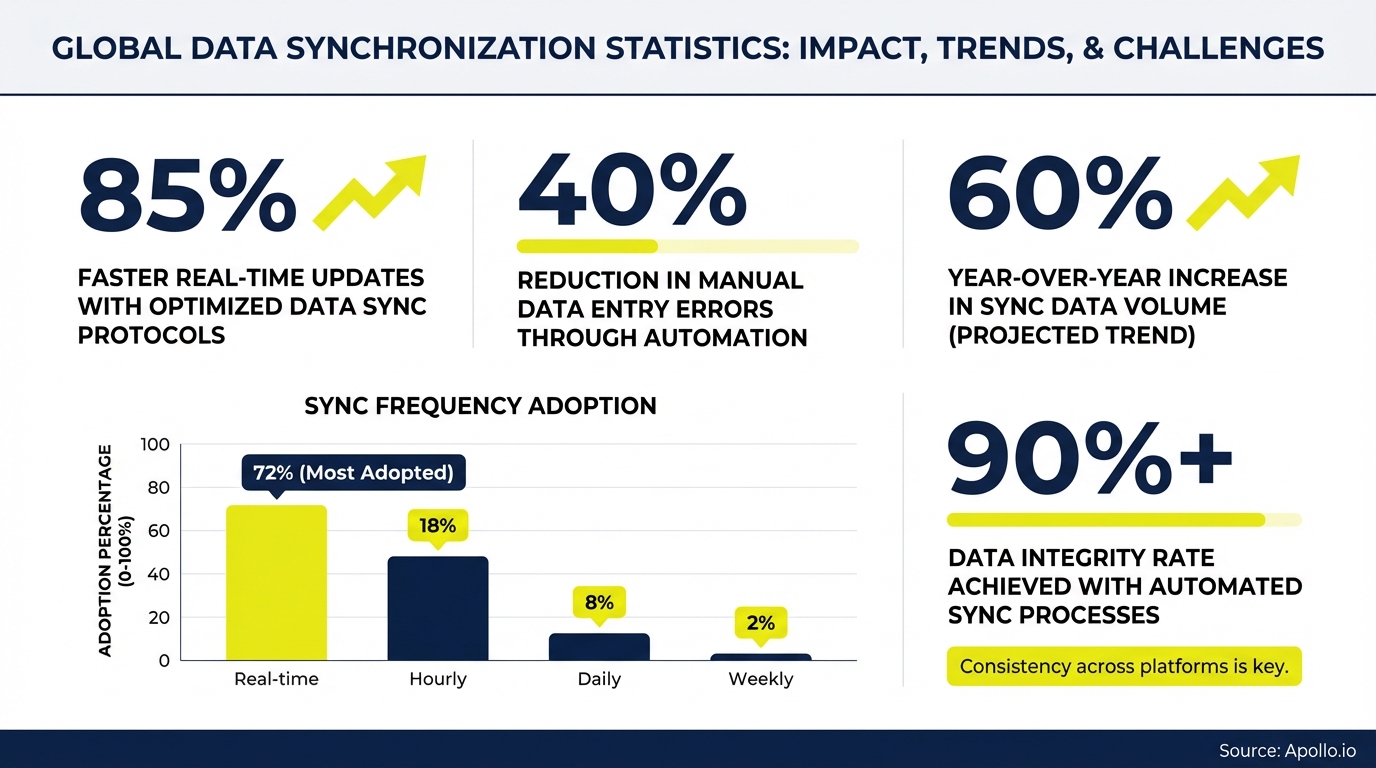
- Effective data synchronization increases meeting bookings by 75% and doubles call conversations
- API-based sync, Change Data Capture (CDC), and ESB architectures each serve different business needs
- Data governance and quality standards must be established before implementing sync solutions
What Is Data Synchronization and Why Does It Matter for B2B Teams?
Data synchronization is the automated process of keeping information consistent and up-to-date across multiple business systems. When a sales rep updates a contact's phone number in your CRM, that change should instantly appear in your marketing automation platform, sales engagement tool, and analytics dashboard.
For B2B sales and marketing teams, data sync solves three critical problems:
- Eliminates manual data entry: Reps spend hours copying information between systems instead of selling
- Prevents conflicting information: Multiple versions of truth create confusion and erode trust in data
- Enables real-time decision-making: Teams can act on current information rather than outdated snapshots
"Apollo enriches everything we have: contacts, leads, accounts... And we don't really have to touch it, it just works."
Research by Martech.org shows that 66% of B2B marketers prioritize improving data quality to enhance their go-to-market strategies. Data sync is the foundation that makes quality data actionable across your entire revenue organization.

How Do Different Data Sync Architectures Work in B2B Stacks?
Choosing the right data synchronization architecture depends on your business requirements, technical resources, and existing infrastructure. Here's how the four primary approaches compare:
| Architecture | Best For | Real-Time Capability | Technical Complexity |
|---|---|---|---|
| API-Based Sync | Modern cloud platforms with REST APIs | Near real-time (minutes) | Medium |
| Change Data Capture (CDC) | Database-level sync with minimal latency | Real-time (seconds) | High |
| Enterprise Service Bus (ESB) | Complex enterprise environments with many systems | Near real-time | High |
| Master Data Management (MDM) | Organizations needing single source of truth | Batch or near real-time | Very High |
API-Based Synchronization
API-based sync connects platforms through documented interfaces, making it the most common approach for B2B sales stacks. Modern platforms like Apollo's API enable seamless two-way data flow between your CRM, marketing automation, and sales engagement tools.
Change Data Capture (CDC)
CDC monitors database transaction logs to capture changes as they happen. This approach delivers true real-time synchronization but requires database-level access and technical expertise to implement correctly.
When to Use Each Architecture
Start with API-based sync if you're using modern SaaS platforms with documented APIs. Move to CDC only when sub-second latency is critical for your use case.
Reserve ESB and MDM for enterprise environments with dozens of systems requiring complex transformation logic.
What's the Step-by-Step Playbook for Implementing Data Sync?
Successful data synchronization requires methodical planning and execution. Here's a practical playbook for B2B teams:
Phase 1: Audit Your Current State
Map every system that touches customer data. Document what data lives where, how often it updates, and who owns each field.
Create a data flow diagram showing how information moves between systems today.
Phase 2: Define Data Standards and Governance
Establish field mapping standards before connecting systems. Decide which system is the source of truth for each data type.
For example, CRM owns account data while marketing automation owns campaign engagement data.
Set data quality rules: required fields, format standards, and validation criteria. Without governance, you'll sync garbage faster.
Phase 3: Choose Your Sync Pattern
- One-way sync: Data flows from source to destination only (e.g., marketing leads to CRM)
- Two-way sync: Changes in either system update the other (e.g., CRM and sales engagement platform)
- Selective sync: Only specific records or fields synchronize based on criteria
"Having Apollo and having everything be in one system was a game changer — for BDRs specifically."
Phase 4: Implement and Monitor
Start with a pilot involving one team and limited data types. Monitor sync success rates, latency, and data quality metrics daily. Expand gradually once the pilot proves stable.
Struggling with data quality across multiple systems? Apollo's automated enrichment keeps 224M+ contacts fresh across your entire tech stack.
Turn Forecast Chaos Into Revenue Certainty
Pipeline forecasting a guessing game? Apollo's real-time deal intelligence shows exactly where every opportunity stands. Built-In increased win rates 10% with Apollo's buying signals and scoring.
Start Free with Apollo →How Do You Measure Data Sync ROI and Success?
Track these metrics to quantify the business impact of effective data synchronization:
| Metric | What It Measures | Target Improvement |
|---|---|---|
| Data Quality Score | Percentage of complete, accurate records | 90%+ across all systems |
| Sync Latency | Time from change to propagation | <5 minutes for critical fields |
| Manual Data Entry Hours | Time saved from automated sync | 10+ hours per rep per week |
| Data Conflict Rate | Records with mismatched information | <1% conflict rate |
| System Adoption Rate | Percentage of team using each platform | 95%+ daily active users |
Real-world impact: Companies implementing proper data sync see 75% increases in meetings booked and double their call conversation rates by ensuring reps always have current, accurate contact information.
Building Your Data Health Dashboard
Create a centralized dashboard tracking sync health across all systems. Include real-time metrics on sync success rates, error types, and data quality scores.
Set up automated alerts when sync failures exceed thresholds.
Tools like Apollo's Data Health Center provide instant visibility into data quality issues before they impact revenue activities.

What Are the Common Data Sync Pitfalls and How to Avoid Them?
Even well-planned data sync implementations face challenges. Here's how to prevent the most common issues:
Conflict Resolution Without Clear Rules
When two systems update the same field simultaneously, which wins? Define conflict resolution logic upfront: last-write-wins, source-of-truth-wins, or manual review for critical fields.
Syncing Too Much, Too Fast
Don't sync every field in every record. Prioritize business-critical data that directly impacts revenue activities.
Start with contact information, engagement history, and deal status before expanding to custom fields.

Ignoring Data Privacy and Compliance
Ensure your sync process respects data residency requirements and privacy regulations. Not all data should sync to all systems, especially when dealing with sensitive information or cross-border transfers.
Neglecting Error Handling and Recovery
Build retry logic for temporary failures. Log all sync errors with enough detail to diagnose issues. Create escalation paths for persistent failures that require human intervention.
Need a unified platform that eliminates sync headaches? Apollo combines prospecting, engagement, and enrichment in one workspace, reducing the number of systems you need to sync.
How Is Data Sync Evolving for B2B Sales in 2026?
Three major trends are reshaping how B2B companies approach data synchronization:
AI-Powered Data Quality and Enrichment
Modern platforms use AI to automatically detect data quality issues, suggest corrections, and enrich incomplete records during the sync process. This reduces manual cleanup work and maintains higher data standards.
Event-Driven Architectures
Rather than polling systems for changes, event-driven sync reacts instantly when specific actions occur. When a prospect opens an email, engagement data flows immediately to your CRM, enabling real-time follow-up.
Embedded Sync in Go-to-Market Platforms
The trend toward all-in-one GTM platforms reduces sync complexity by consolidating prospecting, engagement, and analytics. Fewer systems mean fewer integration points and lower risk of data inconsistency.
Start Building Your Data Sync Strategy Today
Data synchronization isn't a one-time project—it's an ongoing operational capability that requires continuous monitoring and improvement. Start by auditing your current state, establishing clear governance, and implementing sync for your most critical data flows first.
The ROI is clear: companies with effective data sync see dramatic improvements in rep productivity, data quality, and revenue outcomes. The question isn't whether to invest in data synchronization, but how quickly you can implement it to stay competitive in 2026's digital-first B2B landscape.
Ready to eliminate data sync headaches? Try Apollo Free and experience the power of an all-in-one GTM platform with 224M+ verified contacts, automated enrichment, and seamless CRM integration.
Turn Trial Uncertainty Into Budget Approval
Budget stuck on unclear metrics? Apollo delivers measurable pipeline impact from day one—quantifiable time savings and win rate improvements that justify investment. Built-In increased win rates 10% and ACV 10% with Apollo's signals.
Start Free with Apollo →Don't miss these
Sales
Inbound vs Outbound Marketing: Which Strategy Wins?
Sales
What Is a Sales Funnel? The Non-Linear Revenue Framework for 2026
Sales
What Is a Go-to-Market Strategy? The 2026 GTM Playbook
See Apollo in action
We'd love to show how Apollo can help you sell better.
By submitting this form, you will receive information, tips, and promotions from Apollo. To learn more, see our Privacy Statement.
4.7/5 based on 9,690 reviews
