
How AI Assistants Help AEs Generate Pipeline Faster
Account executives carry the weight of quota every quarter, yet most spend the majority of their time on tasks that never directly create pipeline. Apollo's AI Sales Assistantis built specifically to change that equation: it researches accounts, builds prospect lists, generates signal-based outreach, and preps AEs for meetings, all from a single natural-language conversation.
The market has reached an inflection point. According to Cirrus Insight, AI adoption among sales representatives nearly doubled from 24% in 2023 to 43% in 2024. The teams pulling ahead are not just using AI to draft emails. They are using it as an embedded workflow layer that turns scattered signals into accepted pipeline.

Research Less, Close More With Apollo
Tired of your reps burning hours on manual research instead of selling? Apollo surfaces verified contacts instantly so your team spends time closing, not digging. Join 600K+ companies building pipeline faster.
Start Free with Apollo →Key Takeaways
- AEs who use AI as a workflow assistant, not just a writing tool, see measurably faster pipeline generation and higher quota attainment.
- Signal-based outreach (triggered by job changes, funding, or intent) dramatically improves reply rates because it reaches buyers at the right moment with relevant context.
- Apollo's AI Assistant covers the full AE pipeline workflow: account selection, research, sequence creation, meeting prep, follow-up, and CRM updates, in one platform.
- The biggest AI risk in 2026 is tool sprawl. AEs need AI embedded where they already work, not another dashboard to context-switch into.
- Measurable KPIs (accepted opportunities, meeting-to-opp conversion, cycle time) are now the standard for proving AI pipeline ROI.
Why Do Account Executives Struggle to Generate Pipeline Fast Enough?
Account executives struggle to generate pipeline fast enough because non-selling tasks consume the majority of their working hours. Manual account research, list building, message drafting, meeting prep, and CRM updates all compete for time that should go toward conversations.
The result is a pipeline that is perpetually thin relative to quota targets.
The problem compounds because volume-based outreach backfires. A Gartner 2025 B2B buyer survey found 73% of buyers actively avoid suppliers that send irrelevant outreach. AEs cannot win by sending more messages. They win by sending the right message to the right account at a signal-triggered moment, at scale.
What Is the Pipeline Velocity Equation for AEs Using AI?
The pipeline velocity equation for AEs using AI combines three factors: time recaptured from manual work, message relevance grounded in account signals, and human review before sending. Remove any one leg and the result degrades: fast but generic outreach gets ignored; relevant but slow outreach misses the window; unreviewed AI output carries compliance and brand risk.
An AI assistant addresses all three simultaneously when it is embedded in the AE's existing workflow rather than living in a separate tool. Gartner predicts that by 2028 fewer than 40% of sellers will report AI agents improved productivity, specifically because disconnected tools add friction rather than reduce it. The winning architecture is workflow-native AI.
Spending too much time building prospect lists manually? Search Apollo's 230M+ contacts with 65+ filters and let the AI Assistant build your list from a single prompt.

How Do AEs Generate Qualified Pipeline Faster with an AI Assistant?
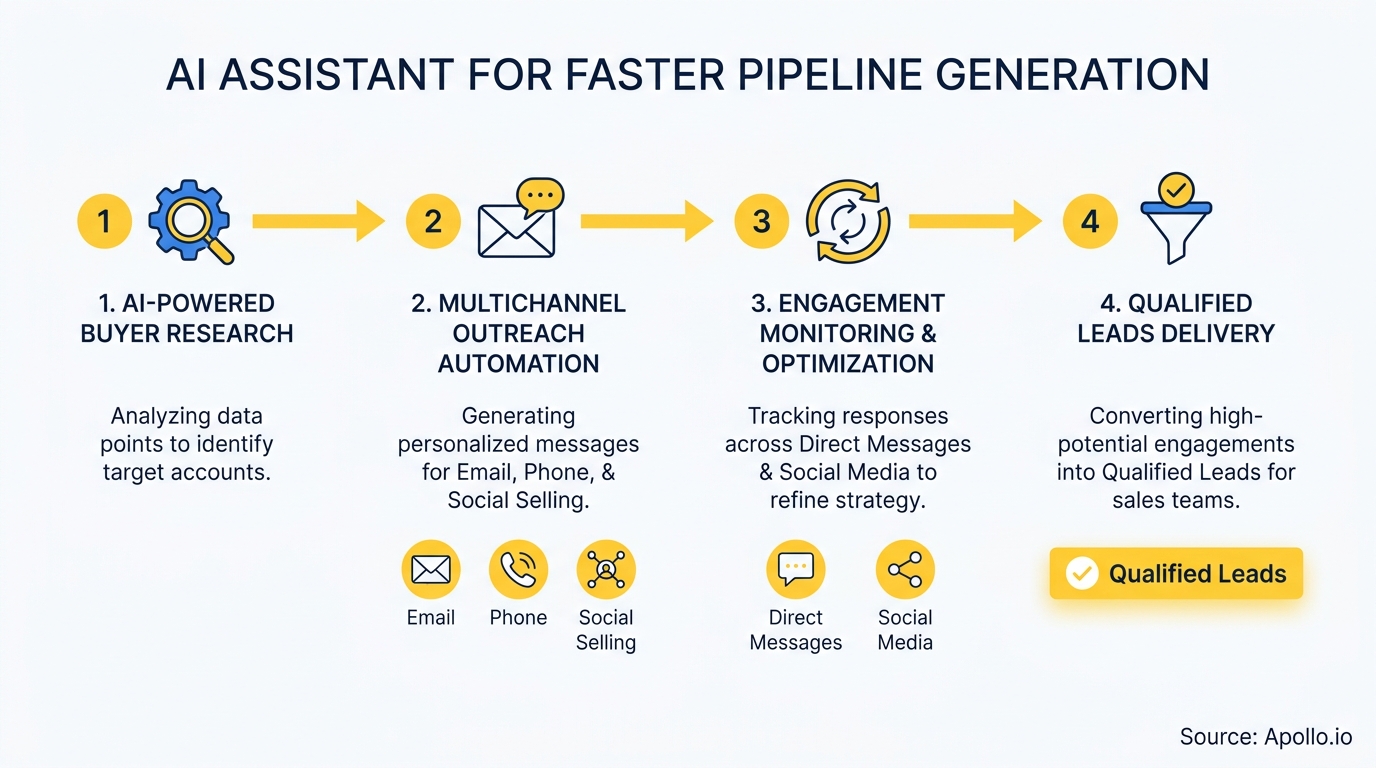
AEs generate qualified pipeline faster by running the full prospecting-to-meeting workflow through a single AI assistant rather than switching between multiple tools. The workflow breaks into six stages, each with a measurable handoff point:
| Stage | AI Action | KPI to Measure |
|---|---|---|
| Account Selection | Score and tier accounts by ICP match using AI Scores | Accounts worked vs. total territory |
| Trigger Research | Surface job changes, funding events, and intent signals via AI Research | Signal-triggered accounts per week |
| Outreach Draft | Generate multi-channel sequences grounded in Content Center context | Reply rate, meeting booked rate |
| Meeting Prep | Auto-summarize company priorities and past interactions before each call | Meeting-to-opportunity conversion |
| Follow-Up | Draft personalized follow-up using conversation summaries | Follow-up send time, deal velocity |
| CRM Update | Log call notes and next steps automatically | CRM data completeness, forecasting accuracy |
Learn how job change alerts can turn CRM updates into pipeline wins by catching trigger moments the moment they happen.
How Does Apollo's AI Assistant Help AEs Build Pipeline from Prompt to Accepted Opportunity?
Apollo's AI Assistant helps AEs move from a single natural-language prompt to an accepted opportunity by handling research, list building, sequence creation, and meeting preparation without requiring the AE to click between tools. It is workflow-native: embedded across prospecting, sequences, workflows, and analytics inside Apollo's unified platform.
Here is how each capability maps to the AE pipeline motion:
- Web-Powered List Building: Ask "Find Series B SaaS companies in fintech with 50-200 employees" and the AI builds the list from live web data. Learn more in the AI Assistant to Sell Smarter guide.
- AI Research: Generates account-level and contact-level insights grounded in real signals (funding, tech stack, recent news). See the AI Research Overview for detail on available models.
- AI Sequence Builder + Messaging 4.0: Produces full multi-channel sequences (email, call, social, tasks) from one prompt, with personalization drawn from account context rather than generic templates.
- AI Content Center: Grounds every AI-generated message in your value proposition, ICP pain points, and differentiators so outreach stays on-brand and relevant. Configure the AI Content Center once and it powers all downstream outputs.
- Pre-Meeting Insights: Summarizes company priorities, identifies meeting attendees, and surfaces objections from prior interactions before the AE joins the call.
- Post-Meeting Follow-Up: Auto-drafts follow-up emails using conversation summaries so AEs send context-rich notes within minutes of hanging up.
Teams using Apollo's AI-powered messaging have seen a 35% increase in bookings. As Harry Gable-Newkirk, Enterprise Sales Development Manager at YipitData, put it: "Apollo's AI Assistant helped me instantly qualify or disqualify accounts using the right signals, saving me at least a full day's work."
Turn Funnel Chaos Into Quota Wins
Pipeline forecasting a guessing game? Apollo surfaces in-market buyers the moment they're ready, so your team stops chasing cold leads and starts closing real opportunities. Nearly 100K paying customers can't be wrong.
Start Free with Apollo →How Can AEs Avoid Generating Irrelevant Outreach with AI?
AEs avoid generating irrelevant outreach by grounding every AI-produced message in real account signals rather than static templates.
The three practices that matter most are: configuring the AI Content Center with specific value propositions and ICP pain points, triggering outreach from live signals (funding, job changes, intent), and reviewing AI drafts before sending rather than automating without oversight.
Research from The Starr Conspiracy found B2B companies using AI-powered lead generation witnessed an average 73% increase in qualified leads within six months. The difference between those outcomes and generic AI blasts is context: AI that knows your product, your ICP, and the prospect's current situation produces messages buyers respond to.
Apollo's Outbound Copilot includes manual approval gates before prospects are added to sequences, giving AEs full control over who receives outreach and when.
What KPIs Prove an AI Assistant Is Generating Pipeline ROI for AEs?
The KPIs that prove AI pipeline ROI for AEs are opportunity acceptance rate, meeting-to-opportunity conversion, average deal cycle time, and pipeline coverage ratio. Generic "time saved" claims are not sufficient.
Sales leaders now ask whether AI-generated pipeline actually advances through the funnel at higher rates than manually sourced pipeline.
Track these metrics at the workflow level:
- Accepted Opportunities: Did AI-sourced accounts convert to accepted opps at a higher rate than cold list pulls?
- Reply Rate by Signal Type: Do job-change-triggered sequences outperform static sequences?
- Meeting-to-Opp Conversion: Are AI-prepped meetings converting to opportunities at a measurably higher rate?
- Cycle Time: Are deals sourced with AI context (pre-meeting summaries, follow-up drafts) closing faster?
- Pipeline Coverage: Is the AE maintaining the required coverage ratio with less manual effort?
For a deeper look at tying pipeline activity to accurate forecasts, see best practices for forecasting accuracy.
Struggling to maintain pipeline coverage without burning hours on manual research? Build qualified pipeline faster with Apollo's AI-powered pipeline tools.
How Does Apollo Consolidate the AE Tech Stack for Pipeline Generation?
Apollo consolidates the AE tech stack by combining sales intelligence, outreach automation, conversation intelligence, deal management, and AI assistance in a single platform. AEs no longer need separate tools for prospecting data, sequence execution, call recording, and follow-up drafting.
Customers describe the impact directly. "Having everything in one system was a game changer" (Cyera). "We reduced the complexity of three tools into one" (Predictable Revenue). For AEs, that consolidation means less context-switching, cleaner data, and faster execution from first signal to first meeting.
Data from Optif.ai shows 89% of revenue organizations were using AI-powered tools in 2025, up from 34% in 2023. The teams that consolidate those tools into a unified workflow rather than managing a fragmented stack are the ones converting AI adoption into pipeline outcomes. For more on building scalable pipeline through automation, see what sales automation done right looks like and review lead generation best practices for filling your pipeline.

Start Generating Pipeline Faster with Apollo's AI Assistant
An AI sales assistant for account executives earns its place when it reduces the gap between signal and outreach, between meeting and follow-up, and between territory and accepted pipeline. Apollo's AI Assistant is built for that end-to-end motion: account research, list building, sequence creation, meeting prep, and post-call follow-up, all from one platform.
AEs using Apollo report measurable gains at every stage of the pipeline workflow. The platform's AI is grounded in real account context, governed by human review, and consolidated into the workspace where selling already happens.
Request a demo and see how Apollo's AI Assistant helps account executives generate qualified pipeline faster in 2026.
Prove Pipeline ROI With Apollo
ROI pressure killing your next budget approval? Apollo gives sales leaders clear, measurable pipeline impact from day one. Nearly 100K paying customers justified the investment — and kept renewing.
Start Free with Apollo →Don't miss these
Sales
Inbound vs Outbound Marketing: Which Strategy Wins?
Sales
What Is a Sales Funnel? The Non-Linear Revenue Framework for 2026
Sales
What Is a Go-to-Market Strategy? The 2026 GTM Playbook
See Apollo in action
We'd love to show how Apollo can help you sell better.
By submitting this form, you will receive information, tips, and promotions from Apollo. To learn more, see our Privacy Statement.
4.7/5 based on 9,690 reviews
