
Top 9 ZoomInfo Alternatives for GTM Teams in 2026
ZoomInfo is a widely used B2B intelligence platform offering contact data, buyer intent signals, and sales automation. But for many teams, the contract structure gives pause: according to Vendr, based on data from 1,568 purchases, the median annual contract sits at $33,500, with potential overage fees reaching $10,000–$50,000 when credit limits are exceeded. Add annual price escalation clauses and the need to negotiate pricing through sales, and it's clear why GTM teams actively explore alternatives.
Teams leave for different reasons: some want transparent self-serve pricing, others need deeper outbound execution built into the same tool, and some simply want a platform where data, sequences, and dialers live together rather than requiring separate modules or negotiations. Whatever your reason, this guide covers the top 9 alternatives to ZoomInfo, starting with Apollo, the fastest-growing platform in the category.

Research Less, Close More With Apollo
Tired of burning hours verifying contact info instead of selling? Apollo surfaces accurate leads instantly so your team spends time closing, not chasing. Nearly 5M users have already made the switch.
Start Free with Apollo →Key Takeaways
- Apollo: AI sales platform combining 240M+ contacts, outbound sequencing, dialing, and inbound routing, transparent pricing starting at $49/user/month with a free tier included.
- Cognism: Compliance-first contact data with phone-verified mobile numbers, strong for EMEA-focused teams. Pricing requires contacting sales.
- Lusha: Credit-based contact intelligence with AI-powered search and MCP integrations. Paid plans starting at $37.45/month billed annually.
- RocketReach: Contact lookup platform for sales, recruiting, and marketing with a large professional database. Enterprise plans start at $6,000/year.
- Clearbit: Data enrichment and IP intelligence platform, now part of HubSpot. No standalone pricing available.
- LeadIQ: Prospecting and contact capture tool built for outbound sales teams. Pricing not publicly displayed.
- Seamless.AI: Real-time AI-driven contact data with built-in pitch intelligence and buyer intent. Pricing not publicly displayed.
- UpLead: Real-time verified B2B email and phone data with technographic filters. Paid plans starting at $74/month billed annually.
- Lead411: Budget-accessible data platform with intent triggers and rollover exports. Spark plan starts at $49/month.
Apollo

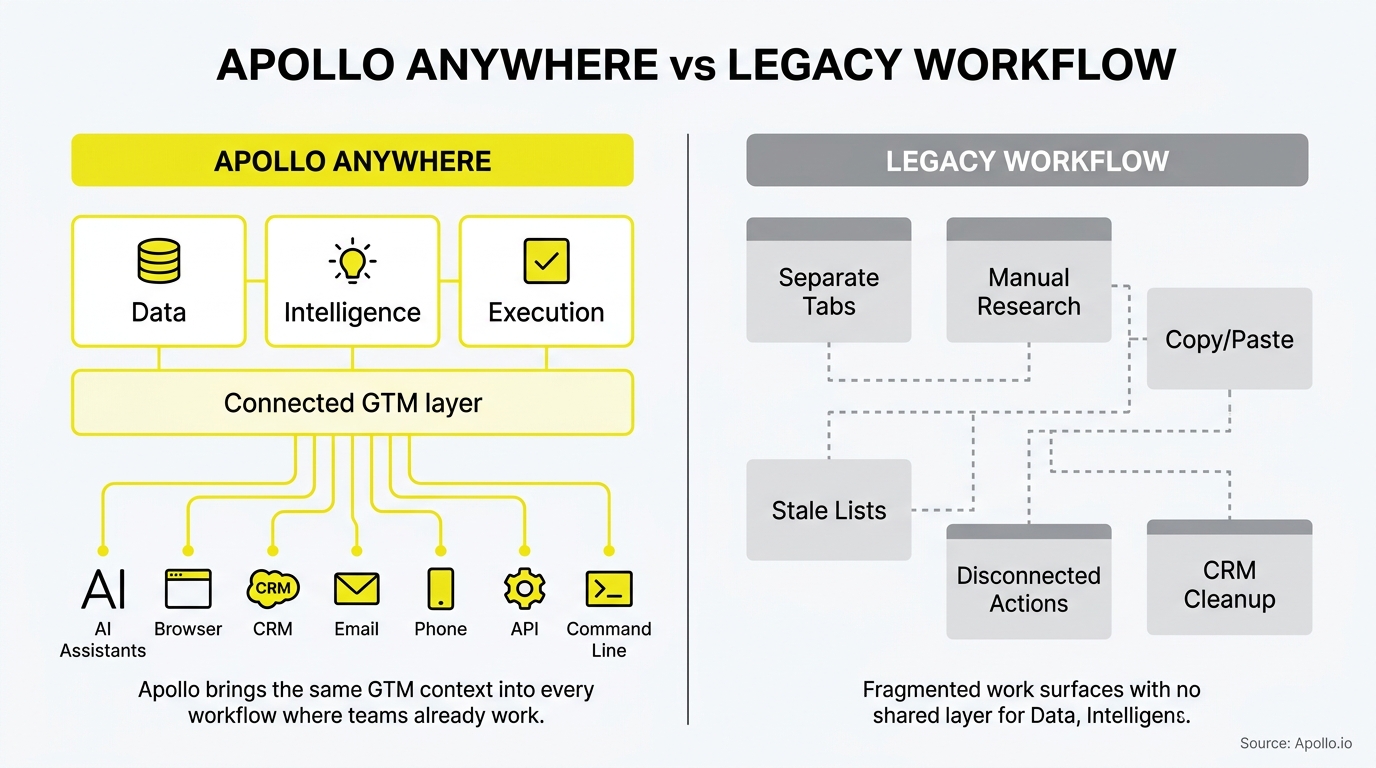
Apollo is an AI sales platform that unifies data, intelligence, and execution into one connected GTM system. Where ZoomInfo typically offers contracts and capabilitiess for data, engagement, and conversation intelligence, Apollo delivers prospecting, sequencing, dialing, enrichment, inbound routing, and AI automation from a single workspace, at transparent, self-serve pricing.
Apollo serves B2B GTM teams, GTM Engineers, and AI Builders building headless GTM workflows with the Apollo MCP, Apollo API, and Apollo CLI, alongside Sales Professionals, SDRs/BDRs, AEs, RevOps, Marketing, and Revenue Leaders. Apollo is built open by design, meeting sellers inside the tools they already use, from AI assistants like ChatGPT, Codex, Claude, and Perplexity via Apollo MCP, to the Chrome extension and Salesforce, rather than requiring teams to switch contexts to get value.
Data and intelligence: Apollo's database spans 240M+ people and 30M+ companies, continuously validated and refreshed through Apollo's Living Data Network, not a static snapshot. With 98% email accuracy and 65+ search filters, teams can build precise ICP lists, monitor buyer intent signals, and let the AI Research Agent rank and summarize accounts before outreach begins.
Outbound execution: Multi-channel sequences span email, phone, and social. The Power Dialer and Parallel Dialer eliminate manual dialing, with AI-generated call scripts, automatic voicemail drop, and call summaries pushed directly to CRM. Apollo's AI Sequence Builder generates full sequences from natural language prompts. Teams using AI-powered messaging have reported a 35% increase in bookings.
Inbound and enrichment: Apollo Inbound identifies website visitors, shortens forms, routes leads using criteria-based or round-robin logic, and triggers AI nurture sequences on form submit. Data Enrichment runs on schedule or in real time, with waterfall enrichment pulling from multiple sources and writing results back to Salesforce or HubSpot automatically.
"Apollo enriches everything we have: contacts, leads, accounts...And we don't really have to touch it, it just works.", Mark Turner, VP of Revenue Operations at Built In
Pricing (full details, annual billing): Free ($0, 900 credits/year), Basic ($49/user/month, 30,000 credits/year, unlimited sequences, CRM integrations), Professional ($79/user/month, 48,000 credits/year, US dialer, AI research, automated workflows), Organization ($119/user/month, min 3 users, 72,000 credits/year, international dialer, SSO, advanced security).
According to Ramp's vendor data, as of August 2026, Apollo holds a 39% adoption rate in its software category, up 5 percentage points year over year, ranking #1 for new adopter capture, meaning more teams buying a sales data platform for the first time choose Apollo than any other vendor.
Zooming out to the category level, Ramp's Sales Data Providers category data as of August 2026 shows Apollo is the fastest-growing vendor in the segment, averaging +0.6 percentage points of adoption growth per month, more than triple the growth rate of the next fastest competitor.
Apollo holds a 4.7/5 G2 rating and won the 2026 MarTech Breakthrough Award for "Best AI-Powered Sales Solution". With nearly 5M users and 100K+ paying customers, including 100+ teams at Fortune 500 companies, Apollo is trusted across every GTM motion and team size.
"We paid less for one tool than for two tools together...we cut our costs in half.", Sylvain Giuliani, Head of Growth & Operations at Census
Cognism

Cognism is a B2B sales intelligence platform focused on verified contact data, particularly for teams with EMEA coverage requirements. Its standout offering is Diamond Data, phone-verified mobile numbers that Cognism reports deliver higher connect rates than standard mobile data.
Key features: Firmographic, technographic, and signal-based filtering; intent data (hiring, funding, M&A, job changes); AI-powered company research; CRM enrichment for automated record maintenance; and Data-as-a-Service via API or bulk delivery. Cognism integrates with Salesforce, HubSpot, and Pipedrive.
Pricing: Cognism's pricing is not publicly displayed on their official website. The platform offers Standard and Pro tiers (minimum 5 seats each), with a credit-based model where one credit reveals one contact record. According to Vendr, based on data from 108 purchases with 107 deals handled, the median annual contract value is $36,000, ranging from $18,350 to $93,886.
- Pros: Phone-verified mobile data; strong compliance positioning for GDPR/CCPA markets; intent and signal data on the Pro tier.
- Cons: No built-in outbound sequencing or dialing on the core platform; minimum 5-seat commitment; pricing requires contacting sales.
Related reading:Apollo vs Cognism
Lusha

Lusha is a B2B contact intelligence platform providing verified emails and phone numbers enriched with buying signals for GTM teams. It includes an intelligence layer that learns business context to surface relevant accounts and next actions. Lusha also supports AI assistants via Lusha MCP, integrating with Claude, ChatGPT, and Perplexity.
Key features: Buying signals (funding, hiring, leadership changes); AI-powered natural language search; CRM auto-enrichment (Salesforce, HubSpot, Monday.com, Zoho); API access and automation workflows (Zapier, Make, n8n, Clay); and a browser extension for web prospecting.
Pricing (official page): Free ($0, 40 credits/month); Starter ($37.45/month billed annually, 4,800 credits/year, 1 seat); Pro ($45.45/month billed annually, 7,200 credits/year, 2 seats); Premium ($259.95/month billed annually, 40,800 credits/year, 5 seats); Scale (custom, contact sales). Note: 1 phone reveal costs 5 credits vs. 1 credit for email.
- Pros: Accessible entry-level pricing; AI search and MCP integrations; broad signal coverage.
- Cons: Phone reveals consume credits at 5x the rate of email reveals, limiting calling volume on lower tiers; limited built-in engagement execution tools; annual credit pools reset at cycle end.
Explore the Apollo vs Lusha breakdown.
RocketReach

RocketReach is a lead intelligence and contact data platform serving sales teams, recruiters, and marketers. According to RocketReach, its database spans over 700 million professionals and 60 million companies worldwide. It includes an AI message writer and an Autopilot feature for automated prospect discovery workflows.
Key features: Verified emails and mobile phone numbers; 100+ advanced search filters; real-time verification; AI-powered recommendations; Messages feature for email outreach with automated follow-ups; and Autopilot for prospect discovery automation.
Pricing: RocketReach's individual plan pricing is not publicly displayed on their official website without account signup. Team/Custom plans start at $6,000/year. According to Vendr, the median annual contract value is $6,750, ranging from $1,800 to $13,340.
- Pros: Broad global database; flexible individual and team plan structures; recruiter-friendly use case coverage.
- Cons: Individual plan pricing requires account signup to view; lighter on intent and signal data compared to dedicated intelligence platforms; built-in engagement tools are limited in scope.
Related:Apollo vs RocketReach

Clearbit

Clearbit was acquired by HubSpot in 2023. Its data enrichment capabilities are now part of HubSpot's platform. Clearbit specializes in B2B data enrichment using public web data, proprietary data, and LLMs to convert unstructured information into standardized datasets. It is particularly strong for enrichment-focused use cases: lead scoring, routing, form shortening, and IP-based website visitor identification.
Key features: Enrichment with 100+ data points across 250+ sources; real-time record refresh on change detection; corporate hierarchy mapping; IP intelligence for anonymous visitor identification; form shortening and dynamic optimization; and 6-digit NAICS/GICS/SIC industry categorization for precise lead routing.
Pricing: Clearbit was acquired by HubSpot in 2023. No standalone Clearbit pricing page is available, enrichment features are now part of HubSpot's platform. Contact HubSpot directly for current pricing details.
- Pros: Deep enrichment accuracy with real-time refresh; strong IP intelligence and visitor identification; native HubSpot integration post-acquisition.
- Cons: No standalone product or pricing since acquisition; limited outbound execution features; best suited for enrichment use cases rather than full prospecting workflows.
Related reading:Apollo vs Clearbit
Turn Funnel Guesswork Into Pipeline Wins
Pipeline forecasting a guessing game because marketing leads never convert? Apollo surfaces in-market buyers with verified contact data so every rep works a funnel that actually moves. 600K+ companies stopped guessing and started closing.
Start Free with Apollo →LeadIQ

LeadIQ is a prospecting and contact capture platform built for outbound sales teams. It focuses on helping SDRs capture contact data during research, sync records to CRM, and trigger timely outreach based on job change signals and account tracking.
Key features: Contact capture during prospecting research; job change tracking for timely outreach triggers; CRM sync (Salesforce, HubSpot, Salesloft, Outreach); account monitoring and signal alerts; and AI-assisted email personalization.
Pricing: LeadIQ's pricing is not publicly displayed on their official website. Teams would contact their sales team for pricing details.
- Pros: Streamlined workflow for SDRs capturing contacts during active research; strong CRM sync and signal alerting; purpose-built for outbound prospecting motions.
- Cons: Pricing not publicly displayed; lighter on full enrichment and inbound capabilities; limited AI automation depth for sequencing and dialing workflows.
See how Apollo compares to LeadIQ.
Seamless.AI

Seamless.AI is an AI-driven B2B lead intelligence platform that provides real-time contact data with verified emails and phone numbers. It includes Pitch Intelligence for personalized outreach, buyer intent signals, and job change tracking, along with a Connect platform for managing email, phone, and task workflows.
Key features: Real-time contact data verification; 100+ live data points per profile updated continuously; Pitch Intelligence for outreach personalization; buyer intent and job change signals; Connect platform for email, calls, and tasks; and integrations with Salesforce, HubSpot, Salesloft, and Zoho.
Pricing: Seamless.AI's pricing is not publicly displayed on their official website. Teams would contact their sales team for pricing details.
- Pros: Real-time data verification at point of search; built-in pitch intelligence and personalization layer; continuous data refresh model.
- Cons: Pricing not publicly displayed; real-time lookup model can result in variable data freshness; limited inbound routing and enrichment automation compared to broader GTM platforms.
Considering Seamless.AI? Here's how Apollo compares.
UpLead

UpLead is a B2B contact database and prospecting platform that verifies contact data in real time as users search, rather than pulling from a cached database. According to UpLead, its email verification rate is 95%. The platform includes technographic data covering over 16,000 technologies and buyer intent data on the Professional tier.
Key features: Real-time AI-verified emails and mobile direct dial numbers; technographic search across 16,000+ technologies; buyer intent data (Professional tier); data enrichment for CRM records; and integrations with Salesforce, HubSpot, Zoho, Pipedrive, and 1,500+ apps via Zapier.
Pricing (official page): Free Trial ($0/7 days, 5 credits); Essentials ($74/month billed annually, 2,040 credits/year); Plus ($149/month billed annually, 4,800 credits/year, adds enrichment and technographics); Professional (requested pricing, annual only, adds intent data and full API). One credit unlocks one contact, both email and mobile direct dial.
- Pros: Real-time verification at search time; transparent, self-serve pricing; technographic filtering for tech stack targeting.
- Cons: Buyer intent data only available on the custom Professional tier; limited built-in engagement and sequencing tools; smaller database than enterprise-tier alternatives.
Explore the Apollo vs UpLead breakdown.
Lead411

Lead411 is a B2B lead intelligence platform offering verified emails, direct dial numbers, and intent-based triggers. It targets outbound sales teams and SDRs who need accessible data with rollover export credits and signal-based alerts for timely outreach.
Key features: Verified email addresses and direct-dial mobile numbers; real-time intent triggers (hiring, funding, executive changes, company growth); AI search assistant; Chrome extension for research; CRM integration (Salesforce, HubSpot, Pipedrive, Outreach.io); and rollover exports, unused credits carry to the next billing cycle.
Pricing (official page): Free Trial ($0/7 days, 50 exports); Spark ($49/month or $490/year, 1,000 exports/month, annual plan includes Buyer Intent Data); Ignite (starting at $150/month or $1,500/year, flexible exports, team features, requested quotes required); Blaze (unlimited exports/year, contact sales). Unused exports roll over each billing cycle.
- Pros: Accessible entry pricing with rollover credits; Buyer Intent Data included in the annual Spark plan; transparent self-serve pricing across most tiers.
- Cons: Ignite pricing varies by team size and requires a requested quotes; limited built-in outbound sequencing and engagement automation; smaller global database than enterprise-scale alternatives.
Apollo vs Lead411, a closer look at the differences.
Comparison Table
| Platform | Database | Outbound Execution | AI Features | Starting Price | Free Tier |
|---|---|---|---|---|---|
| Apollo | 240M+ contacts, 30M+ companies | Sequences, Power/Parallel Dialer, AI workflows | AI Research Agent, Sequence Builder, call summaries, inbound routing | $49/user/month (annual), details | Yes, 900 credits/year |
| Cognism | Phone-verified mobile (Diamond Data), global coverage | Limited, data and filtering focus | AI company research, persona builder, intent signals | Median $36,000/year (Vendr, 108 purchases) | No |
| Lusha | According to Lusha, 300M+ contacts | Basic email sequences (Free tier) | AI search, MCP integrations, buying signal detection | $37.45/month billed annually (Starter) | Yes, 40 credits/month |
| RocketReach | According to RocketReach, 700M+ professionals, 60M+ companies | Messages feature with follow-ups; Autopilot workflows | AI recommendations, AI message writer | Team plans from $6,000/year; median $6,750 (Vendr) | Yes, 5 free lookups |
| Clearbit | 100+ enrichment data points, 250+ sources | None, enrichment and routing focus | LLM-powered data normalization, IP intelligence | Part of HubSpot, no standalone pricing | No |
| LeadIQ | Contact capture and job change tracking | CRM sync; integrates with Salesloft, Outreach | AI-assisted email personalization, signal alerts | Not publicly displayed | Limited |
| Seamless.AI | Real-time verified contacts, 100+ data points per profile | Connect platform (email, phone, tasks) | Pitch Intelligence, buyer intent, job change signals | Not publicly displayed | Limited |
| UpLead | Real-time verified B2B contacts, 16,000+ tech profiles | None built-in, CRM integrations only | Real-time AI verification at search; intent data (Professional) | $74/month billed annually (Essentials) | Yes, 7-day trial, 5 credits |
| Lead411 | Verified emails, direct dials, intent triggers | Chrome extension, CRM integration | AI search assistant, intent and trigger alerts | $49/month (Spark monthly) | Yes, 7-day trial, 50 exports |
| ZoomInfo (reference) | Comprehensive B2B contact and company database | Engage module, Chorus conversation intelligence | AI account prioritization, intent signals, buying committee discovery | Median $33,500/year (Vendr, 1,568 purchases) | No |
How to Choose the Right ZoomInfo Alternative
The right platform depends on where your biggest gap is: data coverage, execution, enrichment, or price transparency.
- If you need data + outbound execution in one place: Apollo is the most complete option, covering prospecting, sequencing, dialing, enrichment, and inbound routing with transparent self-serve pricing. Apollo's Living Data Network continuously refreshes records, making it suitable for teams that run high-volume outbound as well as inbound motions. For technical and advanced users, the Apollo API, CLI, and Apollo MCP support headless GTM workflows.
- If EMEA mobile coverage is critical: Cognism's phone-verified Diamond Data is particularly valuable for teams targeting European markets where direct mobile numbers are harder to source.
- If budget is the primary driver: Lead411's Spark plan and UpLead's Essentials tier offer accessible self-serve entry points. Apollo's free tier also provides a meaningful starting point before committing to a paid plan.
- If you are enrichment-first and already use HubSpot: Clearbit's capabilities are now native to the HubSpot ecosystem, no separate vendor relationship required.
- If you need signal-based outreach triggers: Cognism, Lead411, and Seamless.AI all surface intent signals, hiring activity, and funding events. Apollo also includes buyer intent and AI lead scoring as part of its sales engagement platform.
- If your team is evaluating for enterprise scale: Apollo's Organization tier includes SSO, advanced security, international dialing, and admin controls. Cognism and RocketReach also offer enterprise-tier structures through their sales teams.
Frequently Asked Questions
What is the best free ZoomInfo alternative?
Apollo offers the most capable free tier among the platforms covered here, 900 credits/year with access to core prospecting filters and two sequences, making it practical for testing before upgrading. Lusha (40 credits/month), UpLead (7-day trial, 5 credits), and Lead411 (7-day trial, 50 exports) also provide free access, though with more limited scope.
ZoomInfo does not offer a publicly available free tier.
How does Apollo compare to ZoomInfo on pricing?
Apollo publishes transparent, self-serve pricing starting at $49/user/month on annual billing, no sales call required to see costs or get started. As detailed in the Apollo section above, plans scale through Professional and Organization tiers. ZoomInfo's pricing is not publicly displayed on their official website; according to Vendr, based on 1,568 purchases, the median annual contract is $33,500, with overage fees possible when credit limits are exceeded.
Which ZoomInfo alternative is best for outbound sales teams?
Apollo is the most complete option for outbound teams because it combines contact data, AI-driven sequencing, Power and Parallel Dialers, and outbound analytics in one place. As covered in the comparison table, most other alternatives in this list focus on data sourcing and rely on integrations with separate engagement tools. Teams wanting a fully integrated outbound motion, data, sequences, and dialing together, will find Apollo the most direct fit. Read more about building outbound with Apollo in the lead generation guide.
Can I use Apollo for data enrichment, not just prospecting?
Yes. As covered in the Apollo section above, Apollo's enrichment capabilities include scheduled and real-time CRM enrichment, waterfall multi-vendor enrichment with customizable source order, CSV enrichment, and a REST API for bulk enrichment into external systems. Teams that already have CRM data can use Apollo purely for enrichment without running outbound sequences. Learn more about Apollo's data enrichment capabilities.

Conclusion
The ZoomInfo alternatives market in 2026 spans a wide range: from enrichment-only tools like Clearbit to data-first platforms like Cognism and Lusha, to full GTM execution systems. For most B2B sales teams looking to replace ZoomInfo, the key question is whether they want a narrower data tool or a platform that handles the full prospecting-to-pipeline workflow.
Apollo stands out as the strongest all-in-one alternative, combining a 240M+ contact database, outbound sequencing, AI-powered dialers, inbound routing, and data enrichment at transparent, self-serve pricing. It is the fastest-growing vendor in its category per Ramp's spend data, and it serves every GTM persona from individual SDRs to enterprise RevOps teams and AI Builders running headless workflows.
If you're ready to see what a unified data-and-execution platform looks like in practice, start for free today:Start Free with Apollo.
Prove Pipeline ROI Before Next Quarter
ROI pressure killing your tool budget before it even starts? Apollo delivers measurable pipeline impact fast — teams like Built-In saw +10% win rates and +10% ACV. Start free today.
Start Free with Apollo →Don't miss these
Sales
Inbound vs Outbound Marketing: Which Strategy Wins?
Sales
What Is a Sales Funnel? The Non-Linear Revenue Framework for 2026
Sales
What Is a Go-to-Market Strategy? The 2026 GTM Playbook
See Apollo in action
We'd love to show how Apollo can help you sell better.
By submitting this form, you will receive information, tips, and promotions from Apollo. To learn more, see our Privacy Statement.
4.7/5 based on 9,690 reviews
