A salesperson personality is the pattern of stable traits (like conscientiousness, extraversion, and emotional stability) that shapes how a seller prepares, communicates, and responds under pressure. There is no single ideal personality for sales.
Research points to adaptable, observable behaviors, not a universal "natural-born closer" profile.
That distinction matters if you hire, coach, or manage sellers. Labeling a rep as "too quiet" or "too nice" tells you very little. Watching how they run discovery, follow up, and adjust to different buyers tells you a lot. For a deeper look at how teams measure behavioral strengths, see how sales personality tests improve team ROI.

Skip Manual Research, Let Apollo Find Buyers
Tired of burning hours on manual lead research and data entry while quota clock keeps ticking? Apollo puts business contact info at your fingertips, with 98% email accuracy. Nearly 5M users already spend less time researching and more time selling.
Start Free with Apollo →Key Takeaways
- No single personality type wins in sales. Traits shape outcomes through adaptive behaviors, not on their own.
- Conscientiousness and extraversion show the clearest (but qualified) links to B2B sales outcomes in recent research.
- Introverts can succeed, especially when peer relationships and team support are strong.
- Balanced competitiveness and cooperation predicted better conversion performance in a 2026 B2B study.
- Coach observable behaviors (discovery quality, follow-through, channel switching) instead of personality labels.
What Personality Makes a Good Salesperson?
A good salesperson combines reliability, curiosity about the buyer, emotional control, and flexibility. Research does not support one winning personality.
It supports a set of behaviors that different personalities can produce in different ways.
According to University of Dallas business research, high performance in B2B sales is driven primarily by conscientiousness, emotional intelligence (specifically mentalizing), coachability, delayed gratification, and tactical flexibility. Notice that three of those five (emotional intelligence, coachability, tactical flexibility) are skills a seller can develop, not fixed traits.
Newer evidence reinforces the balance theme. An April 2026 study in Industrial Marketing Management matched surveys from 215 inside salespeople at one U.S. B2B financial-services company with objective performance records. Balanced competitive and cooperative traits positively predicted conversion-based performance. Supportive leadership strengthened that relationship, while unclear roles weakened it. The single-company sample limits how far you can generalize, but it challenges the idea that aggressive closers always win.
How Do the Big Five Traits Show Up in Sales Behavior?
The Big Five model describes personality across five dimensions. Each trait maps to observable selling behaviors, which is more useful for coaching than the trait label itself.
| Big Five Trait | Observable Selling Behaviors | Potential Watch-Out |
|---|---|---|
| Conscientiousness | Researches accounts before outreach, logs activity consistently, follows through on commitments | Over-preparing instead of making contact |
| Extraversion | Initiates conversations easily, builds rapport quickly, comfortable with cold outreach | Talking more than listening in discovery |
| Agreeableness | Builds trust, collaborates with colleagues, listens without defensiveness | Avoiding tough questions or price conversations |
| Emotional Stability (low neuroticism) | Recovers from rejection, stays composed in negotiations, handles quota pressure | Underestimating risk in a deal |
| Openness to Experience | Tests new messaging, adapts to new channels, asks creative discovery questions | Chasing novelty over proven plays |
A seller with high agreeableness is not automatically a weak negotiator. A seller with high extraversion is not automatically a strong one.
The trait sets a starting tendency, and behavior training shapes what happens next.
Does Personality Directly Predict Sales Performance?
Not on its own. Personality predicts sales outcomes mostly through the skills it supports, and the effect varies by what you measure.
A 2024 peer-reviewed study of 430 salespeople across countries and industries found that none of the five Big Five traits had a statistically significant direct effect on exploited cross-selling potential. Conscientiousness and extraversion did show positive indirect effects through adaptive selling skills. A seller does not cross-sell more simply because they are extraverted. They cross-sell more when that extraversion helps them adapt to each customer. You can read the underlying work on ResearchGate.
A separate study of 274 salespeople in Spanish organizations identified extraversion and conscientiousness as the most influential Big Five traits across the sales-work outcomes examined. It does not establish a universal percentage uplift or a hiring cutoff.
How Do the Key Studies Compare?
| Study Focus | Population | Main Finding | Key Limitation |
|---|---|---|---|
| Cross-selling and adaptive selling (2024) | 430 salespeople, multiple countries and industries | No direct Big Five effect; conscientiousness and extraversion work indirectly via adaptive selling | Measures cross-selling, not all sales outcomes |
| B2B sales-work outcomes (2023-2024) | 274 salespeople, Spanish organizations | Extraversion and conscientiousness most influential | No universal uplift or hiring threshold |
| "Quiet sellers" introversion study (2024) | 260+ salespeople, direct-selling and retail | Introversion-performance link becomes more positive with strong peer relationships, especially in larger teams | Retail and direct-selling setting; B2B effect is a hypothesis |
| Competitiveness and cooperation (April 2026) | 215 inside salespeople, one U.S. B2B financial-services firm | Balanced traits predicted conversion performance; leadership support strengthened the effect | Single-company sample |
The pattern across studies: traits matter, but context, skills, and team conditions decide whether they pay off.
Can Introverts Succeed in Sales?
Yes. Introversion is not a performance ceiling, and research suggests team conditions can make introverted sellers more effective.
The 2024 Journal of Retailing paper "Quiet sellers" analyzed more than 260 salespeople and found that strong peer relationships made the introversion-performance relationship more positive, especially in larger teams. Because the study covers direct-selling and retail settings, treat the B2B application as a hypothesis rather than an established effect.
In practice, introverted sellers often bring strengths that buyers value:
- Deep preparation: they research accounts thoroughly before reaching out.
- Active listening: they leave space in discovery for buyers to explain real problems.
- Written fluency: they often excel in email, social, and async follow-up.
The coaching opportunity is peer support. Pair introverted reps with colleagues for call reviews, shared account planning, and role-play so they can lean on team relationships. Sellers who find the phone draining can still excel with a multi-channel approach, and our guide to cold calling tips for 2026 covers research frameworks that reward preparation over improvisation.
How Does Personality Play Out in Real Selling Scenarios?
Personality shows up differently in each selling moment. Coach the scenario, not the label.
How Should Different Personalities Approach Discovery?
Discovery is where adaptive behavior matters most. A high-extraversion seller may need to slow down and ask follow-up questions.
A high-conscientiousness seller may need to loosen a rigid question script. A highly agreeable seller may need to push past surface answers.
| Seller Tendency | Discovery Risk | Coaching Behavior |
|---|---|---|
| Highly extraverted | Dominates the conversation | Set a target of two follow-up questions before pitching |
| Highly conscientious | Follows script too rigidly | Practice branching to buyer-led topics |
| Highly agreeable | Avoids probing or uncomfortable questions | Role-play budget and timeline questions |
| Introverted | Under-initiates early rapport | Open with a prepared account-specific observation |
How Do Sellers Adapt to Different Channels?
McKinsey's B2B Pulse research, covering nearly 4,000 decision-makers across 13 countries, found that buyers used an average of 10 interaction channels. Roughly one-third preferred in-person interaction, one-third remote communication, and one-third digital self-service at a given buying stage. That makes channel-switching a core selling behavior. A seller who is comfortable only on the phone will miss buyers who prefer email or self-service, and the reverse is also true. Teams building multi-step outreach can start with Apollo's sales engagement tools to mix email, phone, and social touches in one sequence, so each rep can lean into the channels that suit their style.
How Should Sellers Handle a Large Buying Group?
Forrester's January 2026 findings put the typical buying decision at 13 internal stakeholders and nine external influencers. Building rapport with a single champion is no longer enough.
Sellers need to reconcile competing concerns, adapt explanations by role, and supply stakeholder-specific evidence. This rewards diplomacy, patience, and emotional stability more than raw charisma.
Fill Your Funnel With Leads That Convert
Tired of leads that never become real opportunities? Apollo helps you find the right people at right companies with 98% email accuracy and real-time sales intelligence. Nearly 5M users build pipeline they can actually trust.
Start Free with Apollo →Why Does Buyer Autonomy Change the Personality Question?
Buyers now control more of the journey, so the best sellers act as contextual advisers instead of persuasive gatekeepers. Gartner announced in March 2026 that 67% of 646 B2B buyers preferred a rep-free experience, and 45% had used AI during a recent purchase.
These findings concern channel preferences, not a rejection of every human interaction.
Other Gartner research shows where human sellers still add value. In a May 2026 survey of 645 B2B buyers, respondents were 39 percentage points more likely to say a sales representative understood their needs, and 32 points more likely to say a rep increased their purchase confidence, compared with GenAI.
These measure buyer perceptions, not personality directly, but they point to empathy and judgment as differentiators.
Relevance also matters. A June 2025 Gartner publication based on 632 B2B buyers found that 73% actively avoid suppliers sending irrelevant outreach.
The takeaway: patience and preparation beat contact volume. For a seller, that means traits like conscientiousness (preparing) and emotional intelligence (reading context) pay off more than relentless persistence.
Struggling to find the right accounts and contacts to personalize against? Search Apollo's database of 240M+ people and 30M+ companies to build focused lists so every touch is relevant.

How Does Emotional Intelligence Fit Into Salesperson Personality?
Emotional intelligence (EI) amplifies the value of other traits and skills. Research published in the Journal of Personal Selling & Sales Management shows that EI, specifically self-regulation and empathy, moderates the relationship between adaptive selling and long-term customer account value. You can review the study at Taylor & Francis Online.
A July 2026 Journal of Business-to-Business Marketing study of 196 French B2B salespeople adds another angle. Confidence in one's creativity was associated with performance through creative selling behaviors, with emotional intelligence strengthening key relationships. The study relied on self-reported measures rather than independently verified sales results, so treat it as directional.
The practical message: a seller who pairs inventive solutions with emotional awareness is better positioned than one who simply pitches harder.
Is Personality or Coaching the Bigger Lever?
For most teams, coaching and role clarity are the bigger lever. Personality sets tendencies, but structure and feedback shape results.
Salesforce's 2024 research across 5,500 sales professionals in 27 countries found that reps spent 70% of their time on non-selling tasks, and 67% expected to miss their 2024 quota. Those are broad sales findings, not exclusively B2B, but they show that performance problems often come from workload and process, not personality. Salesforce's 2026 State of Sales report, based on 4,050 sales professionals across 22 countries, found that 46% of reps rarely receive feedback on sales conversations and 41% lack sufficient role-play opportunities.
Before attributing a performance gap to a rep's personality, check these first:
- Role clarity: does the rep know what a good week looks like?
- Feedback frequency: do they receive regular call and email reviews?
- Time allocation: how much of their week goes to admin versus selling?
- Enablement: do they have practice reps for discovery and objection handling?
Reducing admin load is a practical place to start. Gartner reported that AI saves sellers 4.8 hours per week, yet 72% of sales organizations reported low reinvestment into high-value activities. The question for managers is whether that recovered time goes toward preparation, discovery, and attentive follow-up, or simply toward more outreach. Teams exploring that shift can look at how to build a sales tech stack that scales revenue.
How Can You Interview and Evaluate for Sales Personality Fit?
Evaluate observable behaviors, not personality labels. The worksheet below is an editorial framework, not a validated assessment, so use it to structure conversations instead of to score candidates.
| Behavior to Observe | Interview or Role-Play Prompt | What Strong Evidence Looks Like |
|---|---|---|
| Curiosity and preparation | "Walk me through how you researched your last prospect before the first call." | Specific research steps, a clear hypothesis about the buyer's priorities, and tailored questions. |
| Listening | Role-play a discovery call and have the "buyer" give a vague answer. | The candidate asks a follow-up question instead of moving on to the pitch. |
| Adaptability | Switch the role-play from a single buyer to a group with conflicting priorities. | The candidate adjusts tone and content, and names the stakeholders they still need to reach. |
| Follow-through | "Describe a deal that stalled. What did you do in the next two weeks?" | Concrete next steps, a documented cadence, and a clear reason for each touch. |
| Resilience | "Tell me about a quarter you missed. What changed afterward?" | Ownership without blame, plus a specific change in process or skill. |
Score each behavior against the same rubric for every candidate. Structured, repeatable evaluation reduces the pull of charisma, which can be mistaken for sales ability.
How Can Apollo Help Sales Teams Act on Personality Insights?
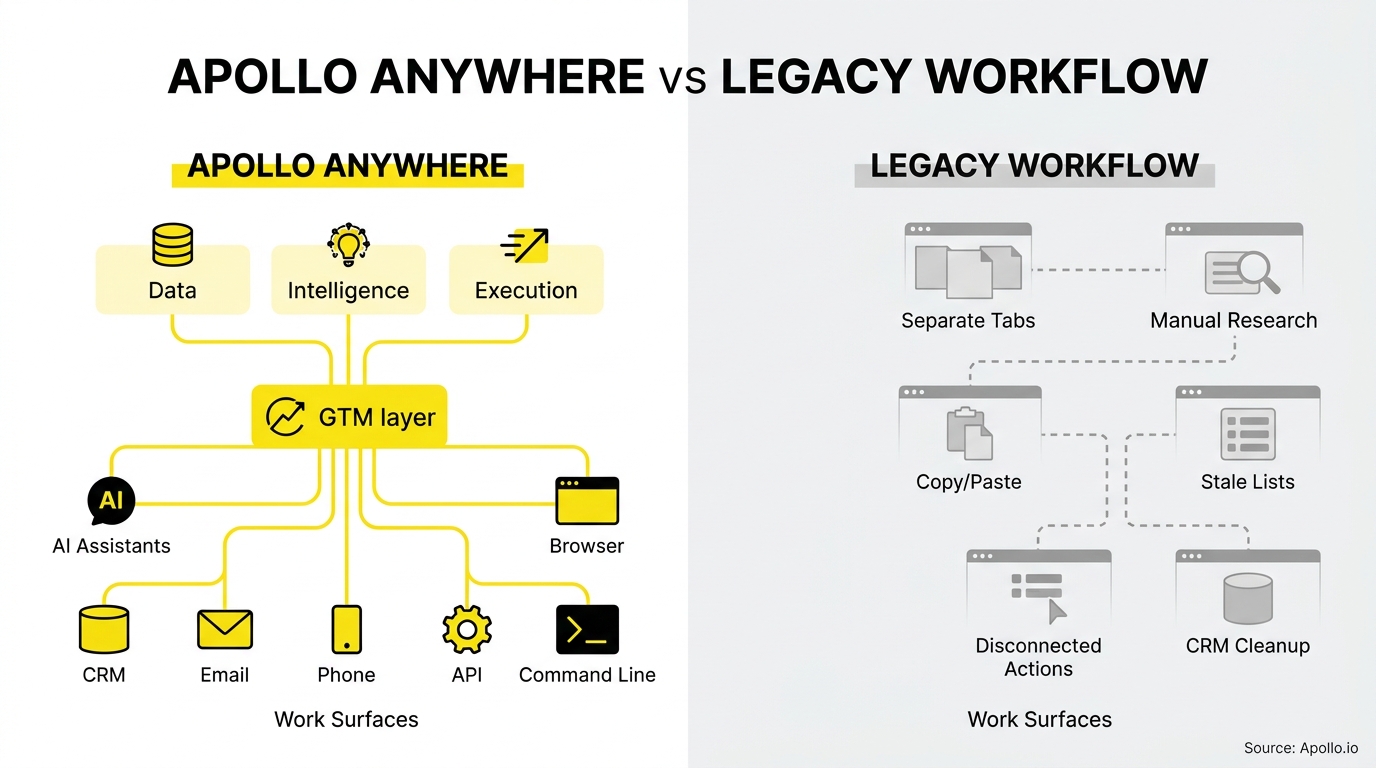
Apollo gives reps of every temperament the same foundation: accurate business contact information, connected engagement, and AI-assisted preparation. That lets a reflective rep and an outgoing rep run the same process in their own style.
- Preparation-heavy reps can use Apollo's prospecting tools to filter by role, company, and signals before they write a single message.
- Relationship-driven reps can build multi-step outreach in Apollo sales engagement, mixing email, phone, and social touches.
- GTM Engineers and AI Builders can pull Apollo data into their own agents and workflows through Apollo MCP, the API, and the CLI.
"The thing that made me most excited as somebody who's been in sales development a long time was Apollo's integration between sales data and sales engagement and the magic that you can make happen when those two are together on the same platform."
Apollo brings B2B data, sales engagement, and AI-powered execution together in one connected go-to-market system, so teams don't have to stitch together separate vendors for research, outreach, and analysis.
Frequently Asked Questions About Salesperson Personality
Should a Sales Manager Hire for Personality or Skill?
Hire for observable behaviors, then build skill through coaching. Curiosity, listening, and follow-through are easier to confirm in a role-play than any trait label, and the rest can be taught with feedback and practice.
What Personality Traits Should an SDR Have?
Resilience, conscientiousness, and coachability matter most in high-volume outreach. An SDR who takes feedback well and follows a consistent cadence will usually improve faster than one who relies on natural charm.
Can an Account Executive Change Their Selling Style?
Yes. Personality traits tend to be stable, but selling behaviors are trainable. An AE can adopt structured discovery, deliberate preparation, and multi-threading habits without changing who they are.
How Should a RevOps Leader Use Personality Data?
Use it as a conversation starter for coaching and role design, never as a hiring filter or a performance score. Pair it with pipeline metrics, call reviews, and activity data for a complete view.
Is Extroversion Required to Succeed in Sales?
No. Extroversion helps in some situations, such as high-energy cold calls, but listening, preparation, and persistence matter across most B2B selling motions.

What Is the Bottom Line on Salesperson Personality?
No single personality type guarantees sales success. Traits like conscientiousness, emotional intelligence, and openness shape how reps prepare, listen, and adapt, but process, coaching, and tooling shape how far those traits carry.
Evaluate behaviors, fix the environment before blaming the person, and give every rep a system that fits their natural style.
Apollo helps reps of any temperament find the right buyers, reach them across channels, and follow up with context. To see how it fits your team, Get Leads Now.
Prove Pipeline ROI Fast With Apollo
ROI questions stalling your budget approval? Apollo puts prospecting, outreach, and pipeline tracking in one platform, so wins show up fast. Leadium tripled annual revenue by automating follow-up. Customer. io grew 50% YoY.
Start Free with Apollo →Don't miss these
Sales
Inbound vs Outbound Marketing: Which Strategy Wins?
Sales
What Is a Sales Funnel? The Non-Linear Revenue Framework for 2026
Sales
What Is a Go-to-Market Strategy? The 2026 GTM Playbook
See Apollo in action
We'd love to show how Apollo can help you sell better.
By submitting this form, you will receive information, tips, and promotions from Apollo. To learn more, see our Privacy Statement.
4.7/5 based on 9,690 reviews
