
Sales Leads: How to Find Contacts and Automate Outreach
Finding sales leads used to mean choosing between quantity and quality. Now, with buyers actively avoiding irrelevant outreach and inboxes enforcing stricter spam controls, that tradeoff can break your sender reputation and your pipeline at the same time.
This playbook shows you how to find verified contacts, automate only the outreach that adds value, and build in the suppression rules that keep your domain healthy.

Apollo Ends Manual Lead Research For Good
Burning hours every week verifying emails and phone numbers by hand? Apollo hands your reps verified contact data instantly, with 98% email accuracy built in. Reclaim your selling time starting today.
Start Free with Apollo →Key Takeaways
- Relevance beats volume: most B2B buyers actively avoid vendors who send generic, irrelevant outreach.
- A repeatable workflow (ICP → signals → verification → research → sequence → suppression) protects deliverability while scaling contact discovery.
- Deliverability rules aren't optional anymore. Authentication and spam-rate thresholds now determine whether your emails land in the inbox at all.
- Consolidating contact data, enrichment, and outreach into one platform cuts down on the data-quality gaps that come from stitching together separate tools.
- SDRs, AEs, and RevOps teams all need a shared source of truth for suppression and contact status to avoid duplicate or off-limits touches.
What Is a Sales Lead Workflow For Finding Contacts and Automating Outreach?
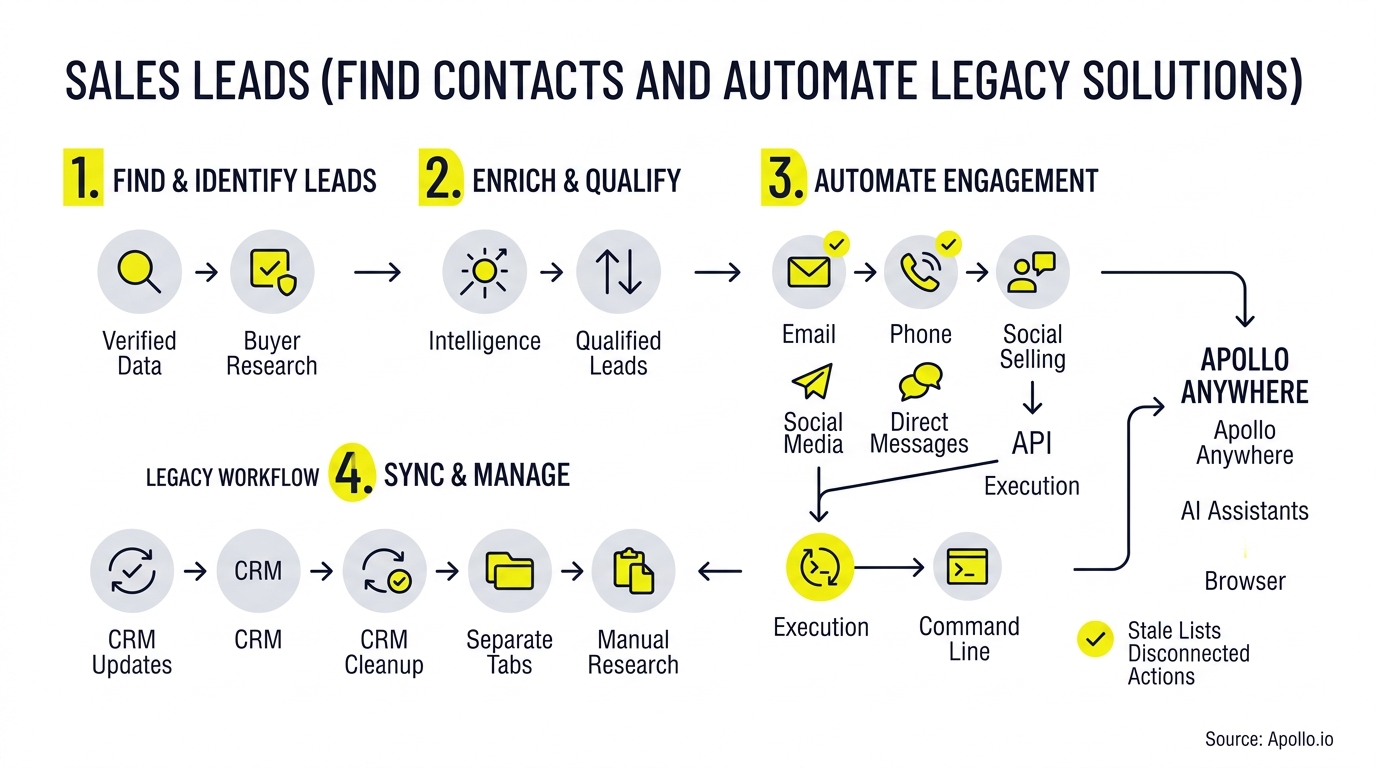
A sales lead workflow is the sequence of steps a GTM team follows to identify target accounts, verify contact information, research buying signals, and launch outreach without wasting effort on the wrong people. The full map looks like this: define your ICP, monitor buying signals, verify contacts, research the account, route for approval, launch a sequence, measure results, and maintain a suppression list.
This is different from simply "buying a list" or blasting a database. A workflow treats contact discovery and outreach as connected steps, not separate purchases.
Skipping verification or suppression is what turns automation into spam.
For SDRs and BDRs focused on pipeline generation, this workflow structure is what separates a scalable outbound motion from a list of cold contacts nobody opens.
How Do You Find Verified Decision-Maker Contacts?
You find verified decision-maker contacts by combining firmographic and technographic filters with a verification step that checks email validity and job-change status before a contact enters a sequence. Static lists decay fast. Landbase reports that professional contact data decays at a rate of 22% to 70% per year, meaning a list that looked accurate in January can be substantially stale by year-end.
A practical verification sequence:
- Filter by ICP criteria: industry, company size, tech stack, and role.
- Layer in intent signals: hiring activity, funding events, or website engagement.
- Verify email and phone accuracy: before the contact ever reaches a sequence.
- Check job-change recency: to avoid contacting someone who left the role.
Struggling to find qualified leads? Search Apollo's 240M+ contacts with 65+ filters to build a verified list without stitching together three separate tools.

How Should SDRs and AEs Decide When Not to Contact a Prospect?
SDRs and AEs should not contact a prospect when the data is stale, the account is already in an active deal cycle with another rep, or the contact has opted out or bounced in a previous sequence. A no-contact checklist prevents wasted sends and protects your domain reputation:
- Email bounced or unsubscribed in the last 90 days
- Contact has changed jobs (title or company mismatch since last verification)
- Account is already engaged by another rep or in a live opportunity
- Contact is on a legal or compliance suppression list
- Prospect requested removal under a state privacy request
This last point matters more in 2026. California's Delete Request and Opt-Out Platform (DROP) became operational on August 1, 2026, letting residents submit one deletion request across hundreds of registered data brokers at once.
RevOps teams should treat supplier-level suppression lists as a standing input to their enrichment cycle, not a one-time cleanup task.
According to Gartner, 73% of B2B buyers actively avoid suppliers that send irrelevant outreach. That's the real cost of skipping this checklist.
See Every Deal Stage With Apollo, Live
Forecasting off stale spreadsheets while good leads stall before they ever become opportunities? Apollo gives you real-time deal visibility and buyer signals so reps chase ready prospects, not guesses. Built-In boosted win rates 10% using Apollo's scoring.
Schedule a Demo →How Do You Automate Outreach Without Hurting Deliverability?
You automate outreach without hurting deliverability by authenticating your sending domain, staying under inbox provider volume thresholds, and monitoring spam complaint rates before they become a blocking issue. Gmail and Outlook both tightened enforcement around high-volume senders, and the rules apply whether you're sending manually or through automation.
| Control | Threshold or Requirement | Why It Matters |
|---|---|---|
| SPF, DKIM, DMARC | Required for domains sending 5,000+ messages/day | Missing authentication risks outright rejection, not just spam folder placement |
| Spam complaint rate | Keep below 0.1%, never reach 0.3% | Google's guidance for maintaining sender reputation |
| One-click unsubscribe | Required for bulk senders | Reduces spam complaints and supports suppression hygiene |
| CAN-SPAM compliance | Accurate sender info, honored opt-outs, no deceptive subject lines | Legal requirement for commercial email in the U.S. |
| Daily send caps | Gradual domain warm-up, capped daily volume | Prevents reputation damage on new or scaling domains |
Spending hours stitching together deliverability tools and separate outreach software? Automate multi-channel sequences with Apollo in one workspace instead of juggling a sender-authentication tool, a separate sequencer, and a suppression spreadsheet.
How Do SDRs Book More Meetings With Fewer, Better-Targeted Touches?
SDRs book more meetings by replacing broad sequences with fewer touches backed by account research and timing signals. A professional networks and Ipsos study of 2,187 sellers found that 62% of top performers conducted industry research before reaching out, compared with just 20% of low performers.
Practical habits that show up in that gap:
- Reviewing recent funding, hiring, or leadership changes before the first touch
- Referencing a specific, current signal instead of a generic value prop
- Multi-threading into buying committees rather than a single contact
Cirrus Insight reports the average B2B buying committee now includes 8 to 13 stakeholders, which makes single-threaded outreach a structural risk, not just a missed opportunity. RevOps leaders building target account lists should plan for multiple contacts per account from the start.
How Do RevOps Leaders Consolidate Contact Data, Enrichment, and Outreach?
RevOps leaders consolidate contact data, enrichment, and outreach by moving from separate point tools into one connected system where verification, research, and sequencing share the same record. Fragmented stacks create duplicate data and inconsistent suppression rules across teams.
Apollo brings B2B data, sales engagement, and AI-powered execution together in one connected go-to-market system, so teams don't have to stitch together separate vendors for research, outreach, and analysis. Collin Stewart of Predictable Revenue put it simply: "We reduced the complexity of three tools into one."
That kind of consolidation also supports sales analytics and deal management visibility, since contact status, engagement history, and pipeline stage live in one place instead of three exports that go stale independently.
What Does a 30-Day Implementation Plan Look Like?
A 30-day plan for building a compliant, automated lead workflow moves from setup to measurement in four weekly phases.
- Week 1: Define ICP criteria, connect a verified contact database, and set up domain authentication (SPF, DKIM, DMARC).
- Week 2: Build suppression rules (bounces, opt-outs, active deals) and load your no-contact checklist into your CRM or sequencer.
- Week 3: Launch a small-volume test sequence with personalized, signal-based messaging. Monitor spam complaint rate daily.
- Week 4: Scale sending volume gradually, review reply and meeting-booked rates by segment, and refine targeting filters.
Track these core metrics weekly: verified contact rate, spam complaint rate, reply rate by segment, and meetings booked per sequence. A basic ROI calculation is straightforward: (meetings booked × average deal value × close rate) minus (tool cost + rep hours spent).
Teams that reduce manual research and list-building time can redirect that time toward higher-value selling activity instead of list assembly.

Conclusion: Build a Lead Workflow That Protects Your Reputation and Your Pipeline
Finding sales leads and automating outreach isn't about sending more messages. It's about building a workflow where verification, research, and suppression happen before a single email goes out.
Buyers are more selective, inbox providers are stricter, and RevOps teams are under pressure to prove their stack drives pipeline instead of just adding noise.
The teams pulling ahead in 2026 are the ones treating contact discovery and outreach as one connected system, not two separate purchases.
That means clean, verified data, a real suppression process, and messaging tied to actual buying signals instead of a generic template blasted to a purchased list.
Get Leads Now and build your verified contact list, research workflow, and automated sequences in one workspace instead of stitching together separate tools for each step.
Apollo Turns Spend Into Booked Revenue
Struggling to prove ROI before the next budget review? Apollo scales outreach without adding headcount, turning tool spend into pipeline leadership can actually measure. Leadium tripled annual revenue after automating outbound with Apollo.
Start Free with Apollo →Don't miss these
Sales
Inbound vs Outbound Marketing: Which Strategy Wins?
Sales
What Is a Sales Funnel? The Non-Linear Revenue Framework for 2026
Sales
What Is a Go-to-Market Strategy? The 2026 GTM Playbook
See Apollo in action
We'd love to show how Apollo can help you sell better.
By submitting this form, you will receive information, tips, and promotions from Apollo. To learn more, see our Privacy Statement.
4.7/5 based on 9,690 reviews
