
Programmatic buying platforms automate how ad inventory is bought, using real-time bidding or negotiated private deals. For B2B teams the hard part is choosing among platform types, auditing fees, and proving that ad exposure turns into pipeline. This guide gives you a dated comparison framework, a cost-and-quality calculator, and a proof-of-value plan. It also covers where the B2B buyer journey stalls after the impression.

Skip Manual Research With Apollo's Verified Data
Tired of spending hours researching leads and verifying contact info? Apollo puts business contact information with 98% email accuracy at your fingertips, so reps spend their day selling instead of searching. Start free and fill your pipeline faster.
Start Free with Apollo →Key Takeaways
- Programmatic platforms fall into distinct categories (DSPs, account-based advertising tools, and professional-audience channels). Compare within a category first.
- Open RTB and private marketplaces trade reach for control. Match the route to your quality and transparency needs.
- Judge platforms on quality-adjusted delivery and cost per qualified opportunity, not CPM alone.
- Run a CRM-linked proof of value before committing annual budget.
- Ads create awareness. Sales intelligence and engagement turn engaged accounts into meetings.
What Are Programmatic Buying Platforms?
Programmatic buying platforms are software systems that let advertisers purchase digital inventory through automated auctions or pre-negotiated deals. A demand-side platform (DSP) is the core buying tool.
It handles audience targeting, bidding, budget pacing, and reporting.
The market is large. According to Christoph Olivier Consulting, US programmatic ad revenue rose 20.5% year over year to $162.4 billion. Grand View Research reports that DSPs hold more than 40.0% of programmatic software platform revenue. B2B has followed: Flint reports programmatic execution accounts for 58% of digital B2B ad placements, up from 44% in 2024.
Which Types Of Programmatic Buying Platforms Should B2B Teams Compare?
Compare platforms within a category, because a general DSP and an account-based tool solve different problems. Pricing for most vendors is not publicly displayed, so treat the column below as a checklist item and confirm fee schedules in writing.
Data reflects the market as of late 2026.
| Category | Best Fit | Buying Routes | Pricing Disclosure | Evidence To Request |
|---|---|---|---|---|
| General-purpose DSP | Teams needing broad reach across display, video, and CTV | Open RTB, private marketplaces | Often not publicly displayed; confirm platform fee and data fees | Quality-adjusted delivery, placement reports |
| Account-based advertising platform | ABM teams targeting named account lists | Mostly curated inventory plus account matching | Often not publicly displayed | Account match rates, account-level engagement |
| Professional-audience channel | Teams targeting by job title, industry, seniority | Platform-native and via partner DSPs | Check each platform's pricing page | Audience coverage, availability by region |
| Self-serve managed service | Lean teams without a trading desk | Varies | Confirm management fee | Pacing logs, optimization changes |
Timing matters here. On October 22, 2026, professional networks announced U.S. CTV buying through Display & Video 360 with job title, industry, and seniority targeting. That makes professional-audience coverage a separate evaluation line from streaming reach.
How Do Open RTB And Private Marketplaces Differ?
Open RTB offers the widest reach through public auctions, while private marketplaces offer curated inventory with more control. Open RTB suits scale and testing.
Private deals suit teams that need known publishers and tighter quality controls.

| Factor | Open RTB | Private Marketplace Or Direct |
|---|---|---|
| Reach | Broad | Narrower, publisher-specific |
| Quality control | Requires active filtering | Higher by design |
| Transparency | Depends on supply-path reporting | Usually clearer |
| Best use | Testing, prospecting audiences | Named-account and category plays |
How Do You Calculate True Cost And Quality?
Calculate cost per qualified opportunity, not cost per thousand impressions. The ANA's Q4 2025 benchmark found quality-led advertisers converted 56.7% of spend into benchmark-qualified impressions, versus 37.5% for lower-performing advertisers. Those are cross-industry figures, but they show why CPM alone misleads.
Use these editable inputs and formulas in a spreadsheet:
| Line | Formula |
|---|---|
| Effective spend | Media spend x qualified-impression share |
| Total cost | Media spend + platform fee + data fees + management fee |
| Cost per engaged account | Total cost / target accounts showing engagement |
| Cost per qualified opportunity | Total cost / CRM opportunities created from engaged accounts |
Run sensitivity cases for low, base, and high values of qualified-impression share and account match rate. If a platform only wins in the high case, treat it as a risk.
Do not use a vendor's estimate in place of your own CRM data.
How Should Demand Gen Managers And RevOps Leaders Score Platforms?
Score platforms against shared criteria so marketing, RevOps, and sales leadership agree before purchase. Weight each line from 1 to 5 and require evidence for every score.
| Criterion | Acceptance Test |
|---|---|
| CRM integration | Engaged accounts sync to your CRM within an agreed window, with no duplicate records |
| Placement transparency | Placement or show-level reports are exportable |
| Quality controls | Fraud, viewability, and made-for-advertising filters are documented |
| Audience fit | Account list match rate and professional-attribute coverage verified on your list |
| Fee clarity | Every fee appears in the contract |
Be care ful that scores reflect your own account list and CRM data, not vendor demos. Ask each finalist to run the same test list so results are comparable.
How Does Apollo Fit Alongside Programmatic Buying Platforms?
Apollo is a sales intelligence and engagement platform, not an ad-buying platform. It does not replace a programmatic buying platform.
It gives the sales side of your go-to-market motion a way to act on the accounts your media reaches.
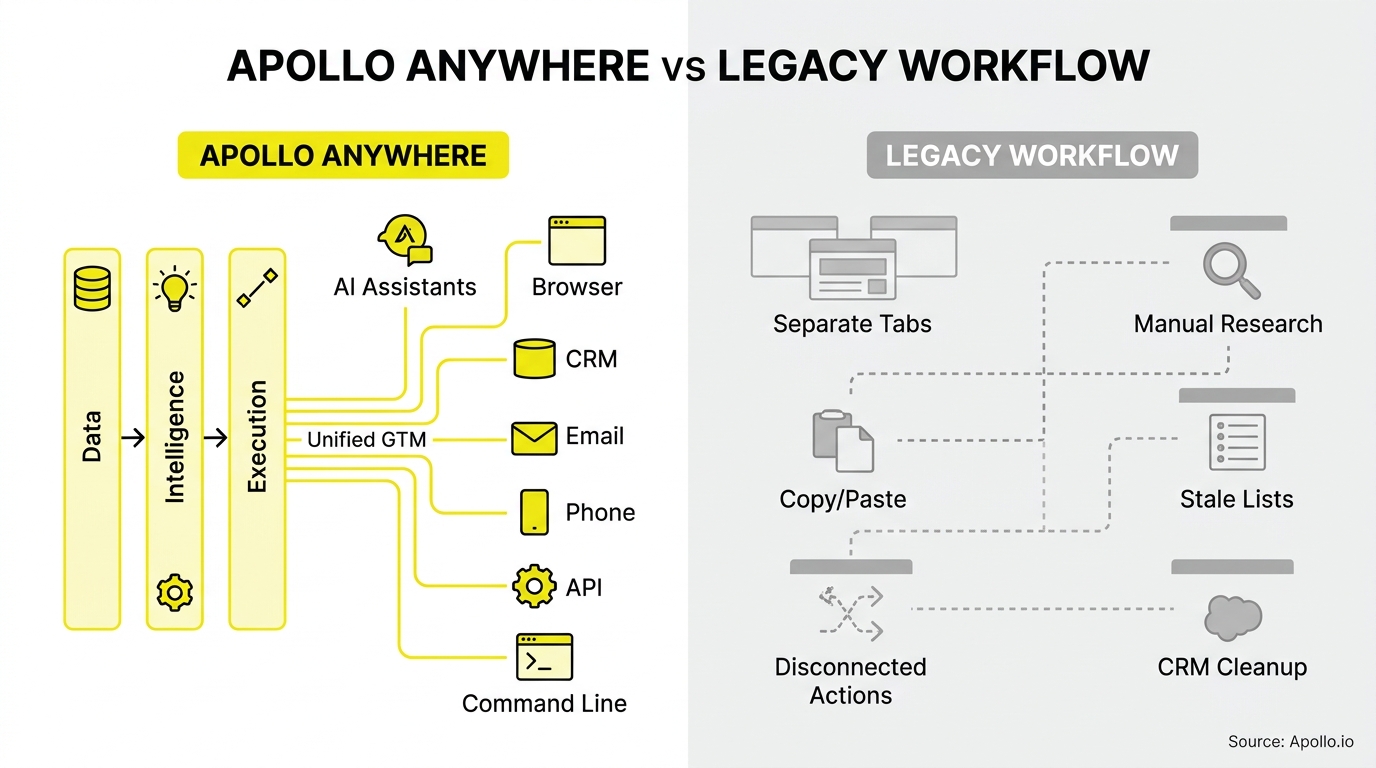
Apollo brings B2B data, sales engagement, and AI-powered execution together in one connected go-to-market system, so teams don't have to stitch together separate vendors for research, outreach, and analysis. Here is how that connects to programmatic spend:
- Build the target account list: Use Apollo's prospecting search to define accounts and buying-group titles before you upload audiences to any buying platform.
- Keep records clean: Data enrichment fills in business contact information for the businesses and professionals in your CRM, in their business capacity.
- Follow up on engagement: When an ad-engaged account surfaces, reps choose who to contact and launch outreach through sales engagement sequences across email, phone, and social.
- Work where you already are: Apollo MCP brings Apollo data into AI assistants like Claude, ChatGPT, and Perplexity, and the integrations connect to Salesforce.
"The thing that made me most excited as somebody who's been in sales development a long time was Apollo's integration between sales data and sales engagement and the magic that you can make happen when those two are together on the same platform."
Sales leaders at growing mid-market and enterprise companies are adopting this model. According to Ramp's Sales Data Providers category data, Apollo is the fastest-growing vendor in the category as of November 2026.
Apollo Turns Forecast Guesswork Into Clarity
Forecasts feel like a coin flip because deal data is stale? Apollo gives your team one connected view of every deal stage, so you act while deals are still winnable. Nearly 5M users already work this way. Start free and see where your pipeline really stands.
Start Free with Apollo →How Should You Run A Programmatic Buying Pilot?
Run a fixed-window pilot with one audience, one budget, and one success definition agreed in advance. Narrow tests produce results you can defend to finance.
- Pick one segment: Choose a target account list your SDRs and AEs already prioritize.
- Set a holdout: Keep a comparable set of accounts unexposed so you can isolate lift.
- Define the handoff: Agree on which engagement signals trigger sales outreach and who owns follow-up.
- Track to the opportunity: Report cost per engaged account and cost per qualified opportunity using the formulas above, not click-through rate.
- Review the invoice: Reconcile media, platform, data, and management fees against the contract.
Cost is the other half of the decision. Collin Stewart of Predictable Revenue put it this way when describing his team's tool stack:
"Apollo could be a third of the cost if you look at the full price of what we were spending on ZoomInfo, Outreach, Salesforce, and admins to make it all work."
Apply the same full-cost lens to ad tech. Count every fee and every admin hour, then compare.
Frequently Asked Questions About Programmatic Buying Platforms
What Is The Difference Between A Programmatic Buying Platform And A Sales Engagement Platform?
A programmatic buying platform purchases ad impressions automatically through real-time auctions or private deals. A sales engagement platform helps reps contact prospects directly through email, phone, and social.
Marketing teams use the first to build awareness. Sales teams use the second to start conversations.
How Should A RevOps Leader Evaluate Programmatic Platform Data?
Start with CRM sync and account match rate on your own list. Then check whether placement reports are exportable and whether engaged accounts map to opportunities.
Vendor-reported averages are a starting point, not proof.
What Should A Demand Gen Manager Ask Before Signing?
- Which fees sit on top of media spend?
- What fraud, viewability, and made-for-advertising controls are documented?
- Can I export placement-level reports?
- What happens to my audience data if I leave?
Can SDRs Use Programmatic Engagement Signals?
Yes, if the handoff is defined. SDRs and BDRs can prioritize accounts showing engagement and select which contacts to reach out to. Apollo supplies the contact data and sequencing for that follow-up.
Does Apollo Replace A Programmatic Buying Platform?
No. Apollo does not buy ad inventory. It covers prospecting, enrichment, and outbound execution, so it complements programmatic media rather than substituting for it.

Which Programmatic Buying Platform Is Right For Your Team?
The right platform is the one that passes your acceptance tests on your own data, with a total cost you can verify. Compare types first, model true cost per qualified opportunity, and score vendors against the same weighted criteria so the decision is defensible to finance and sales leadership alike.
Use these rules of thumb to narrow the field:
- Small teams with limited ad ops capacity: favor a managed or self-serve platform with transparent reporting and a clear fee schedule.
- Account-based programs: prioritize platforms that can match your target account list and report engagement at the account level.
- Brand-sensitive categories: weigh private marketplace access and supply path controls more heavily than raw reach.
- Teams with strong in-house analytics: look for log-level data access and flexible integrations with your CRM.
Whichever route you choose, keep the pilot small, define acceptance thresholds before spend begins, and decide in advance what happens when results land above or below those thresholds. Programmatic media works best when it feeds a measurable pipeline motion rather than operating as a standalone channel.
Pair that discipline with a reliable outbound workflow. When ad engagement raises an account's priority, your SDRs and BDRs need accurate contacts, enriched firmographics, and sequences ready to run.
That is where Apollo fits: it gives your team the data and execution layer to turn account interest into conversations.
Conclusion
Programmatic buying platforms can extend your reach and sharpen targeting, but only if you compare platform types carefully, calculate true cost beyond the CPM, and test on your own audiences before scaling. Score vendors against shared criteria, run a controlled pilot, and make sure sales has a clear plan for acting on the signals that media generates.
Ready to turn account engagement into pipeline? Start with Apollo to find the right contacts, enrich your target accounts, and launch outbound sequences that complement your programmatic media.
Prove Pipeline ROI Fast With Apollo
Budget approval stuck because you can't quantify time saved or pipeline impact? Apollo puts prospecting, outreach, and deal activity in one place, so wins are easy to show. Leadium tripled annual revenue and Built-In lifted win rate 10%. Start free and show results sooner.
Start Free with Apollo →Don't miss these
Sales
Inbound vs Outbound Marketing: Which Strategy Wins?
Sales
What Is a Sales Funnel? The Non-Linear Revenue Framework for 2026
Sales
What Is a Go-to-Market Strategy? The 2026 GTM Playbook
See Apollo in action
We'd love to show how Apollo can help you sell better.
By submitting this form, you will receive information, tips, and promotions from Apollo. To learn more, see our Privacy Statement.
4.7/5 based on 9,690 reviews
