
B2B Buyer Journey: What Actually Works in 2026
The B2B buyer journey has fundamentally shifted. In 2026, 61% of B2B buyers prefer a rep-free experience, yet Gartner predicts that by 2030, 75% will prefer human interaction over AI. This paradox defines modern B2B selling: buyers want control and self-service, but they still need expert guidance at critical moments.
The stakes are high. According to Forrester's State of Business Buying, 86% of B2B purchases stall, and 81% of buyers are dissatisfied with their chosen providers. The companies winning today aren't just mapping the buyer journey—they're architecting omnichannel experiences that blend AI-powered self-service with strategic human touchpoints.

Apollo Finds Contacts While Your Team Sells
Tired of spending 4+ hours daily hunting for contact info? Apollo delivers 224M verified contacts with 96% email accuracy instantly. Join 550K+ companies who replaced manual research with automated prospecting.
Start Free with Apollo →Key Takeaways
- 89% of B2B buyers now use generative AI as a primary research tool, fundamentally changing how they discover and evaluate solutions
- 74% of buyer teams experience unhealthy conflict during decisions, making consensus-building frameworks critical
- Organizations offering both rep-led and self-service interactions are 3.9x more likely to exceed profit growth expectations
- Buyers now engage 22% fewer vendors (down from 3.2 to 2.5), making first impressions more important than ever
- Effective buyer journey mapping requires persona segmentation, touchpoint identification, friction analysis, and stage-aligned content
What Is the B2B Buyer Journey?
The B2B buyer journey is the complete path a business takes from recognizing a problem to purchasing and implementing a solution. Unlike B2C purchases, B2B buying involves multiple stakeholders, longer timelines (typically 3-12 months), and higher stakes.
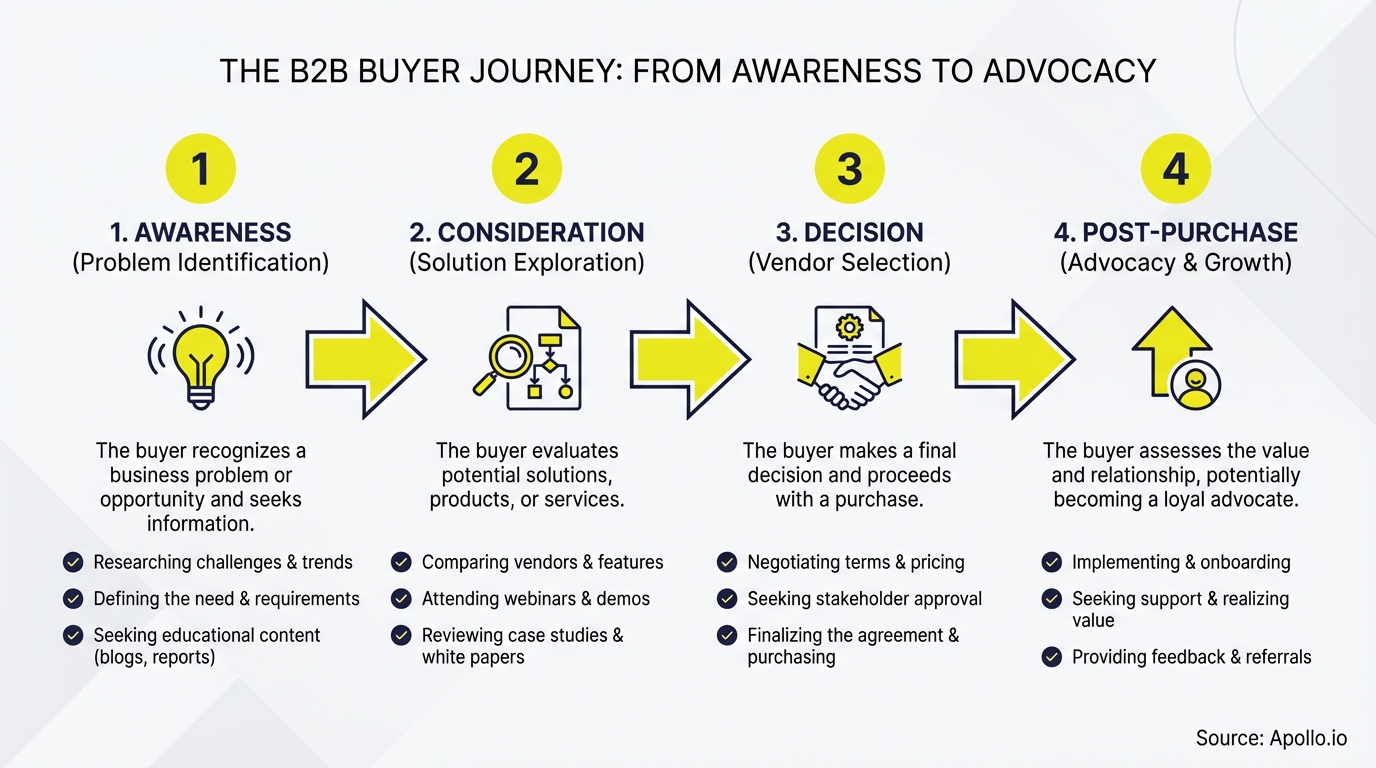
The journey traditionally consists of three core stages: Awareness (problem recognition), Consideration (solution evaluation), and Decision (vendor selection). However, modern B2B buying is rarely linear.
Buyers loop back between stages, conduct independent research across 10+ channels, and often make decisions in committee settings where consensus is difficult.
"The thing that made me most excited as somebody who's been in sales development a long time was Apollo's integration between sales data and sales engagement and the magic that you can make happen when those two are together on the same platform."
How Has AI Changed the B2B Buyer Journey?
According to Forrester research, 89% of B2B buyers now use generative AI for self-guided research. This has compressed awareness stages, elevated buyer expectations for instant answers, and made traditional gating strategies obsolete.
Buyers are asking AI tools to compare vendors, summarize reviews, draft RFPs, and even predict implementation timelines. This means your content must be AI-extractable: structured with clear answers, semantic optimization for retrieval, and rich data that AI can parse and present.
The tactical shift: stop optimizing only for search engines. Start optimizing for answer engines. Use schema markup, FAQ sections, comparison tables, and explicit "Is vs. Is Not" distinctions that help AI accurately represent your solution. Need verified contact data to reach buyers earlier? Apollo's 224M+ verified contacts help you connect before competitors.
Why Do 74% of B2B Buying Teams Experience Conflict?
Research from Gartner reveals that 74% of B2B buyer teams demonstrate unhealthy conflict during decision processes. The root cause: misaligned priorities across stakeholders.
CFOs prioritize ROI and cost containment. IT leaders demand security and integration capabilities.
End users want ease of use. Without structured consensus-building frameworks, deals stall or result in buyer's remorse.
How to Build Consensus Across Buying Teams
| Stakeholder | Primary Concern | Content That Converts |
|---|---|---|
| CFO/Finance | ROI, total cost of ownership | TCO calculators, payback period analysis, cost-savings case studies |
| IT/Security | Integration, compliance, data security | Technical architecture docs, security certifications, API documentation |
| End Users | Ease of use, day-to-day efficiency | Product demos, tutorial videos, user testimonials |
| Executive Sponsors | Strategic fit, competitive advantage | Strategic roadmaps, industry benchmarks, executive briefings |
Winning vendors provide stakeholder-specific content libraries and facilitate internal alignment meetings.
Create decision-rights templates that clarify who owns what aspects of the purchase decision.
This reduces friction and accelerates consensus.
What Are the Three Core Stages of the B2B Buyer Journey?
1. Awareness Stage
Buyers recognize a problem or opportunity. They're researching symptoms, not solutions. Content p
Turn Forecast Chaos Into Revenue Confidence
Pipeline forecasting a guessing game? Apollo's real-time deal tracking gives you accurate visibility across every stage. Built-In increased win rates 10% with Apollo's scoring and signals.
Start Free with Apollo →Key tactics: SEO-optimized content, social media engagement, industry events, and intent data to identify accounts showing early buying signals.
2. Consideration Stage
Buyers define their solution criteria and evaluate alternatives. They're comparing features, pricing models, and vendor capabilities.
Content priorities: comparison guides, product demos, case studies, and ROI calculators.
Key tactics: Personalized email sequences, targeted ads retargeting website visitors, gated assets like playbooks, and consultative sales conversations that address specific use cases.
3. Decision Stage
Buyers narrow to final vendors and negotiate terms. They're validating fit, mitigating risk, and building internal consensus.
Content priorities: customer references, security documentation, implementation plans, and contract terms.
Key tactics: Executive briefings, pilot programs, customer advisory board introductions, and negotiation support. Struggling to track deals across stages? Apollo's deal management keeps every opportunity visible and moving forward.

How Do You Build a Buyer Journey Map That Converts?
Effective buyer journey mapping translates customer behavior into actionable sales and marketing plays. Here's the four-step framework:
Step 1: Segment by Persona
Not all buyers follow the same path. Enterprise accounts have longer cycles and more stakeholders than SMB deals. Segment by company size, industry, role, and buying committee structure. For enterprise strategies, see our guide on breaking into enterprise accounts.
Step 2: Identify All Touchpoints
Map every interaction: website visits, content downloads, email opens, demo requests, pricing page views, and competitor comparisons. Use analytics tools, CRM data, and customer interviews to build a complete picture.
Step 3: Find Friction and Fix It
Where do deals stall? Common friction points include unclear pricing, lengthy security reviews, complex implementation requirements, and lack of executive sponsorship.
Prioritize fixes based on deal volume impact.
Step 4: Align Content to Stage
Match content to buyer intent. Awareness content should educate, not sell. Consideration content should differentiate your approach. Decision content should de-risk the purchase. Audit your B2B marketing funnel to ensure stage alignment.
"Apollo allowed us to 3x our annual revenue without any decrease in efficiency. Apollo's features & functionality allow us to pick and choose what's needed for each client.
It's our single source of truth and the backbone of how we run our company."
What Is an Omnichannel B2B Buyer Journey Strategy?
Data from Gartner shows that organizations offering both rep-led and self-service interactions are 3.9 times more likely to exceed profit growth expectations. Yet most companies silo these channels.
An omnichannel strategy means seamless transitions between digital and human touchpoints. Buyers can start in self-service (product tours, pricing calculators, knowledge bases), escalate to chat or email for specific questions, and schedule calls when they're ready for deeper conversations.
Omnichannel Implementation Framework
| Channel | Best Use Case | Handoff Trigger |
|---|---|---|
| Self-Service Portal | Product exploration, pricing research | High-intent actions: enterprise pricing page visits, multiple demo video views |
| Chatbots/AI Agents | FAQs, technical questions, scheduling | Complex questions requiring domain expertise |
| Email/SMS Sequences | Nurturing, education, event invites | Reply engagement or meeting requests |
| Sales Rep Outreach | Consultative selling, custom demos, negotiation | Throughout—triggered by intent signals and stage progression |
How Do You Reduce B2B Purchase Regret?
Forrester found that 81% of B2B buyers are dissatisfied with their chosen providers. Purchase regret stems from misaligned expectations, poor onboarding, and lack of ongoing support.
Mitigation strategies include transparent pricing (no hidden fees), realistic implementation timelines, pilot programs that prove value before full commitment, and post-purchase customer success programs. Build trust signals throughout the journey: customer reviews, case studies with metrics, security certifications, and financial stability indicators.

What Metrics Define B2B Buyer Journey Success?
Track these KPIs to optimize your buyer journey:
- Stage Conversion Rates: Awareness to Consideration, Consideration to Decision
- Time in Stage: Identify bottlenecks where deals stall
- Content Engagement: Which assets move buyers forward vs. which create noise
- Multi-Touch Attribution: Understand which touchpoints contribute to closed-won revenue
- Customer Acquisition Cost (CAC): Total sales and marketing spend per new customer
- Win Rate by Channel: Which channels produce the highest-quality pipeline
For deeper metrics guidance, review our comprehensive list of B2B marketing metrics that drive growth.
Accelerate Your B2B Buyer Journey with Apollo
Apollo consolidates the entire go-to-market tech stack into one unified platform. Instead of juggling ZoomInfo for data, Outreach for engagement, and Gong for intelligence, Apollo provides 224M+ verified contacts, AI-powered personalization, and deal management in a single workspace.
The result: faster prospecting, higher engagement rates, and shorter sales cycles. Apollo customers report 46% more meetings with AI Research Agent and a 35% increase in bookings with AI messaging.
Ready to transform your buyer journey from friction-filled to seamless? Schedule a Demo to see how Apollo's all-in-one platform accelerates every stage from awareness to closed-won.
Prove Apollo's ROI In Your First 30 Days
Budget approval stuck on unclear metrics? Apollo tracks every dollar—from prospect to closed deal. Built-In increased win rates 10% and ACV 10% with Apollo's deal scoring and signals.
Start Free with Apollo →Don't miss these
Sales
Inbound vs Outbound Marketing: Which Strategy Wins?
Sales
What Is a Sales Funnel? The Non-Linear Revenue Framework for 2026
Sales
What Is a Go-to-Market Strategy? The 2026 GTM Playbook
See Apollo in action
We'd love to show how Apollo can help you sell better.
By submitting this form, you will receive information, tips, and promotions from Apollo. To learn more, see our Privacy Statement.
4.7/5 based on 9,690 reviews
