
Predictive lead scoring uses machine learning on your historical CRM outcomes to rank leads and accounts by their likelihood to convert. It replaces hand-assigned points with patterns learned from past wins and losses. Prioritization still eats rep time: Salesforce reports that the average B2B sales rep spends 70% to 72% of their week on non-selling activities, including 8% manually prioritizing leads.
This guide is for RevOps leaders, SDR managers, and AEs who want evidence, not hype. It covers readiness, evaluation, and routing. If you are still building a rules-based foundation, start with these lead scoring models.

Skip Manual Research, Apollo Finds Contacts
Tired of burning hours researching leads and double-checking emails? Apollo puts verified business contacts at your fingertips with 98% email accuracy. Spend your day selling, not copy-pasting. Start filling your pipeline today.
Start Free with Apollo →Key Takeaways
- Predictive lead scoring ranks leads by learned conversion probability. It does not guarantee a deal.
- Model accuracy is not revenue lift. Judge a model by pipeline created from the leads it ranks highest.
- Clean labels, deduplicated records, and consistent outcome fields matter more than algorithm choice.
- Contact scores should roll up into account priority, because buying decisions involve several people.
- Test against your current method with a time-based split and a controlled rollout before full deployment.
What Is Predictive Lead Scoring and How Does It Differ from Rules-Based Scoring?
Predictive lead scoring is a statistical model that estimates conversion likelihood from past outcomes. Rules-based scoring is a fixed point system a person writes by hand.
The two are not the same, and neither is a guarantee of revenue.
Historically called "lead grading" or "propensity modeling," the practice now often covers both contact-level and account-level scoring. It is not intent data, and it is not a replacement for rep judgment.
It is one input to prioritization.
| Factor | Rules-Based Scoring | Predictive Scoring |
|---|---|---|
| Logic source | Manual point assignments | Patterns in historical wins and losses |
| Maintenance | Frequent manual tuning | Periodic review and refresh |
| Data needed | Minimal | Enough closed-won and closed-lost history |
| Transparency | Easy to explain | Needs visible top drivers |
| Best fit | Early-stage or low volume | Teams with consistent outcome data |
What Data Do You Need Before Predictive Lead Scoring Works?
A predictive model is only as reliable as the outcome labels behind it. Before you evaluate any vendor, audit the CRM fields the model will read.
- Clear outcome labels: Define what counts as a win (opportunity created, closed-won) and apply it consistently.
- Deduplicated records: Duplicate contacts and accounts distort which leads appear to convert.
- Complete firmographics: Industry, company size, and role fields should be populated, not left blank.
- Stable lifecycle stages: If reps skip or backfill stages, the model learns from noise.
- Enough history: Both wins and losses must be present, covering your current ICP and motion.
Missing fields are the most common gap. Apollo data enrichment fills in business contact information and company attributes so scoring inputs stay complete.
"Apollo enriches everything we have: contacts, leads, accounts... And we don't really have to touch it, it just works."
How Do You Evaluate a Predictive Model Beyond Accuracy?
Judge a model by the pipeline it produces, not by a technical accuracy score. A model can rank well on past data and still fail to change rep behavior or revenue.
- Use a time-based split. Build on older data and test on newer data, so the model is checked against leads it has not seen.
- Compare to your current method. Measure how many opportunities come from the top-ranked leads versus your existing rules or rep instinct.
- Run a controlled rollout. Give one group of reps scored lists and another the standard process, then compare meetings and pipeline created.
- Check for leakage. Remove fields that only exist after a deal advances, such as stage dates, which inflate results.
- Inspect top drivers. If the leading factors make no business sense, do not trust the score.
Track conversion by score band (top, middle, bottom). A useful model shows a clear gap between bands. If the bands look similar, the score is not adding signal.

How Should RevOps Leaders and SDR Managers Route Scored Leads?
Scores only pay off when they change who gets worked and how fast. Route by score band and account context, not by contact score alone.
- RevOps leaders: Roll contact scores up to account priority, since several people influence one purchase. Set routing rules and review them each quarter.
- SDR managers: Assign top-band leads to your fastest-response reps and place them in high-touch sequences. Send mid-band leads to lighter automated cadences.
- Account Executives: Use the score and its top drivers to prepare the first conversation, not to skip discovery.
- Sales leaders: Review pipeline by score band to confirm the model still reflects your ICP.
Speed matters once a lead is flagged. Apollo sales engagement lets reps move a selected prospect straight into a sequence.
"The moment we select someone in our database, they're instantly added to a sequence and we can take action right away. We're effective and efficient with our outreach."

How Does Apollo Support Scoring and Routing Workflows?
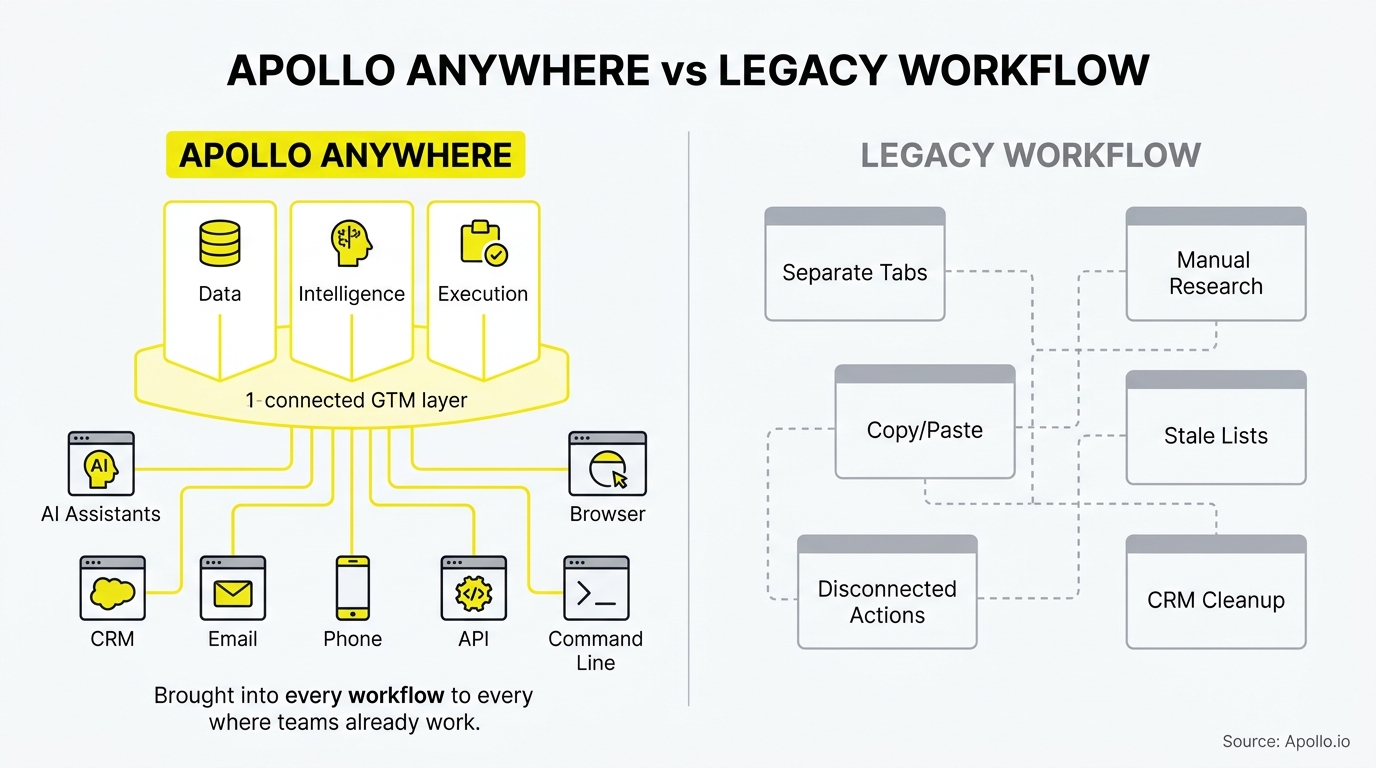
Apollo brings B2B data, sales engagement, and AI-powered execution together in one connected go-to-market system, so teams don't have to stitch together separate vendors for research, outreach, and analysis. That matters for scoring because the inputs and the follow-up live in the same workspace.
Use Apollo's prospecting search to build lists that match your highest-converting profile, then enrich and sequence them. Apollo Workflows can assign prospects to campaigns and reps based on criteria you set. GTM Engineers can also pull Apollo data into their own models and agents through Apollo MCP, CLI, and API.
Adoption is not limited to small teams. According to Ramp's vendor data, as of November 2026, 31% of enterprise companies buying in the Sales Data Providers category use Apollo, the same share as mid-market companies.
"The thing that made me most excited as somebody who's been in sales development a long time was Apollo's integration between sales data and sales engagement and the magic that you can make happen when those two are together on the same platform."
For scoring programs, that same-platform setup shortens the loop between a score and an action. A rep sees who matches your best-fit profile, enrolls them in a sequence, and the reply and meeting data flows back into the next round of model training.
Forecast With Confidence Using Apollo
Forecasts feel like guesswork because deal data is stale? Apollo puts a fresh, connected view of every opportunity in front of your team, so you can act before deals stall. Nearly 5M users already run their pipeline on Apollo. Stop guessing and start knowing.
Start Free with Apollo →How Do You Roll Out Predictive Lead Scoring Without Disrupting Your Team?
A phased rollout lets you prove value before reps change how they work. Most teams do well with three stages.
- Baseline (weeks 1-2): Document your current rules-based score, conversion rates by score band, and speed-to-lead. You need these numbers to show whether the model improves on what you already have.
- Shadow mode (weeks 3-6): Run the predictive score alongside the existing score without changing routing. Compare which leads each method would have prioritized and how those leads actually converted.
- Controlled launch (weeks 7-12): Route a portion of inbound or outbound leads using the predictive score. Keep a holdout group on the old process so you can measure lift in meetings booked and pipeline created.
Share the top factors behind scores with SDRs during the rollout. Reps trust a score more when they can see why a lead ranks high, and their feedback often reveals data gaps you can fix.
What Are the Most Common Predictive Lead Scoring Mistakes?
- Training on the wrong outcome: Scoring for form fills or MQLs optimizes for activity, not revenue. Train on opportunities created or closed-won where you have enough volume.
- Leaking future information: If a field is only populated after a deal progresses, such as a late-stage contact role, the model will look accurate in testing and fail in production.
- Ignoring model drift: Markets, messaging, and ICP change. Retrain on a regular schedule and monitor conversion by score band.
- Treating the score as a verdict: A score should prioritize attention, not replace rep judgment. Give reps a way to flag leads the model misjudged.
- Skipping data hygiene: Duplicates, stale contacts, and missing firmographics weaken any model. Enrich and clean records before you train.
Frequently Asked Questions
How much data do I need for predictive lead scoring?
There is no universal threshold, but you need enough closed outcomes, both wins and losses, for a model to find patterns. If your history is thin, start with a rules-based score built on your best-fit customer profile and move to predictive scoring as outcomes accumulate.
Is predictive lead scoring better than rules-based scoring?
Not automatically. Predictive models can surface patterns humans miss and update as behavior changes, but they depend on clean data and sufficient volume.
Many teams combine both, using rules for hard disqualifiers and a model for ranking.
How often should I retrain a scoring model?
Review performance monthly or quarterly, and retrain when conversion rates by score band start to flatten or when your ICP, pricing, or go-to-market motion changes.
What metrics show that a scoring model is working?
Look at conversion rate by score band, lift over your baseline, precision among top-scored leads, speed-to-lead, and pipeline created per rep hour. A good model concentrates more of your wins in the top bands.
Can small teams use predictive lead scoring?
Yes. Smaller teams can begin with a simple fit score using firmographic and technographic criteria, then layer in engagement signals.
The goal is to focus limited rep time on the accounts most likely to convert.
Conclusion
Predictive lead scoring works when it is built on clean data, trained on revenue outcomes, evaluated beyond accuracy, and connected to clear routing rules. Start with a baseline, test in shadow mode, and expand only when the lift is measurable.
With data, prospecting, and engagement in one place, your team can turn scores into booked meetings faster.
Start with Apollo to build your ideal customer lists, enrich your data, and put scored leads into action.
Prove Pipeline ROI Fast With Apollo
Budget approval stuck on unclear ROI? Apollo puts prospecting, outreach, and pipeline tracking in one place, so you can show leadership real impact fast. Built-In saw +10% win rate and +10% ACV. Start free and see value in minutes.
Start Free with Apollo →Don't miss these
Sales
Inbound vs Outbound Marketing: Which Strategy Wins?
Sales
What Is a Sales Funnel? The Non-Linear Revenue Framework for 2026
Sales
What Is a Go-to-Market Strategy? The 2026 GTM Playbook
See Apollo in action
We'd love to show how Apollo can help you sell better.
By submitting this form, you will receive information, tips, and promotions from Apollo. To learn more, see our Privacy Statement.
4.7/5 based on 9,690 reviews
